
Boris Johnson Plans to Make the UK a World Leader in Freeports, Building 10 State-of-the-Art Facilities for Collectors After Brexit
The UK’s new prime minister,
Boris Johnson, has quickly followed through on his campaign promise
to establish “Singapore-style” freeports post-Brexit. Plans are
coming together to introduce up to 10 freeports across the UK,
which the government hopes will boost trade and cut through customs
red tape.
The move comes as Johnson makes
planning for a hard Brexit from Europe without a trade deal his
government’s priority. He has staked his new premiership on leaving
the European Union on October 31, “come what
may.”
The UK’s international trade
secretary, Liz Truss, announced on Thursday that she hopes to
launch “the world’s most advanced freeport model” as soon as
possible, promising it will create “thousands of jobs.” The move
was immediately criticized by the opposition Labour Party. Peter
Dowd, the shadow chief secretary to the treasury, said that
creating tax havens, where the super-rich can store their “art,
wine, and gold,” is “payback for Tory funders and their
mates.”
Ports and airports around the
country will be able to bid to become a freeport. Front runners
include one to the east of London at the port of Tilbury on the
Thames. Tax and technology experts have joined ministers on a newly
established Freeports Advisory Panel, which will help set them
up.
Johnson, who has
promised to take the UK out of the EU customs union by
Halloween this year “do or die,” took to the idea of freeports
during his campaign to become leader of the Conservative Party.
Sometimes known as “free zones,” they are areas where goods,
including valuable artwork, cars, and jewelry, can be imported and
processed while avoiding customs duties before they are exported
again. They can also be used to import raw materials, which can be
transformed in situ into finished products ready to export.
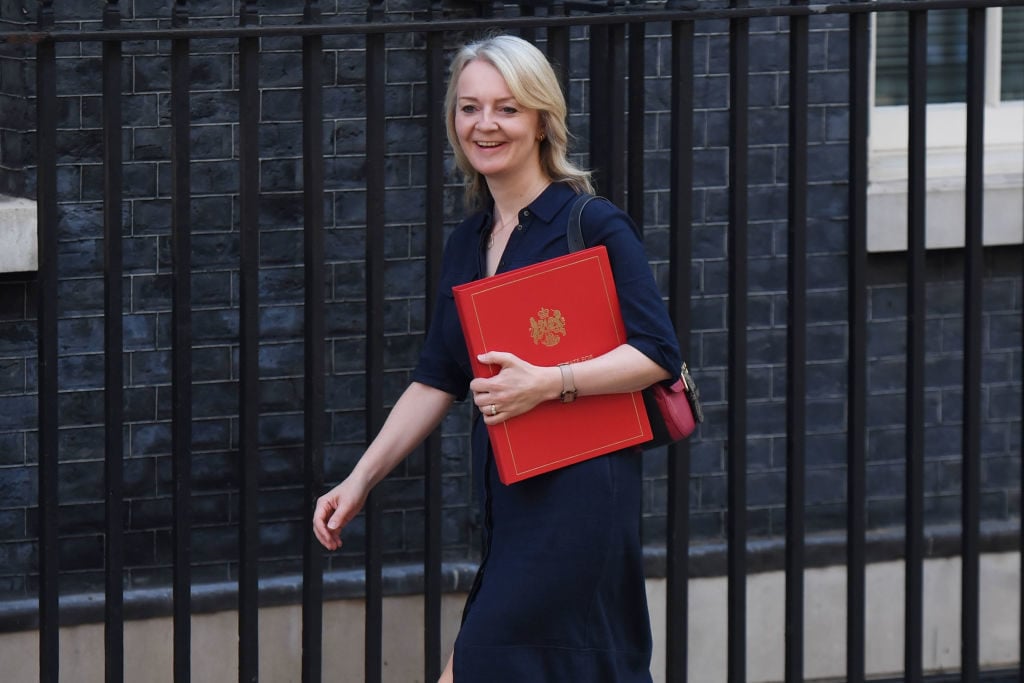
International Trade Secretary Elizabeth
Truss. Photo by Chris J Ratcliffe/Getty Images.
The high-security storage
facilities are under increasing scrutiny across Europe after EU
experts found them to be a haven for money
laundering and tax evasion.
The UK’s chief secretary to the
treasury, Rishi Sunak, said that the government will introduce
freeports to “areas that could benefit the most.” The mayor of Tees
Valley in the North East of England has floated the region as a
freeport, extolling its potential benefits. Ben Houchen says it
would “turbocharge jobs and growth,” as well as bring investment to
the region. Other areas that have expressed interest include the
port of Tyne in the North of England, and Milford Haven in
Wales.
The US has several similar
models called “Foreign Trade Zones,” including in Delaware and also
in Miami, where Art Basel is held every December. Some 7 millions
tons of goods pass through the Miami port each year.
A consultancy firm last year
found that establishing seven freeports in the north of England
could generate $10.8 billion for the UK, and create 150,000 jobs,
according to Reuters. However, the UK Trade Policy Observatory,
which aims to ensure that new trade policies are constructed in a
manner that benefits all, suggests that the net benefits to
establishing UK freeports would be limited. It said that much of this would simply be
redistributing existing economic activity from elsewhere in the
country.
The post Boris Johnson Plans to Make the UK a World Leader
in Freeports, Building 10 State-of-the-Art Facilities for
Collectors After Brexit appeared first on artnet
News.
Read more https://news.artnet.com/art-world/uk-freeports-boris-johnson-1616704
Further reading


Leave a comment