
‘It Worked Beyond Our Wildest Dreams’: How Cutting-Edge New Technology Is Transforming the Field of Maya Archaeology
The Maya civilization flourished more than 1,000 years ago, but
modern technology is only now revealing the secrets of this ancient
Mexican and South American culture—and it’s happening at an
unprecedented pace. A recent spate of discoveries is transforming
the field of Maya archaeology, as researchers discover new ways to
identify and investigate ancient ruins.
In 2018, archaeologists in
Guatemala announced the discovery of thousands
of unknown Maya structures, hidden in plain site beneath
overgrown jungle greenery. But it wasn’t a bushwhacking, Indiana
Jones type who found them. Instead, the ancient ruins were
identified remotely, thanks to aircraft from the National Center
for Airborne Laser Mapping that were equipped with high-tech Light
Detection and Ranging (LiDAR) mapping tools.
Using laser pulses tied to a GPS system, LiDAR makes
topographical readings and creates three-dimensional maps of the
earth’s surface. In an instant, LiDAR can survey a wide geographic
area that would take years to map on foot.
“LiDAR is showing us things that we never would have been able
to see with 100 years of research—and we have 100 years of research
under our belts already, so it’s not like that’s hyperbole,”
archaeologist Marcello Canuto told artnet News. An anthropology
professor and the director of the Middle American Research
Institute at Tulane University in New Orleans, Canuto is on the
committee that oversaw the landmark LiDAR initiative in Guatemala,
funded in 2016 by Pacunam, or Patrimonio Cultural y Natural
Maya, Guatemala’s Maya heritage foundation.

A newly discovered ancient Maya site
north of Tikal as detected by LiDAR. Image courtesy of Luke
Auld/Thomas Garrison/Pacunam.
A “Paradigm-Shifting” Technology
Archaeologists have long been aware of the tremendous potential
of LiDAR. Back in 2009, the technology was used to great effect in
Belize, where it scanned an 80-square-mile region at the
archaeological site of Caracol.
“We started trying to get LiDAR in 2005. Everybody told us we
were nuts, that it wouldn’t work,” Arlen Chase, the co-director of
the Caracol site, told artnet News.
Now a professor of anthropology at Pomona College in Claremont,
California, Chase was convinced that LiDAR was the answer to
archaeologists’ prayers. But when the results of the scans finally
came back, “I was completely stunned,” he said. “It worked far
beyond our wildest dreams.”
For years the Caracol team had been aware that they were were
working on a site that stretched deep into the jungle, but to prove
as much was another matter. “Caracol is over 200 square
kilometers,” said Chase. “Trying to convince our colleagues of that
in 2009 was impossible without the LiDAR.”
The mapping project showed just how big the city truly was,
revealing causeways and other structures previously hidden beneath
the jungle. Caracol was a large, continuous settlement that showed
that the Maya had dramatically transformed their landscape.
“LiDAR is paradigm shifting,” Chase said. “It’s effectively
changing our entire view of the ancient Maya.” Each time it covers
a new area, “you start to see different things.”
Over the last decade, many archaeology projects in the region
have begun using LiDAR, revealing more and more about this lost
civilization. But the Pacunam project was unprecedented. No one had
ever scanned such a large geographic region with LiDAR at one
time.
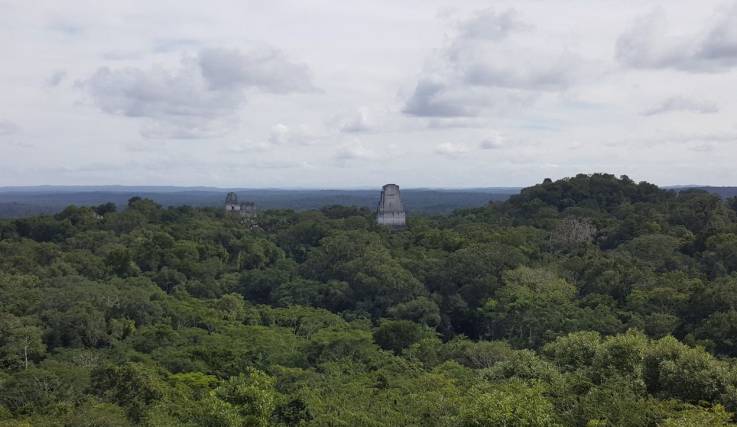
An aerial view of Tikal. Photo courtesy
of Marcello Canuto.
61,000 Maya Structures in One Day
“As an archaeology remote sensing expert, I have been using
satellite imagery for years trying to locate sites under the dense
jungle canopy,” Francisco Estrada-Belli, also a professor of
anthropology at Tulane University, told artnet News in an email.
“When I learned about LiDAR, I was skeptical initially because it
looked like it could only map small areas. Then we learned that
with the right amount of money—many times more than what we can
raise for a single-season expedition—we might map a very large area
in a matter of days.”
Canuto and Estrada-Belli were among the lead researchers on the
groundbreaking LiDAR project launched by Pacunam. As a Maya
cultural heritage foundation that works with a large number of
Guatemalan archaeological sites, Pacunam was the perfect
organization to oversee a project of this magnitude.
“Most researchers are interested in their own particular site
and the area around it, and LiDAR is pretty expensive,” explained
Canuto. “For an individual researcher to say, ‘Hey, give me a
half-million dollars or a million dollars to cover this whole
massive area over which I do not have any permit to do any
research,’ would not have worked. Pacunam was the perfect entity to
be able do LiDAR in these different regions and then coordinate the
results.”
Based on the results at Caracol, and other sites surveyed with
LiDAR, archaeologists were expecting to be able to identify new
architecture elements built by the Maya. “The technology is
fabulous,” said Chase. “We knew they were going to find all kinds
of interesting stuff.” But no one could have predicted just how
extensive the findings would be.
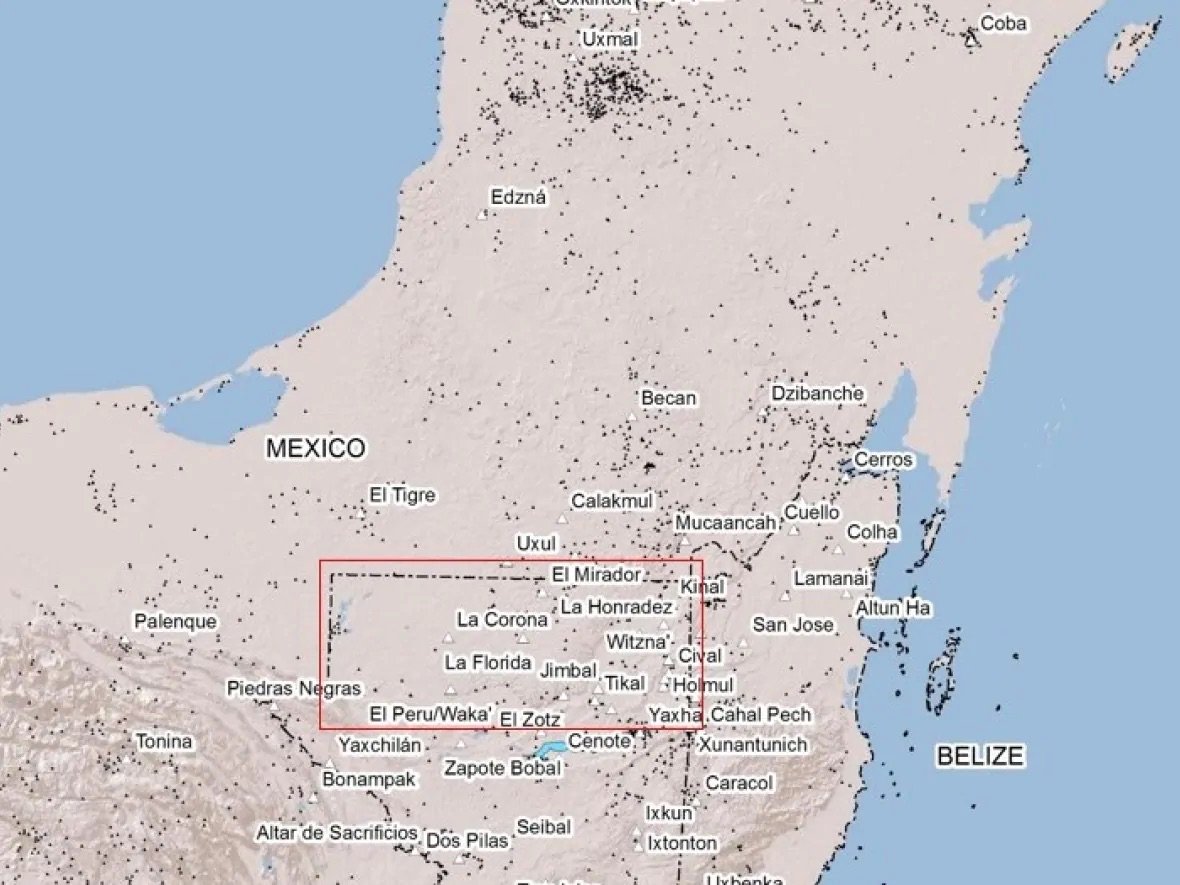
The Pacunam LiDAR Initiative scanned the
Maya Biosphere Reserve in northern Guatemala, finding tens of
thousands of previously unknown ancient structures. Image courtesy
of Francisco Estrada-Belli/Pacunam.
Remarkably, a digital landscape generated of an 810-square-mile
area of the Maya Biosphere Reserve in Petén, Guatemala, revealed no
less than 61,000 unidentified ancient Maya structures that were
invisible to the naked eye because of overgrown vegetation. What
experts had mistaken for unusable swampland, for instance, had
actually been farmland, crisscrossed with canals.
Seeing so many previously unknown roads, irrigation systems,
defense fortifications, and other buildings, scholars started
reevaluating their estimates as to how many people lived in the
region—instead of five million, Petén may have been home to a
population of up to 10 or even 15 million people.
“We knew the Maya were a complex and sophisticated
civilization,” said Estrada-Belli, but “the size, density, and
complexity of cities and the amount of landscape infrastructure the
Maya built was just astonishing.”
The day the LiDAR data arrived, Canuto and Estrada-Belli had
plans to attend a conference. Instead, they couldn’t tear
themselves away from the computer, waiting with bated breath as a
team at the University of Houston uploaded files with two gigabytes
of data to a shared cloud.
“It was just one surprise after another,” Canuto recalled. “We
couldn’t get enough of it.”
“We started looking around at 2 p.m. By 8 p.m., there were maybe
15 or 20 students in our lab, staring at these images we were
getting,” he added. “I remember telling the students, ‘remember
this day, because this is the day that lowland Maya archaeology
really changed.’”

Buried temple, Maya Biosphere Reserve,
El Petén. Photo: Geoff Gallice, via Wikimedia Commons.
Hidden in Plain Sight
When Canuto and his co-authors published Pacunam’s findings in
the journal Science last
September, the news was widely covered in the media. But for the
men and women who have dedicated their lives to the study of the
Maya civilization, it was a game-changer.
Whereas before, archaeologists could only see what was right in
front of their faces, LiDAR allows them to zoom out, taking in
large regions at once. Quite simply, it would be impossible to
replicate the scale of the Pacunam LiDAR scans on foot. After being
hamstrung for decades by the time-consuming process of exploring
the jungle on foot—discoveries were necessarily limited by how much
ground could be physically covered by foot—researchers suddenly had
mountains of data at their disposal.
“When you’re in the jungle, you’ve got five to 10 meters of
visibility all around you,” explained Canuto. “Sometimes you can
entirely miss things. It’s not as if, oh, at 100 meters away
something looks small, but I can tell it’s something. At 100 meters
away, you’re not seeing it at all, whether it’s big or small.
Unless you get within 10 meters of that building, you’re just not
going to see it.”
That’s particularly true for things that are large, but flat,
like causeways, terraces, and roads—linear features that at first
glance might be mistaken for natural elements of the landscape, but
that LiDAR can identify with great accuracy. The prevalence of
these structures seems to disprove previously held notions that
Maya society consisted of disconnected city-states.

A LiDAR scan of the ancient Maya city of
Tikal. Image courtesy of Marcello Canuto/PACUNAM.
“We’ll be able to talk about urbanism, population size, and
demographic changes in ways that we’ve never been able to before,”
said Canuto. “[The LiDAR findings] gives rise to the notion of
sociopolitical and economic complexity and integration [among that
Maya] in a way that perhaps 20 years ago we would have been
uncomfortable declaring.”
And as archaeologists set about to confirm the accuracy of the
data provided through ground-verification, their efforts to map the
dense jungle groves are targeted better than ever before. “Instead
of striking out into the forest blindly or on a hunch, we now know
what to expect,” said Canuto. “There were lots of things shown by
the LiDAR we had never noticed before, so we want to visit and see
what in the world they might be.”
Of course, knowing the location of Maya ruins ahead of time does
rob the field of some of some of its cinematic romance, Canuto
admits—”the intrepid explorer going off in the jungle and finding
the lost city; all that kind of mythology.” But he maintains that
the scientific possibilities opened up by this technology are more
than exciting enough to make up for that.
And just as important as revealing where unknown structures were
built, LiDAR also shows the empty spaces, the areas where the Maya
left the landscape empty. That might not seem significant, Canuto
said, but consider New York: “Knowing that there’s a big empty
space in the city known as Central Park is critical to
understanding the nature of Manhattan.”
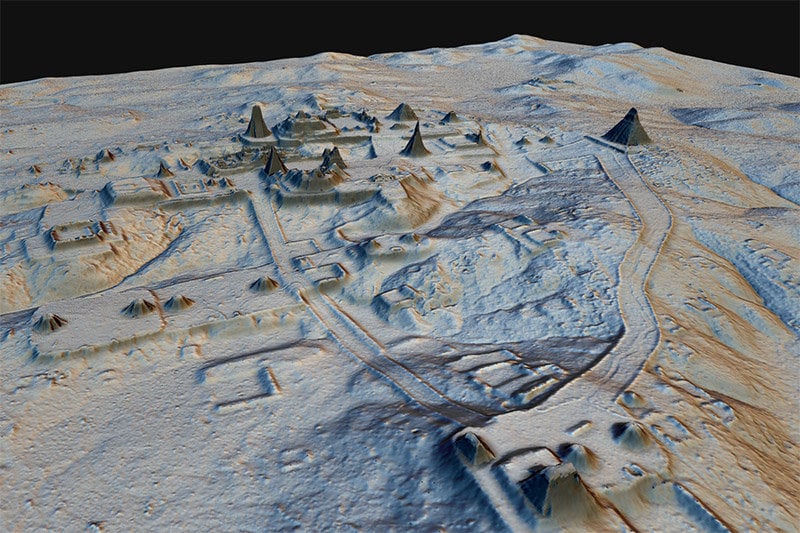
A topographical map of ancient Maya
cities in northern Guatemala created with LiDAR scanning of the
jungle. Image courtesy of the American Association for the
Advancement of Science.
A Global Phenomenon
“Everybody wants LiDAR scans, but the problem initially was the
cost, and convincing people to spend the money,” said Chase. The
initial project at Caracol, which was funded by NASA, cost $171,000
dollars. “That’s a lot of money for a Maya archaeology project to
spend, but it’s so economical compared to the amount of labor we
invested trying to map on the ground, and it’s much more
comprehensive.”
Consider, for instance, the city of Tikal in Guatemala, one of
the best-known ancient Maya sites and part of the Pacunam LiDAR
Initiative. Over the 1960s, ’70s, and ’80s, archaeologists there
created “one of the largest and most celebrated maps of a Maya
city,” said Canuto. “Let’s be generous, maybe there were 30 square
kilometers [11.5 square miles] of mapping in and around it Tikal
over the last half century. Around Tikal, this LiDAR we did,
covered 150 square kilometers [58 square miles]. We quintupled
the amount of area that was mapped around Tikal in one summer.”
Other archaeologists are benefitting as well around the world,
particularly in Southeast Asia at Angkor Watt, which did LiDAR
scans in 2016. “It’s not just a Maya phenomena,” said
Chase. “It’s a worldwide phenomena.”
Knowing exactly where these ancient sites are can also help
protect them moving forward. Investigating the LiDAR findings, said
Estrada-Belli, “we also learned the extent of the damage looters
had done over the years in Guatemala. Literally hundreds of
thousands of looting pits have been counted.”
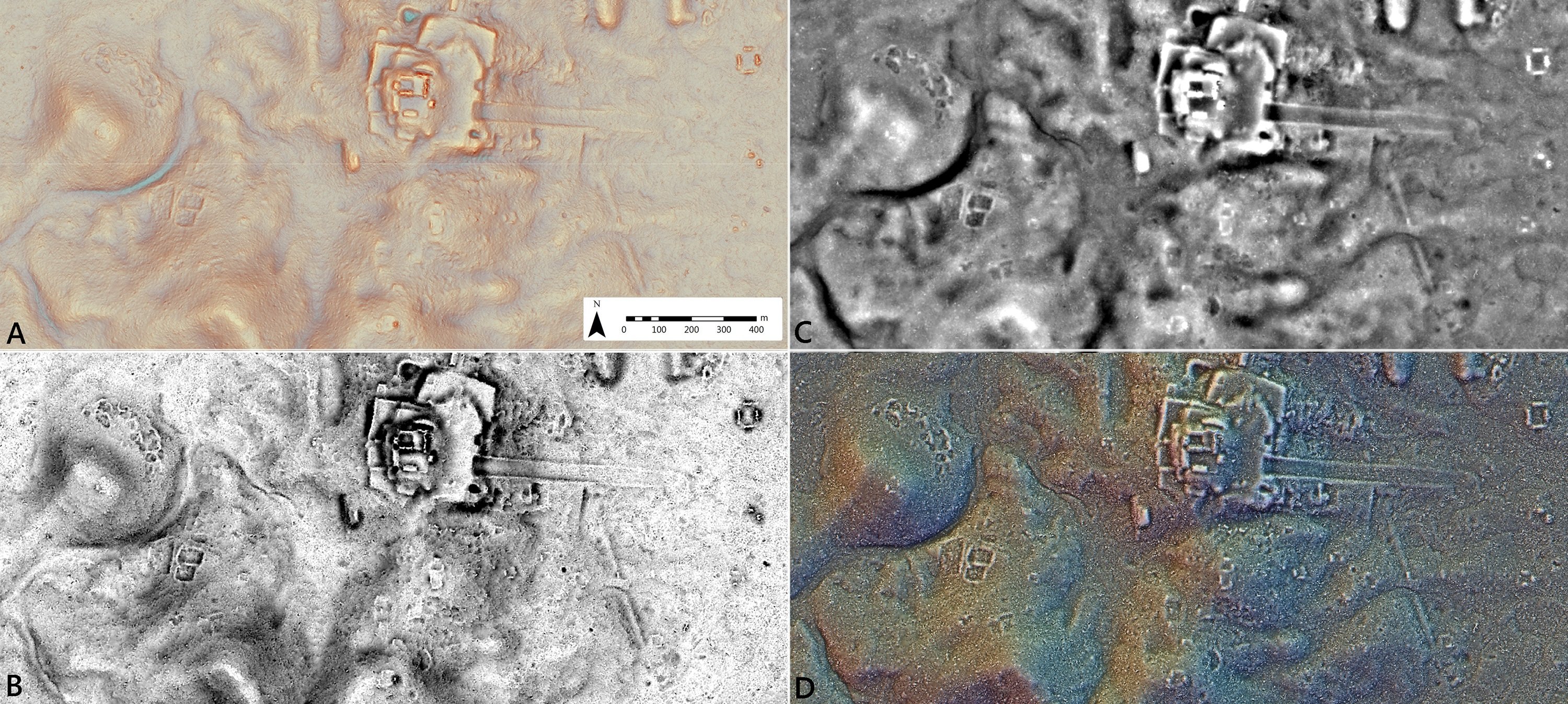
Visualizations used for LiDAR analysis.
(A) Red Relief Image Map (RRIM); (B) Sky-View Factor (SVF);
(C) Simple Local Relief Model (SLRM); (D) Prismatic Openness. Image
courtesy of Marcello Canuto.
New Horizons
Both Chase and Canuto liken the impact of LiDAR to that of
carbon-14 dating, which allowed archaeologists to accurately date
artifacts for the first time, identifying their exact ages, not
just relative to other objects. What radiocarbon dating does for
the archaeological timeline, LiDAR does for physical space.
But LiDAR isn’t the only way in which archaeology has changed
dramatically in recent decades. Artifacts are being
analyzed by 3-D scanning. “Just like LiDAR, it is a new de
facto standard in documenting antiquities,”
said Estrada-Belli. Sites are being photographed, documented,
and mapped at new, previously inaccessible angles thanks to drones.
Scientists can test bones to determine what people and animals ate,
or do a chemical residue analysis to figure out what kinds of
activities might have been carried out at a given location.
“All of those technologies are part and parcel of the arsenal
now,” said Canuto, marveling over the tools available to him now
versus 30 years ago. “They usually come from other parts of the
sciences, and we’re just applying them to Maya archaeological
research.”
As a teenager on his first dig back in 1985, Canuto discovered a
rib bone that turned out to be the oldest example of Maya writing
known to that point. It took two years to get an epigrapher to
analyze the hieroglyphs and decipher the ancient script. The bone
had to be photographed, the markings copied in a drawing, and the
images mailed off to the expert, a process that would take
months.
Today, thanks to digital photography and the internet,
archaeologists can get these types of answers in hours. “Despite
the fact that I am in the middle of the jungle in Guatamala,” said
Canuto, “satellite technology is allowing me to do real-time
decipherment of objects that are just out of the ground. The
presumption is that we’ll be able to decipher any text that we
might find. In 1985, it was a big shoulder shrug!”
“Some people might regret that we’re not isolated in the jungle
the way they were in the 1960s and ’70s,” he added. “But sometimes
that kind of isolation is not so good for your intellectual
development.”
And despite the massive impact of LiDAR, plenty of mysteries
remain for archaeologists to solve. “What LiDAR doesn’t give us is
depth, the things under the ground, so there are plenty of
discoveries to be made,” said Canuto. “Who knows what
technology can come up with next!”
The post ‘It Worked Beyond Our Wildest Dreams’: How
Cutting-Edge New Technology Is Transforming the Field of Maya
Archaeology appeared first on artnet News.
Read more https://news.artnet.com/art-world/technology-transforming-mayan-archaeology-1558456
Further reading


Leave a comment