
The Greek Artist Takis, Who Used Magnets to Create Pioneering and Entrancing Kinetic Art, Has Died at 93
The pioneering kinetic artist
Takis, whose work harnessed the power of electromagnetism, has died
at age 93. The artist’s Athens-based foundation, which is dedicated
to promoting art and scientific research, confirmed his death on
social media. The artist’s inventive work is currently on view in a
survey at Tate Modern in London (through October
27).
“His uniquely poetic and
endlessly inventive spirit will be missed by all those who knew
him,” Achim Borchardt-Hume, the director of exhibitions at Tate
Modern, said in a statement. “Using magnetism, light, and sound as
his raw materials, Takis’s audacious sculptures were a radical
break from convention. I’m sure he will continue to be an
inspiration to artists for generations to come.”
Born Panayiotis Vassilakis in
Athens in 1925, the artist grew up in the shadow of World War II
and the Greek Civil War. Without money to pay for a formal art
education, he largely taught himself, assembling a varied
curriculum that included philosophy, poetry, science, and the arts.
A fan of Giacometti and ancient Greek sculptures, his earliest
works were elongated sculptures of figures in cast metal and
plaster.
The artist’s horizons broadened
further when he moved to Paris in 1954, where he was introduced to
the avant-garde work of Yves Klein and Jean Tinguely and developed
his own antennae-like sculptures and avant-garde performances. It
was during this fertile period that he began to experiment with
what would become his signature medium: magnets. He has said he was
searching for a material that would allow him to channel energy,
the cosmos, and the forces of nature through his art.
The potential of
electromagnetism was made clear in his 1960 work
titled The
Impossible – Man in Space. Using an elaborate system of magnets, he
floated the South African Beat poet Sinclair Beiles in mid-air at
the Iris Cert Gallery
in Paris while the writer read one of his poems, aptly titled
“Magnetic Manifesto,” aloud.
It was this kind of fearless
creativity and off-the-wall inventiveness that earned Takis the
admiration of artistic giants like Marcel Duchamp, who called him
the “cheerful ploughman of magnetic fields.” John Lennon was also a
fan, having been introduced to the artist’s work in London at the
legendary artist-run gallery Signals. The space had, in fact, taken
its name from a series of sculptures by Takis that incorporated red
and green traffic lights.
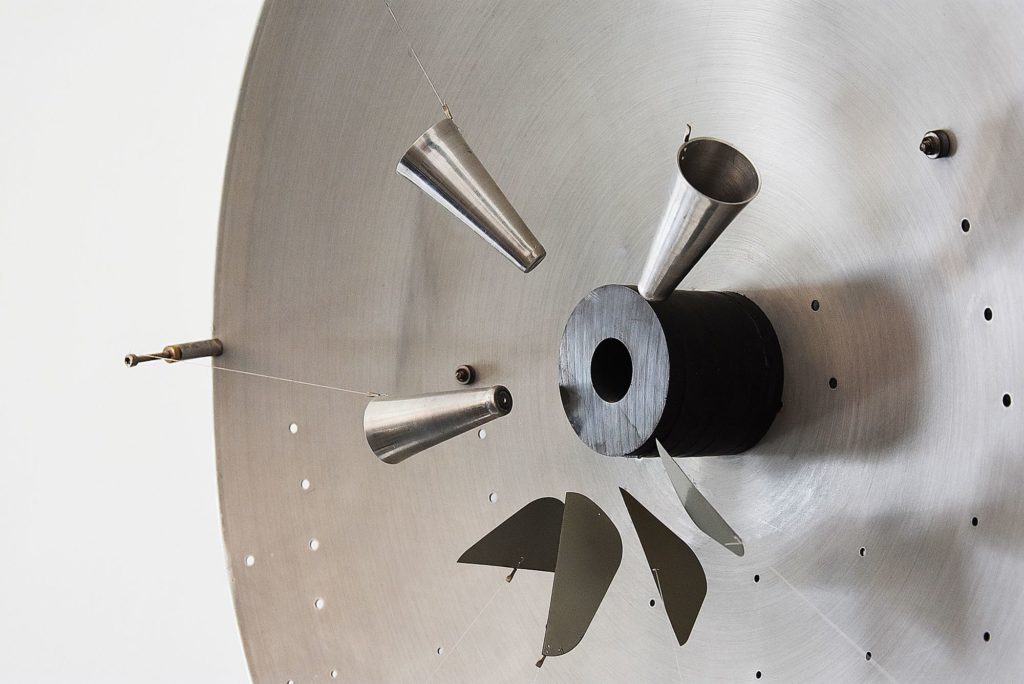
Takis, Radar (detail) (1960). Takis
Foundation © ADAGP, Paris and DACS, London 2019. Photo by Fay
Zervos.
Takis traveled to the United
States in 1968 to take up a scholarship at the Massachusetts
Institute of Technology. There, he continued to experiment with
sound and technology. He even invented a machine that produced
electricity out of the movement of waves. (The artist took out
several other patents as well.)
When he eventually returned to
Paris in the mid-1970s, his interest in the cosmos and philosophy,
coupled with his virtuoso skill in transforming scrap metal and
employing electromagnetism, resulted in memorable kinetic sound
pieces and musical devices.
Electomagnetic Sphere (1979), which is included in
his Tate Modern show, incorporates wire “bow” strings, a sphere at
the end of a pendulum, and an amplifier to create eerily discordant
sounds.
Takis returned to his home city
of Athens in 1986, where he began building what became the Research
Center for the Arts and Sciences in 1993. He installed his
monumental sound pieces in its open-air theater. They include the
thunderous Silver Musical Sphere, as well as
giant Gong, which is made from the rusted wall of
an oil tank.
The artist enjoyed major surveys at the Palais de Tokyo in Paris
and the Menil Collection in Houston in 2015. (The Texas
institution’s founders, Dominique and John de Menil, were
significant early supporters of Takis’s work.) His work was also
included in the 2017 edition of documenta in Kassel.
Greece’s culture minister Lina
Mendoni said in a statement: “For more than 70 years, Takis
was a pioneer, an artist whose childish curiosity of the forces of
the universe never ended.”
The post The Greek Artist Takis, Who Used Magnets to Create
Pioneering and Entrancing Kinetic Art, Has Died at 93 appeared
first on artnet News.
Read more https://news.artnet.com/art-world/kinetic-artist-takis-died-1621450
Further reading


Leave a comment