
Berlin’s Tech Scene Is Exploding. But Will These Young, Wealthy Elites Ever Start Buying Art?
Spend time at enough Berlin gallery
openings, and it won’t take long for conversations to turn bleak.
Recurring talking points include the German capital’s soaring real
estate prices, the ongoing wave of gallery closures, a financial
crunch facing the city’s artists, and a lack of art collectors. A
recent survey of Berlin-based
art professionals found that the majority cannot make a living wage
from their creative work.
But while the arts struggle, another
sector in Berlin—the tech industry—is booming. It is said that a
startup is founded in the city every 20 minutes. As one tech
founder put it, “You don’t need a German
passport or an Ivy League diploma to succeed here.”
By 2020, the sector is expected to create 100,000 new
jobs in a metropolis that is—for now—far cheaper than other global
start-up hubs.
This influx of young people and new
money should be good news for the local art industry but, so far,
the two sectors have clashed more than they have cooperated, and
animosity is rising. Last fall, Google retreated from a plan to
open an office in Berlin after vehement outcry from
anti-gentrification activists, including a number of artists.
Meanwhile, rents in the city have doubled over the past
decade, and are continuing to rise.
Amid the tension, a small group of
art professionals and tech-industry workers are trying to build a
bridge to connect the two communities. Whether they can succeed is
an open question, but they both tend to agree that the survival of
Berlin’s art world—not to mention the vibrant character of the city
itself—depends on it.
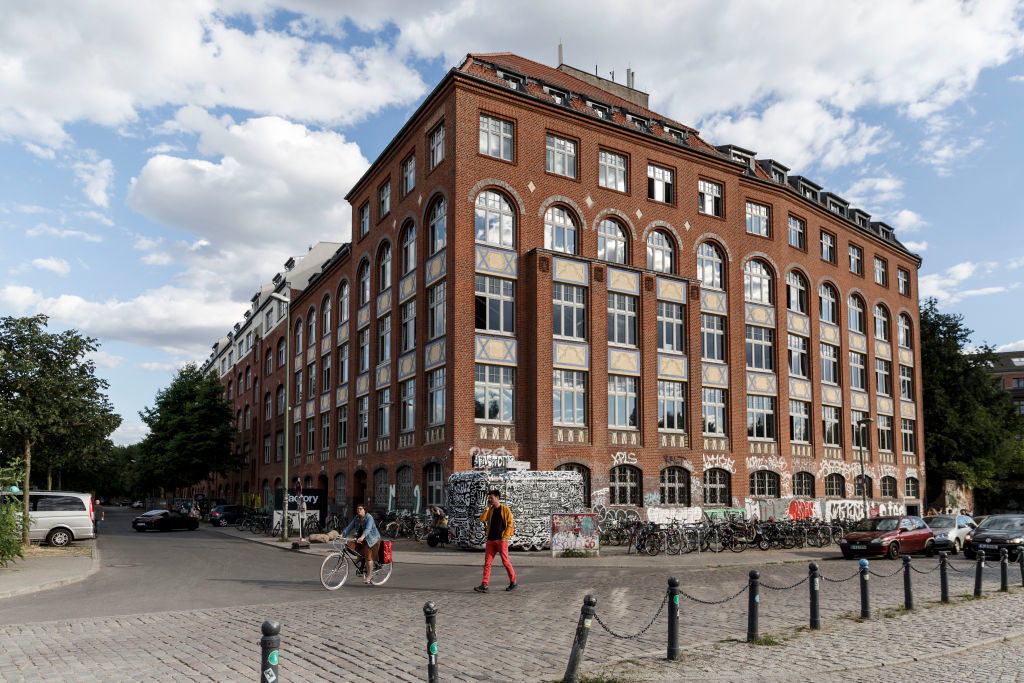
Pedestrians passing the new IoT
(Internet of Things) Hub Berlin incubator location in The Factory
in Kreuzberg district. Photo: Carsten Koall/Getty Images.
Berlin’s Nouveau Riche (Doesn’t
Really Care About Your Art Show)
The change in Berlin is tangible.
Throughout the city’s network of cobblestone streets, chic
co-working spaces have popped up inside industrial warehouses with
the speed of Starbucks in the 1990s. WeWork, Betahaus, and Factory
are just a few of the names now splashed against historic brick
facades. One of Factory’s spaces recently made headlines for
ousting artists from a building and then branding the space as
“abandoned.”
To get a better sense of the tech
industry’s current relationship to art, I go to meet tech insider
Andrew Haw, who is sitting in a Hawaiian shirt with a laptop open
at a cafe inside the cheekily titled co-working space Silicon
Allee. (He is the company’s so-called “community lead.”) As I sit
down with my flat white in a cup crafted from old coffee grounds, I
realize he is one of the first startup people I have talked to at
length, ever.
In Haw’s view, it’s only a matter of
time before tech and art embrace one another. After all, he says,
startups are creative endeavors, too. “The art community in Berlin
can often see the startup community as not really fitting—rightly
or wrongly—into their scene,” he says. “But in five years’ time in
a wealthier Berlin, some of these startups could be sponsoring art
events.”
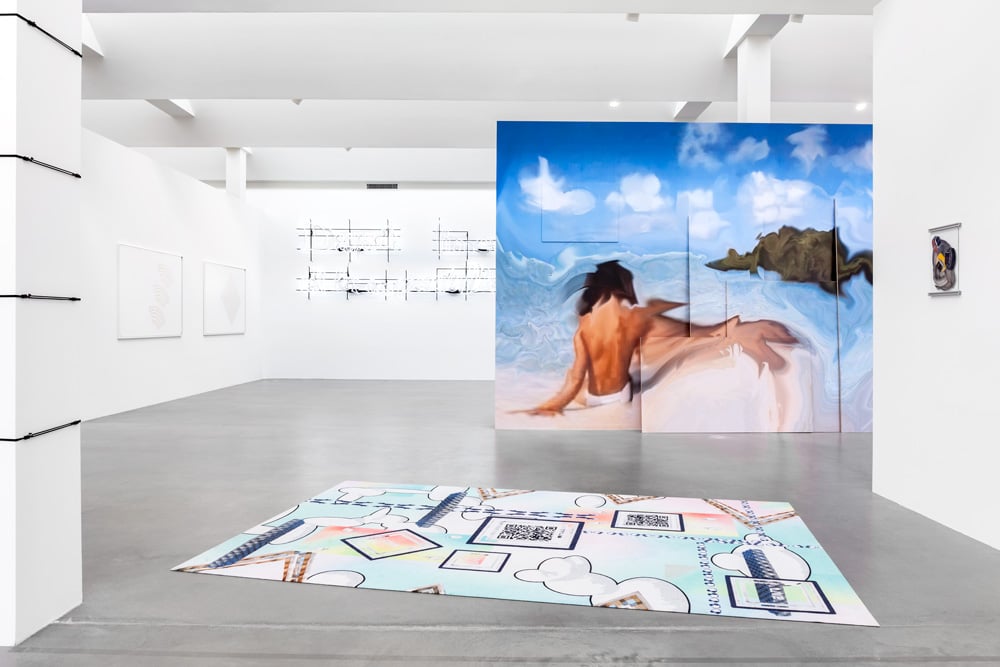
“Behind The Screen” group exhibition at
Kindl Center for Contemporary Art. Photo: Otto Felber
Right now, such a future seems hard
to imagine. Several art dealers I spoke said that their collector
bases only had a small handful of buyers from tech businesses, if
any at all.
“This is something we see in San Francisco,
too, but in Berlin, the problem is even larger,” says software
entrepreneur and art collector Markus Hannebauer. “There are not
many successful tech founders in Berlin who can afford spending on
art. Art does not serve as a good investment, so they tend to focus
on real estate.” Only startups that have
existing relationships with creative industries—like Ableton, a
music sequencer, EyeEm, an AI-powered photography marketplace, or
audio platform SoundCloud—are natural candidates for crossover, he
says.
The art-market economist Magnus Resch, who has founded several
companies in Berlin, concurs. “I am always surprised to see my tech
friends buying new houses or apartments, and then their walls are
empty,” he says.
At the same time, entrepreneurs who are looking
to blend art and tech are often hoovered up by larger tech firms
before their projects get off the ground. This brain drain not only
keeps the sectors separate, it is also “keeping our systems kind of
behind technologically,” one prominent Berlin art dealer
says.
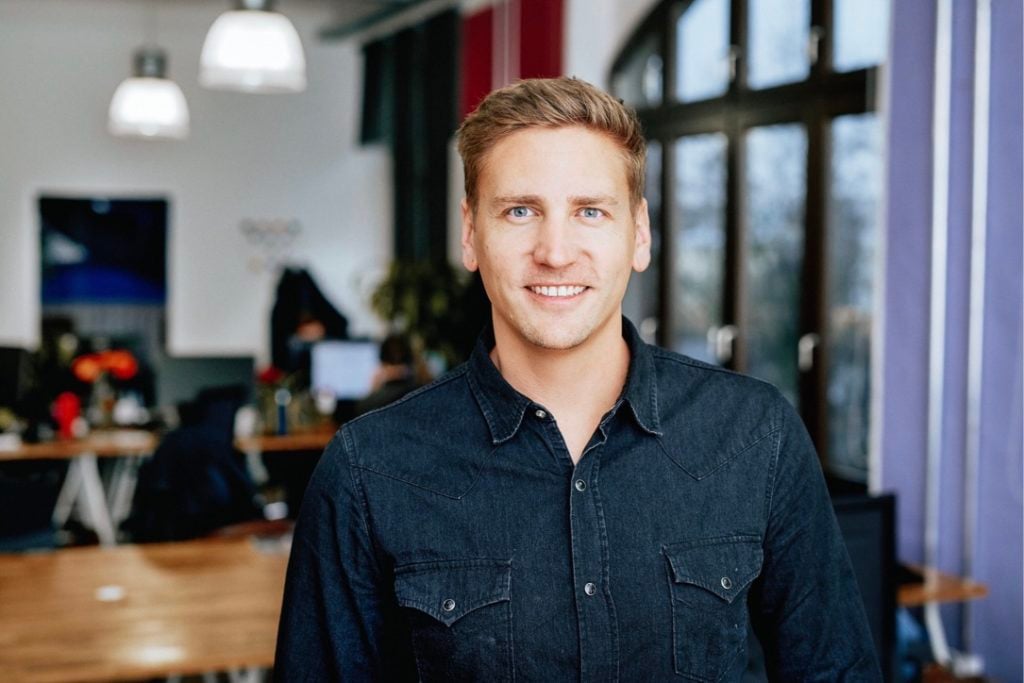
Philip Hartmann, Founding Partner
Rheingau Founders.
Parallel Universes
Sitting at Silicon Allee in Mitte,
Haw refers the neighborhood around us as “NoTo” (abbreviated
Manhattan-style for the street that cuts it off from the rest of
the surrounding area, and short for “North of Torstrasse,”
apparently). Despite living here for years, I have never heard the
term. In my first sit-down with a tech professional, one thing is
becoming clear: We’re living in parallel worlds.
That’s part of the problem when it
comes to the industrial fronts of tech and art in Berlin—the two
sides are not talking all that much, or all that deeply. And some
say the art world shoulders some of the blame.
“These guys just don’t get invited
to art-world events,” Resch says. “The
Berlin gallery scene is celebrating itself, and they are very
exclusive. It almost prevents tech people from entering it. Why
don’t they reach out to new buyers? Why don’t my friends get
invitations? Why aren’t there more panels involving the tech scene?
If you want to include them, you have to got to invite
them.”
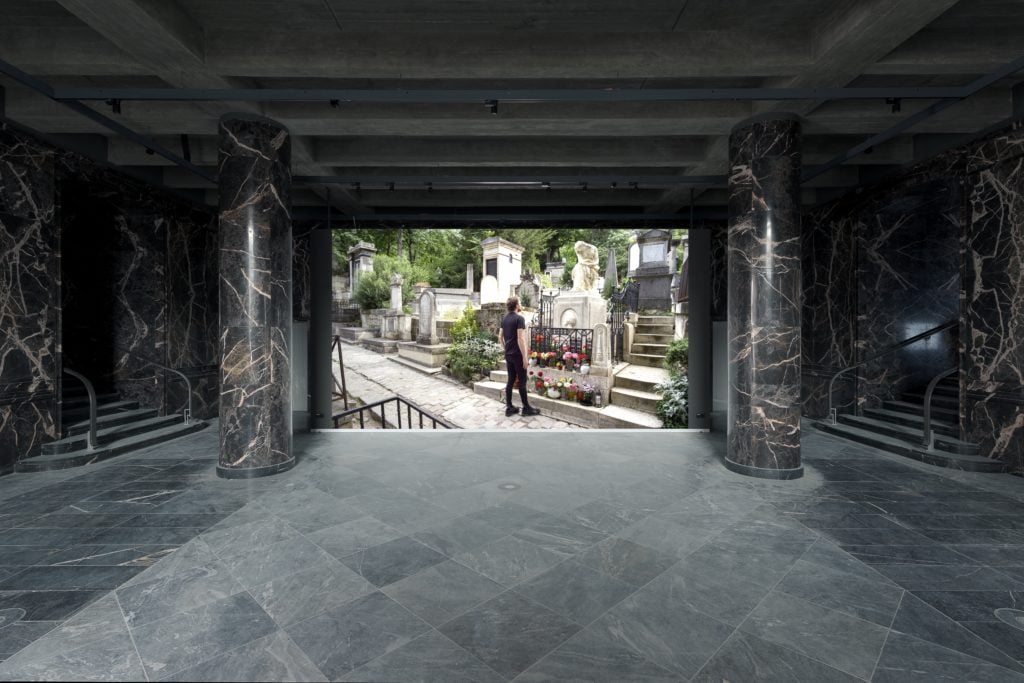
Fluentum (installation view), 2019.
Photo: Moritz Hirsch. Courtesy of Fluentum, Berlin.
There are good reasons for both sides to make an
effort. About 30 art dealers are closing
shop in Germany every year, according to Kristian Jarmuschek,
chairman of the Federal Association of German Galleries and
Art Dealers. At the moment, the city
estimates that there are 20,000 artists
living and working here, but that number could shrink if the
conditions become increasingly unlivable.
“As the creative backbone slowly
drains out, people that move to Berlin will be left without
that what made the city so attractive to them in the first place—a
rich and diverse cultural scene,” Hannebauer says. “And [tech]
companies—in the long term—might lose one of their biggest
assets: happy coworkers.”
Still, some are skeptical that tech
professionals will convert to art-buying quickly enough, or in
large enough numbers, to counteract the rising cost of living and
gentrification to which they are contributing. “I don’t see this
tech influx as likely to be at all positive or relevant to the art
scene here,” says one gallery worker who is based in Berlin but
from San Francisco.
Why Can’t We Be Friends?
With an understanding of the high
stakes, some players are working to bridge the divide between the
art and tech worlds. This spring, Hannebauer, the software
entrepreneur, opened Fluentum, a space dedicated to his private
media art collection, in a palatial building on the outskirts of
the city. For Berlin Art Week this September, he is inviting two
notable art dealers in the city, Alexander Koch and Nikolaus
Oberhuber from the gallery KOW, to curate a group show. The gallery
just moved from Mitte—sorry, I mean NoTo—earlier this year, due in
part to the doubling rents in the area, according to
a report in
Monopol.
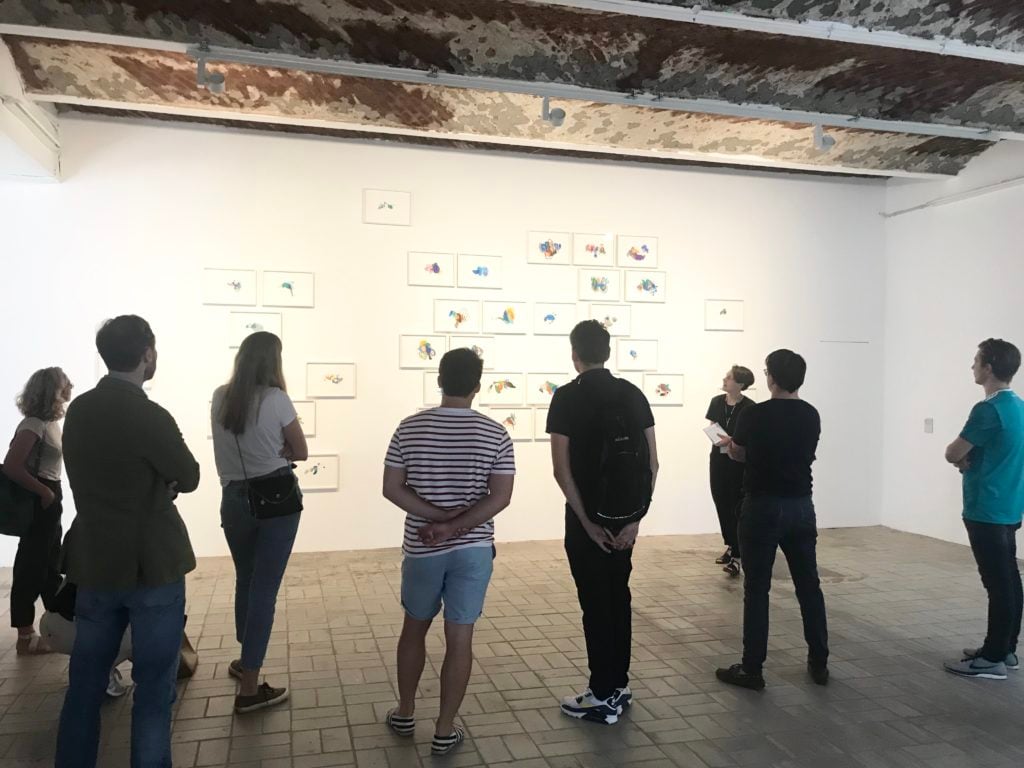
Start-up “Get together and Tour” at
Kunst-Werke Berlin, which are organized at various locations by the
gallery OFFICE IMPART.
Meanwhile, Philipp Hartmann, a venture-capital investor and
founding partner of Rheingau Founders, has opened a small
pop-up art space inside his burgeoning startup consulting company.
The venue, called The Wall, is curated in collaboration with the
veteran gallery Eigen+Art Lab. Members of the startup scene and the
art scene are invited to mingle at its intimate
openings. “This way we can support
young aspiring artists and help start a dialogue between start-ups
and art lovers,” Hartmann says. “My hope is to see many more of
these initiatives in the years to come.”
For some, tech’s explosive energy
and out-of-the-box thinking recall the excitement of Berlin’s
burgeoning art scene in the decades after the fall of the Berlin
Wall. “Berlin is a city that attracts creative and curious minds
and there are similar characteristics between an artist’s mind and
a tech mind,“ Haw says. He speaks about networks, creating space,
and collaboration, as well as the relentless pursuit of funding—all
terms that I find myself using all the time to speak about the art
industry.
“I have felt a close connection to the ways
that a start-up operates, as opposed to a regular company,“ says
Berlin art dealer Tanja Wagner. She points out that, like a
gallery, venture capital firms tend to float several start-ups at
once. They might believe in all of them, but most won’t survive;
the economic model for both art dealers and tech investors depends
on at least one taking off.
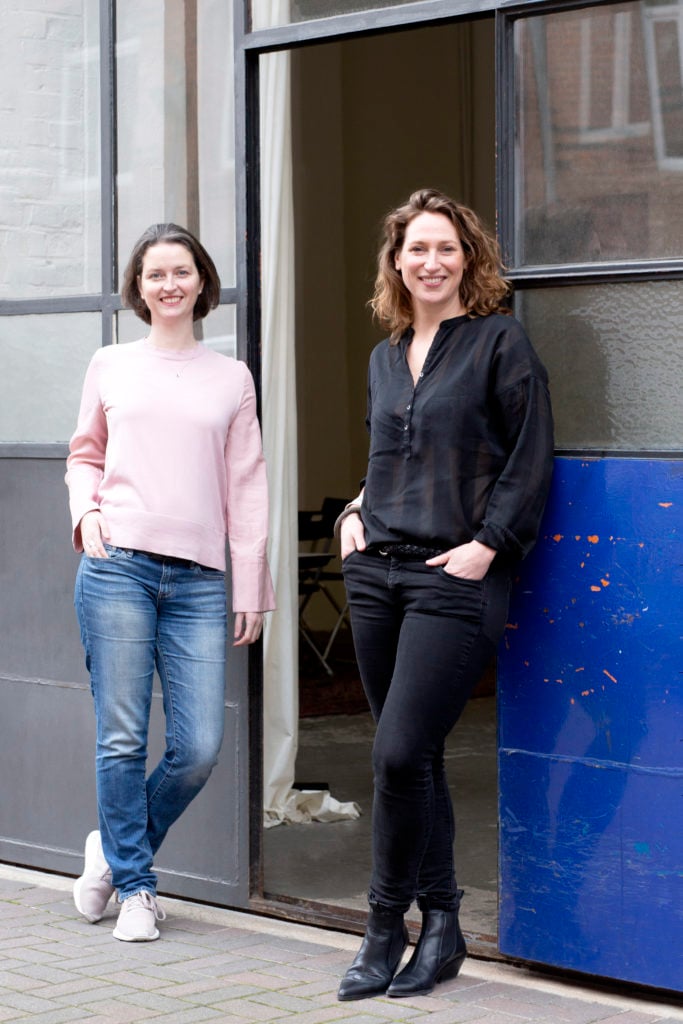
OFFICE IMPART’s Anne Schwanz (left) and
Johanna Neuschäffer outside their location. Photo: Charlotte
Spiegelfed
Cultivating New
Patronage
A duo of art dealers is also working
to penetrate the wall separating the art and tech worlds. Last
year, Johanna Neuschäffer and Anne Schwanz, two industry veterans
who had previously worked at Eigen+Art, established Office Impart,
which is not a gallery but a “representative office.” It aims to
change the way dealers work with artists amid a rapidly
transforming local and global economy.
“Berlin is built by creativity and change,” Neuschäffer says. “Standing still is death; We cannot
do everything in the next 10 years what everyone [else in other
industries] did 30 years ago.”
Their office is far
from the gallery districts, nestled in a renovated brick building
that houses other tech businesses. We meet in the sun just outside
the entrance. (This is a post-gallery business, after
all.)
Part of their business plan is to
minimize overhead by partnering with individual artists on projects
beyond the confines of a gallery space. (Their most recent
exhibition, “Behind the Screen,” featured work that examines how
our behavior is shaped by technology.) The duo has also been working to
introduce tech-industry people to art by hosting regular lunch-hour
tours of shows and publishing a newsletter, called the Weeker, to
help newcomers navigate local art events.
“We are very positive about the
changes in Berlin,” Schwanz says. “There is still overall money in
the market. People being interested in art, wanting to live with
art—this will never stop. There are so many start-ups
and so many investors coming in, however you can only grasp them if
you make them understand what is going on here, and take them to
the relevant places.”
As we chat, a man in a crisp shirt dashes by with a phone and
suitcase in hand, his fancy-looking watch glinting in the sun. He
stops short when he sees us. “Hey! What are you guys doing here?”
he says, and the three of them catch up. He informs the dealers
that he is building a new company and delivers a quick elevator
pitch for a new high-def screen. “Could work
for art maybe!” he muses before jetting off through the
courtyard.
We all laugh at the chance
encounter. “We believe that the analog meeting, the analog
discussion is the best way forward in digital
times,” Schwanz says. She notes that they often hear
people from the tech world say they don’t understand art. “When
they think of art, it is painting on a wall,” she explains. “But in
fact, there are many artists that are just as technologically
engaged as these tech entrepreneurs. You have to take the time to
educate people outside the scene—and it takes a while—but it
eventually works.”
The post Berlin’s Tech Scene Is Exploding. But Will These
Young, Wealthy Elites Ever Start Buying Art? appeared first on
artnet News.
Read more https://news.artnet.com/market/berlin-startup-scene-art-collector-1619146
Further reading


Leave a comment