
How Six Female Artists in Post-Revolutionary Mexico Broke Down the Borders Between Fine Art and Design
In 1935, Clara Porset settled in
Mexico City in political exile from her native Cuba. Well-traveled,
and especially well-connected, the designer and educator was a
student of international Modernism, having trained in Cuba, New
York, and Paris before studying with Bauhaus émigrés Josef and Anni
Albers at North Carolina’s famed Black Mountain College.
Landing in Mexico, Porset was
already recognized as a force with distinctively progressive views.
She used her practice to advocate for affordable and
egalitarian-minded design, and strategically deployed local
techniques in her furniture and interiors, as well as materials
(like leather and jute) optimized to thrive in local climates. Her
Butaque chairs are perhaps her best known pieces—adapted from a
popular Colonial-era design fusing pre-Columbian duhos and Spanish
X-frame forms.
Porset would soon set up her own
studio in her adopted city, and in 1952 she mounted a landmark
exhibition, “Art in Daily Life,” which radically dissolved established hierarchies of art and craft by
featuring industrial-produced furniture and fitted kitchens
alongside handmade traditional woven baskets and
textiles.
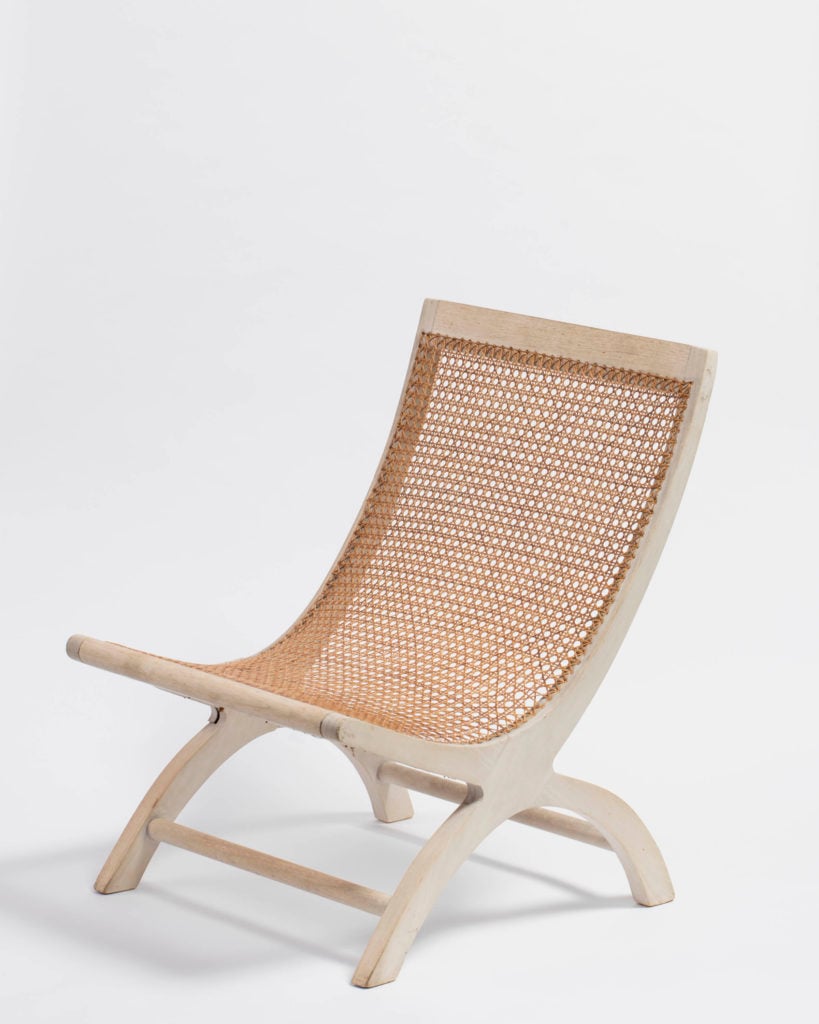
Clara Porset, Butaque Chair (about
1955–56). Collection of Gálvez Guzzy Family/Casa Gálvez. © The Art
Institute of Chicago. Photography by Rodrigo Chapa.
Porset serves as the nucleus
of “In a Cloud, in a Wall,
in a Chair: Six Modernists in Mexico at Midcentury,” now on view at
the Art Institute of Chicago. Its impetus came over two years ago,
when curator Zoë
Ryan was on a trip to Mexico
City. After visiting
Porset’s archives, Ryan was struck not just by “how much of an
advocate she was for a culture of design in Mexico at this period,”
but also by her wide network. “That’s how the story
began.”
“In a Cloud, in a Wall, in a
Chair” brings together a group of artists and designers for the
first time: Porset, Anni Albers, Lola Álvarez Bravo, Ruth Asawa,
Sheila Hicks, and Cynthia Sargent. All six members of this
international, cross-generational group either lived or worked in
post-revolutionary Mexico between the 1940s and the 1970s; all of
them furthered their practices there; and all of them upended the
paradigm of interdisciplinary methodology. According to Ryan, the show is very much the
“beginning of a conversation. It’s a very specific moment in these
practicioners’s careers. It’s that moment when you see artists
grappling with these techniques and ways of making
art.”
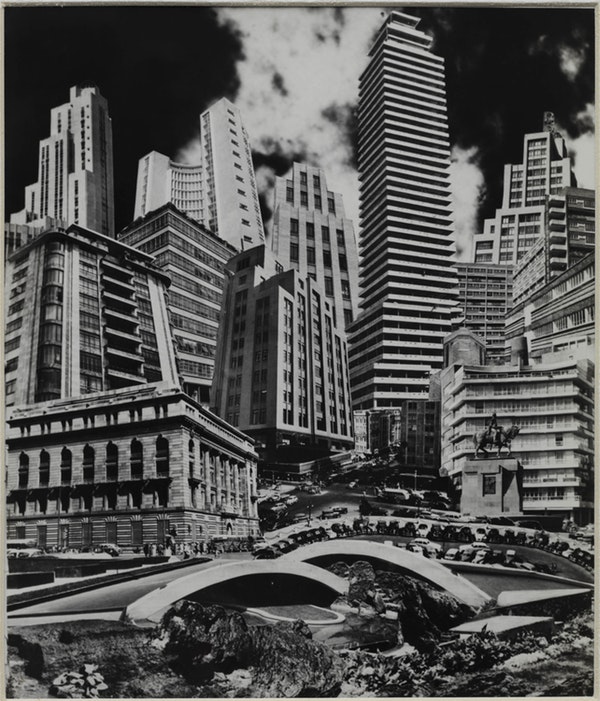
Lola Álvarez Bravo, Anarquía
arquitectónica en la ciudad de México (about 1954). Collection
of González Rendón Family. © Center for Creative Photography.
Photography by Rodrigo Chapa, courtesy of the Art Institute of
Chicago.
Ryan introduces the exhibition
with a ten-foot by
twenty-foot photomontage by Álvarez Bravo, depicting a mural she made for an interior of
a car factory Porset designed; it signals a country in the midst of
mass industrialization. Álvarez Bravo was one of the few women
photographers working in the country during this period. Raised in
Mexico City, she was a prolific portraitist and photojournalist,
and spent much of the 1940s and ‘50s traveling the country
photographing its changing rural and industrial landscape.
Additionally, Álvarez Bravo was a chronicler of Porset and her
work; many of those images appear in the exhibition, along with her
photomontages of a changing Mexico.
Overall, the exhibition zeroes
in on the exchange of ideas and Mexico as the site of it all. Each
practitioner has her own dedicated space in the show, complete with
studies, finished works, and associated ephemera. Porset was a
connecting thread between the group. After Cynthia Sargent moved to
Mexico City from New York and established a weaving workshop
turning out popular rugs imbued with her own sense of color and
geometry, Porset included her in the “Art in Daily Life” show.
Sargent would go on to found the Bazaar Sábado, a popular
arts-and-crafts market that continues today.
After their time at Black
Mountain College, Porset encouraged Anni and Josef Albers to visit
Mexico; they subsequently made more than 13 trips. Anni connected
with the abstract visual geometric language found in
traditional weavings and
archeological sites, including the triangular motif that would be incorporated
into much of her work.
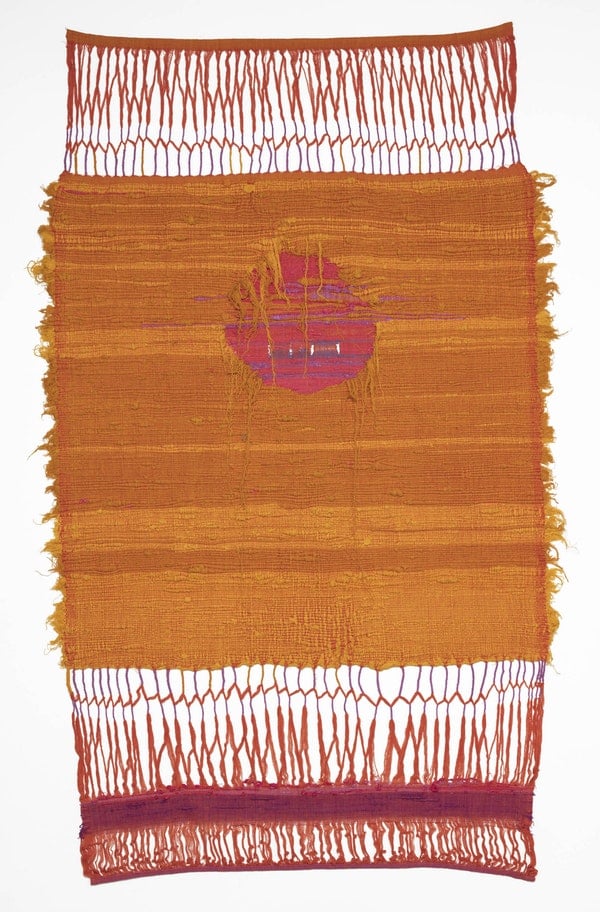
Sheila Hicks, Learning to Weave in
Taxco, Mexico (about 1960). The Art Institute of Chicago, gift
of Martha Bennett King in memory of her brother, Dr. Wendell Clark
Bennett. © Sheila Hicks. Photography: © The Art Institute of
Chicago.
“She thought there was so much
to learn from here, especially in the modernist vernacular,
or ‘universal language,’” Ryan says of Albers. “Crafts were
valued, working by hand was something seen as very legitimate,
which was not necessarily what they’d come from, what their
training had been.”
An especially big discovery,
restored and on view in the show, was a weaving Albers produced for
the modernist Camino Real Hotel, which opened in 1968 in Mexico
City’s Polanco neighborhood. Commissioned by the hotel’s architect,
Ricardo Legorreta, it was thought to be lost. Found in the basement
of the hotel, Ryan was surprised to learn the weaving was an
industrial-made appliqué. Several of
Albers’s Camino
Real screenprints are
also included in the exhibition.
After visiting Toluca and seeing
artisans fabricate baskets by hand with a looped wire technique,
Ruth Asawa (another Black Mountain College and Porset alumna)
applied it to her drawing practice, bringing it into three
dimensions, articulating the sculptural language that would define
her body of work. A grouping of Asawa’s delicate, hanging wire
sculptures, as well as an egg basket Asawa produced as a gift for
Anni Albers, are included here.
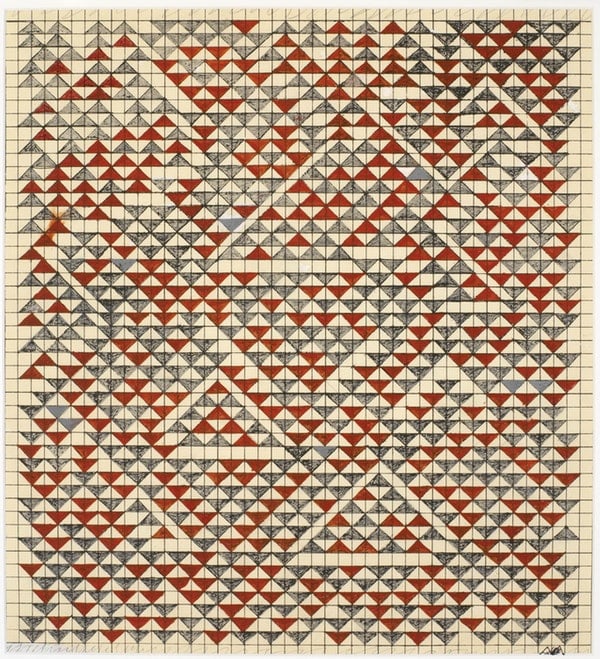
Anni Albers. Study for Camino
Real (1967). © The Josef and Anni Albers Foundation /
Artists Rights Society (ARS), New York 2019. Photography by Tim
Nighswander/Imaging4Art.
Though Sheila Hicks is the only
artist without a personal connection to Porset, the architect Luis
Barragán, Hicks’s major mentor, was a client and friend of
Porset’s. Hicks had traveled to Chile and throughout the region,
familiarizing herself with pre-Columbian textiles and learning
ancient Andean weaving techniques before continuing her studies in
Mexico and settling up a workshop in Taxco el Viejo. Ryan has
included an array of Hicks’s wall hangings from this period, as
well as Falda (1960), a staggering multicolored tangle of
wool in which Hicks freed her work from the loom.
“If you’d understood work from
the Bauhaus and a much more interdisciplinary approach to practice,
you definitely would have gravitated to Mexico where it was playing
out in reality,” Ryan says. “Sheila Hicks talks a lot about the
fact that she wanted to work and sew but she wasn’t necessarily
encouraged. She wanted to remove herself from her environment in
America and travel elsewhere to find inspiration. She never looked
back.”
The post How Six Female Artists in Post-Revolutionary Mexico
Broke Down the Borders Between Fine Art and Design appeared
first on artnet News.
Read more https://news.artnet.com/exhibitions/zoe-ryan-mexican-modernists-1644277
Must-See Art Guide: Cologne and Düsseldorf
Further reading


Leave a comment