
‘Magic Realism Is Our Reality’: Two Hong Kong Artists Reflect on the City’s History of Protest as the Unrest Approaches Its Fourth Month
When Hong Kong artist Luke Ching Chin-wai waved his shirt while
standing in an old, dimly lit train compartment for a series of
photographs taken at the city’s Railway Museum in 2013, he didn’t
know that the eerie images would have a disturbing resonance today,
a time when police are firing tear gas canisters at protesters
inside Hong Kong’s underground stations
and beating unarmed civilians in the Mass
Transit Railway’s train compartments.
“I wanted to create images that are surreal,” Ching said.
Standing in front of Dark Night, White Cloud, the artist
recalled how he took the set of 12 photographs using a long
exposure technique to visually alter the movement of the shirt
waving into an illusion of cloud, mist, or smoke.
“But who would’ve thought these imaginary scenes from six years
ago could become real today,” said the 47-year-old artist,
referring to the ongoing pro-democracy protests that have been gripping the
city since early June. For nearly 100 days, demonstrators have
braved the tear gas to rally in the streets, demanding universal
suffrage after China announced a controversial plan to
allow extraditions to the mainland.
“From the Umbrella Movement [in 2014] to now, we have
been unpacking what happened. But we still haven’t come to terms
with it yet. And now the [Mass Transit Railway] is not the MTR we
used to know. Normal today is not the same as what we were used to.
Magic realism is our reality.”
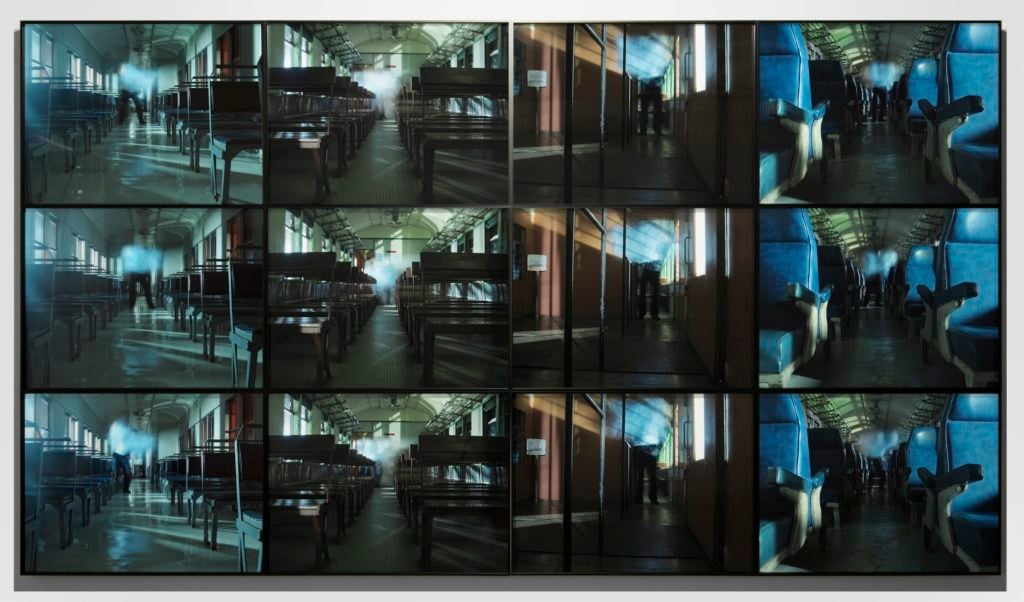
Luke Ching Chin Wai, Dark Night,
White Cloud (2013). Courtesy of the artist and Blindspot
Gallery.
The new normal
Ching spoke as he was pacing up and down the floor of Blindspot
Gallery, where his solo exhibition “Liquified Sunshine” is being
held. The show runs until November 2 in parallel until with
“Force Majeure,” a solo exhibition by fellow Hong Kong artist South
Ho, who is 12 years older than Ching.
The dual solo exhibition was conceived months ago as a way to
bring together two socially-engaged artists from two different
generations for a dialogue about the city’s changing sociopolitical
landscapes. The ideas was to focus on the artists’ older
works, which were inspired by the memories of typhoons, but as Hong
Kong became caught in the midst of the biggest social unrest the
city has seen since the 1967 riots, the recent civil uprisings have
inspired them to create new works. Meanwhile, their past works take
on new, almost prophetic meanings.
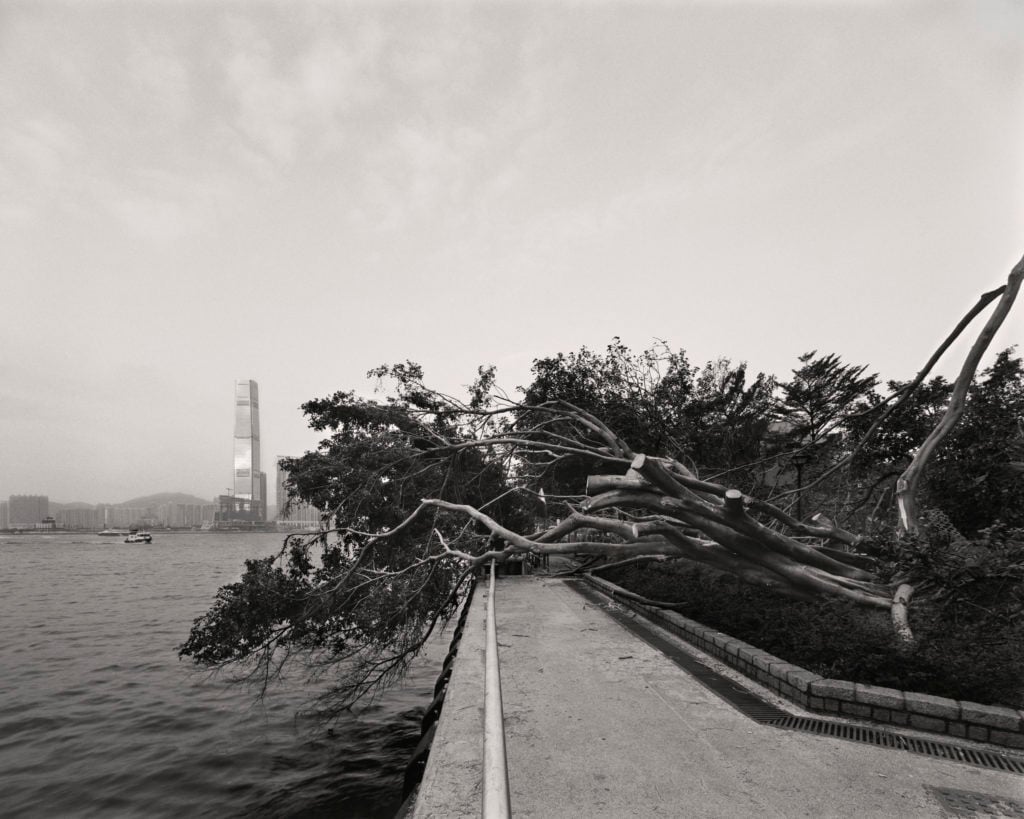
South Ho Siu Nam, Whiteness of Trees
III (2018). Courtesy of the artist and Blindspot Gallery.
Echoing Ching’s idea of the new normal is Ho’s photography
series “Whiteness of Trees,” hung on the walls at the other
end of the gallery. It is a set of 19 black-and-white photographs
of the aftermath of super typhoon Mangkhut, which hit Hong Kong
last year and was said to be the most intense tropical cyclone the
region has ever seen. The government said it caused a record storm
surge and more than 1,500 trees were uprooted.
Ho took his camera with him to photograph the uprooted trees and
their torn-apart trunks, revealing the inner whiteness hidden
beneath their rough skin. “I knew these trees will soon be gone
based on how the city is run,” he said, referring to Hong Kong’s
efficiency when it comes to cleaning up the streets after a
typhoon. But to him, that did not feel right.
“What was not normal was the way people reacted the day after
the super typhoon. People were rushing to work as if nothing
happened, despite the streets were still full of debris and broken
tree trunks. Roads were still blocked,” he said.
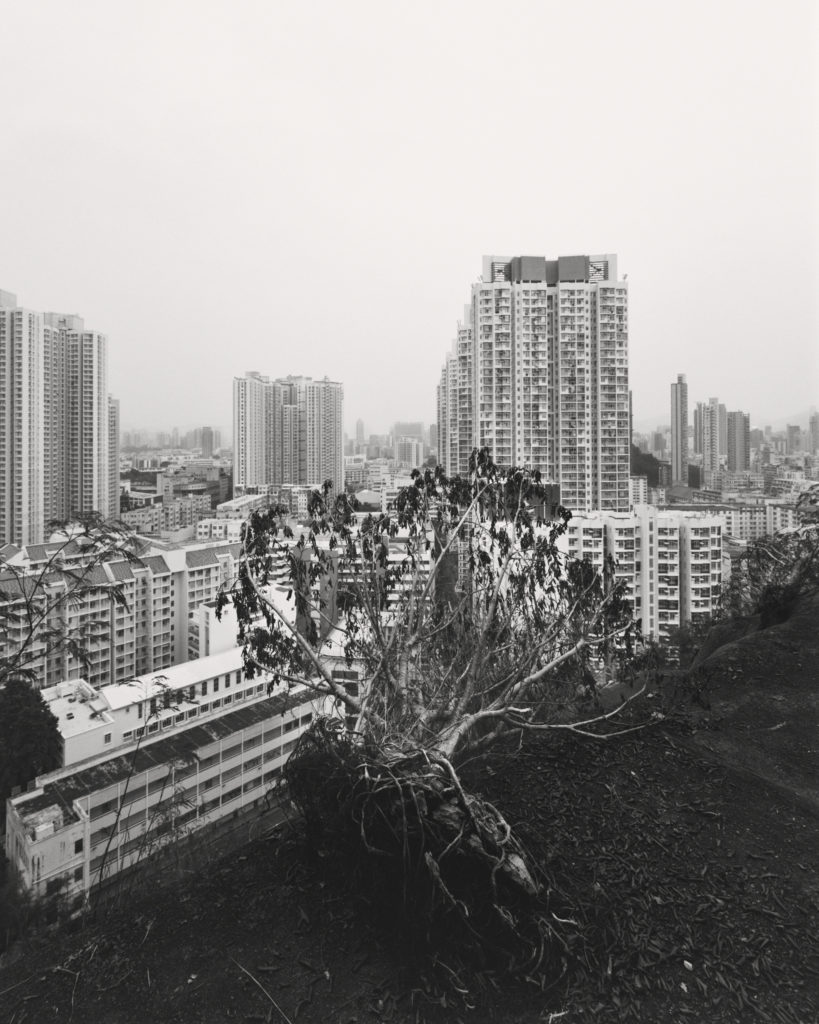
South Ho Siu Nam, Whiteness of Trees
IV (2018). Courtesy of the artist and Blindspot Gallery.
Pretending to be normal has become the norm since the failure of
the 79-day Umbrella Movement. Ho was at the protest sites five
years ago documenting the movement, during which people were asking
for the right to vote for the city’s leader, unscreened by Beijing.
The outcome was Umbrella Salad, his last major body of
work prior to “Whiteness of Trees.” The protests did not achieve
their goals, but life went on.
“The world was not normal, but people were trying to act normal.
It was wrong,” he said. “My works always respond to what happens in
the society, from the Umbrella Movement photographs to now. But
back then, I never expected how things would turn out today. It is
much worse than what I imagined.”
Facing their fears
Ho has been back at the protest sites in recent months shooting
and filming, and he’s added to the exhibition some of the long
takes of the massive protests that have seen millions of people
peacefully taking to the streets. Ho wound up getting tear gassed
himself on several occasions and, without an eye mask or gas mask,
said he had to rely on protesters to help him treat the affected
areas. Alongside the videos he has also created an installation
made up of colorful rubber balls to mock the so-called “less
lethal” sponge grenades, which were fired at the crowd.
“They are called less lethal but they can be lethal if they are
used in a lethal way. A photographer friend came from Taiwan to
cover the protests and was hit by one of these sponge rounds. He
had to leave. Luckily he was safe and had no bone fractures,” Ho
said.
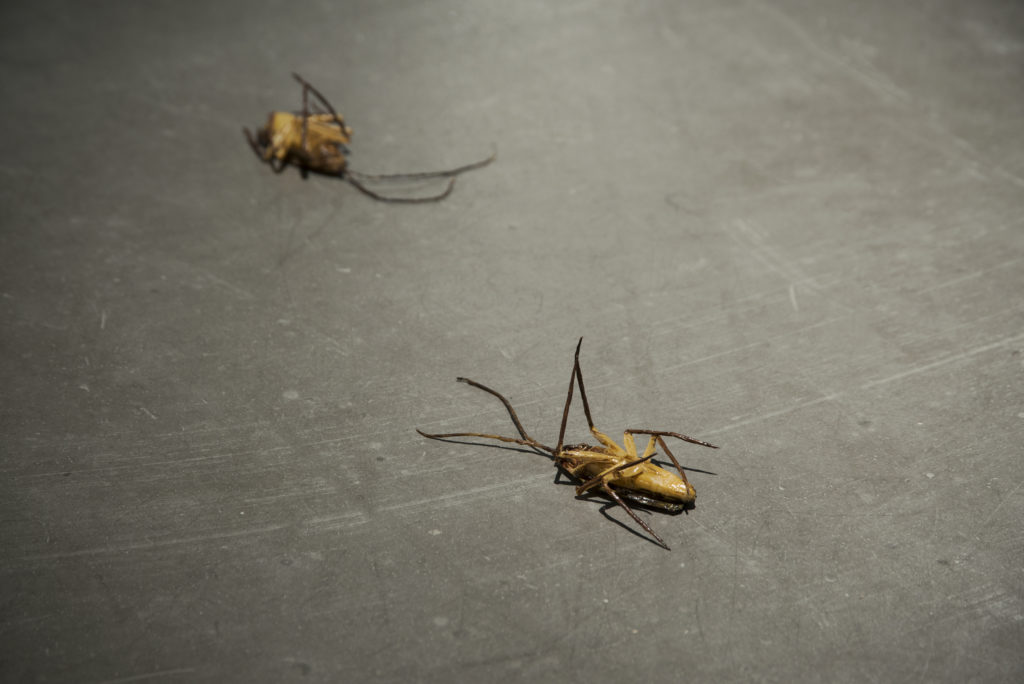
Luke Ching Chin Wai, Panic
Disorder (2019). Courtesy of the artist and Blindspot
Gallery.
The police also refer to the protesters as cockroaches, a tactic
used to dehumanize enemies that was borrowed from the Nazis during
World War II. In response, Ching’s show includes the cockroach
sculptures he made in 2006, along with a new six-minute video
work, Panic Disorder, showing his hands making the
sculptures, punctuated by flashing images of police.
“Cockroaches are among the most common insects in Hong Kong and
you often see them fly around before a typhoon comes. But I’m very
scared of cockroaches,” Ching said. “These are made with reference
to my imagination of what a cockroach looks like, rather than a
real image. We conjure up an image to address our fears. And this
is what the police are doing. But their fear is not the protesters.
Their fear is the deed they do, to beat unarmed protesters with
excessive force. They have to dehumanize them to justify their
violent actions.”
The new order
The ongoing political crisis has brought Hongkongers face to
face with what they have refused to acknowledge in the past, Ching
said: “It’s like unravelling all the dirt hidden beneath a
carpet.”
He related this to his exhibition’s title
work, Liquefied Sunshine. Conceived between 2014 and
2015, the installation is made up of 721 postcards of views of Hong
Kong under a clear blue sky, but painted over with lightly-colored
brushstrokes that look like rain.
Ching questioned why nearly all the postcards he came across had
sunny views of the city, despite the frequency of rain in Hong
Kong’s humid, sub-tropical climate. “These postcards tell us that
sunny days, blue and clear skies are an order. Rain, however, has
been deemed as a distortion of such an order,” he said.
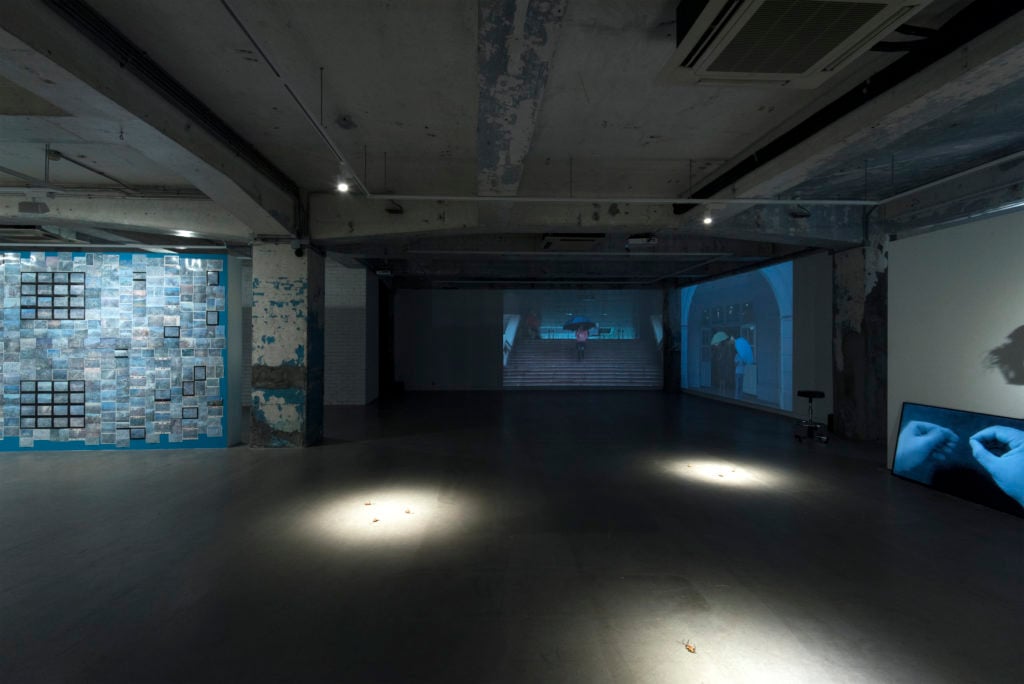
Installation view of “Liquefied
Sunshine” (2019). Courtesy of the artists and Blindspot
Gallery.
In light of the the protests, Ching’s rainy scenes are given a
new meaning. “I hand-painted the rain with single individual
brushstrokes. Rain is made up of drops of water, just like protests
formed by groups of individuals disrupting certain orders in the
city,” Ching said, looking intently at the wall of postcards in
front of him. “And now I don’t see how this rain will ever
stop.”
“We are facing a much bigger shakeup compared to five years ago.
We are confronted with what kind of future we want for Hong Kong,
and it seems that we have never been so clear about it,” Ho said,
holding a transparent shield made of roofing panels that he modeled
after those used by riot police.
“There is a delicate balance of Hong Kong that must be
maintained. It cannot be one country, one system. But it cannot go
against Beijing’s will. There must be checks and balances,
otherwise Hong Kong will collapse,” he said.
Ho banged the bottom edge of the shield on the floor, just like
the riot police do on the front lines of protesters. He yelled out
to the exhibition goers: “Stop charging at artists!”
The post ‘Magic Realism Is Our Reality’: Two Hong Kong
Artists Reflect on the City’s History of Protest as the Unrest
Approaches Its Fourth Month appeared first on artnet
News.
Read more https://news.artnet.com/exhibitions/hong-kong-protest-art-1661176
Further reading


Leave a comment