
Why Was Machu Picchu Built in Such a Remote Location? New Research Suggests It Was Because of Geological Fault Lines
Why did ancient builders construct Machu Picchu, the ancient
Inca city in present-day Peru, in such an inaccessible region of
South America? Researchers say they may finally have found an
answer: the presence of tectonic fault lines.
In a presentation to the Geological Society of
America, Brazilian scientist Rualdo Menegat presented new
satellite imagery and field measurements drawn from four
expeditions completed over 11 years. The biggest takeaway from
his research is evidence of a network of faults underneath the
famed archaeological site.
The faults—separations between large rocks in the Earth’s crust,
which vary in length from just a few millimeters to thousands of
miles—presented the Incas with naturally occurring
pre-fractured rocks, which would have been significantly easier to
move around and build with than complete blocks of stone.
“The intense fracturing… predisposed the rocks to breaking
along… planes of weakness, which greatly reduced the energy needed
to carve them,” according to Menegat.
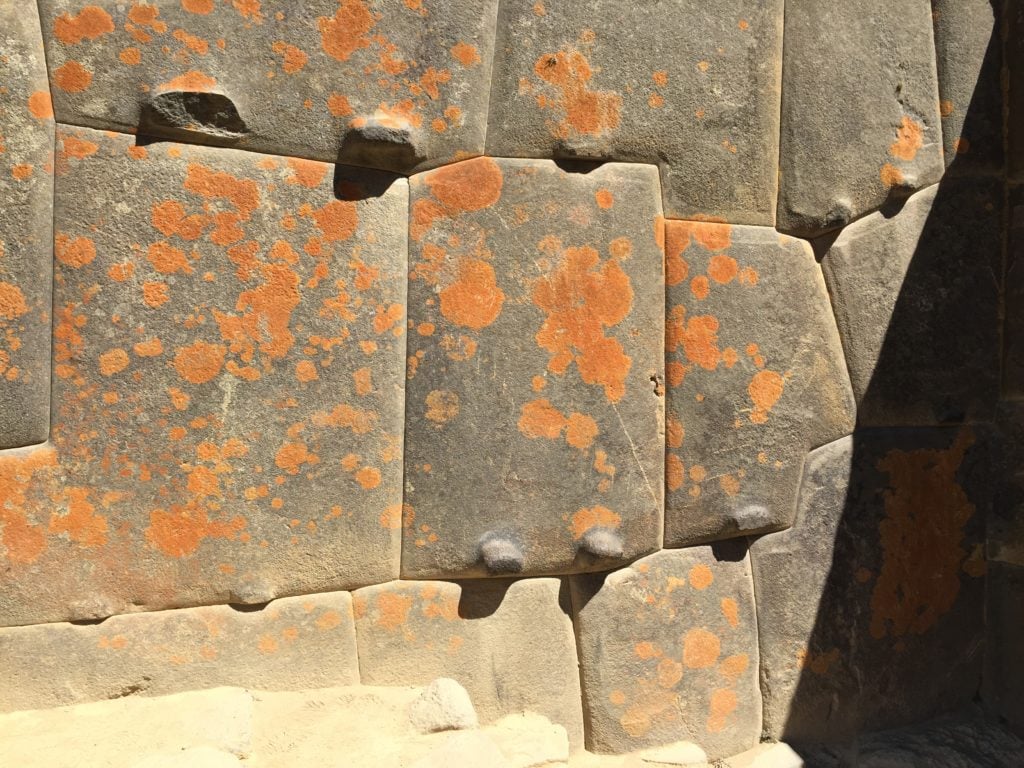
Ollantaytambo, Peru: The Incas took
advantage of pre-existing fractures in local stones to reduce the
amount of energy needed to create their master stonework. Photo:
Terri Cook & Lon Abbott.
“In addition” Menegat says, “the blocks take on typical
shapes such as triangles, hexagons, and rhombohedra. These forms
fit geometrically on the wall mosaics of the buildings.”
The areas Menegat mapped correspond with the axis of Machu
Picchu’s layout, some running northeast to southwest, and others
northwest to southeast, creating an “X” shape that cuts through the
under-layer of the city. The Incas, knowing they were onto
something, actually built many ancient cities (including
Ollantaytambo, Písac, and Cusco) to correspond with similarly
underlying geological faults.
The Incas were master stoneworkers, and images from Menegat’s
analysis show what he describes as “mortar-free masonry,” with
stones fit together like perfect puzzle pieces. They are so
precise, in fact, you can’t even slide a credit card between
them.
In addition to helping shape the massive stone city, the
underlying fractures also helped to provide water in the remote
alpine environment, as melted ice and rainwater could be delivered
straight to the site via the breaks between the massive stones.
The post Why Was Machu Picchu Built in Such a Remote
Location? New Research Suggests It Was Because of Geological Fault
Lines appeared first on artnet News.
Read more https://news.artnet.com/art-world/machu-picchu-fault-lines-1662205
Further reading


Leave a comment