‘You Make a Decision to Continue’: Amid a Crushing National Deficit, Beirut’s Art Scene Finds Creative Ways to Stay Afloat
Hanging in the booth of Saleh Barakat Gallery during
the 10th edition of the Beirut Art Fair last week was the latest
work by Lebanese painter Ayman Baalbaki: a large-scale depiction of
Beirut’s Piccadilly Theatre in its present, ruined state, priced at
$250,000. Painted in fleshy red and black brushstrokes, the empty,
ghostly theatre in Hamra serves as a potent reminder of both the
city’s rich cultural history and its present economic
predicament.
Bordered by Syria to the north and east and Israel to
the south, the little Levant country of Lebanon is used to
continuous states of economic and political woe. Yet after its
parliament approved a 2019 austerity budget in late July in an
attempt to rescue the economy from spiraling debt and unlock
billions of dollars in international aid, many believe the country
is now experiencing some of its darkest days yet.
The measure, which led to massive protests in Beirut,
is expected to trim Lebanon’s deficit to 7.59 percent of its GDP,
nearly four points lower than its budget deficit in 2018, which
reached 11.5 percent of its GDP. (For comparison, Greece’s
deficit was more than 100 percent of its GDP in 2009, while another
debt-riddled country, Ireland, had a deficit that was 14.4 percent
of its GDP that year.)
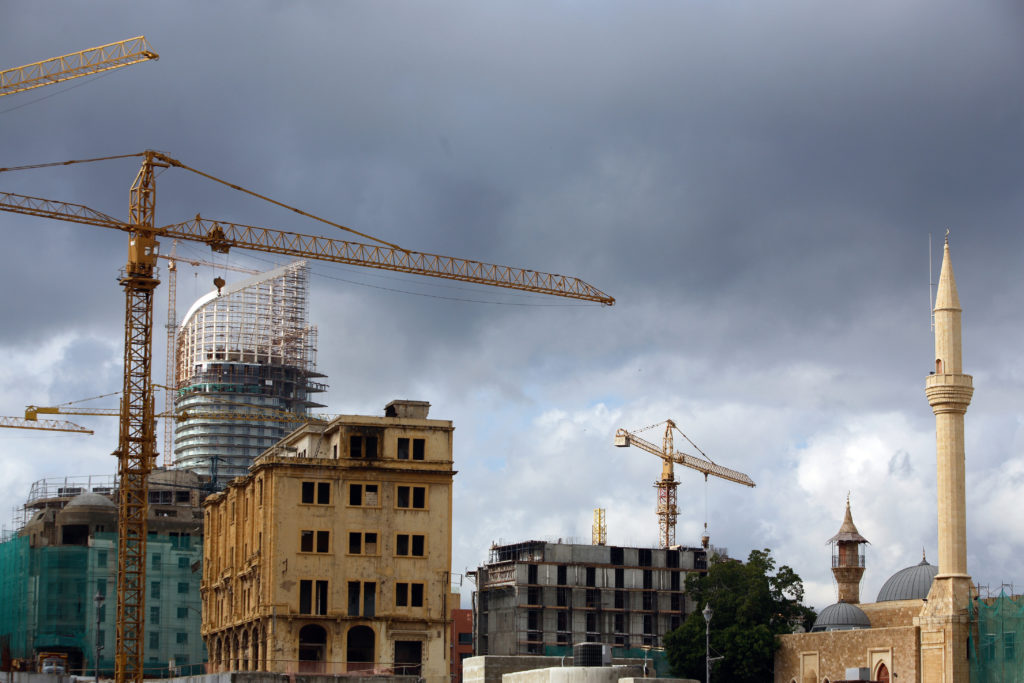
Old and new buildings mix in the skyline
of the Lebanese capital during pre-austerity days back in January
2006. (Photo by Pigi CipelliArchivio Pigi CipelliMondadori via
Getty Images)
The country has also been deeply affected by the
Syrian refugee crisis. Lebanon, home to a population of six
million, is currently hosting more than 950,000 Syrian refugees,
according to the UNHCR. There are also mounting tensions with
Israel—in late August, Israeli drones struck an Iranian-backed
Palestinian militia in the Eastern Bekaa Valley, an act that
Lebanese Defense Minister Elias Bou Saab called “the most dangerous
act of aggression by Israel” since the 2006 war between Israel and
Hezbollah.
“The crisis is very present and things are very tough,
but what do you do in such a moment?” asks the prominent Beirut art
dealer Saleh Barakat, who opened Agial Art Gallery in 1991 and a
second eponymous space in the Clemenceau area of Beirut in 2017.
“It’s either you close or you make a decision to continue. We took
the latter decision. We want to resist by moving on in a positive
way.”
One small silver lining, he says, is that artists feel
less pressure to churn out commercial material, freeing them up to
experiment. “We are not expecting anything,” he says. “There are no
big returns from the market during a time of economic collapse,
which makes everyone feel more free to create and do as they
want.”
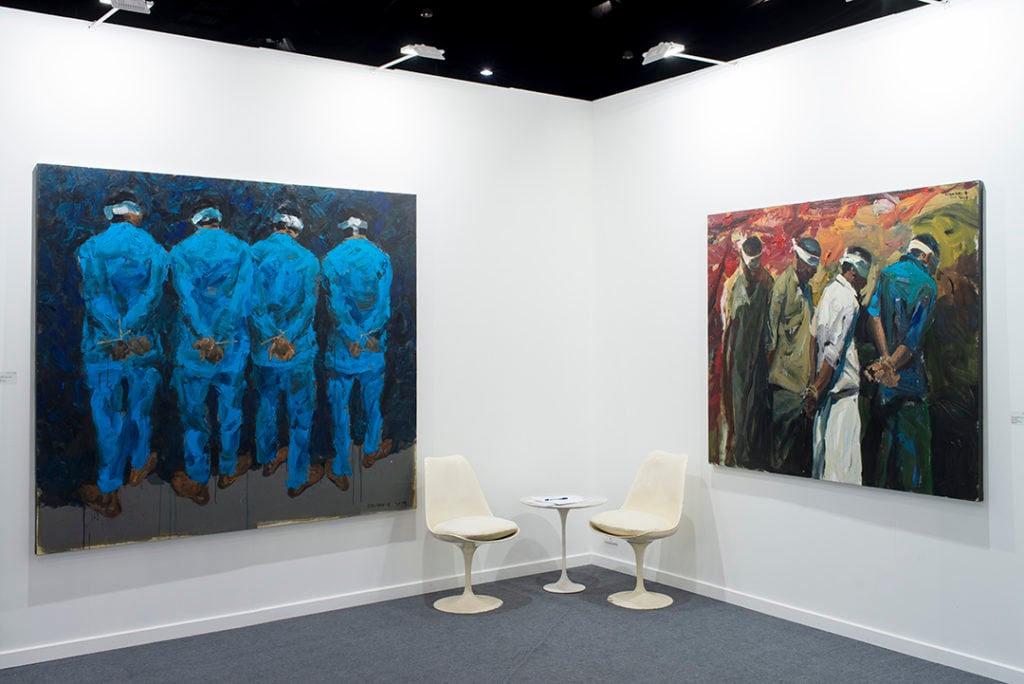
Installation view of Agial & Saleh
Barakat Gallery booth at the Beirut Art Fair.
Often, that results in art that reflects the world
around them. Most recently, Barakat mounted “Interminable Seasons
of Migration,” an exhibition of sculptures made out of bits of car
metal by Lebanese artist Ginane Makki Bacho that portrayed the
millions of refugees escaping conflict in Syria. “I wanted to show
the tremendous exodus of people fleeing the war with or without
expectation or hope of a secured destination,” the 71-year-old
artist says.
Barakat adds: “Often abroad, I’ve been told the work
is too cruel and violent—I can’t change it, that’s how a lot of the
work is. I am focused on defending the vision of art in the Middle
East.”
Surprising Success
Even in times of crisis, however, the art market manages to chug
along, and Beirut is home to a number of deep-pocketed collectors
who can ride out the storm, including economist Ramzi Dalloul,
Aïshti retail magnate Tony Salamé, and insurance broker Abraham
Karabajakian.
At the Beirut Art Fair, which ran from September 18 to 22,
Barakat nearly sold out his booth. Works by younger artists such as
Serwan Baran and Nadia Safieddine were on offer for less than
$5,000, while works by Ayman Baalbaki sold for between $50,000 to
$70,000. “It was a really good week,” he says. “I was very
surprised.”
The fair remains under the leadership of its founder,
French-born Laure d’Hauteville, who has worked to raise the profile
of the event with a heightened focus on contemporary work and new
international participants, including kamel mennour and Galleria
Continua. In all, this year’s iteration presented 55 galleries
hailing from 18 countries. Five dealers sold out their booths,
according to d’Hauteville.
She claims that “the fair has not at all been affected by the
economic crisis—we had more museum groups and collectors than
ever.” Though the fair and a number of galleries declined to
disclose specific sales and price points—often an indication of
lackluster performance—many seemed genuinely and pleasantly
surprised by the strong attendance of collectors and museum
groups.
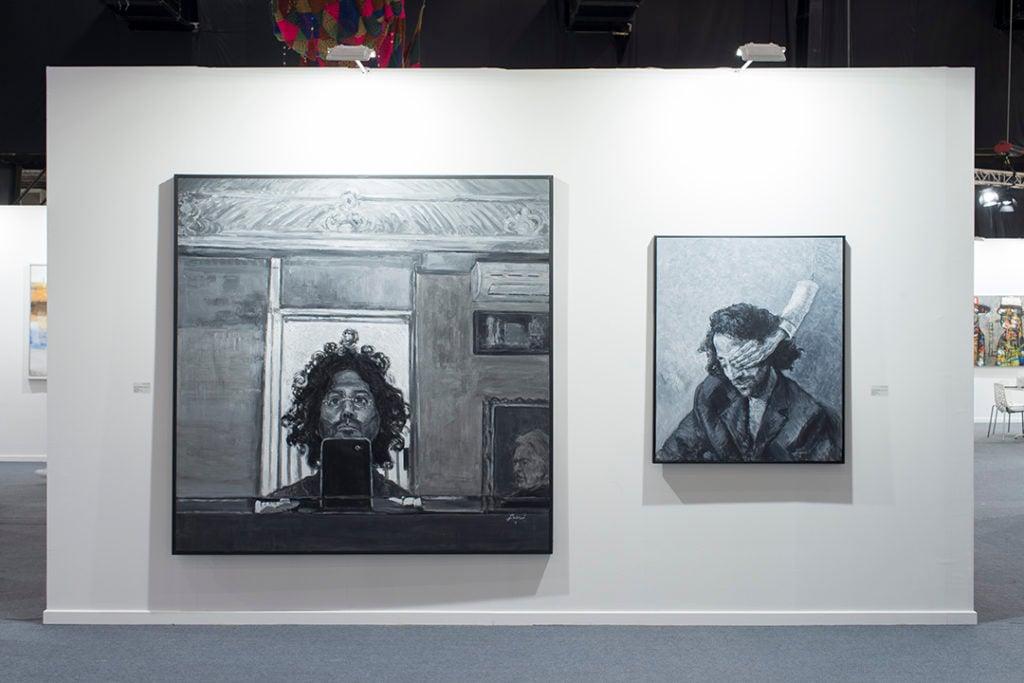
Installation view of Agial & Saleh
Barakat Gallery booth at the Beirut Art Fair.
Approximately 2,000 foreign collectors flocked to Beirut’s
shores this year, hailing from such institutions as the Sao Paulo
Contemporary Art Museum, the Centre Georges Pompidou, the Palais de
Tokyo, and the Fondation Cartier in Paris, the Al-Ula Project in
Saudi Arabia, the Barcelona Museum of Contemporary Art, and the
Middle East Institute from Washington, DC.
Milan-based Primo Marella gallery sold an installation
by Radenko Milak to a prominent Lebanese collector in addition to
works by Abdoulaye Konaté and Joel Andrianomearisoa, who
represented Madagascar at this year’s Venice Biennale. Paris-based
Galerie In Situ-fabienne leclerc showed works by internationally
renowned Lebanese artists Daniele Genadry and the duo Joana
Hadjithomas & Khalil Joreige.
The fair also mounted a handful of special
presentations, including an exhibition of the impressive
Orientalist collection of hedge-fund manager Philippe Jabre and a
selection of works that acclaimed Lebanese modernist Hussein
Madi—known by many as the “Picasso of Lebanon”—made during his many
years living in Rome, on loan from the collection of Mazen and
Loulia Soueid.
“I remain an optimist,” says Mazen Soueid, an
economist and advisor to Lebanon’s prime minister, of Lebanon’s
future. “Resilience is part of the country’s DNA; a lot of the
downside is due to the regional rather than the local factors. Let
us be frank: the region is at war; and for a country in the middle
of a region at war, we are actually still holding up.”
A Rise in Museums
Indeed, the new austerity measures seem not to have
dramatically affected Beirut’s rising crop of new museums. For the
most part, such institutions have been propelled by a class of
elites less affected by the belt-tightening and committed to
maintaining the city’s place as a global hub for art and culture.
At least three institutions are scheduled to open within the next
five years.
Among them is the Beirut Museum of Art (BeMA),
dedicated to Lebanese art and slated to open in 2023. The opening
was delayed three years after its original architect was dismissed.
Now, a strong group of supporters around the world are “working to
stay in line with its budgetary and fundraising goals,” a
spokesperson for the institution says. In December 2018, BeMA named
a new architect: Lebanese-born Amale Andraos of Workac.
There’s also the Dalloul family collection, known as
the Ramzi and Saeda Dalloul Art Foundation (DAF), comprising more
than 4,000 Modern and contemporary Middle Eastern artworks. Their
private museum is scheduled to open within the next three
years.
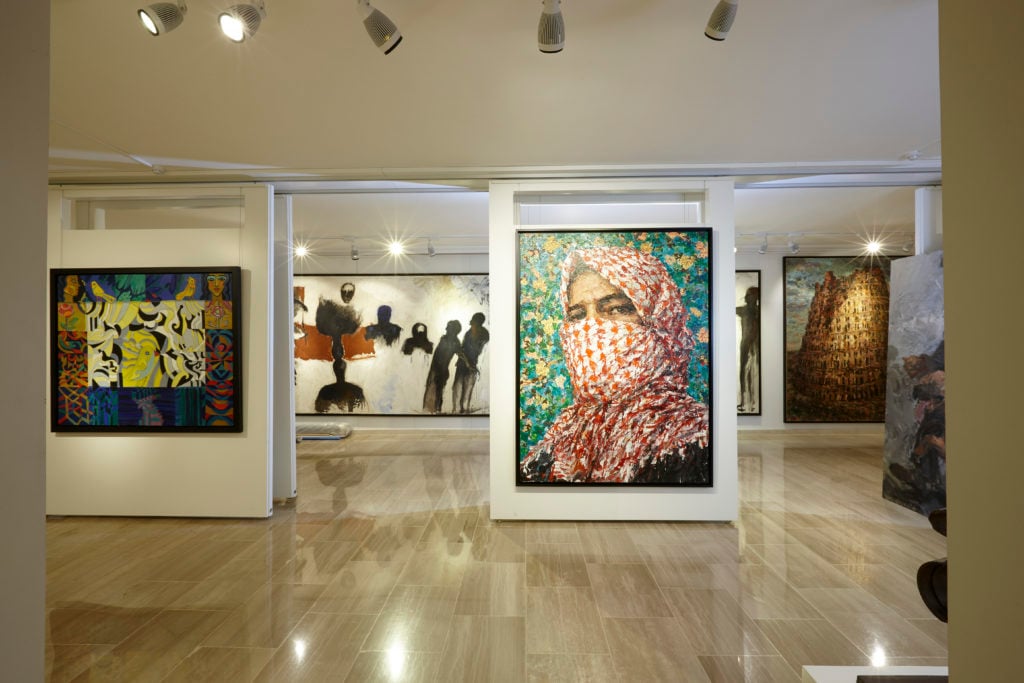
Installation view of the Ramzi and Saeda
Dalloul Art Foundation (DAF). Courtesy of Rebecca Ann Proctor.
“To have the largest collection of Pan-Arab art in a
city like Beirut will change the cultural landscape of the country
and it will most certainly help the artists of the community both
Lebanese and others,” says Basel Dalloul, Ramzi’s son, who has
introduced a variety of high-tech apps to catalogue the works in
the collection.
Finally, the Charles Corm Foundation has set out to
develop “an active cultural meeting place,” according to architect
and founder David Corm. Situated in Beirut’s pioneering skyscraper,
the former headquarters of the first Ford cars in the Middle East
and the family’s former residence is scheduled to open as a
foundation in April 2020. It will offer exhibition space, lecture
halls, a bookshop, restaurant, and a private library.
“It is a tough time over here and everyone is
scrambling, but the community helps each other out,” Dalloul says.
“We have lots of visitors from outside of town that assist as well
by buying artworks to take back home.”
Hurdles to Surpass
For some dealers, however, the existing help is not
enough. Annie Vartivarian, co-founder of the two-year-old Letitia
Gallery, feels she must look beyond her local environment to stay
afloat. “We are trying to grow the market for young artists from
Lebanon and abroad but realize we need to expand and participate
more in international art fairs to connect with stronger markets,”
she says.
Some are now planning to leave Beirut entirely.
“During a time of crisis, it’s important to keep a foot in a safe
zone,” says Canadian dealer Nicolas Bellavance-Lecompte, who
founded Carwan Gallery in 2010 as the city’s first gallery
dedicated to collectible design.
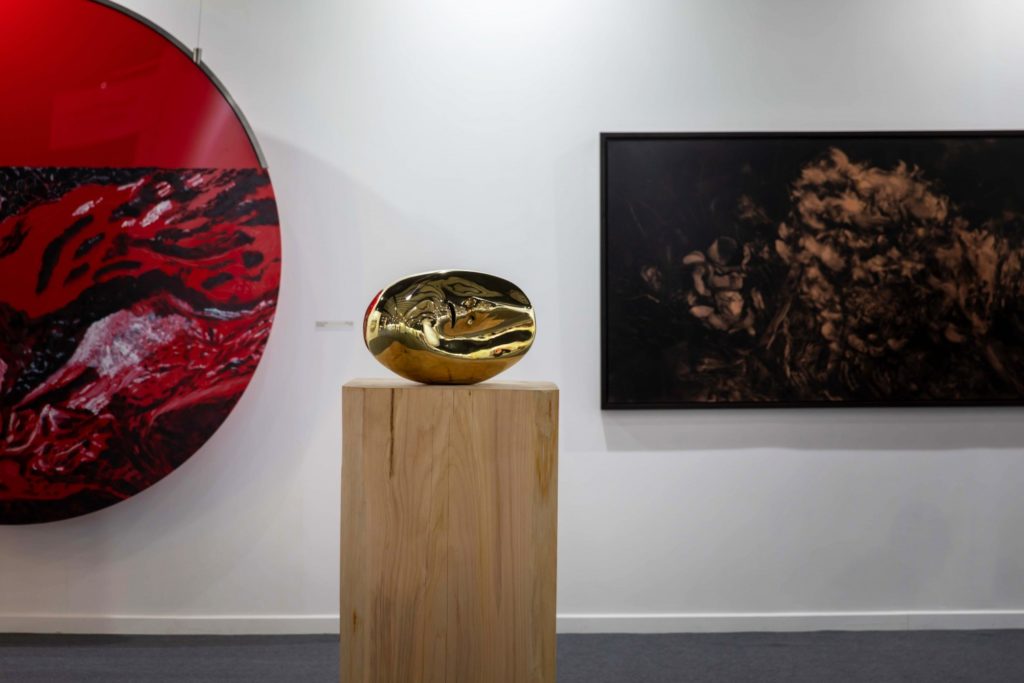
Installation view of Letitia Gallery’s
booth at the Beirut Art Fair. Courtesy of Letitia Gallery.
“After a lot of reflection, I have come to the
realization that I need to carve out a space with new fresh
energy,” he says. This year, he plans to move Carwan Gallery from
Beirut to Athens, a city “close enough to the Near East” that he
can “continue operations from there.”
Others are making do at home, but facing challenges
they never could have anticipated. “We are going through a huge
crisis,” says Joumana Asseily, owner of Marfa’ Gallery, which
opened in 2015. In June, Asseily was selected to show the work of
Palestinian-Jordanian artist Saba Innab in Art Basel’s Statements
section, a coveted spot. At Frieze London next week, she will
showcase a series of drawings depicting different parts of Beirut
by Lamia Joreige, marking her first participation with the
fair.
But the new austerity measures have affected Asseily’s
ability to transport artworks abroad—a particularly demoralizing
challenge at a moment when her business should be taking off. Most
recently, she tried to reclaim three works that were lent to a
traveling exhibition in Europe, only to be asked at customs to pay
for the objects as if she had purchased them.
“It’s a nightmare—now I have an issue with getting my
works back to Beirut from Frieze if I don’t sell everything,” she
says. Asseily has decided store any unsold works in Paris until the
situation changes.
“I still have artworks stuck in customs—it’s been
around eight weeks,” she adds. But “even if it is a struggle, I
want to stay and work. There are great artists, a great scene, and
amazing energy in Beirut.”
The post ‘You Make a Decision to Continue’: Amid a Crushing
National Deficit, Beirut’s Art Scene Finds Creative Ways to Stay
Afloat appeared first on artnet News.
Further reading


Leave a comment