
As the Art World Stomps Its Carbon Footprint Across London, Dealers and Frieze Are Innovating New Green Solutions
It ain’t easy being green in the globetrotting art world, but
gallerists in London for Frieze this week are trying harder than
ever to reduce their carbon footprint. The fair itself, which may
look like a gas guzzling fiesta of conspicuous consumption, is, in
fact, greener than ever.
The generators that keep the fair running and the booth lighting
bright run on biodiesel fuel. “This year we are very excited to use
a new fuel, Green D,” which is made from a waste vegetable oil,
says Frieze art fair director Victoria Siddall says. Her
expectation is that it will reduce the fair’s carbon emissions by
90 percent.
That is a big step, but in its war on waste, the fair has also
banished a status symbol: plastic VIP cards. A-list collectors who
arrived yesterday, October 2, instead brandished a digital version
on their smart phones. (The BMW limo service between Frieze London
and Masters is still running for super collectors.)
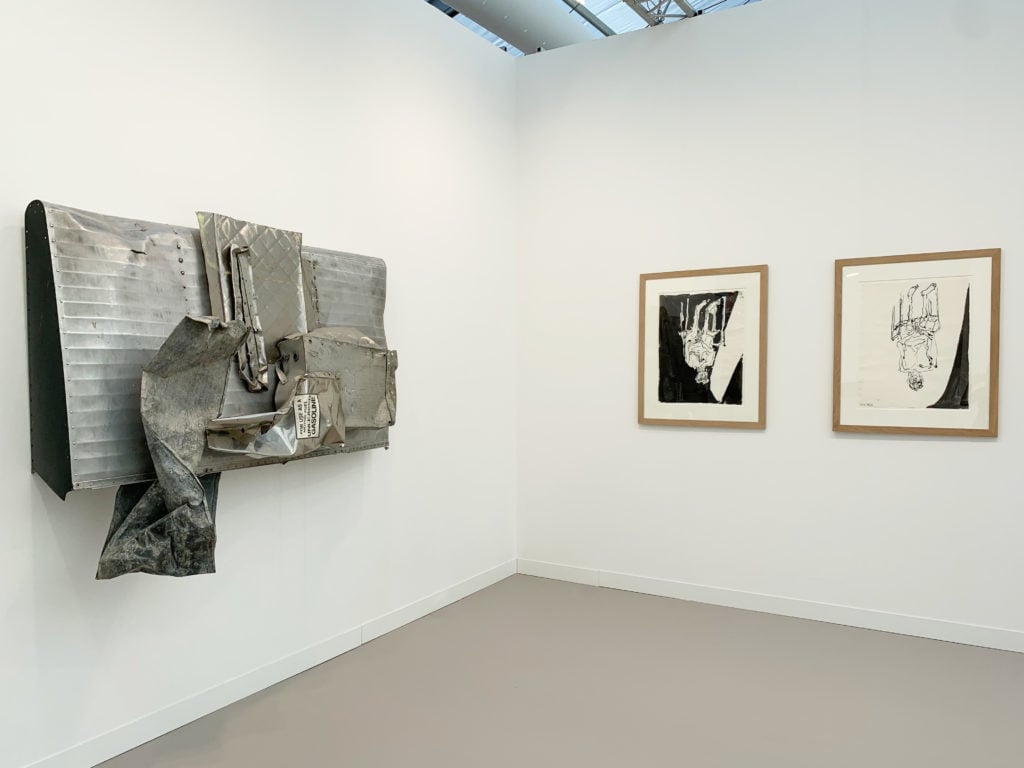
Robert Rauschenberg’s sculpture
Bumper Slip Late Summer Glut (1987) on Thaddaeus Ropac’s
booth at Frieze London 2019. Photo by CA Andrews, courtesy of
Galerie Thaddaeus Ropac.
Leading art dealer Thaddaeus Ropac and his team are ahead of the
green curve, reducing, recycling, and reusing whenever they can.
The majority of the works in the gallery’s heavy-hitting booth at
Frieze London, including appropriately a Robert Rauschenberg 1987
“glut” sculpture made of upcycled metal, were trucked in rather
than shipped by air. Ropac says that whenever the gallery can, it
ships large sculptures by sea.
Behind the scenes at any art fair you will find hundreds of
bespoke crates being stored. At Art Basel they fill a whole floor
of the vast exhibition hall. In the past, most would be single-use
crates. To radically reduce the waste, Ropac is buying a warehouse
in Paris with the sole purpose of storing crates so that they can
be reused. (It is too costly to store them in high-security
facilities where art is stored.) “I am looking for a building in
London,” Ropac tells artnet News. “If we cannot reuse [crates], we
try to recycle the wood,” he says.
“Many small steps” can lead to big changes, says Ropac, who has
galleries in Paris, London, and Salzburg. He predicts that Brexit
will mean more works have to be trucked from Paris to London,
however. When deadlines are tight, or a collector wants to see a
work ASAP, that might still mean flying it to London. “We used to
fly all works from Paris but would not do that now,” he says.
Ropac, who has just flown back from Expo Chicago where his
gallery made its Midwest debut, says that many works are still
flown across the Atlantic for fairs but that is changing. “Shipping
works to Miami will mean planning much earlier,” he says. “I think
artists will go with the change in deadlines,” he says.
The brand color of this year’s Frieze London signage is green,
but most collectors are probably unaware that the tent, walls of
the booths, and the carpets are reused, including by other art
fairs. The same is true of Frieze Masters. “We try to make
sure materials are reused year after year,” Siddall says, adding,
“We did our first carbon audit in 2007.”
While some fair directors might be reluctant to guide its
exhibitors on such practices, Frieze is quietly evangelical.
Siddall wrote to all the exhibitors on Saturday to explain what it
was doing, and says the feedback has been positive. Now, Frieze is
surveying all the galleries at this year’s fairs to see how they
shipped works to and from the tents in London’s Regent’s Park.
“Once we know, we will set a meaningful goal to reduce the amount
of work shipped by air,” she says.
In Paris, too, new steps are being taken at FIAC, set to open in
the Grand Palais hot on the heels of Frieze. The vast exhibition
hall has the space to store all the wall partitions the fair needs,
eliminating the need to truck them. Since Jennifer Flay took over
as director, FIAC has shared the same walls with the Paris Photo
fair. Flay says that the fair is committed to reducing its
waste by 20 percent in 2019. It is due to take place in a temporary
building during the Grand Palais’s revamp. The swanky structure
near Eiffel Tower may have a second life, artnet News has
learned.
One issue no fair director can escape is the environmental
impact of encouraging so many exhibitors and collectors to travel
from far and wide to attend their events. (There are so many
private jets chartered by super collectors for a certain Swiss fair
they can be held in a holding pattern for an hour.) The art
industrial complex runs on aviation fuel washed down with
champagne. “It is a real factor,” Siddall admits. “The art world
flies a lot.”
Siddall says in defense of Frieze and Frieze week, during which
London’s museums and galleries pull out all the stops, that a jet
setting collector can make the most efficient use of their air
miles. “You can do an awful lot in one trip,” she says.
This year in London the climate activist group Extinction
Rebellion stopped traffic in the capital with their creative
demonstrating. Members will be at Frieze, not to picket the
fair, but to speak inside the Frieze London tent on Sunday. “We
heard on the grapevine that they wanted to do something, so we
reached out to them,” Siddall says. “A lot of our audience as well
as gallery clients are interested in hearing what they have to
say.”
The eco-aware fair director cannot speak for everyone, however.
At least one disgruntled collector was overheard today complaining
about the newfangled digital VIP card that has to be downloaded in
advance. They huffed:”I’d really like a plastic card.”
The post As the Art World Stomps Its Carbon Footprint Across
London, Dealers and Frieze Are Innovating New Green Solutions
appeared first on artnet News.
Read more https://news.artnet.com/market/frieze-london-environmental-initiatives-1666564
Further reading


Leave a comment