
As a Young Artist, Kiki Smith Wrote a Fan Letter to Pat Steir. 30 Years Later, They Reflect on Their Enduring Friendship and How They Inspire Each Other
It’s almost remarkable how
regularly it happens. You’re speaking to an established person in
the art world and they casually mention Pat Steir as if talking
about a parent or pal—not one of the most influential artists of
the last 50 years: “Pat suggested I do X,” “Pat introduced me to
Y,” “Pat stopped by my studio last week and we talked about
Z.”
Now 79, Steir looms large as a
pathfinder, mentor, and friend to what seems like an entire
generation of artists, especially women.
One of those artists is Kiki
Smith, a well-known art star in her own right, who has known Steir
for more than three decades. Smith wrote a postcard to Steir after
seeing her on the cover of ARTnews
magazine in 1985. In the image, Steir sits alertly in a chair
in an all-black gown and bare feet, her gaze meeting the viewer
uncompromisingly. Coming off of a solo show at the Brooklyn Museum,
she was at the height of her powers. Smith was just beginning her
own career.
Next week, Steir opens “Color Wheel,” an exhibition at the
Hirshhorn Museum in Washington, D.C. The latest in a long line of
solo museum outings for the artist, it’s also her single largest
painting installation to date. Steir has created a suite of
30 towering paintings, each
featuring a central color shifting in hue from the one preceding
it. These will line the museum’s circular second-floor gallery to
create an immersive color wheel.
Ahead of the occasion, artnet sat
down with Steir and Smith together to discuss their friendship,
work, and what it means to be a woman artist in the art world
today.
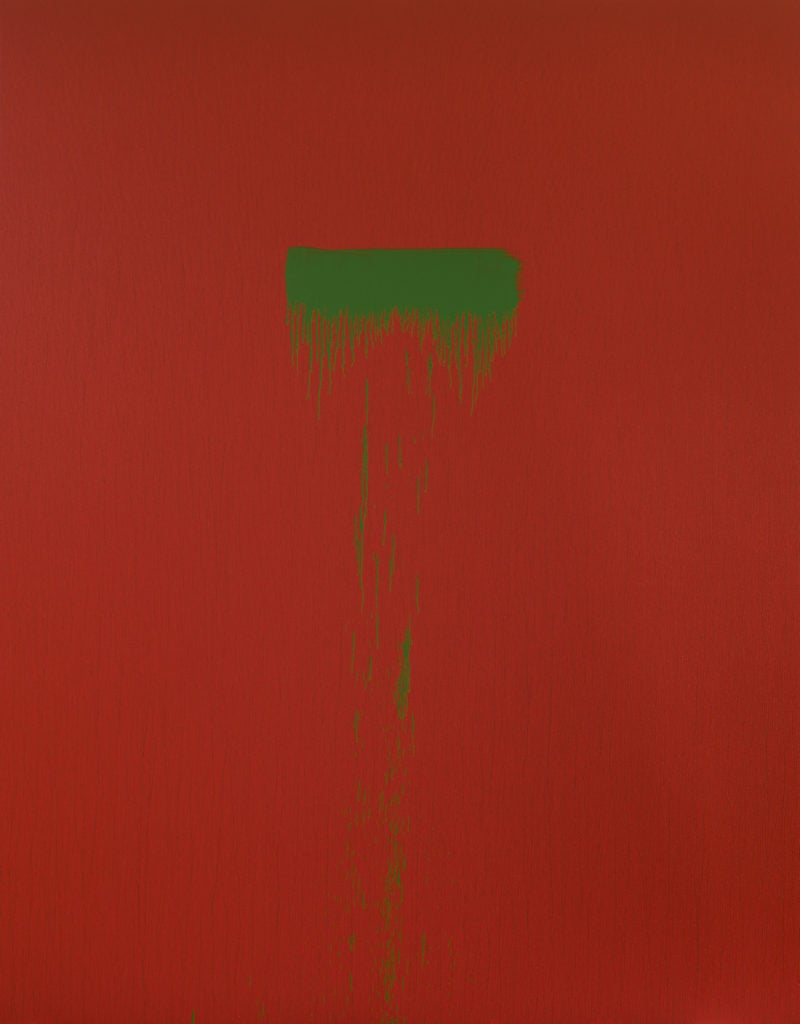
Pat Steir, Two (2018–19).
Courtesy of Pat Steir and Lévy Gorvy. Photo: Alex Munro.
As the story goes, Kiki, you wrote to Pat after seeing her on
the cover of ARTnews.
Kiki Smith: In that
article, she said she had become something that was
“unimaginable”—an artist. That still makes me cry. Even for me,
coming from an art background, [that line] gave me such a sense of
possibility and hope for my own life. It wasn’t like I had an idea
of what I could become, but I liked that I could become
something unimaginable. So I wrote her a postcard.
Pat Steir: The postcard
said, “If you could survive, it means I can, too.”
KS: I remember as a kid I
thought maybe, as a woman, you could be the subject of an
artwork—you could be a model or something like that. But I never
thought that I could do it myself, even though I liked making
things. But Pat and many women of her generation were such strong
evidence. Her generation made it very possible for women of my
generation to embrace the idea that they could be artists. Also,
Pat was working at a scale that most artists—men or women—weren’t
working at.
PS: I had gotten to the
age when you say “no” to normal.
KS: I never made anything
bigger than a breadbox for most of my life. But Pat, you made these
enormous conglomerations. There was an undeniable scale and
presence in your work. And you were so free, playing with different
styles and art historical languages, not being stopped by all the
conventions of the time. I remember when I came to New York in the
late ’70s, the artists who showed in galleries all made the exact
same thing, practically. And people would always ask me, “when are
you going to make that?” The galleries would come and they would
look at my work and say, “But Kiki, are you going to be doing this
next year?” I thought, “I don’t know.” Pat was utilizing all the
different languages that were available.
PS: Well, I thought that
since I was doing something that nobody could imagine I could do, I
could do anything. I had the freedom of not being imaginable. I
could wander around in my own field of preferences and desires,
really. I didn’t have to stick to a program.
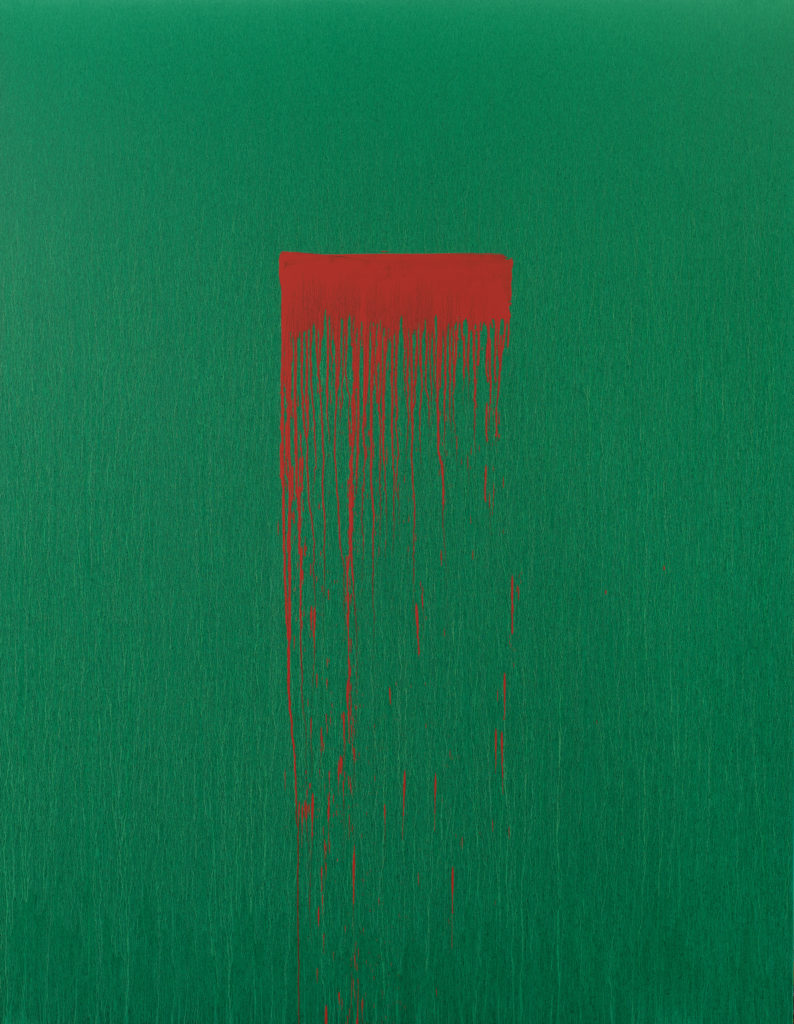
Pat Steir, Thirteen (2018–19).
Courtesy of Pat Steir and Lévy Gorvy. Photo: Alex Munro.
KS: Also, it wasn’t like I
was writing postcards to artists all the time! [Laughs] First, I’m
shy, and second I’m lazy. It was the only postcard I ever wrote,
practically. Another person could have written a letter, but a
postcard is about as much as I could muster.
PS: And here’s the
coincidence. Growing up, my family lived in Livingston, New Jersey,
off South Orange Avenue. And down that same road is where Kiki and
her family lived. My father went to art school but didn’t pursue
art—which is good, because he wasn’t a good artist. [Laughs] He
would point down the road to Kiki’s father’s house and go, “That
man [sculptor Tony Smith] is a great artist. I’m not an artist,
that man is an artist.” But we didn’t know each other then. We
didn’t meet until later, after Kiki sent me the postcard. And I
just fell in love with Kiki’s work and Kiki. Eventually I grew
close with her whole family. When her mother Jane Smith was alive,
she and Kiki and her sister, Seton, organized Sunday dinners, which
I always went to.
KS: My mother died in
2005, so this was a few years before that. We had started making
dinner every Sunday night at my mother’s house, because she lived
around the corner from Pat. She couldn’t go out so much—she was in
her late eighties. And then Pat and Joost [Elffers, Steir’s
husband] said okay, they would come. They are very good cooks. So
for three years we’d make dinner every Sunday night that we were
there.
PS: It became a thing.
Sometimes it was really a lot of people, like nine or ten
people.
KS: It was non-negotiable.
It’s just what you did on Sunday night. But Pat was already like
that. Pat has always been responsible for throwing parties, hosting
on holidays, getting people together.
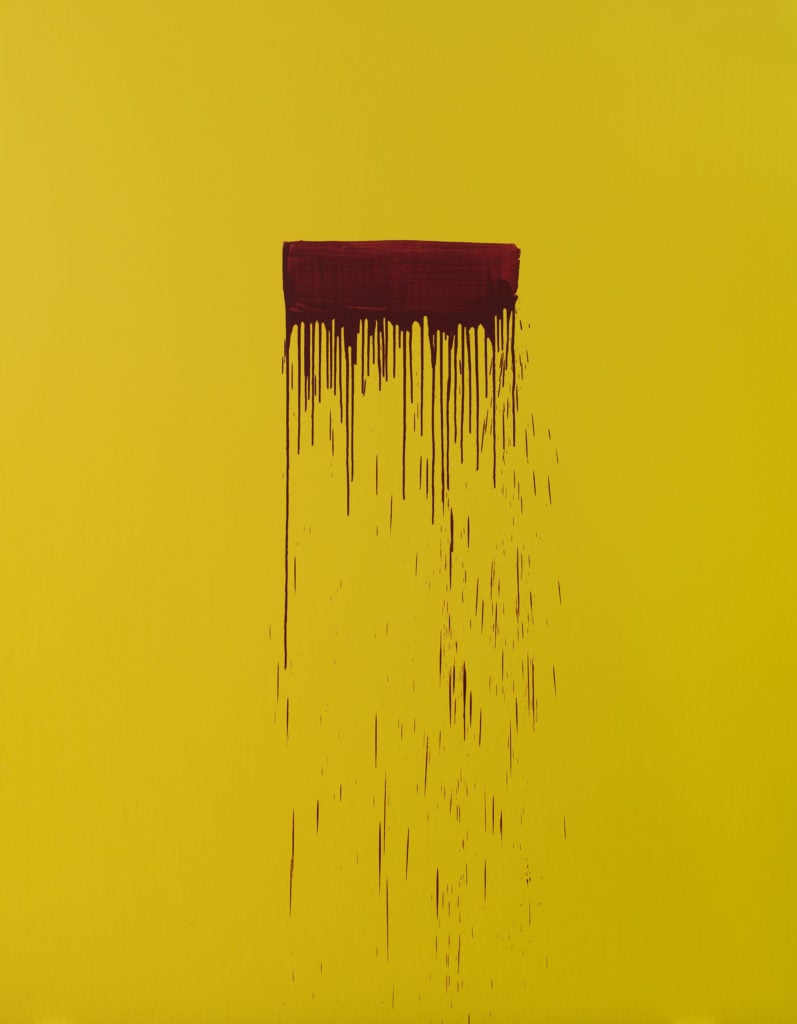
Pat Steir, Seven (2018–19).
Courtesy of Pat Steir and Lévy Gorvy. Photo: Alex Munro.
Pat’s parties are famous in the art world. Can you tell me
about them?
PS: For years, we did
Christmas and Easter and Thanksgiving. We did a lot. People brought
food and we cooked too. Kiki, being a vegetarian, was always
responsible for roasting a lamb. So many people would come, such as
Anne Waldman and her husband, Ed Bowes.
KS: Yes, and Betty and
George Woodman.
PS: Herbert Muschamp.
Lynne Tillman.
KS: Linda Yablonsky was
often there and the Rowers—Mary Rower and Sandy
Rower.
PS: And Joan Jonas. John
Yao and his wife. The Tuttles. Carol and Eva
LeWitt.
KS: Everybody had a good
time. They have an incredibly beautiful house. Everything is
perfect in it, and Joost and Pat are really good cooks. People
would sit down on their beautiful Frank Gehry tables and really get
to know each other. Pat is a person who’s always done this. She and
Joost invited people into their hearts, and people felt that. And
it was all different kinds of people.
PS: We didn’t have a
crowd. Some people in the art world stick to their crowd, their
people. We didn’t have that and still don’t. We just have
friends.

The Hirshhorn Museum’s Sculpture Garden.
Courtesy of Wikimedia Commons.
What about in the studio? In what ways have your respective
practices been influenced by each other’s work?
KS: I don’t know if it
has, particularly. Though I come over here and go, “Whew, I got to
go home and get to work!” I’ve made three things the size of a
shoe-box all summer and she’s made about 30 paintings that are all
17-feet tall. [Laughs]
PS: Kiki exaggerates on
the low end. She just had three major museum shows. And when I see
all the pictures of her show, I say, “Wow, when did you do all this
work?”
KS: We’re both workers.
You can say that. It doesn’t matter if you’re an artist or not. You
don’t get from one place to another without working. Some people
can make enormous jumps, they don’t have to make all the little
steps. But Pat’s a worker and I’m a worker. It’s just our
personalities.
PS: I still come to the
studio every day. There’s no room to do anything else. I have a
studio downstairs where people are stretching canvases for me now,
because I have two shows coming up after the Hirshhorn.
KS: The scale Pat works
at—there were very few women historically who made things at such a
scale. It’s not that the size matters so much. Artists work to the
scale that’s appropriate for their work. That’s something one knows
internally. But still, Pat working at that size made a difference
in the community.
PS: I’m making landscapes,
not landscape paintings. Landscapes. They’re bigger than my niece’s
apartment—isn’t that incredible? [Laughs]
KS: Because my father made
very big, all-black sculptures, I didn’t make anything big or black
until I was in my forties or fifties. It was like, “That’s my
father’s territory” or something. It takes a lot out of you though.
Pat’s work takes a great deal of tenacity and physical stamina and
energy to do.
PS: I never made work to
be recognized or to become famous. I make art because I have to
make art. Of course I want to make something touching and
beautiful, but more than anything, I just want to
make
something. I don’t do it
for any purpose more than making it. And so it gives me leeway to
make it something more than just a beautiful object. I think that’s
true of Kiki’s work, too. Kiki can touch a dust bunny and make it
become magic.
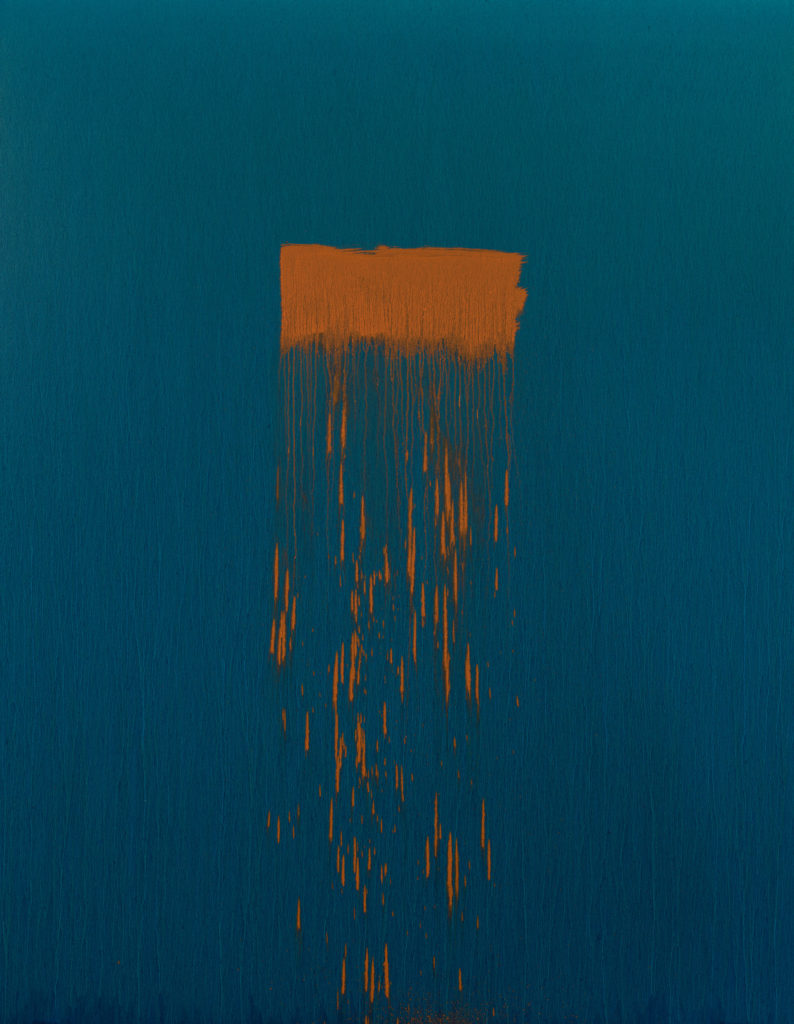
Pat Steir, Twenty (2018–19).
Courtesy of Pat Steir and Lévy Gorvy. Photo: Alex Munro.
Pat, when Kiki first reached out to you, her career was just
beginning in many ways. What’s it been like to see her work evolve
so significantly since then?
PS: Kiki’s work has always
been intimate, no matter what the scale—her big work is intimate,
too. But there are some things that just pulsate. She has a little
tiny sculpture of a man and a woman who are having sex. It’s so
personal that I hate to look at it. I feel like a peeping
tom.
KS: I’m embarrassed by it,
too. I felt like, “Oh, they’re going to think I’m thinking about
sex.” [Laughs]
PS: Her work has always
had that feeling. Even from the beginning, from the early embryo
drawings.
KS: That would have been
in the late ’80s, around the time I had my first one-person show in
’88. The first year I
had a show and the first year Seton had a show was the year our
other sister died. Pat had a sister die too. And she cared for her
niece after her sister’s death, and my sister also had a child that
we had to care for. People don’t talk about the significance of
their families that much in the art world. That was something that
I saw in Pat—the care and the kind of spirituality in her attention
to others. It’s very significant to me.
PS: My parents died young.
Of natural causes, but young. And my brother moved to New Zealand,
so in a way my sister was the only family that I had.
KS: I’m the oldest in my
family now. It’s strange, your parents die and you’re kind of just
out there floating. It’s not that reassuring in life to think that
you’re the top of the food chain, because you know what a nitwit
you are.
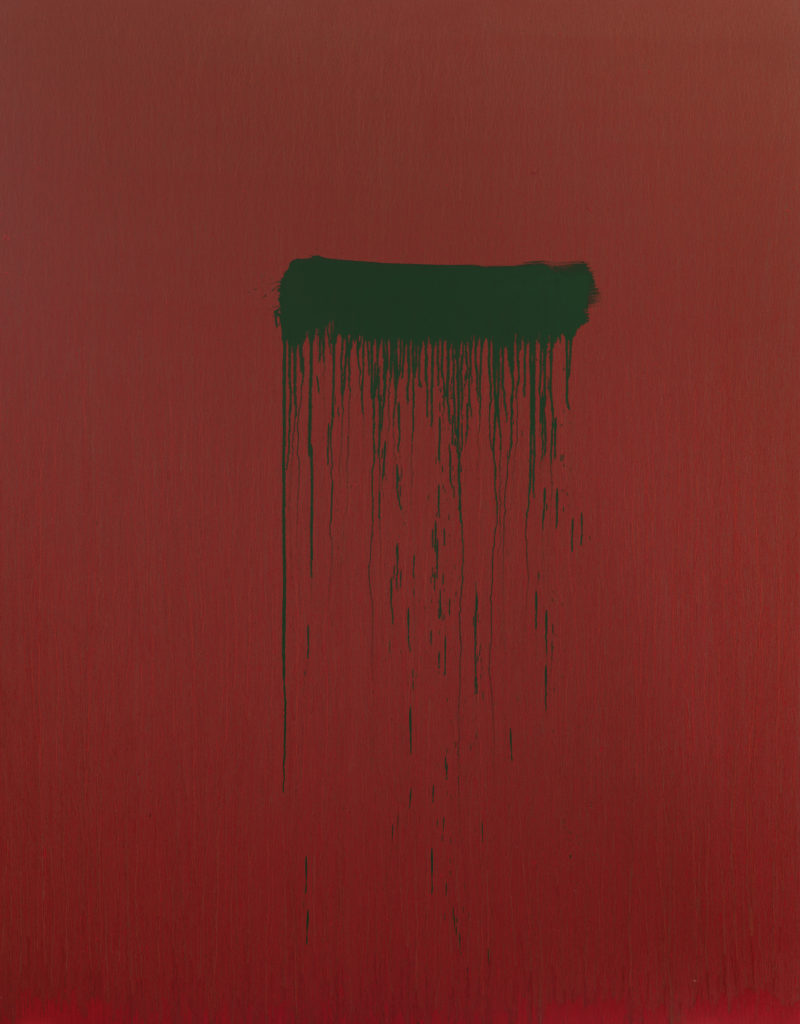
Pat Steir, One (2018–19).
Courtesy of Pat Steir and Lévy Gorvy. Photo: Alex Munro.
Being both friends and fans of each other’s work, how do you
see the other’s personality coming through in their art?
KS: Pat’s work is made in
the present. I can’t say that it influences me in any discernible
way that I can see, but I think that’s important. It’s not about
having a fixed notion or manipulating and squishing things into a
predetermined form, making things subservient. It’s about creating
a situation and then allowing something to happen in that
situation. It has a vitality because of that.
PS: I think Kiki’s work is
magical. She’s the best Snow White witch you could find. She’s not
a dark witch. She’s a light witch. And what she touches becomes
magic. She’s been doing these tapestries. It’s hard to make
tapestries magical, maybe almost impossible. Hers are
magical.
I think the same thing was true
for Agnes Martin and the magic of art. Agnes made straight lines.
We can see straight lines anywhere, and yet when Agnes makes a
straight line, I will get it. I burst into tears before I
think about anything. I’m so incredibly moved and
touched by it. And that’s what’s mysterious about art. How can that
happen? One straight line is math and another is magic. One drawing
of a foot is a drawing of a foot, and the other is a drawing of a
foot by Kiki, and so it gets to be magic.
KS: Pat has also
championed and supported so many artists and has lived with many
artists’ work. I mean, you can go into artists’ houses and they
have nothing but their own work or they have no work at all. You go
into her house and it’s this really vibrant history of friendship
and appreciation of other people’s work. It’s not easy to have the
space inside of yourself to fit in other people’s work; many
artists don’t. Pat does.
The post As a Young Artist, Kiki Smith Wrote a Fan Letter to
Pat Steir. 30 Years Later, They Reflect on Their Enduring
Friendship and How They Inspire Each Other appeared first on
artnet News.
Read more https://news.artnet.com/art-world/kiki-smith-pat-steir-1682749
Further reading


Leave a comment