
A Museum Planned to Show Dozens of Newly Discovered Nazi-Era Artifacts in an Exhibition. The Problem Is, Most of Them Are Fake
Just last week, the Buenos Aires Holocaust Museum was
planning to open a sensational exhibition on December 1
including a major trove of Nazi artifacts.
The group of 72 objects, which had been seized from an
Argentinian collector in 2017, made worldwide headlines earlier
this month when it was officially handed over to the museum
by Argentinian police. Included in the hoard—the largest ever
discovered in South America, and valued at a reported $34
million—were several busts of Hitler, a Nazi-decorated ouija
board, and medical tools such as a device for measuring the
circumference of skulls. The media had dubbed the hoard
“Hitler’s Silver Treasure.”
But last week, the museum received a damning report authored by
a international delegation of experts declaring the vast
majority of the trove to be fakes produced after 1945. Among the
telltale signs were various misspellings on artifacts, inscriptions
naming fake company, and unverifiable locations from where the
objects supposedly came. According to the report, only 10 of the
objects are authentic, and 62 others were deemed counterfeit. While
several objects do indeed date to the Nazi era, a large portion of
the forged works were embellished with insignia to connect them
with the Nazi party after the end of the war.
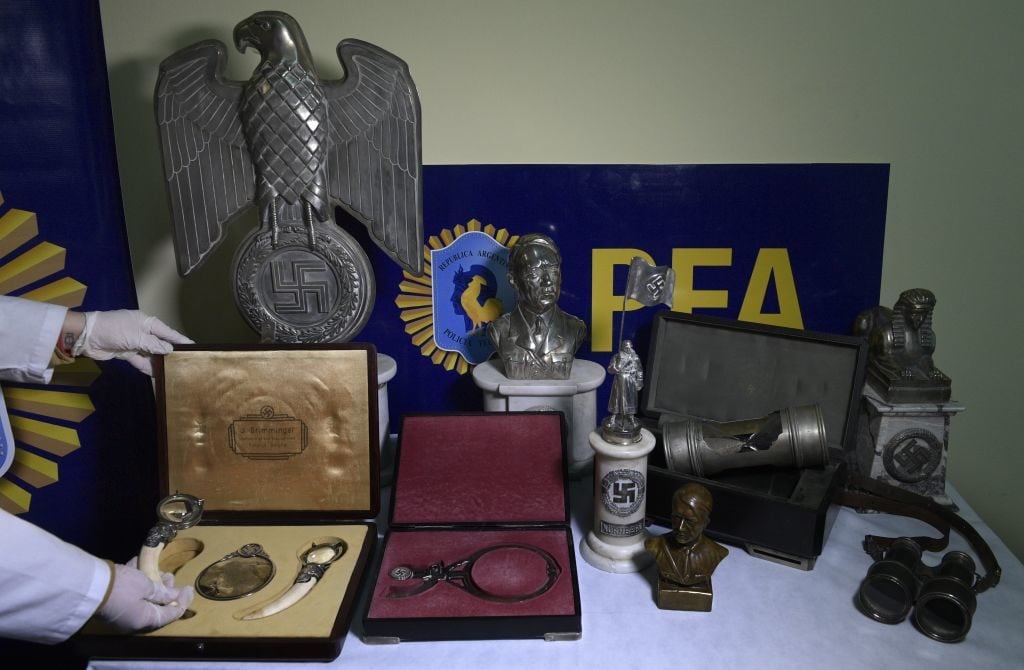
Argentinian authorities show the
artifacts seized in 2017. Photo: Juan Mabromata/AFP/Getty
Images.
The delegation of 32 European experts who examined the artifacts
included representatives from the German History Museum, the
National Police of the Netherlands, and Berlin’s Topography of
Terror, among other institutions.
One member of the group, Stefan Klingen from the Central
Institute for Art History in Munich, told artnet News that there
were some blatant details that tipped the group off about the
trove. While many of the objects do date to the 1930s, the
swastikas, engravings, and other supposedly wartime inscriptions
were not affixed until after 1945. “The medical instruments do not
originate from the Nazi period, but are older and were subsequently
provided with [Nazi] symbols and false company names,” he told
artnet News.
Speaking of one inscription on an object, Klingen
says: “The ‘Amt für Rassenpolitik’ [Department of Race
Politics] never existed in this spelling. The correct spelling must
be ‘Rassenpolitisches Amt der NSDAP.’”
Reached by artnet News, the Buenos Aires Holocaust Museum
confirmed that the fake works and those that were adulterated in
the post-war period would not go on display.
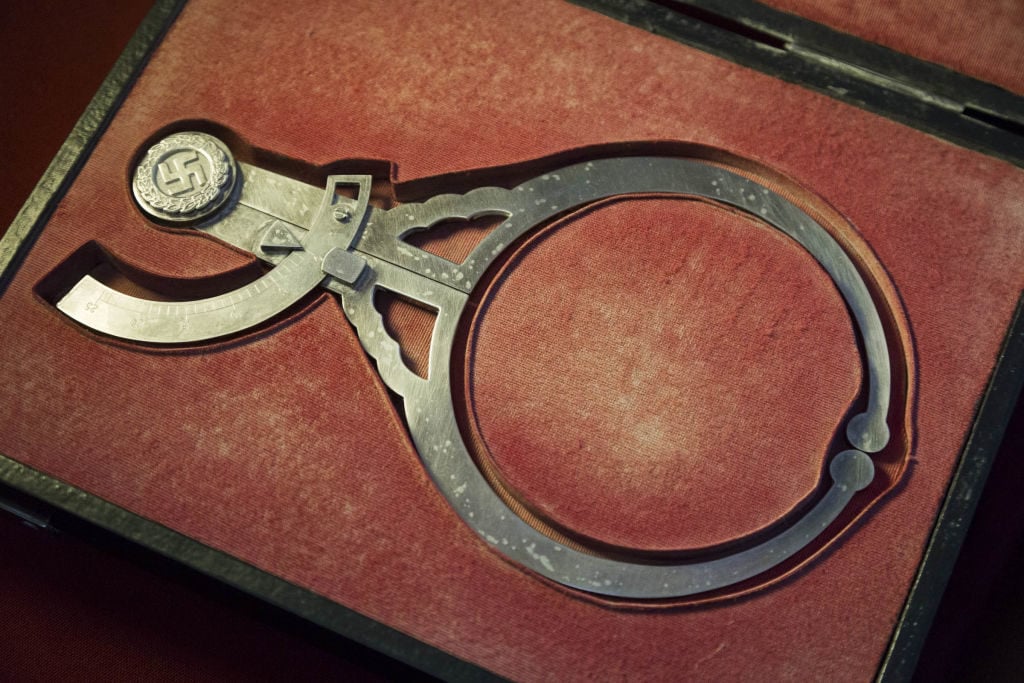
A device for the measurement of skulls
at Interpol offices in Buenos Aires, Argentina. Photo: Andres Perez
Moreno/dpa/picture alliance via Getty Images.
In the report, which was obtained by artnet News, the authors
suggest that the objects could be returned to Germany. They note
that the Military History Museum in Dresden, the Zeppelin
Museum in Friedrichshafen, and the State Museum in Schwäbisch Gmünd
have already expressed interest in objects from the trove. The
museum told artnet News that it is considering the suggestion.
The artifacts were seized during a series of raids in the
wealthy outskirts of Buenos Aires, where collector and
antiques dealer Carlos Olivares had hidden them. According to
the Australian,
Olivares purchased the items over 20 years ago, believing them to
be copies. He faces up to three years in prison if convicted
of violating cultural heritage protection laws. Argentina has
the largest Jewish population in South America.
“The historical significance of these objects is low,” Klingen
said, adding: “Overall, one must assume that the objects were
created for a thriving market in South America.”
The post A Museum Planned to Show Dozens of Newly Discovered
Nazi-Era Artifacts in an Exhibition. The Problem Is, Most of Them
Are Fake appeared first on artnet News.
Read more https://news.artnet.com/art-world/argentina-nazi-fakes-1691662
Further reading


Leave a comment