
Just in Time for Trump’s Impeachment, the Watergate Is Back in the Spotlight—as a Place to Show Contemporary Art
There’s a prevailing notion that Washington, DC, is a
one-industry town beset with bloodthirsty lobbyists, ambitious
Capitol Hill aides, White House employees cashing fat checks and
walking through a revolving professional door, and cutthroat
Supreme Court clerks fresh from Harvard Law—and that’s just during
a normal administration. I grew up in the area, and I can tell you
that such a reputation is… well, it’s basically correct! And yet,
it has a history of producing artists of true genius, such as
Morris Louis (born in DC in 1912), who alongside fellow Washington
resident Kenneth Noland pioneered the Washington Color School. More
recently, the artist from the city who’s had perhaps the most
outsize influence on a new crop of artists is Kenneth Noland’s
daughter, Cady, who was born in Washington in 1956. And now,
decades after Noland stopped making work (she’s long maintained a
Pynchon-level disappearing act and is said to be holed up in a
fifth-floor one-bedroom apartment west of the Flatiron District in
New York), her work returns to DC for a show in a location that
fits her obsession with the conspiracy theories and political
malfeasance: The Watergate Complex, the iconic half-circle
riverside series of apartment buildings where a break-in brought
down a president, and where prominent swamp-dwellers such as Karl
Rove, Bob Dole, and Alan Greenspan all lived at one point or
another.
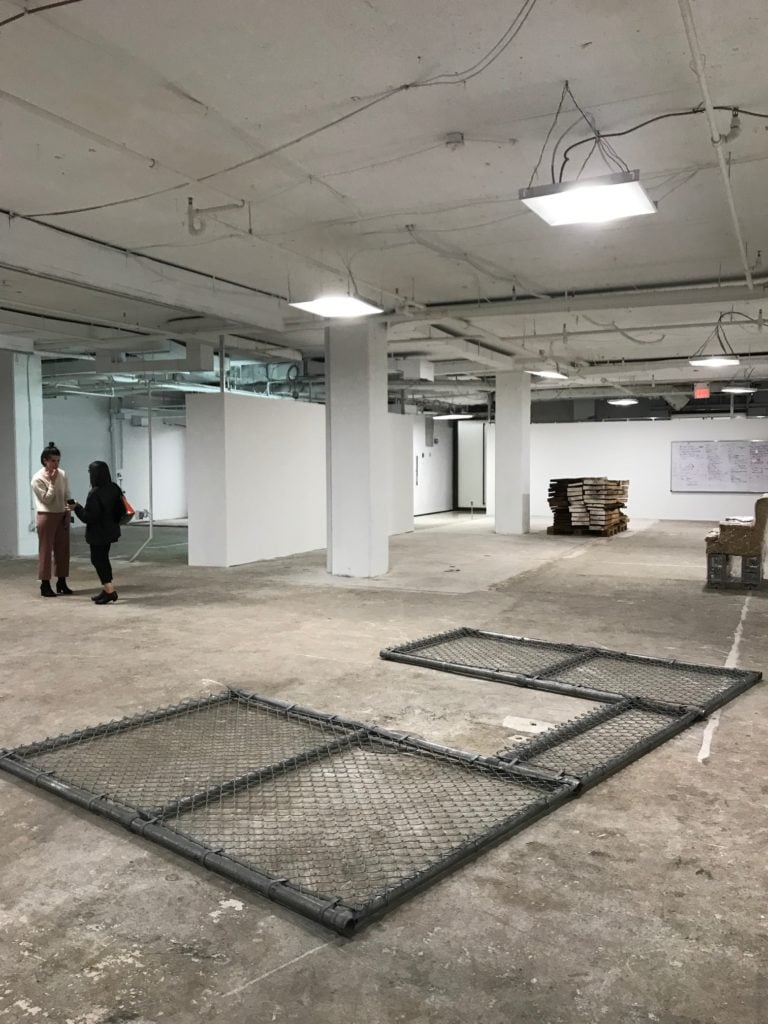
Works by Cady Noland, Dahn Vo, and
Sondra Perry in the exhibition.
The two works by Noland are in a show organized by Tribeca’s
Bortolami Gallery as part of its Artist/City project, wherein an
artist is invited to make use of an underappreciated aspect of
one non-New York city. Previous iterations have handed the reins to
artists on the Bortolami roster, but for this edition, gallery
founder Stefania Bortolami wanted to work with artist Paul
Pfeiffer, who instead of accessing his own works decided to curate
a group show with artists he had long admired. Titled “Exodus,” the
show relies on work by Noland as well as Josh Kline, Cameron
Rowland, Sondra Perry, Lorraine O’Grady, Dahn Vo, Eric N. Mack,
Renee Green, Arthur Jafa, and Lutz Bacher. In a press release,
Pfeiffer explained that he wants the show to comment in a broad
sense on migration—physical migration on land, but also the
migration of a readymade from object to artwork. If the timing
seems almost too on-the-nose—a deeply political show in the
nation’s capital, in the heart of the Watergate, as President Trump
faces an impeachment threat, and with the Washington Nationals
playing the first World Series in DC since the 1930s—it’s
interesting to hear that the exhibition has been in the works for
years. “The list of artists has been formed for a long time,”
explained Emma Fernberger, who is the Artist/City director at
Bortolami. “But the political moment that we’re living in, as time
has gone on and this conversation has progressed, it seemed more
and more urgent.”
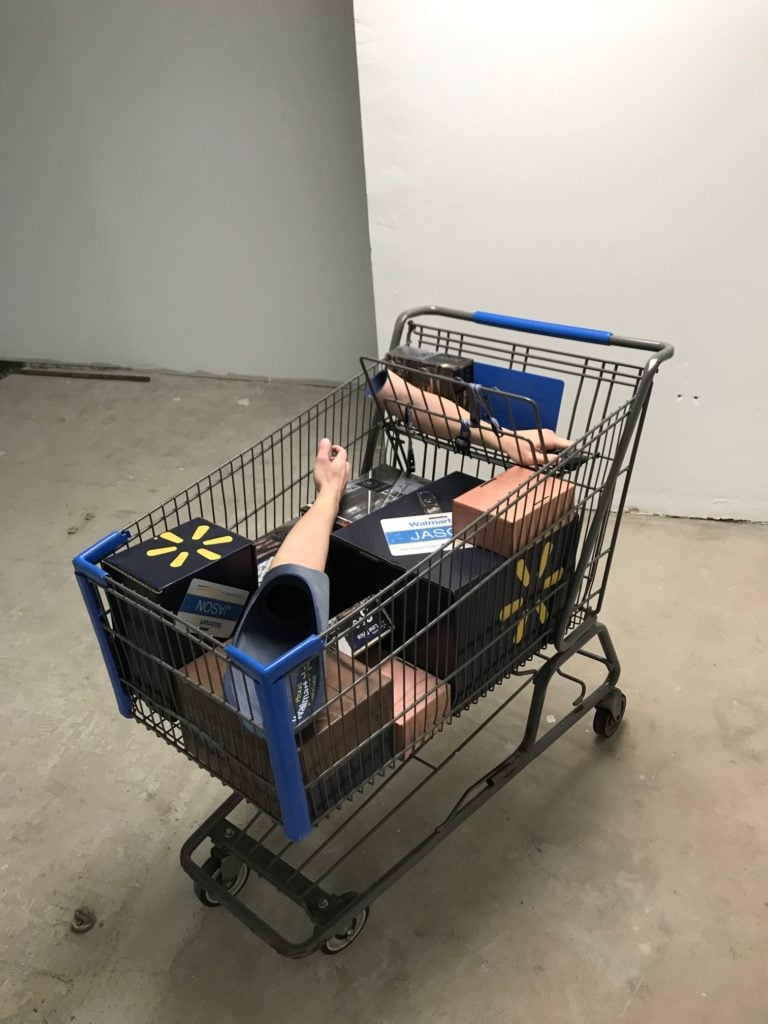
A work by Josh Kline.
We were speaking last Sunday morning in the Watergate space, the
day after the evening opening. It had been an eventful night. In
addition to Bortolami hosting a lovely toast-filled dinner nearby,
the Nats got drubbed by Astros just over three miles away by the
Anacostia River, and Trump watched from the White House situation
room (or from the back of a golf cart leaving his country club
across the Potomac, according to a pool report) as American
commandos killed ISIS leader Abu Bakr al-Baghdadi. Fernberger
explained that the gallery space had once been a PNC Bank branch
with a metal vault (it’s still intact), and as I walked around, the
familiar scene of Foggy Bottom peeking out in the background (my
late grandmother had lived in the Watergate) took on an eerie
quality in a building so associated with abuse of executive power.
It turns out to be an unexpectedly great space to show art, hinting
at a potential art-centric future for the centrally located,
globally iconic Watergate. Could its spiffy Watergate Hotel—which
opened within the complex in 2016 with the self-aware slogan “no
need to break in”—be the choice venue for a Washington DC art fair,
in the vein of new suite-based expos such as Felix LA and the NADA
Chicago Invitational? Either way, “Exodus” will be a hard act to
follow. The show ended up in the Watergate instead of in Atlanta,
where it was originally going to be, because of a random connection
to the curator Owen Duffy, whose brother was a former property
manager of the Watergate space. After finding out there was a
vacant space available, Duffy got in touch with Bortolami Gallery
about the possibility of a DC Artist/City. “It was too good an
opportunity to pass up,” Fernberger said. “We pretty quickly came
down here with Paul and he was like, ‘Oh my god, this is
incredible.’ And it fit thematically with what we were already
envisioning. It was kismet.”
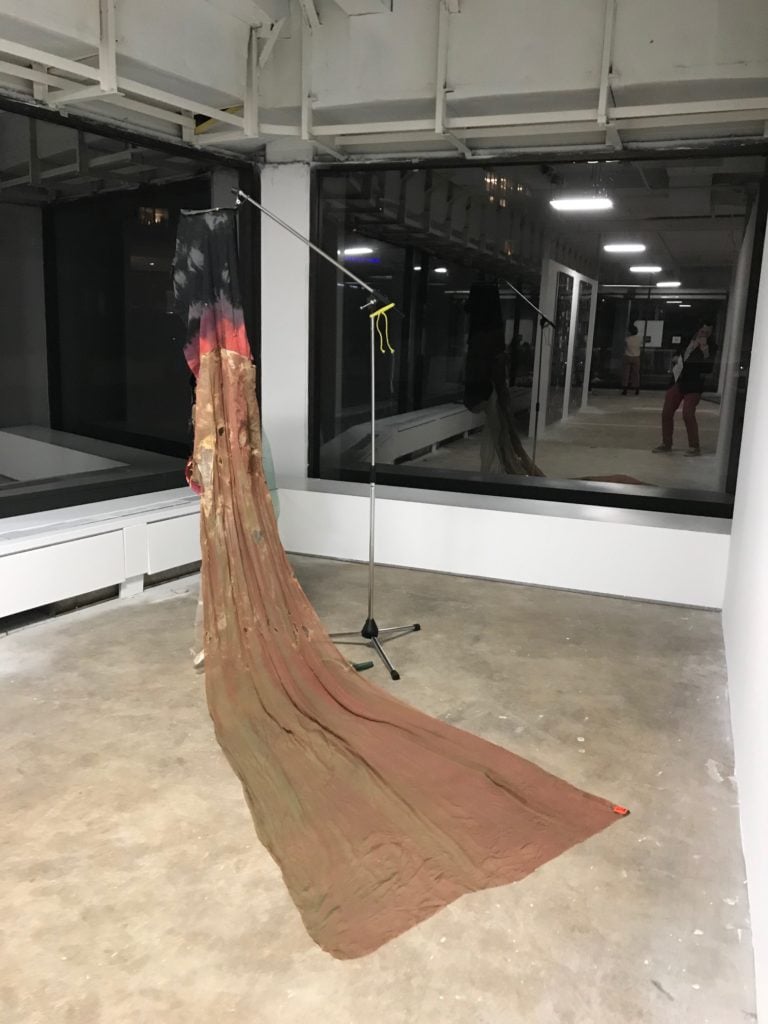
A work by Eric N. Mack.
The exhibition is a gorgeous, brawny critique of our nationalist
fervor, staged in the heart of a government center that’s been
infected by it, with top-notch examples from some of the most
exciting artists alive (though, sadly, Bacher died in May, as the
show was being finalized). Noland’s chain-link fence
sculpture, Institutional Field (1991), was
recently shown at her acclaimed retrospective at the Museum für
Moderne Kunst, but it gains a new power here at the Watergate,
blocks away from the White House, where policies are being drawn up
that rip children from their parents at fences that exist across so
much of the country. Elsewhere in the show, Kline’s video
Crying Games / Financial District Display 65” (2015) makes
reference to one former Watergate resident, former Secretary of
State Condoleezza Rice, and two of Vo’s works explicitly reference
another: Robert McNamara, the Vietnam War architect who died in his
sleep in his Watergate apartment in 2009. One Vo work, Walnut
Lumber (2019), is a pallet of wood taken from orchards
owned and maintained by Craig McNamanra, Robert’s son, who invited
Vo to visit after hearing of his fixation with his father. One
aspect of that fixation is Vo’s habit of buying McNamara
memorabilia in online auctions, and the other work in the show,
Lot 19 Test Ban Treaty Signing Pen, 5 August 1963
(2013) is the tip of the pen used by McNamara to sign the Test Ban
Treaty—an object that was sold at Sotheby’s. Bacher’s
Whiteboard (2018) makes references to the Tet Offensive
and the Mai Lai Massacre amid a bunch of semi-inscrutable
doodlings. There are also photo collages by Arthur Jafa and a
series of photographs by Lorraine O’Grady that show a performance
from 1982 that took place in Central Park, and an elegant draped
fabric work by Eric N. Mack that’s installed on a stand, catching
the curved shadows that come off the S-shaped building as the sun
goes down.
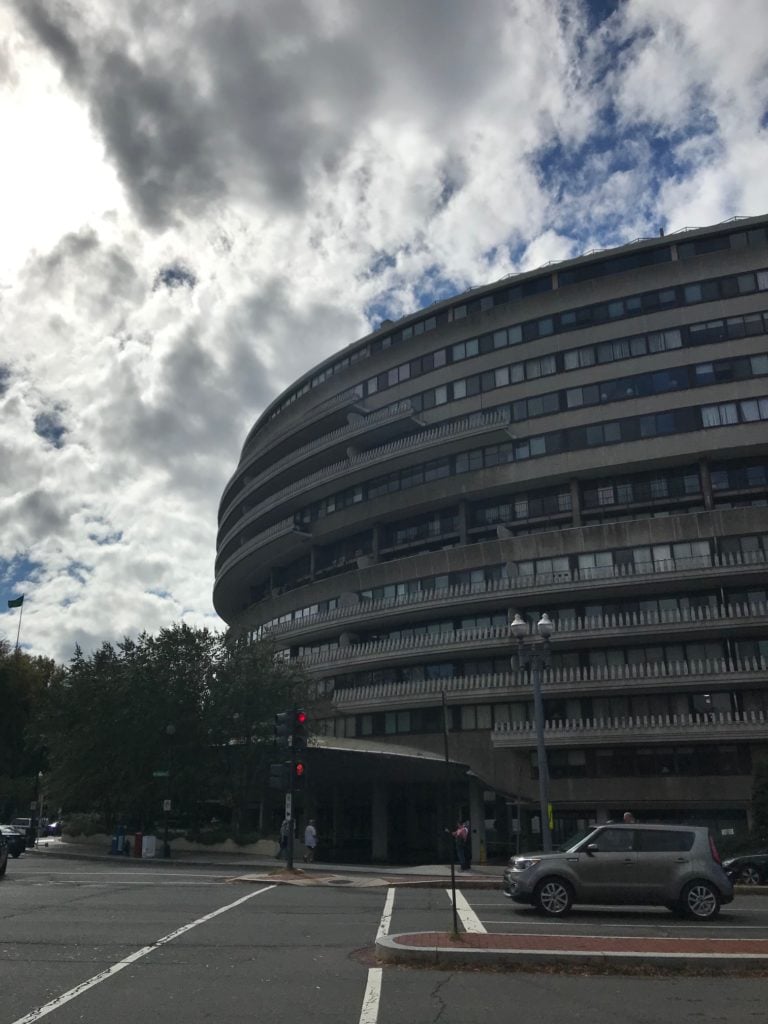
The Watergate from across the
street.
Bortolami told me that the show would hopefully draw in
government workers and other big shots in politics who might not
have time to make contemporary art a regular part of their cultural
consumption—even if the local gallery scene has been beefed up by
arrivals such as the Georgetown space started by former Team
gallery director Todd von Ammon. And Fernberger reached out to some
of the more well-known policy makers in the area as well. “I wanted
AOC to come, and the squad—I really wanted the squad to come,” she
said. “The idea of exodus deals with immigration, and that’s a
pressing issue that these politicians are addressing the best they
can.” And it’s a distinct possibility that Foggy Bottom’s most
prominent tenant—the State Department—will at least notice
that there’s something unusual going on in the old bank space as
they run out to grab sandwiches at the deli downstairs or cocktails
at the swanky hotel bar. It would be hard for them to miss it. But
one visitor that Fernberger is not counting on is Cady Noland.
Though the artist sometimes comes to personally install works at
shows via an arrangement where someone leaves her the keys and lets
her install in complete solitude, in this case, she was sent emails
asking whether the works were installed correctly, and responded
with small requests, indicating that one work had to be flipped,
and another needed to be moved a few inches. The famous recluse may
not be coming back to the city where she was born, but apparently
she’s a very prompt emailer.
The post Just in Time for Trump’s Impeachment, the Watergate
Is Back in the Spotlight—as a Place to Show Contemporary Art
appeared first on artnet News.
Read more https://news.artnet.com/exhibitions/watergate-exhibition-1692445
Further reading


Leave a comment