
‘It Needs to Be More Than Just a Surface-Level Effort’: Dealer Tina Kim on the Rise of Women Artists in 2019, and What Must Happen Next
The art dealer Tina Kim opened
her Chelsea gallery in 2001 with a mission to provide exposure to
lesser-known international artists, particularly those from her
native Korea.
Over the years, Kim has
established her space as a go-to destination for Korean
contemporary and historical art, which she showcases through
illuminating exhibitions that bring to life the country’s storied
cultural history. Earlier this fall, for example, Kim organized a
well-attended show of work by Suh
Seung-Won, an unsung painter who helped to pioneer the
Modernist movement in Korea by encouraging his contemporaries to
look inward and draw inspiration from their own traditions instead
of turning to the Western art world for guidance. In addition, Kim
has also given a platform to important emerging and renowned women
artists, such as Minouk Lim, Wook-Kyung Choi, and Suki Seokyeong
Kang.
After a whirlwind year in the
art world where much of the conversation centered around the need
to provide more exposure to women artists from around the globe,
Artnet News sat down with Kim to discuss her thoughts on everything
that transpired this year, and how she feels artists will fare in
2020.
What were the big art-world trends in
2019? And do you see those same trends carrying over into the new
year?
There was certainly interest in
revisiting the history of female artists, particularly 1960s
American artists in California and across the country. There were a
lot of exciting shows that I saw within that vein.
I think in 2020 there will be a
more international approach. I am personally interested in learning
more about which Asian American artists were missed in the history
of art. I think that’ll probably be the next big thing in New
York. I am especially
curious about the generation of artists who arrived here in the
’60s. A lot of them received Rockefeller grants, like the artist
I’m showing now, Kim
Tschang-Yeul.
Through that research, I learned
what an important role those grants played in inviting
international artists, particularly Asians, to show in New York.
The grant allowed them to meet
other artists, take courses at the Art Students League, and travel
throughout America. I’m
learning that there were a number of strong female artists who were
invited, and I’m looking into that more. I have been bouncing ideas off
of different curators.
Looking ahead to exhibitions on the docket for 2020,
what are you most excited about?
I am looking forward to the the
first Asian Art Triennial, which is being organized by the Asia
Society. It will open here in New York in June. There has never
been anything quite like it, so I’m very excited.
At the Mori Art Museum in Japan, they are organizing
a historical exhibition of living female artists who were born
before 1940. There are many institutions internationally who are
interested in looking at female artists from that generation. For
instance, the Pompidou is organizing an all-female
abstract-painting exhibition. There is certainly going to be a lot
of rediscovery next year!
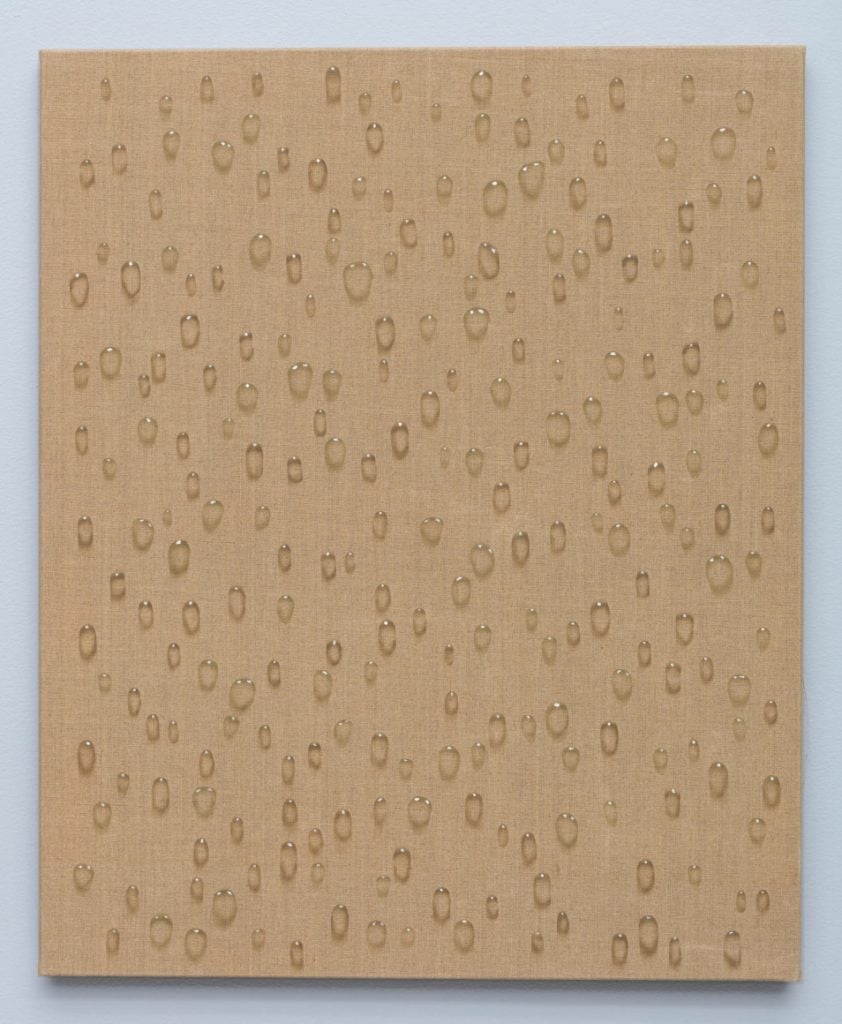
Kim Tschang-Yeul, Water drops
(1973). Image courtesy Tina Kim Gallery.
And how do you see that playing out in the market over
the next year?
I think it’ll inspire art
dealers to become more curious about those artists. It might take
some time for the market to have the confidence to really acquire
their work, but the institutions who are supporting these broader
exhibitions will certainly help to bolster that confidence. In
terms of the quality of work, there is no question that a lot of these
artists’ work is undervalued. Frankly, it speaks for
itself.
Artists don’t have to be young
to be cool. You can look at certain periods and
investigate—there is so much
that we’ve missed. Back in the ’60s, the opportunities were very limited,
especially if you were not a
male Caucasian artist. There were only a few galleries and a few
museums. There’s so much that wasn’t shown. The
collectors who have sophisticated taste and the knowledge will
recognize that, so I think it’s really only a matter of time before
it catches up to the market.
Do you see any resistance to rediscovering older artists from
collectors? Are people still trophy-hunting for
the big names or do you think that’s starting to
shift?
I think it’s definitely
shifting. Some younger
artists’ works are overpriced. There’s huge speculation, and that
market, in my opinion, is not safe. That’s especially true when
compared to some of the historical artists who had long, strong
careers, even though their bodies of work have never
been on the market before. Their prices compared to these younger
artists who are getting so much hype now? I don’t need to tell any
experienced collector which one is a better purchase. One will stay
in the art history books, the other will maybe not exist in five
years. You see it happen all the time: prices escalate, they
get locked in at a point where the trade stops, and then people
don’t remember the artist.
I think it’s risky to push a
young artist’s price so early on. Even when they’re not so young,
in their 40s or 50s, they still have 40-plus more years of their
career. How can you continue to push an artist’s price so high for
the next 40 years? How much growth will you actually see? How is
that sustainable?
What can we expect from your gallery’s program next
year?
Two female artists I am
concentrating on at the moment are Minouk Lim and Wook-Kyung Choi.
Minouk Lim, who is from Korea, has already had a major exhibition at the Walker
Art Center [in Minneapolis], and has been shown at many
international venues, but she’s still building her career here. She
had a very fruitful residency at the Rauschenberg Residency down in
Florida. Since she started making those works in America, it makes
sense to show them for the first time here.
Wook-Kyung Choi, who is also
Korean, came to America in the ’60s. She was at the Cranbook
Academy in Michigan. And she lived here, too. She had a residency
at the Brooklyn Museum. I can’t imagine how strong she had to be
and how much will was required on her part to stay in America and
make it work here. She suffered from depression and her
career was very short. She passed away in the ’80s.
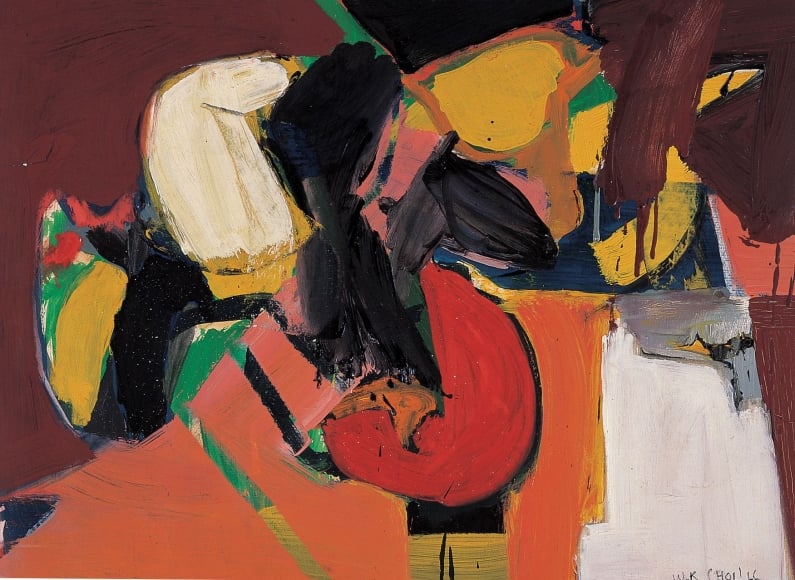
Wook-Kyung Choi, Untitled
(1966). Image courtesy Tina Kim Gallery.
While in New York, she experimented with different mediums,
specifically black-and-white ink works on paper and beautiful
abstract paintings. Everything she did is really striking—you see it and you’re
drawn to it. Whenever I show her work, people say it
looks very much like Lee Krasner and de Kooning. But that’s not
fair—you have to look at the influences that were going both ways,
because many American artists at the time were fascinated by Asian
culture. If you look at Jackson Pollock’s drip paintings, you
can see they were strongly influenced by calligraphy.
Do you think the museums will continue to
broaden our view of the art world beyond the accepted Western
canon?
It’s a really exciting moment. Many institutions are really
revisiting their collections and making them broader. They feel the
urgency to change so that it’s not such a dominant New York- and
European-centric view but more a global one. You cannot expect
everything to be centered around New York. A lot of things happened
in Asia. And even if the center was New York, those
artists who were here were looking abroad for inspiration.
Artnet News recently published a series of articles
about where women in the art world truly
stand today, and what we noticed is that the growth of women
artists’ share of the art market and representation in museums is
not as great as we might have thought. Do you think we’re making
enough progress, and do you see anything that’s holding us back
from achieving gender equality more quickly?
I definitely see that there’s
far fewer female artists represented in museums’ overall
collections. Many museums see the urgency to collect female artists
now. But not only should
they be thinking about adding work by female artists,
they need to collect in
depth and build out their scholarship. They can’t collect just one
work by this female artist, or one work by that female artist and
say, “We have five female artists’ work.” That won’t do. Placing one or two works in a museum is not
really going to help an artist’s career. It needs to be more than
just a surface-level effort.
Everybody is aware that change
needs to happen, but you cannot force a curator to work on something
that they didn’t study. For those who are already
working at the big institutions, this may not be their specialty.
They will do what they can, but how much is that, at the end of the
day? You cannot force change—it requires time.
The curators who are in school now have a more genuine
understanding of these issues. They see an opening to do research
papers or their PhDs on some of these subjects, which haven’t
really been covered. And when those young curators come into their
positions at the museums, I think change will happen. There are so
many talented young curators who are working today. We have a bright future.
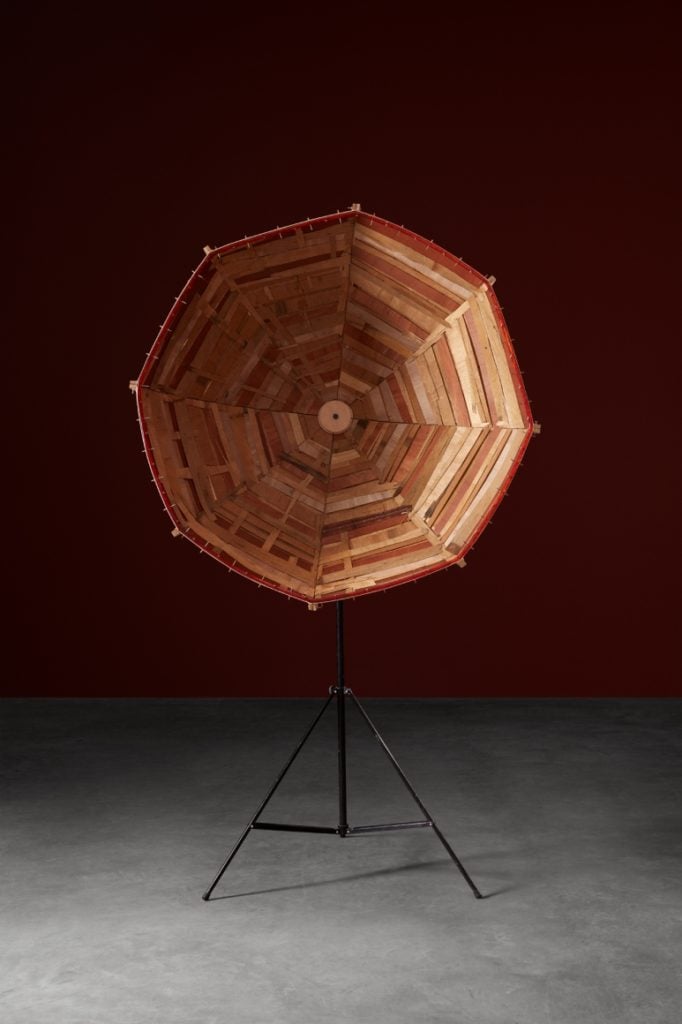
Minouk Lim, Parabolic Satellite
(2015). Photo courtesy Tina Kim Gallery.
Is equal representation of women something you think
about a lot in your own gallery?
For me, when I’m
working with an artist, I never think about them
as female or male. Gender is never really a question
for me. And maybe that’s an advantage that a female gallerist has.
Maybe it just comes more naturally. I don’t know why that
is.
I sometimes think, “Wow, I work with a lot of women artists,”
but it was never a specific intention to do so. When you don’t have that kind of prejudgment
and you just see, the balance is more natural. That’s just
what I believe.
The post ‘It Needs to Be More Than Just a Surface-Level Effort’:
Dealer Tina Kim on the Rise of Women Artists in 2019, and What Must
Happen Next appeared first on artnet News.
Read more https://news.artnet.com/art-world/tina-kim-1706511
Further reading


Leave a comment