
What One Mysterious, Easily Overlooked German Painting Taught Me About How to Visit a Museum in the Age of Blockbusters
This is an essay on what it means to visit a museum, or, better,
what it means to write about visiting a museum.
Recently I was in Vienna to give a talk, and I did what visitors
do in Vienna, whether they care for art or not: visit the
Kunsthistorisches Museum. It is one of the world’s most celebrated
collections of art, a relic of the Hapsburg monarchy’s rapacious
splendor, massive and full of numinous paintings presented in a
stately manner.
I waited in a long line for a ticket, in a downpour, then
climbed the grand staircase and finally arrived at the European
painting galleries, with their twilight lighting. I dutifully
followed the itinerary laid out in the museum brochure, bobbing
between the highlights: Bruegel’s earthy, gnomic Tower of
Babel; the urbane bombast of Rubens’s The Miracles of
Saint Loyola; the trapped-in-amber tranquility of Vermeer’s
The Art of Painting.
I try to not only follow the itinerary, however, and at any
rate, it was not any of the famous paintings that seized me with
the most force. Instead it was a small painting of a weather-beaten
old man in a felt cap, hung in Gallery XII, close to the door that
takes you to the Vermeer and therefore often passed over on
visitors’ way to it.
There is a sort of method I follow when it comes to navigating
museums. The highlights are usually the highlights for a reason, so
you should see them. But I also find that art history is always
subtly changing as I change, different parts of it becoming
activated or losing force. To pay some attention to this personal
dimension—and to avoid the ticking-the-box, photo-opportunity type
of visit that contemporary life encourages—it is best to simply
wait to see what speaks to me, then to sit down and try to figure
out why.
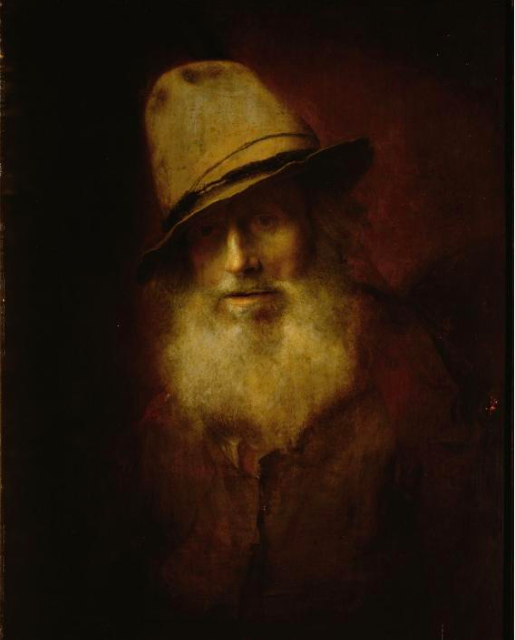
Detail of Christoph Paudiß, Ein
Marodeur (A Marauder) (1665).
The painting I discovered this time is called Ein Marodeur
(A Marauder), dated 1665 (or at least that is the information
in the galleries; on the Kunsthistorisches Museum website it is called Bildnis eines
bärtigen Mannes mit Hut (Portrait of a bearded man with a
hat), and dated 1663).
The man’s face has a slightly unplaceable expression, gazing off
to the left. You read it, based on his unruly white beard and
rumpled costume, as plaintive.
A particularly unusual aspect of the painting is how dark
everything is outside of the face and hat. It is as if a candle has
picked him out of the dark. It’s not just that the man is framed
against a black background. You can barely make out what is going
on with his torso at all, which merges into the darkness.
Indeed it took me some minutes to see the most important feature
of the painting, the one that makes sense of the title, A
Marauder: The old man is carrying a rifle, slung over his left
shoulder. As I looked closer, I also think I spot that he is
holding a cigar gripped between his index and middle finger, a few
dashes of paint seeming to suggest embers smoldering in the
darkness. But it’s not mentioned anywhere, so maybe that’s in my
head.
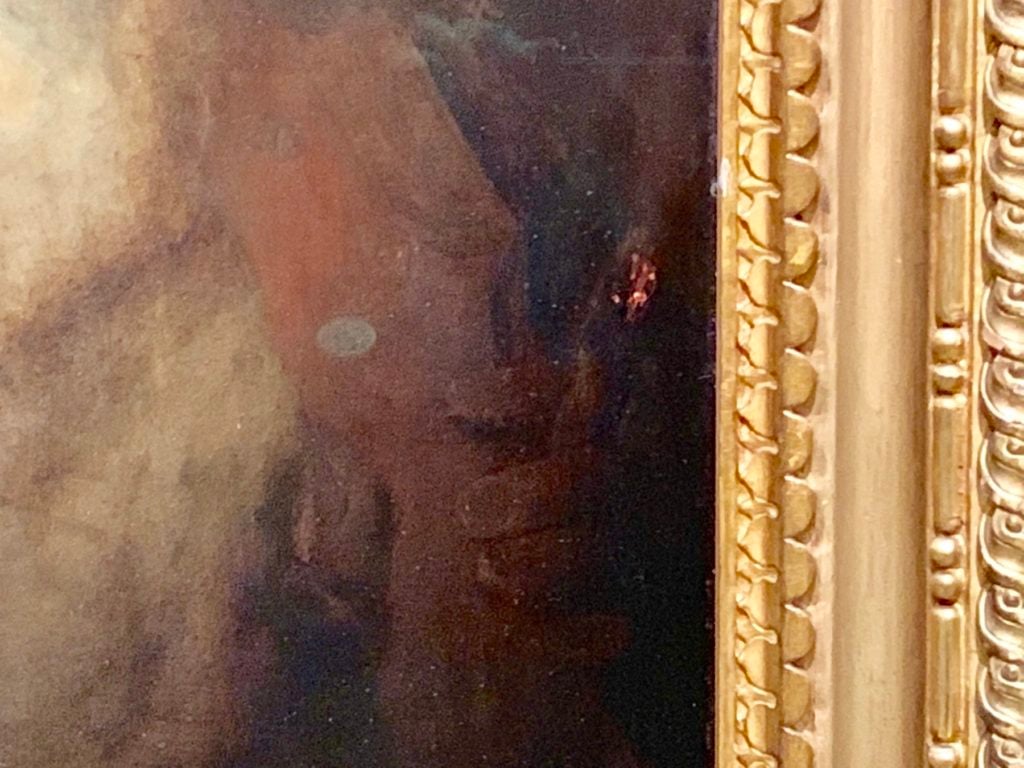
Detail of the hand in Christoph
Paudiß’s Ein Marodeur (A Marauder) (1665).
Image: Ben Davis.
At any rate, having picked out these details, the world-weary
man now seems to have a bit more of a twinkle in his eye. He
appears less supplicant, more challenging. He seems to be sizing up
something off to the side.
The artist is Christoph Paudiß, whose dates listed here are 1625
to 1666—a brief life, ending in his early 40s. Little about him is
available in English and little, I gather, is known in general,
though a show some years ago—the only one dedicated to Paudiß, as
far as I can see—styled him the “Bavarian Rembrandt.” He was, in
fact, a student of Rembrandt, carrying the Dutchman’s style of
poignant chiaroscuro with him back to the German lands.
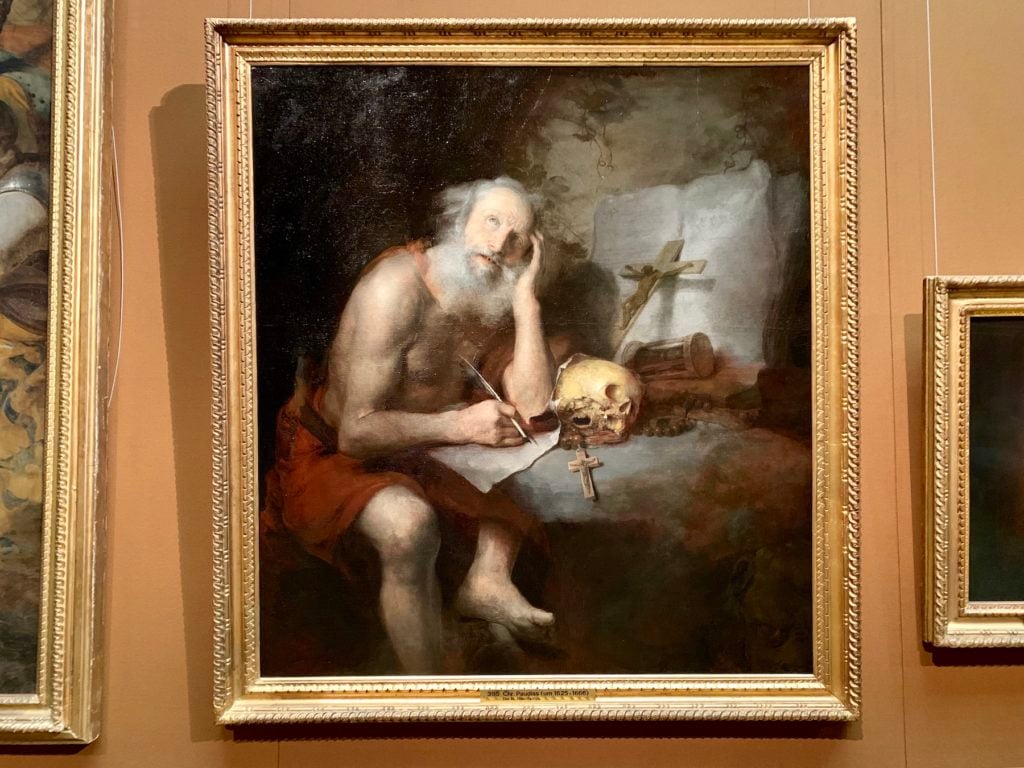
Christoph Paudiß, Hl.
Hieronymus (Saint Jerome) (ca. 1656-58). Image: Ben
Davis.
A text in the gallery notes that A Marauder sets out
“to search for dignity in the lonely old man.” Evidence for this
mission sits right next to it at the Kunsthistorisches Museum in
another, larger painting, also by Christoph Paudiß: Hl.
Hieronymus (Saint Jerome) (ca. 1656-58).
Saint Jerome, much beloved by Paudiß’s countryman Albrecht Dürer
100 years before for his status as a scholar-saint (he was the
translator of the Bible), is depicted in his study, staring up,
transfixed, with his symbol, the skull, before him. The accent
falls on Saint Jerome’s austerity and the solitude wherein he
contemplates the fleetingness of earthly things. Most importantly
it strikes me—and it’s amazing how long it takes to realize
this—that Jerome’s features are the same as those of his neighbor,
the outcast marauder.
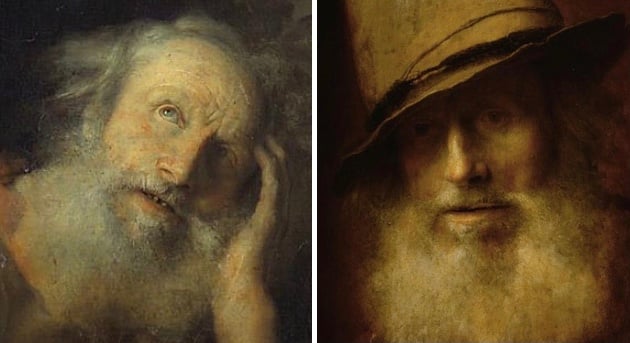
Left: Detail from Hl.
Hieronymus (Saint Jerome). Right: Detail from Ein
Marodeur (A Marauder).
The old bandit is spun from the same symbolic stuff as the
saint, the two images connected via the idea that poverty
symbolizes grace rather than wretchedness. At the same time,
the identification of the figure in A Marauder as a
bandit means that the holy and the criminal are close, complicating
its religious sentimentality for me.
Paudiß lived in a world where the sense that the high ideals of
civilization could break down, and that anyone could be reduced to
the state of chaos, violence, and desperation, was not at all
abstract. His life coincided with the pan-European disaster of the
Thirty Years War, a complex, multi-fronted epic of carnage that
stemmed from Protestant and Catholic rivalry. Much of
German-speaking territory was riven by violence, famine, and
plague. Banditry actually was a fact of daily life as the social
order broke down.
What Paudiß knew of this, returning from the Netherlands in its
aftermath, I do not know. He seems to have lived a restless and
wandering life, moving from town to town and job to job for a few
years at a time. He is supposed to have died in distress after
losing a painting contest. From the evidence of the paintings I
know, he had a taste for the eerie, unconventional, disturbed
atmosphere that might have emerged from this wounded historical
moment.
A third painting on the same wall with A
Marauder at the Kunsthistorisches Museum gives a
sense.
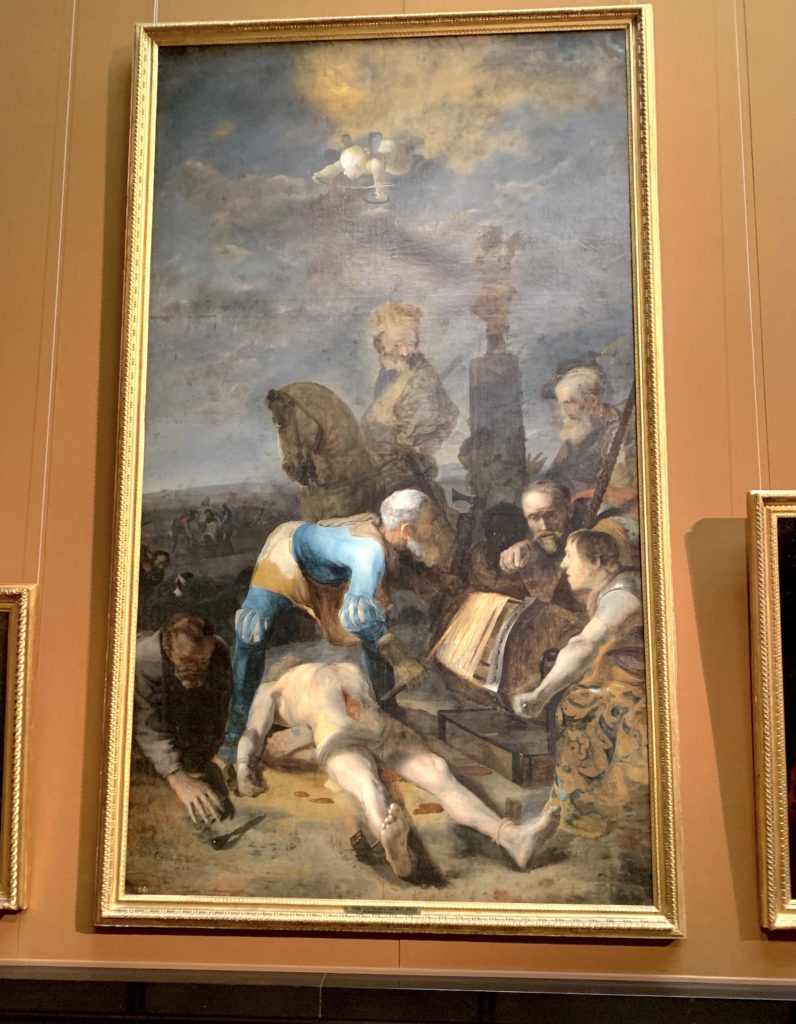
Christoph Paudiß, The Martyrdom of
Saint Thiemo (1662). Image: Ben Davis.
Titled The Martyrdom of Saint Thiemo, the
painting depicts the death of the titular German saint. Aside from
the ghastly image of intestines being unrolled on a winch, the
painting has a mannerist and irrationalist feeling—the figures all
looking in different directions, the composition crowded in parts
and empty in others, the setting haunted by fragments and ruins,
the rendering of different subjects ghostly to the point of looking
incomplete.
There’s a real sense of modern broken-ness and displacement that
shines through. Maybe on some level that aura also seeps its way
into the unsettled mystery of the later A
Marauder.
But The Martyrdom of Saint
Thiemo stands out, even today, as a gory, horror-show
spectacle. As for the much smaller painting, my guess is that not
one in a thousand visitors to the Kunsthistorisches Museum will
stop to give it the seconds you need to make out what the old man
is doing. Of those who do and want to know more, the
English-speaking ones at least will find very little information
about the painting or the artist easily available.
The old man sits there, in the shadows, just half seen.
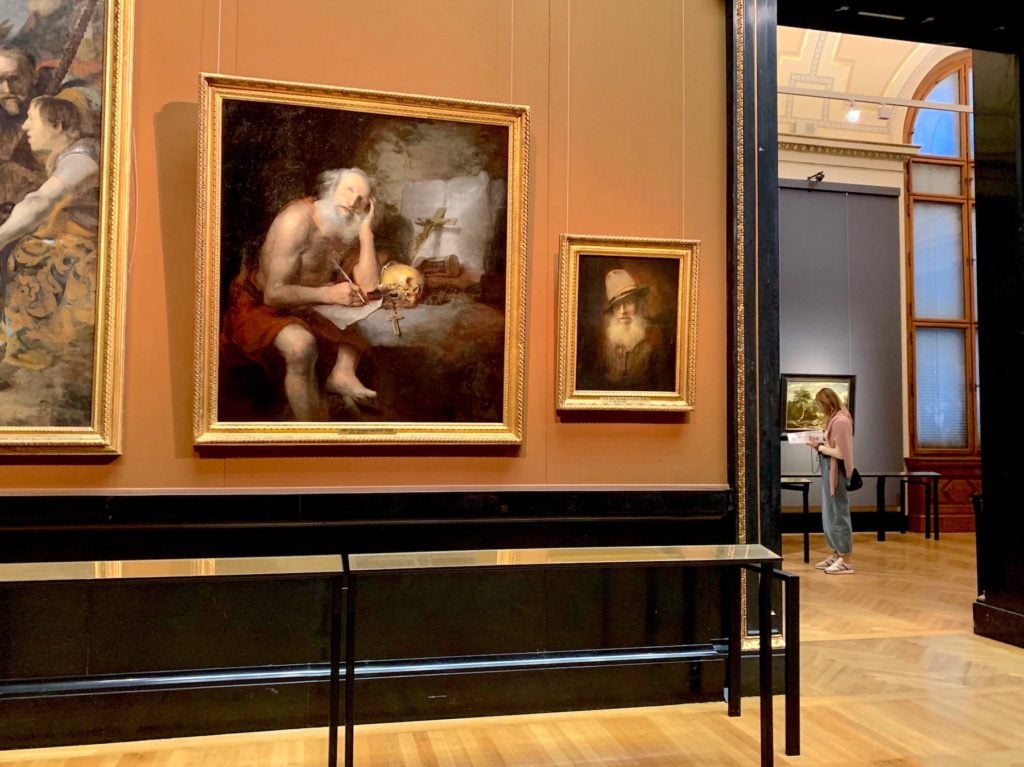
Installation view of Gallery XII. Image:
Ben Davis.
The painting moves me. As I turn the picture over in my head in
retrospect, I realize that the reason why is that its subject and
atmosphere seem to reach forward in time to stand as an allegory
for its contemporary fate.
For art history, this painting is present—but it is neither
famous nor a novelty, the two conditions to command contemporary
attention. There’s no news hook to hang this article on. The
velocity of modern media and pressures of modern life press against
me ever having the time needed really to know it. The tenuous light
that picks out the old man represents the narrow, fleeting window
of attention that connects the painting’s world to ours.
When I do stop to look, another story emerges in the shadows, or
at least the sense of one. Maybe the man is a wily bandit who’s
waiting in the darkness for a mark; maybe he’s a poor man who is
standing watch over his meager possessions or who has had to defend
himself. And so, the painting also reads to me as being about all
that’s hidden in plain sight that can still threaten or surprise,
the things secreted in art that the catastrophes of time and
forgetting haven’t quite managed to take away.
When you think about it, A Marauder stands for the
best-case fate for the typical piece of art in a museum—which
then also makes it stand for the typical condition of “Art” when
you strip away the mythologization of its transparent timelessness.
That fate is not to vanish. It endures. But it’s also not to
inspire lasting ecstasies of interpretation or to summon crowds.
Instead, it is to be present but not present, lurking at the corner
of vision, laying in wait for the moment when it might actually be
seen and known.
The post What One Mysterious, Easily Overlooked German
Painting Taught Me About How to Visit a Museum in the Age of
Blockbusters appeared first on artnet News.
Read more https://news.artnet.com/exhibitions/german-painting-vienna-museum-1685740
Further reading


Leave a comment