
Learn the Stories Behind 8 Major Women Artists Who Only Got Their Art-World Break Well Into Their 80s
Last week, we explained why it
was never too late for a
big break in the art world. And as our list reveals, many
late-to-fame artists are women in their 70s, 80s, and even
90s.
So we got to thinking about just
what changed to open the flood gates to such long-awaited stardom.
For some, like Carmen Herrera, it was a pure matter of tenacity in
the face of critical disregard; for others, like Grandma Moses,
painting only became an interest once other pursuits became
physically impossible.
Read about them and six other great women artists who made it
big in their 80s.
Carmen Herrera, b.
1915
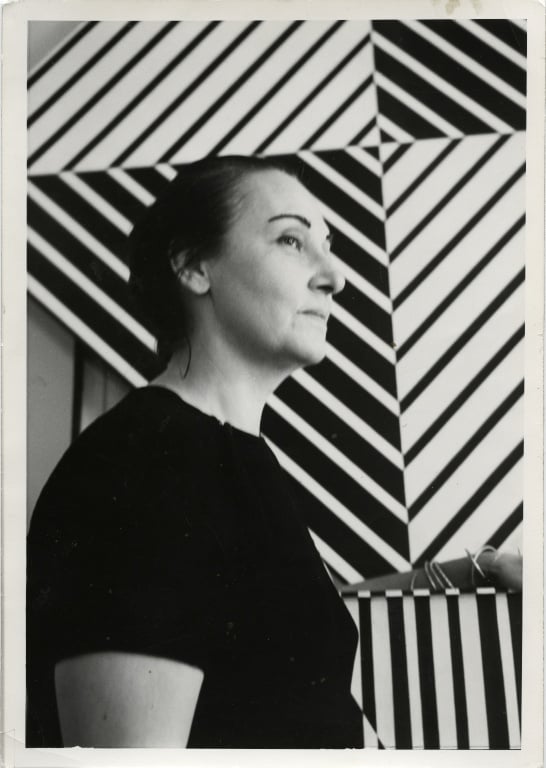
Carmen Herrera. Courtesy of Alison
Klayman.
The Backstory: Now 104 years old, the Cuban-born geometric artist Carmen
Herrera attributes her lifelong interest in straight
lines and clean forms to her years spent studying architecture as a
university student. After moving to New York City with her husband
in the mid-1950s, Herrera took classes at the Art Students League
and the Brooklyn Museum. During a multi-year sojourn in Paris, she
was introduced to the bold colors and shapes of Kazimir Malevich
and Piet Mondrian, two inspirations behind her mature style. For
decades, she had the unwavering support of her husband, Jesse
Loewenthal, an English teacher, but was rejected by dealers such as
Rose Fried, who ironically refused to include Herrera in a show
because she was a woman.
Her Big Break and
What Followed: Triumph did, however, come with a bang. Herrara
sold her first painting in 2004, at the age of 89. Later that same
year, several of her paintings were acquired by MoMA. Naturally, a
bigwig gallery followed suit, with Lisson Gallery ultimately
picking up the artist. Then, in 2017, she had a major
retrospective, “Carmen Herrera: Lines of Sight,” at the Whitney
Museum of American Art. Though she suffers from arthritis, Herrera is still at work today,
and just this year, she debuted Estructuras
Monumentales, her first-ever public
sculptures, in
Manhattan’s City Hall Park.
Etel Adnan, b.
1924
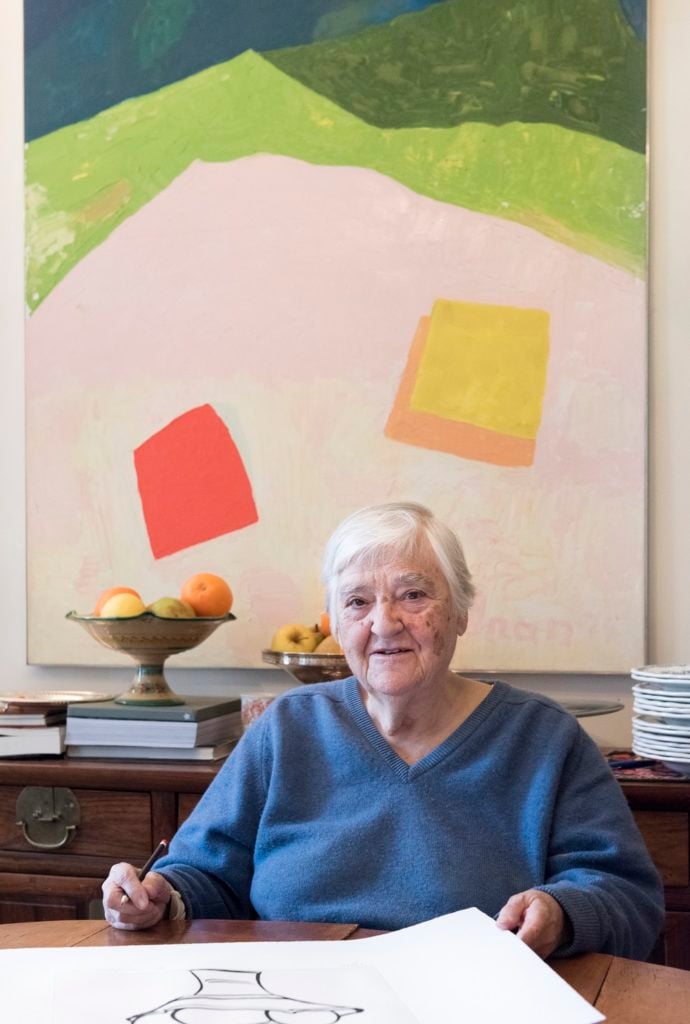
Etel Adnan. Courtesy Galerie Lelong. ©
Etel Adnan 2016. Photo: Fabrice Gibert
The
Backstory: For most of her life, the
Beirut-born Adnan was regarded foremost as a poet and essayist,
having spent much of her time studying and teaching philosophy in
France and California. But the mutli-talented artist, who had
dabbled in painting as early as the 1950s, began to paint with more
vigor during the Algerian War in the 1970s as a form of creative
resistance to the colonial implications of writing and publishing
in French. She continued to publish in English, however, and
decades would pass before the art world recognized her small,
pastel-toned landscapes, which depict her native Lebanon and her
adopted home of northern California.
Her Big Break and
What Followed: A critical fog seemingly
dissolved in 2012, allowing the beauty of Adnan’s compact, vibrant
canvases to suddenly shine through for all to see. That year, at
Documenta 13, a much-praised room was devoted to her works, and
exhibitions—including an invitation to the 2014 Whitney
Biennial—quickly followed. More recently, in 2018, both MASS MoCA
and SFMoMA presented solo
exhibitions of her work.
Zilia Sánchez, b.
1926
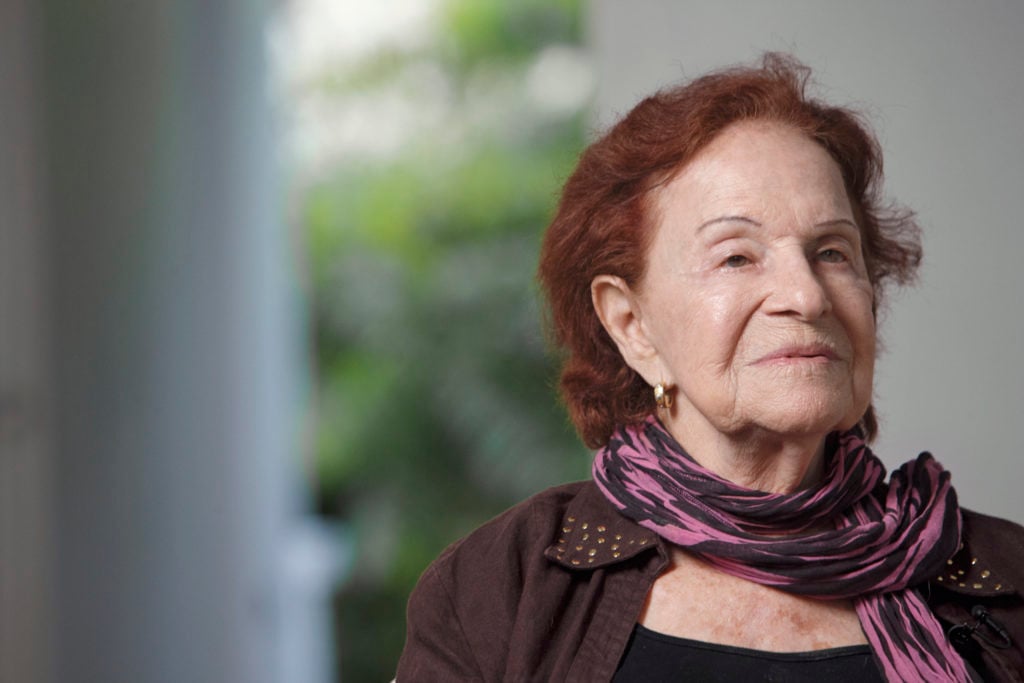
Zilia Sánchez. Courtesy Galerie Lelong.
Photo: Raquel Pérez Puig.
The
Backstory: The 93-year-old Cuban-born, Puerto Rican
artist first began her career as a set designer for radical theater
groups. Later, inspired by the silhouette of a sheet she saw
blowing in the wind, she began creating sensual shaped canvases
painted in delicate shades of pastels and whites. And she’s been at
it for over half a century since.
Her Big Break and
What Followed: Her work was rarely seen outside Puerto
Rico until it was included in the exhibition “Radical Women: Latin
American Art, 1960–85” at the Brooklyn Museum in 2018, the year
after Hurricane Maria tore the roof off her San Juan studio.
Earlier this year, her first solo museum show, “Soy Isla,” opened
at the Phillips Collection in Washington, DC. It just recently
traveled to El Museo
Del Barrio in New York and will coincide with “Eros,” an exhibition
of her recent work at Galerie Lelong. That show will include
completely freestanding works and her first marble
sculpture.
Sally Gabori, 1924–2015

Sally Gabori.
The
Backstory: Australian aboriginal artist
Mirdidingkingathi Juwarnda Sally Gabori was born on Bentinck
Island, Australia, and spent the first twenty-odd years of her life
fully immersed in her indigenous culture, learning Kaiadilt
cartography and cosmology. That
changed in the late 1940s when Christian missionaries came
into contact with the region and the entire aboriginal population
was forcibly relocated to a reservation on Mornington Island.
There, she mothered 11 children, and in keeping with tradition,
raised several others. Though Gabori was skilled in traditional
weaving and craft techniques, she didn’t begin painting until she
was 80 years old, when she was introduced to the materials at a
local arts center.
Her Big Break and
What Followed: In 2005, Gabori, began painting
vibrant and colorful abstract works that depicted personal and
mythical experiences through her ancestral language and symbols. It
didn’t take long for her exceptional talents to be recognized,
first by dealer Simon Turner, of Brisbane’s Woolloongabba Art
Gallery, and then by Beverly Knight of Melbourne’s Alcaston
Gallery. Enthusiasm for her work quickly grew in Australia, and she
was selected to represent the nation in the 2013 Venice Biennale.
Today, her work is primarily held in Australian museum
collections including those of the National Gallery of Australia,
the Queensland Art Gallery, and the Art Gallery of New South
Wales.
Diane Simpson, b.
1985

Portrait of Diane Simpson. Courtesy of
Corbett vs. Dempsey.
The
Backstory: Simpson’s sculptures have often,
rightly or wrongly, been described as embodying a Midwestern
modernism. The description might be coastal snobbery, but the
artist has certainly built her career as a Chicagoan first and
foremost. Born Diane Klafter in Joliet, Illinois, in 1935, she went
on to study at the School of the Art Institute of Chicago, where
she earned both her BFA and MFA. Always something of an enigma,
Simpson was tangentially involved with the Chicago Imagists during
the 1960s, and yet has always stood decidedly apart. Over the
years, she’s ascribed to a strict three-part process in which she
first creates an isometric drawing of a chosen subject on graph
paper, then translates that drawing into a set of instructions for
composing an interlocking sculpture, and ultimately builds the
final work. Her finished sculptures, which are often inspired by
soft materials such as Samurai skirts and Elizabethan collars, are
pleasurably utilitarian.
Her Big Break and
What Followed: In the nearly half-century since she
started exhibiting, Simpson has had a few standout moments,
including “Samurai,” her memorable 1983 show at Phyllis Kind
Gallery, but she’s only quite recently been garnering widespread
attention. She was featured in the most recent Whitney Biennial and
just last week was named a recipient of the $25,000 Anonymous Was a
Woman Award for women artists over 40.
Monir Shahroudy
Farmanfarmaian, 1922–2019
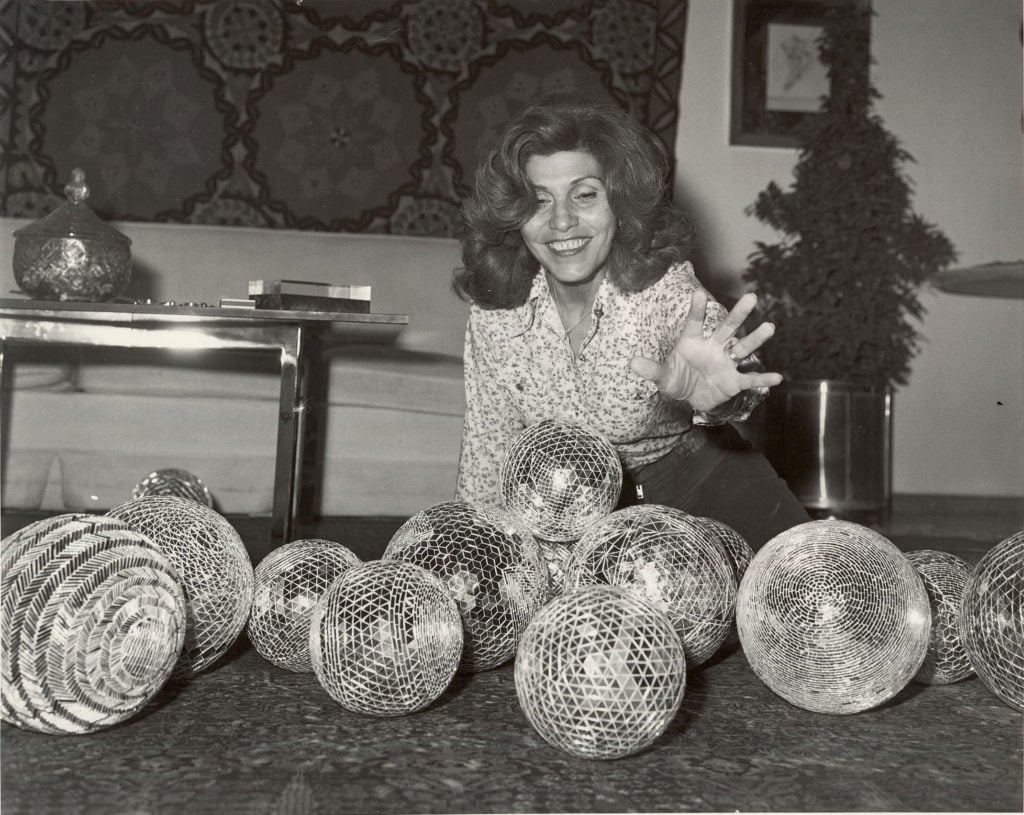
Monir Shahroudy Farmanfarmaian. Photo
courtesy of the Third Line, Dubai.
The Backstory:
When Iranian artist Monir Shahroudy Farmanfarmaian passed away
earlier this year at the age of 97, there was an outpouring for
recognition for an artist whose mirrored sculptural works
singularly combined Islamic geometric traditions with modernist
abstraction. But it was a long time coming. For a period in the
1950s, the artist lived in New York, where she worked as a fashion
illustrator and befriended the likes of Louise Nevelson, Joan
Mitchell, and Jackson Pollock. And for decades before she found
widespread acclaim, she was carefully honing her craft.
Her Big Break and
What Followed: Returning to Iran in 1957, Shahroudy
Farmanfarmaian worked with mirror mosaics and Iranian reverse glass
throughout the 1970s. The artist was exiled from Iran following the
Islamic Revolution in 1979, and returned only in the early 1990s.
Unlike many others on this list, she didn’t experience a singular
transformative exhibition; instead, her career slowly
crescendoed. Late in
life, she became the darling of the museum world, with a notable
exhibition of her work opening at the Serralves Museum of
Contemporary Art in Porto, Portugal, in 2015. (It later traveled to
the Guggenheim Museum in New York.) Her work is included in many collections today,
with works on view at the Metropolitan Museum of Art and at
the single-artist Monir Museum in Tehran—the only
museum devoted to a woman in the entire country.
Mernet Larsen, b.
1940
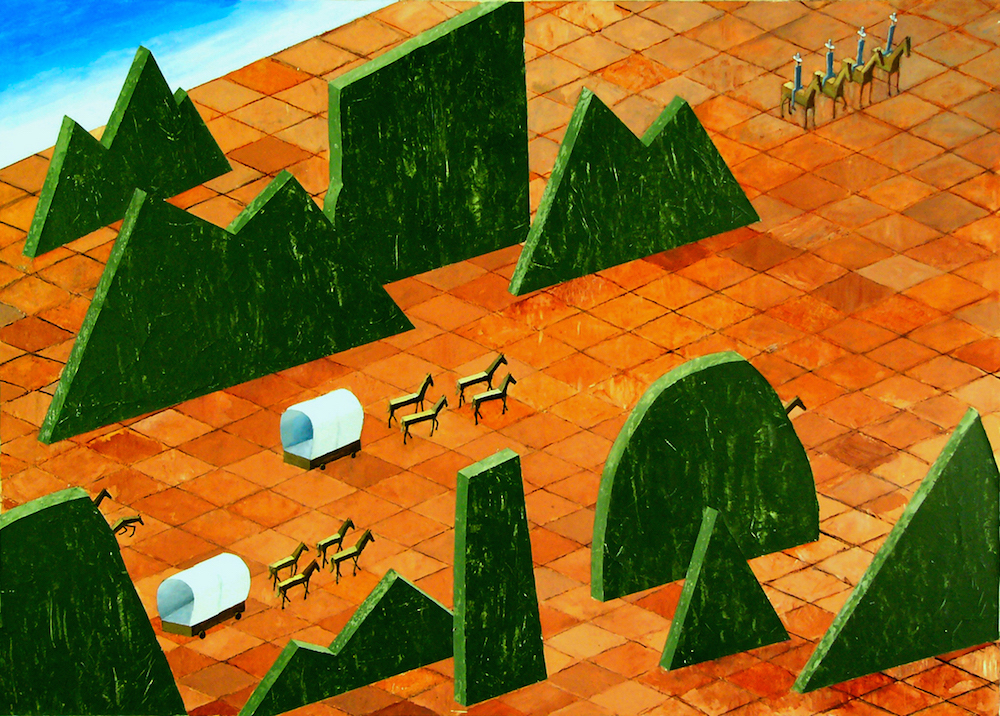
Mernet Larsen, Ambush. Courtesy
of Various Small Fires.
The
Backstory: Since the 1970s, Michigan native
Mernet Larsen has devoted herself to painting robotic, squared-off,
toy-like people—all without much in the way of critical reception.
From 1967 until her retirement in 2003, she supported herself as a
teacher at the University of South Florida in Tampa. Describing her
work, Larsen has said, “I
try to evoke a sense of permanence, solidity, weight: time stopped,
essences of ordinary events made tangible. As if I were leaving
this life and had to take with me only a few very concrete images,
filtered through wry detachment. Not ephemeral, but memory turned
into object, monumentalized.”
Her Big Break and
What Followed: In 2012, New York’s Vogt Gallery held a
three-part solo exhibition of her work titled “Three Chapters.” It was a
watershed moment for the artist. Roberta Smith praised the show,
writing, “Three decades ago Ms. Larsen’s work might have been
called regional… Today her efforts are extremely viable
participants in an extensive, possibly global conversation about
how to portray modern, three-dimensional life on two-dimensional
surfaces.” Representation by James Cohan Gallery soon followed,
along with shows at Various Small Fires in Los Angeles, among other
galleries. Today, Larsen’s work can be found in
the collections of the Walker
Art Center in Minneapolis and the Los Angeles County Museum of
Art.
Grandma Moses,
1860–1961
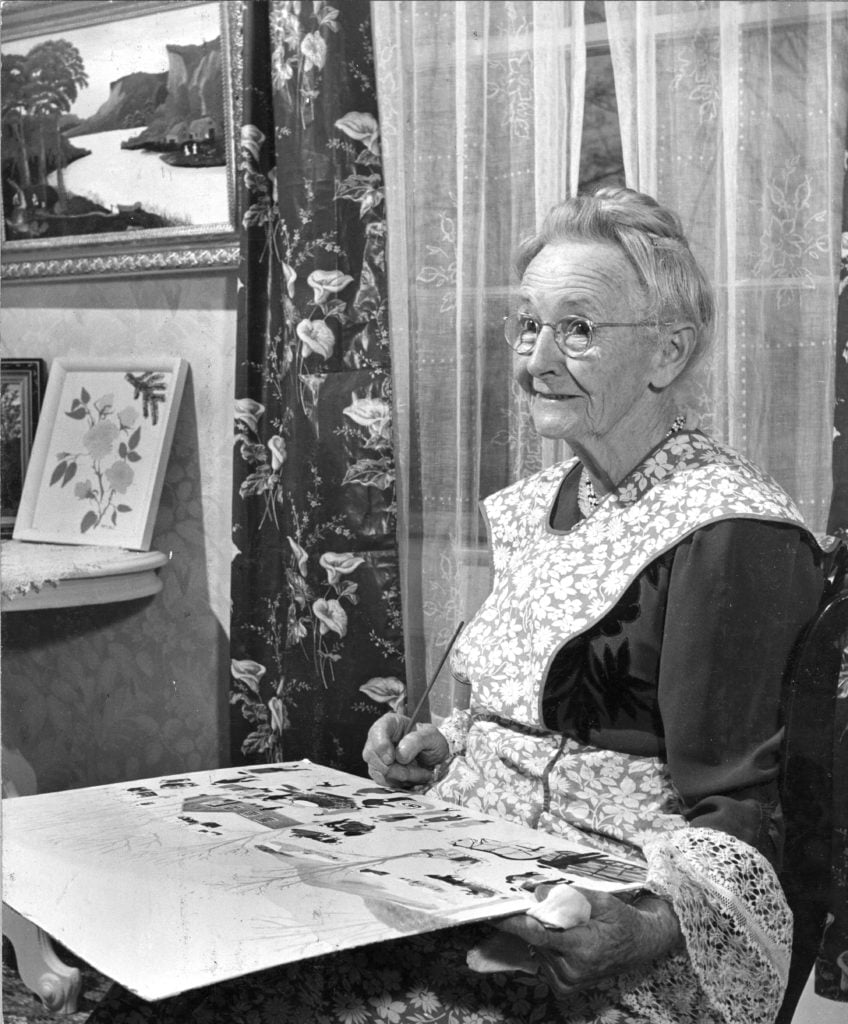
Anna Mary Robertson Moses, better known
as Grandma Moses. Courtesy of PhotoQuest/Getty Images.
The
Backstory: What list of late-blooming artists
would be complete without Grandma Moses? Born Anna Mary Robertson
Moses, the famed folk artist took up painting rural scenes at 78,
after a life spent raising five children in Upstate New York. Why
the turn towards painting? Moses, who started out doing embroidery,
was suffering from arthritis and her daughter encouraged to try
painting, which is less strenuous.
Her Big Break and
What Followed: As though scripted for the movies,
in 1938, the engineer and collector Louis J. Caldor spied one of
her works hanging in a drug store window. Immediately enamored, he
purchased all her available works in one fell swoop. Fame came soon
after, and the following year, several of Moses’s works were
featured in MoMA’s “Contemporary Unknown American Painters.”
Moses’s heartwarming scenes are now staples of American Art
auctions, and routinely garner prices in the hundreds of
thousands.
The post Learn the Stories Behind 8 Major Women Artists Who
Only Got Their Art-World Break Well Into Their 80s appeared
first on artnet News.
Read more https://news.artnet.com/art-world/8-women-artists-over-80-1710444
Further reading


Leave a comment