
The Market for Disturbing Nazi Artifacts Is Growing. Who Is Buying Them—and Why?
Ahead of the scheduled opening of the Buenos Aires Holocaust
Museum’s exhibition of 72 Nazi-era artifacts next week, the museum
revealed some shocking news: all but 10 of them have been declared fakes by
an international group of European experts. The revelation
underscored a surprising fact about Nazi paraphernalia. Like in the
market for more traditional art and collectibles, there is so much
demand for this stuff that inauthentic objects and forgeries are a
large part of the trade.
“A lot of fake material, ersatz
garbage, is coming in from Bulgaria, Poland, the Ukraine, even
Pakistan,” said Bill Panagopulos, owner of Alexander Historical
Auctions in Chesapeake City, Maryland, which sells Nazi artifacts
among other items. “Some of it is faked so well that it is
difficult to tell.”
There’s an incentive to copy
this material, obviously. Prices are on the rise. The most
sought-after German World War II items that Panagopulos sells are
soldiers’ medals (ranging from $30 to $200,000), helmets ($300 to
$15,000) and daggers ($300 to $300,000), with the wide price
differences based on condition and the importance of the individual
who originally owned the item. For instance, the Knight’s Cross was
the highest award in the military, and the highest prices are for
those that are accompanied by a document that validates the medal
and identifies which important soldier it was given
to.
Rooting Out Fakes
Sometimes, Panagopulos is able
to tell an item is a fake at a glance. “Here’s a desk statue of a
hippopotamus behind a fence, surrounded by swastikas,” he said,
looking through a file of images on computer. “What the hell is a
hippo doing on a Nazi piece? It’s so cheesy, there’s no sense to
it. Here’s another: a harmonica set in a case with a smiling Hitler
Youth image on it. It’s so contrived and ridiculous that it
couldn’t be authentic.”
There are others that he
identified as clear fakes. “Here’s a Nazi cat sitting atop a
swastika. There is no symbol of a cat in Nazism; it has no business
being there,” he points out. “Here’s another, a head caliper cast
with a swastika and a wreath. This is a scientific instrument; it’s
ridiculous that it would have these decorations on
them.”
Giel van Wassenhove, owner of
Giel’s Militaria in Ghent, Belgium, which sells military artifacts
from the 19th
and 20th centuries, noted that whether an object is
authentic or not is the “million-dollar question.” More than 200
factories in Germany were producing combat medals during the Second
World War, he said, and “we have a large database of medals,”
consisting of designs that were created along with an archive of
“well-known flaws in dies and strikes.”
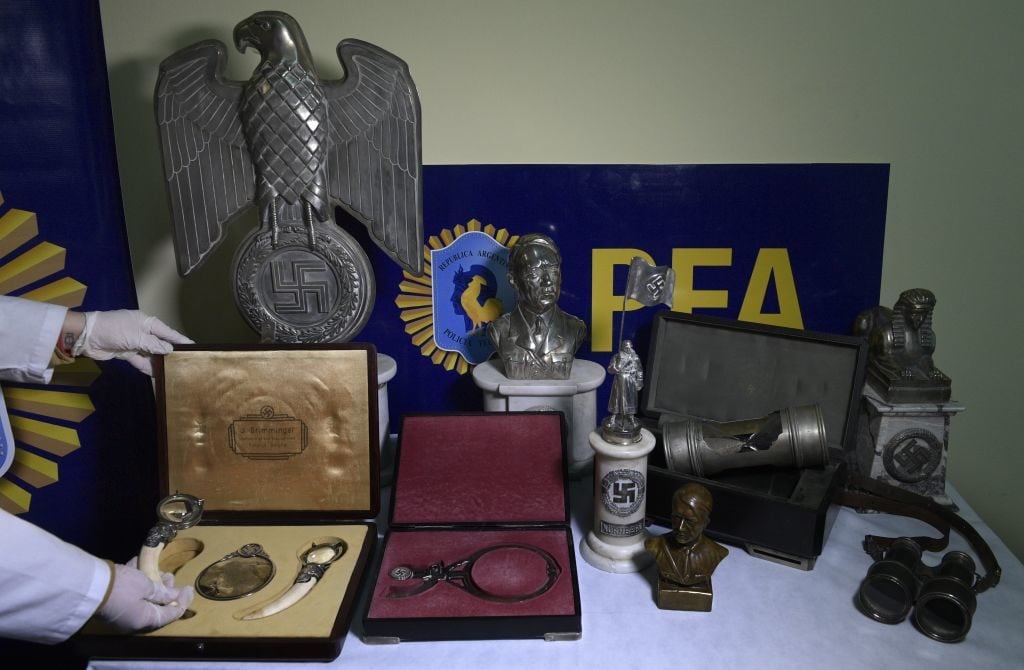
A member of the Department of Protection
of the Cultural Heritage of the Federal Police shows the artifacts
seized in 2017. Photo: Juan Mabromata/AFP/Getty Images)
A Conundrum for Collectors
If it is difficult for people in
the trade to know what is and is not authentic Nazi paraphernalia,
private buyers have even more trouble. Howard Cohen, a retired
optometrist in Pittsburgh, Pennsylvania, who principally collects
“anti-semitica” (posters, books and objects that caricature and
denounce Jews), noted that he once bought six Jewish ghetto
armbands with yellow stars on them at a military show, “and they
all turned out to be reproductions.”
Michael Bulmash, a retired
clinical psychologist in Lewes, Delaware who has collected both
anti-semitica and Nazi artifacts, claimed that he purchased
drawings, purportedly by a rabbi in Auschwitz, depicting life in
the camp. “I later found out these came out of the Ukraine,”
Bulmash said. “It infuriates me that people are making money out of
the Holocaust.”
Information on the authenticity
of German army paraphernalia is readily available—this site
is a go-to source. But there are
still many confused collectors posting images of items on the forum
pages of military websites (for instance, germandaggers.com), asking for input from others as to what
does, and does not, look real.
In certain cases, the provenance
of items is a bit more clear. Mike Morris, an 82-year-old collector
and dealer of Nazi paraphernalia in Fredericksburg, Texas, noted
that he visited Germany on numerous occasions starting in the late
1950s and bought directly from German military veterans or their
families. “I would put ads in the local newspapers there, asking
people to meet me at a hotel,” he said. “I would buy these veterans
a couple of beers, and they would bring me sacks of this stuff,”
which included helmets, daggers, medals, guns, flags, and uniforms.
“It’s against the law in Germany to have anything with a swastika
on it, so they wanted to get rid of it.”
A Niche Market
The people he sells these
artifacts to are private collectors and “investor groups, [who]
have researched the market and seen the returns you can get on this
stuff.” Like so many other aspects of the collectibles market,
Nazi-era items now have a global reach. Panagopulos said that he’s
made sales to collectors in Asia and the Middle East: an SS
leader’s great coat to a buyer in Qatar for $55,000, and a carved
eagle and swastika to a buyer in mainland China for
$30,000.
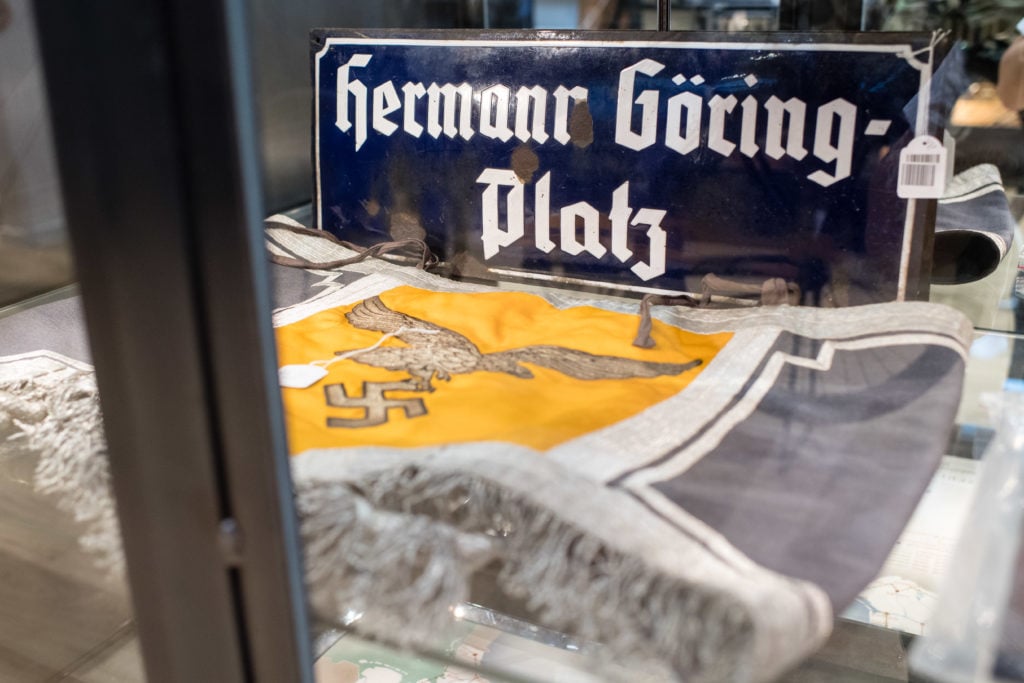
An enamel plate reading “Hermann
Goering-Platz” square and a kettledrum decoration with a swastika.
(Photo by MATTHIAS BALK/dpa/AFP via Getty Images)
Unlike most artwork and
decorative objects, the collectors of Nazi paraphernalia tend not
to display these items in their homes. “They don’t put it in the
living room, but they might put it in a private room in the house
or in storage,” Craig Gottlieb, a dealer in military artifacts in
San Diego, California, said. (“It’s not respectful to display a
swastika in public,” he added, which is something of an
understatement.) Michael Bulmash intends his collection to go to
Kenyon College in Ohio, his alma mater, and Howard Cohen also
expects to donate his 1,000-plus collection to an
institution.
Until then, these things are
kept out of sight, as even a collector’s family members generally
don’t want to see them. Mike Morris, as noted, is selling off his
collection bit by bit. “I’ve been married five times, and my wives
have learned not to say anything about it,” he admitted.
Who Wants Them?
Who actually buys these
collectibles from the 20th century’s darkest moment? Nazi artifact
dealer Andreas Gronemann noted that “all my clients are educated
people, university professors, medical doctors, as well as museums
such as the US Holocaust Museum, and many try to preserve this kind
of material for future generations and to learn from
it.”
The market for Nazi
paraphernalia is not new and “dates back to the war itself, when
allied soldiers looted memorabilia from the Berlin bunker and many
other sites at the war’s end,” said Gavriel Rosenfeld, professor of
history at Fairfield University in Connecticut. “These artifacts
had a market value already in the late 1950s.”
Rosenfeld said that the buyers
of these objects don’t always fit one’s assumptions. “The
stereotypical collector of Nazi artifacts is either a wealthy Texas
oil baron with military veterans in the family tree, or neo-Nazi
lunatics creating basement shrines to their historical idols,” he
noted. Still, he doubts that there are many in the latter
category.
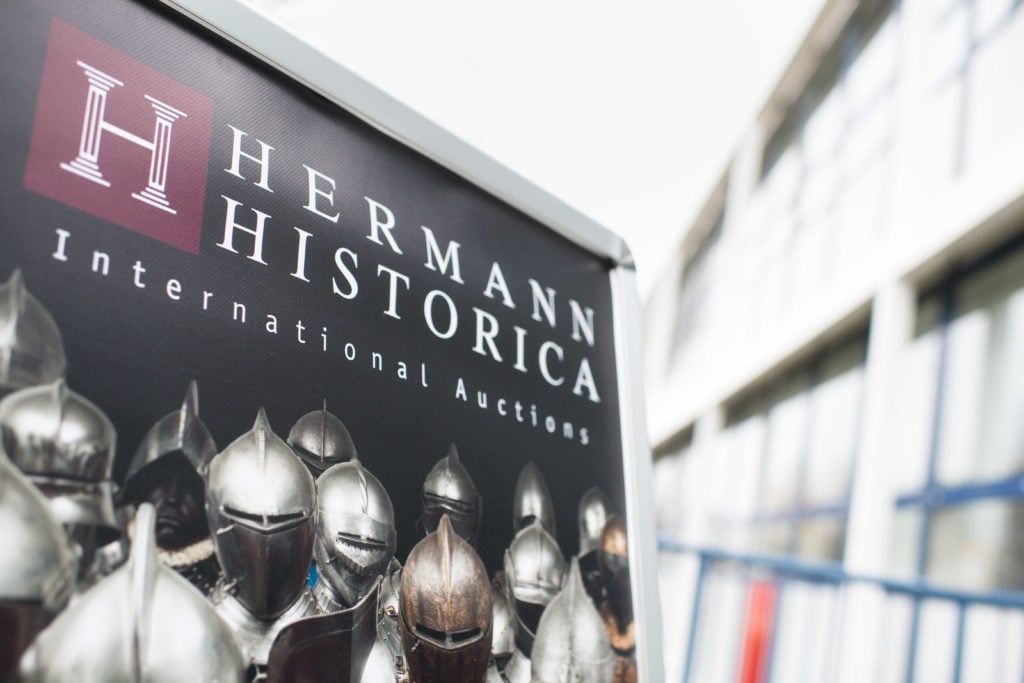
The Munich-based auction house “Hermann
Historica – International Auctions” where Nazi devotional objects
are auctioned off. (Photo by Matthias Balk/picture alliance via
Getty Images)
In recent years, far-right
groups and neo-Nazi political parties have gained far greater
prominence in Europe and the United States. Concern that this
memorabilia would fall into the wrong hands—their hands—sparked protests
against the German auction house Hermann Historica last week ahead
of its sale of Nazi artifacts, including Adolf Hitler’s top hat.
But in the end, several objects, including the hat, were purchased
by the Lebanese-born Swiss real estate mogul Abdallah Chatila, who
said he spent around $660,000 to keep the objects from being
purchased by neo-Nazis. He plans to donate them to a Jewish
organization, the Keren Hayesod-United Israel Appeal group,
according to the
AP.
Dealers of Nazi memorabilia say
that while neo-Nazis may fuel the demand for less expensive
reproductions, they are less likely to spend hundreds or thousands
of dollars on authentic Nazi artifacts. Experts speculate that
neo-Nazis can just as easily make their own flags and emblems for
far less money than purchasing an old one at auction.
Paul Jaskot, professor of art
history and visual studies at Duke University, noted that “fascism
and National Socialism in particular exerts a compelling
imaginatory experience for many people, the thrill of violence in
modern society, the idea of hyper-masculinity, what Susan Sontag
once called ‘fascinating fascism.’” For his part, Craig Gottlieb
said that his Nazi artifacts buyers are “mostly male, aged 40s to
60s, white collar but not uber-wealthy. As far as I can tell, they
don’t have any political interest in the material.”
There are a number of collecting
markets that have a decided “ick” factor, and Nazi artifacts is
doubtlessly one of them. Some objects, such as the
battlefield-frayed helmets and uniforms, speak of important moments
in history, while other items merely fall into the category of
disturbing ephemera—such as a used handkerchief that had belonged
to Hermann Goering, or Eva Braun’s underpants, both of which have
sold at auction.
The post The Market for Disturbing Nazi Artifacts Is Growing. Who
Is Buying Them—and Why? appeared first on artnet
News.
Read more https://news.artnet.com/market/market-nazi-art-1714905
Further reading


Leave a comment