
As Jetsetters Prepare to Descend on the Eroding Shores of Miami, Art Basel Awkwardly Tries to Address Climate Change
As Art Basel Miami Beach
prepares to open this week, the subject of climate change has once
again come center stage in the art world. One of the American
cities most vulnerable to climate disasters, the sea-level rise in
coastal Miami has tripled over the past decade and the city has
resorted to importing sand to restore its rapidly eroding
coastline.
To confront the worsening effects of the climate crisis, artists
and institutions around the city are organizing panel discussions and art projects, both at the
fair and beyond, over the next week.
“Addressing the environmental impact of the international art
world is a pressing issue,” a spokesperson for Art Basel tells
Artnet News. “Art fairs are not by their nature environmentally
friendly as they require extensive travel and shipping and create
waste.” The fair is currently looking at long-term initiatives to
improve its ecological footprint, and has created an internal
working group to investigate strategies for reducing its
environmental impact.
Confronting the Elephant in the Room
This year, Art Basel Miami Beach
is hosting a panel on climate change denial, “which from what I
understand is still a really big issue in the United States,” says
Stefanie Hessler, a curator and writer who is moderating the
discussion. “One pressing question—the old question—is what
role does art actually play when it comes to social justice and
environmental justice? What are the limitations of the art
world?” says Hessler, who will be joined on the panel by
artists Allison Janae Hamilton and Alexis Rockman, author David
Wallace-Wells, and Miami-based environmental activist Sonia Succar
Ferré.
“Part of the tradition of art is
to be activist on some level, so I see my job as showing some of
the implications of these ideas, these facts that are being ignored
by the general public, and trying to speak out about it,” Rockman
tells Artnet News. “Just in the same way that people have been
political in terms of gender equality or racial equality, this is
an issue of global equality.”
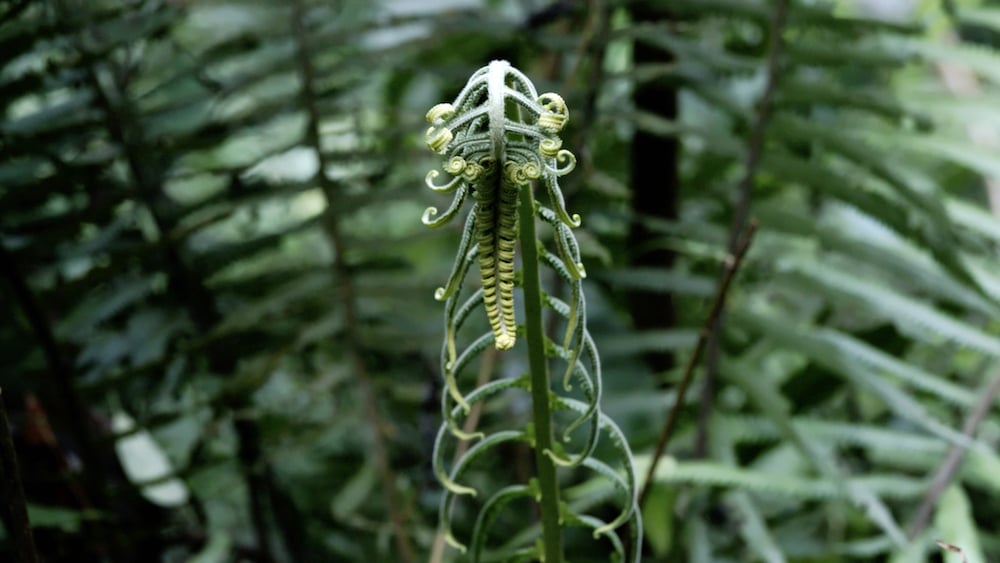
Zheng Bo, Still from Pteridophilia
IV (2019). Image courtesy of the artist and Edouarde Malingue
Gallery, Hong Kong and Shanghai.
One of the biggest carbon
expenditures of art fairs is the footprint left by all of the
guests, organizers, artists, and artworks traveling by plane to
attend. “The irony of
getting on a plane to go talk about those issues doesn’t escape me,
and I feel terrible about it. I’m very conflicted,” Rockman
says. “I want to be Greta [Thunberg] and get in my
rowboat and go down there, but that’s just not feasible for many
reasons, and that’s one of the agonies of being alive at this
moment in history: the conflict that we all have to face in terms
of the things we eat, the amount of water that we use, even the
materials that I make the work out of—I was literally wondering if
the wood panel I’m working on came from Borneo and I thought of an
orangutan.”
In an effort to balance out this
damage, Art Basel says it’s paying to carbon offset the flights of
its team, VIP representatives, external consultants, operational
partners, and media guests, as well as the speakers from the
Conversations program.
But some activists remain incredulous at the spectacle of
wealthy fair goers shopping at the site of climate change’s ground
zero. “People are flying in on private jets to buy art in a region
that is on the frontlines of climate change,” says William Skeaping
of the activist group Extinction Rebellion. “How are we promoting
and allowing this insane global circus to continue?”
“Miami is literally a frontline of climate change and the very
presence of Art Basel Miami is threatened,” Skeaping adds. “It’s
almost an incredible and artistic self-destructive loop. The more
people come to Art Basel Miami Beach the faster Art Basel Miami
Beach disappears. All these people with art collections and new
foundations in Miami are actually threatened by the people who come
to visit them—the loop is completely unsustainable.”
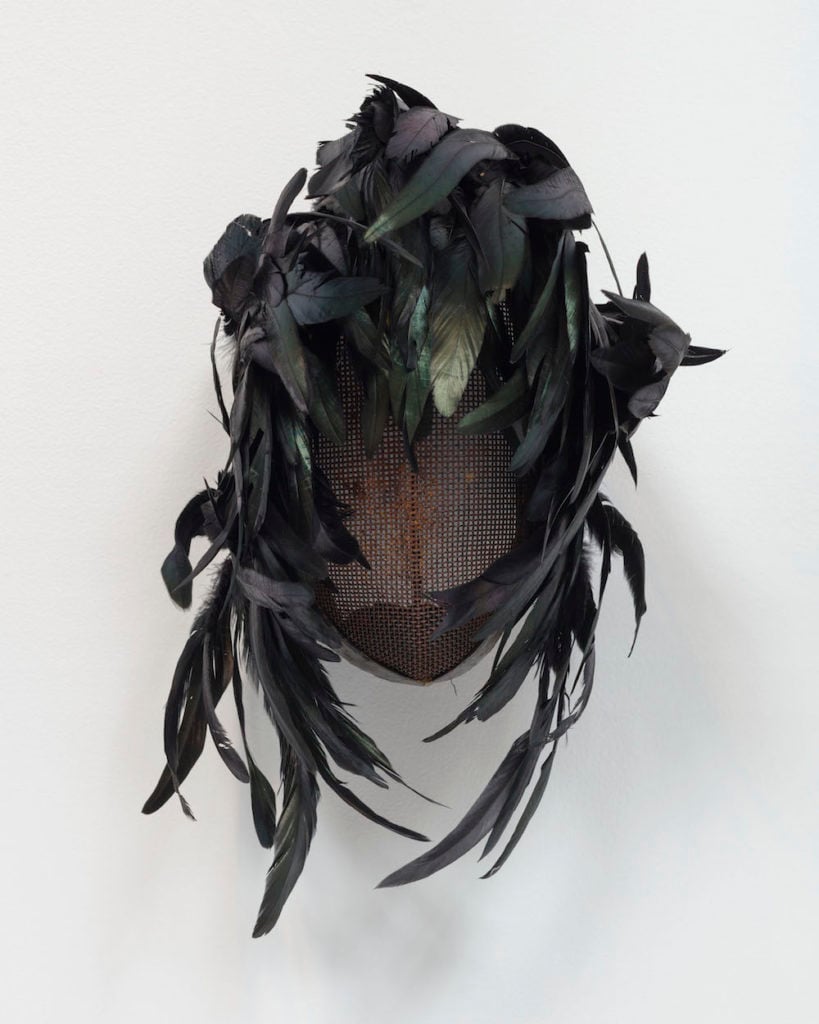
Allison Janae Hamilton, Fencing Mask
with black feather headress (2019). Image courtesy of the
artist and Marianne Boesky.
A New Normal
For some in Miami, that threat
is already being acutely felt. The Bass Museum of Art has had to
adapt to the new reality of flooding and storm surge caused by
hurricanes, tropical storms, and king tides. “From June to
November, we are living in what is called the cone of uncertainty,”
the museum’s executive director, Silvia Karman Cubiñá, tells Artnet
News. (The Bass’s current show of work by
artist Haegye Yang
takes its title, “In the Cone of Uncertainty,” from the
phrase.)
When Hurricane Irma hit the museum in 2017 it was just
a “dress rehearsal” for a new
era of climate catastrophe, Cubiñá
says. “We were all set
to move into a newly renovated building, and we weren’t sure
whether we would have to start construction all over again when we
returned.” Fortunately, the museum survived and opened its new $12
million space after just a short delay.
The museum has since adjusted to
a new normal. It has moved all of its art in storage offsite onto
the mainland of Miami, and it takes added precautions when planning
installations. “We think twice about work that is difficult to lift
and avoid installing those works on the first floor, should we need
to enact our hurricane preparedness plan,” Cubiñá
says. And when
collecting work, especially for outdoor sculptures, the museum now
more carefully considers the surface of the art and whether it can
withstand the exposure to “blistering sun and saltwater off the
ocean.”
Sylvie Fleury’s monumental
installation Eternity
Now on the Bass’s
exterior, for example, will need to come down in the event of a
major storm. (The museum has a standing contract with a crane
company to deinstall the work once a hurricane watch is upgraded to
a hurricane warning.)

On the Fair’s Grounds
Roughly 10 of the projects at
this year’s fair will specifically address climate change, the
environment, or natural disasters, according to Art Basel
organizers. Artist Tatsuo Miyajima responds to the changing
environment with his “Pile Up Life” series, a mound of stones
reminiscent of an ancient memorial that conveys the powerlessness
of humans in the face of nature.
Meanwhile, the Lisbon gallery
Madragoa will present a new project by Italian artist Renator
Leotta, Il mare é
tutto azzurro, in which
the artist aims to create an immersive, lyrical environment that is
related to landscape painting but uses the landscape itself as a
medium. In the same “Positions” section, Sao Paulo gallery Marilia
Razuk will show Newspapers by Vanderlei Lopes, comprised of a dozen cast
pieces of bronze that resemble newspapers with headlines concerning
recent worldwide natural and cultural catastrophes, scattered on
the floor.
Elsewhere, Edouard Malingue
gallery will present works by Zheng Bo, including
Pteridophelia 4
(2019), the fourth chapter of the
artist’s ongoing investigation into ferns, as well as the open
book Survival Guide
#3 (2019), which
addresses colonial assertion through the foil of identified edible
plants. And New York
gallery Venus Over Manhattan is showing works by Joseph Yoakum, who
is known for densely patterned and flattened drawings that feature
vibrantly colored geographies, flowing streams, and layers of
receding trees.
Allison Janae Hamilton, who’s
also participating in the fair’s climate-change panel, tells Artnet
News that she is presenting a series of found masks that she
embellishes with different elements from the surrounding landscape
where she grew up in Northern Florida. She sees her work as
addressing the ways “the
environment really is a story of people and lived experience and
not just the science behind it all,” she
says. “It’s really
important to look at who the most vulnerable people are, and as
natural disasters like hurricanes and other occurrences grow more
and more intense, [to ask] how are they illuminating and shedding
light on the already existing social disasters?”
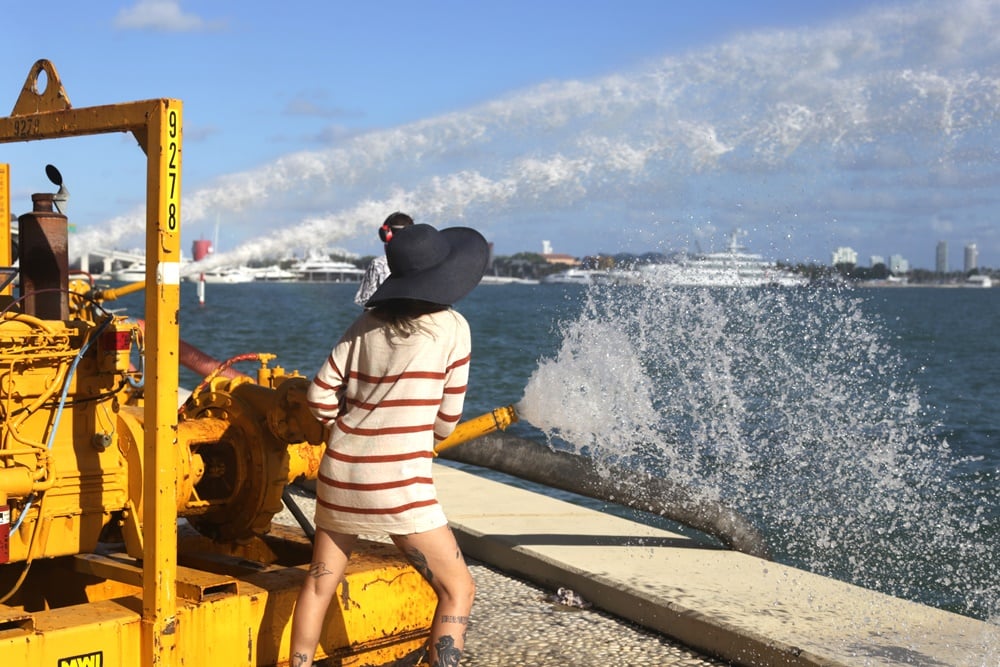
Misael Soto, Flood Relief (2017)
at Museum Park, Miami. Seawall adjacent to Pérez Art Museum.
Courtesy of the artist.
Outside the fair, Miami’s
first artist-in-residence aimed at addressing rising sea
levels, Misael Soto, has installed a public work titled Sand: Amphitheater,
Theater, Arena and a para-fictional city known as
the Department of
Reflection. The
works’ goal is to “build towards a greater understanding from
everyone involved about how best to engage with and harness artists
in processes outside of the art world,” Soto says, “not just on a
municipal level, though that’s obviously essential here, but in
other networks as well.”
Given the scale of the task at hand, it’s fitting that Soto was
just invited to stay on in the residency for an extra year.
Additional reporting by Kate Brown.
The post As Jetsetters Prepare to Descend on the Eroding
Shores of Miami, Art Basel Awkwardly Tries to Address Climate
Change appeared first on artnet News.
Read more https://news.artnet.com/market/miami-basel-combat-climate-change-1718745
Further reading


Leave a comment