
Werner Herzog’s New Film Is About an Ace Sotheby’s Specialist Who Became a Legendary Explorer
Enigmatic to the core, the late
Bruce Chatwin was at his best when ambling around on the hunt for
Brontosaurus bones in Patagonia. He would later be accused of
making up many of the interviews and experiences in his iconic
travel book In
Patagonia, but by then
Chatwin had established himself as a charismatic writer, and would
go onto write several adventure books and novels. One of those
novels, The Viceroy of
Ouidah, was adapted into
the film Cobra
Verde by Werner Herzog,
and Chatwin and Herzog became friends. In Herzog’s new film,
Nomad: In the Footsteps of Bruce
Chatwin, Herzog ruminates
on their friendship, and re-enacts some of the trips that Chatwin
took in what the director calls “an erratic quest” to get to the
heart of who the man was.
No story about Chatwin is complete without his connection to the
arts. Before Chatwin became a travel writer and novelist, he was an
art specialist at Sotheby’s. According to his biographer Nicholas
Shakespeare, Chatwin began as a lowly porter in 1958 before moving
into the antiquities and Impressionist art departments as a
cataloguer. There, he developed an eye for spotting forgeries, and
quickly moved up the ranks, becoming an expert in both
departments.
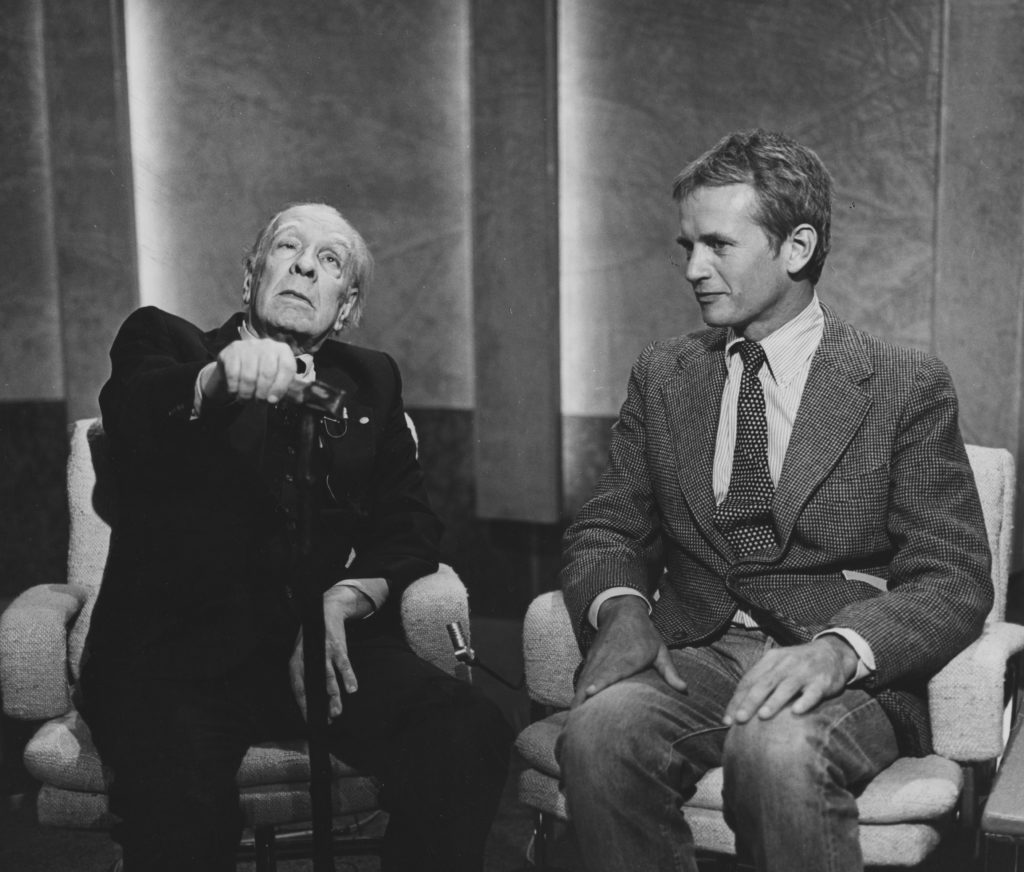
Bruce Chatwin with writer Jorge Luis
Borges (left) on the BBC television series ‘Frank Delaney’, October
1983. Photo by Chris Ridley/Radio Times via Getty Images.
Chatwin was sexually fluid.
According to Shakespeare, the then-director of Sotheby’s supposedly
used Chatwin’s attractiveness to both sexes to the house’s
advantage when it came to convincing the rich to sell their art
collections through Sotheby’s. In any case, he had mixed feelings
about his role. Another biographer, Nicholas Murray, wrote about
his frustration with being an appraiser. “In the end I felt I might
just as well be working for a rather superior funeral parlour,”
Chatwin said. “One’s whole life seemed to be spent valuing for
probate the apartment of somebody recently dead.”
Chatwin would later go onto become a director at the auction
house, though only at a junior level. This lower position further
rankled Chatwin, and he became embittered towards the auction
house’s shadier dealings, including the controversial
deaccessioning of archaeological objects from the Pitt Rivers
Museum in Oxford, England. In June 1966, three months after he
became director, the then-26-year-old Chatwin resigned.
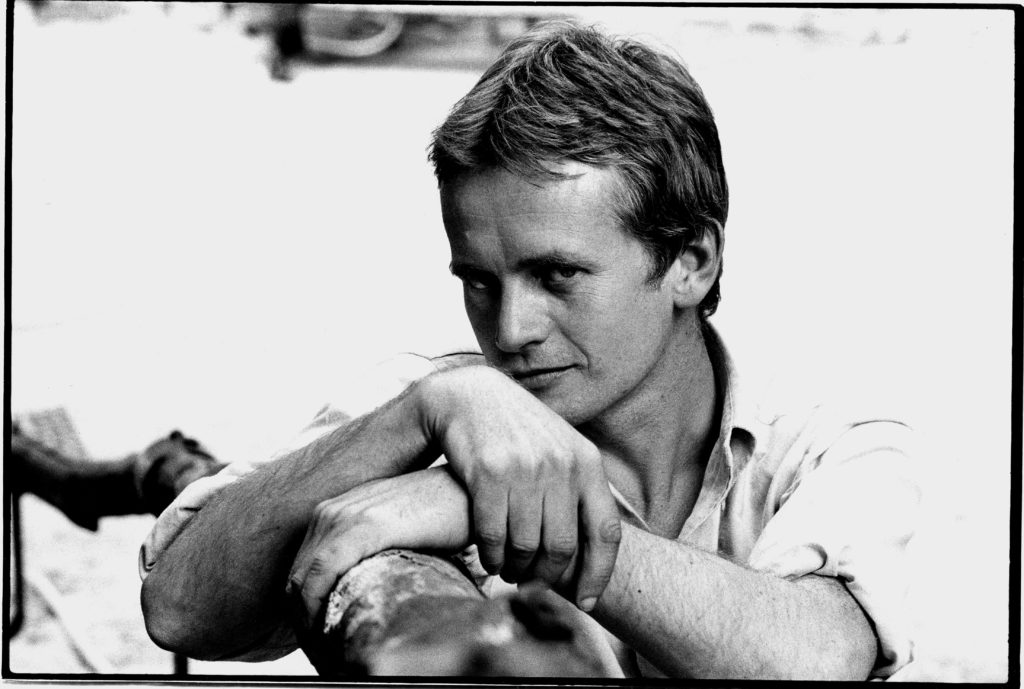
Chatwin in May 1984. Photo by Ulf
Andersen/Getty Images.
He would go on to become an art
and architecture writer at the Sunday Times Magazine, where he would pen pieces on Russian art
collectors, art theorist André Malraux, and Irish architect and
designer Eileen Gray. The latter would become important in
Chatwin’s life; during his interview with Gray, he noticed a map of
Patagonia, and told her he had always wanted to travel there. “So
have I,” she replied, “Go there for me.”
Thus began Chatwin’s most fruitful period of wandering—the
focus of Herzog’s Nomad—but it
wasn’t the end of Chatwin’s relationship to the arts. He would go
onto have an affair with Robert Mapplethorpe’s lover Sam Wagstaff;
according to Shakespeare’s biography, Chatwin was one of the only
men Mapplethorpe photographed fully clothed. Chatwin would later
write an essay in Mapplethorpe’s book, Lady, Lisa
Lyon, which collected the photographer’s portraits
of the famed bodybuilder.
Chatwin was diagnosed with HIV in the mid-80s—Shakespeare
writes that Chatwin said he may have contracted it from
Wagstaff—but continued to write. He passed away in 1989. One of his
final works was the novel Utz,
about a character named Kaspar Utz, a collector of Meissen
porcelain; the character was based on Czech art collector Konrad
Just.
In Nomad: In the Footsteps of Bruce
Chatwin, Herzog travels to Patagonia
and Australia (where Chatwin would embed himself with Aboriginal
communities) to retrace his friend’s steps. There’s plenty of drama
there, but sadly, the film doesn’t paint a full picture of the
man’s wild career. It’s a shame: Chatwin’s adventures
within the art world were no less
fascinating.
The post Werner Herzog’s New Film Is About an Ace Sotheby’s
Specialist Who Became a Legendary Explorer appeared first on
artnet News.
Read more https://news.artnet.com/art-world/sothebys-bruce-chatwin-werner-herzog-film-1719876
Further reading


Leave a comment