
The Rubell Effect: How the Miami Couple Brought the Midas Touch to Generations of Young Artists
The story of Don and Mera
Rubell, two of the most influential and perhaps most beloved
contemporary art collectors of our time, typically unfolds with a
rote sequence of numbers: The year they married and started
collecting (1964); the modest budget they first devoted to buying
art ($25, a quarter out of Mera’s weekly teacher’s salary); and the
year they opened the Rubell Family Collection to present their
holdings to the public (1993). By their latest tally, the Rubells
own about 7,200 works by more than 1,000 artists, and that number
grows by the hundreds every year.
New numbers join the sequence
this week as Don and Mera say goodbye to Wynwood, their Miami
neighborhood of 26 years, and say hello to their collection’s new
home in the adjacent Allapattah. On Wednesday, the Rubell Family
Collection officially reopens there under a new roof and a new
name: the Rubell Museum, a 100,000-square-foot campus of 40
galleries, a library, and a restaurant in a former food processing
complex refurbished by Selldorf Architects.
“Everything is a long story,”
Mera tells Artnet News over the phone, but the short explanation
for the move is that the collection that she and Don amassed had
outgrown their old space, while Wynwood had outgrown their budget.
The formerly high-crime neighborhood where they bought a
40,000-square-foot former DEA warehouse for $450,000 in 1993 is now
home to boutique gyms and cocktail bars. That gentrification is
due, at least in part, to the Rubells’ own impact.
“Whether we like it or not,
wherever art goes, it changes neighborhoods,” Mera says. And,
admittedly, “we’re benefitting.” In 2017, the Rubells took out a
$16 million mortgage against the value of their warehouse combined
with their other nearby properties. The couple still lives in the
same home they’ve accessed through the original museum’s library,
but they eventually plan to sell. “The appreciated value of that
building can more than pay for this building and the renovation,”
says Mera, “so that’s very exciting.”
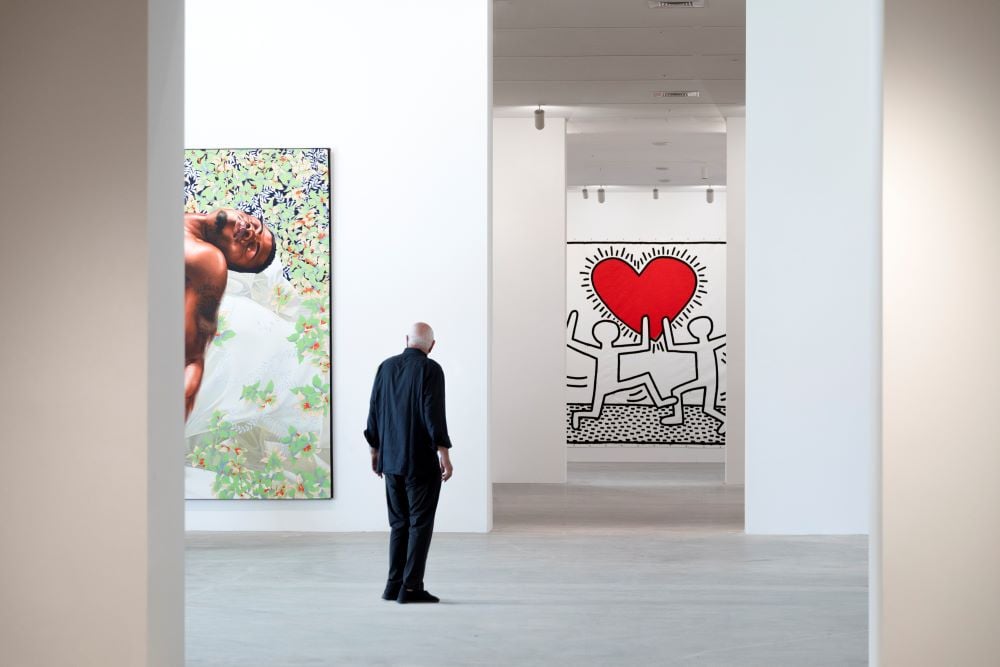
Don Rubell in front of work by Kehinde
Wiley and Keith Haring at the Rubell Museum. Image courtesy of the
Rubell Museum.
Early Investors
The Rubells’ real estate
windfall in Wynwood echoes the shrewd investments they’ve made in
art collecting—and in Miami, the two industries are often
intertwined. Over the course of more than 50 years, Don and Mera
have built a reputation for investing in emerging artists deeply
and cheaply, then watching the value of their holdings
ascend beyond their range as the masses eventually caught on. The
prescient acquisitions in the Rubell Museum’s inaugural exhibition
are a highlight reel of their ability to spot greatness in its
nascent stages: a 1979 Jeff Koons vacuum, early-’90s Catherine Opie
portraits, a 1999 woodcut by Kerry James Marshall.
“There is no such thing as a
great young artist,” Don once
said. “There are only
artists with potential.”
For longtime friend and dealer
Jeffrey Deitch, the couple represents a bygone, albeit idealized
era of collecting, “when buying a work was such a significant
endorsement,” he says. “It wasn’t like today, where an artist comes
on the scene and within six months, there’s a waiting list of 200
people.”
Never having hired an art
advisor, Don and Mera, respectively a former gynecologist and
teacher, constantly seek new talents on their own, visiting young
unknowns in their studios and spending the time to understand both
the artist and the work. “[Mera]’s like Howard Stern,” says
gallerist Michele Maccarone, who sold the Rubells works by Nate
Lowman and Trulee Hall before either had their first solo shows.
“She’s somebody that’s able to do this phenomenal interview and get
everything out of you. Moving forward, I don’t know if there’s a
real collector couple or collector that has that kind of
passion.”
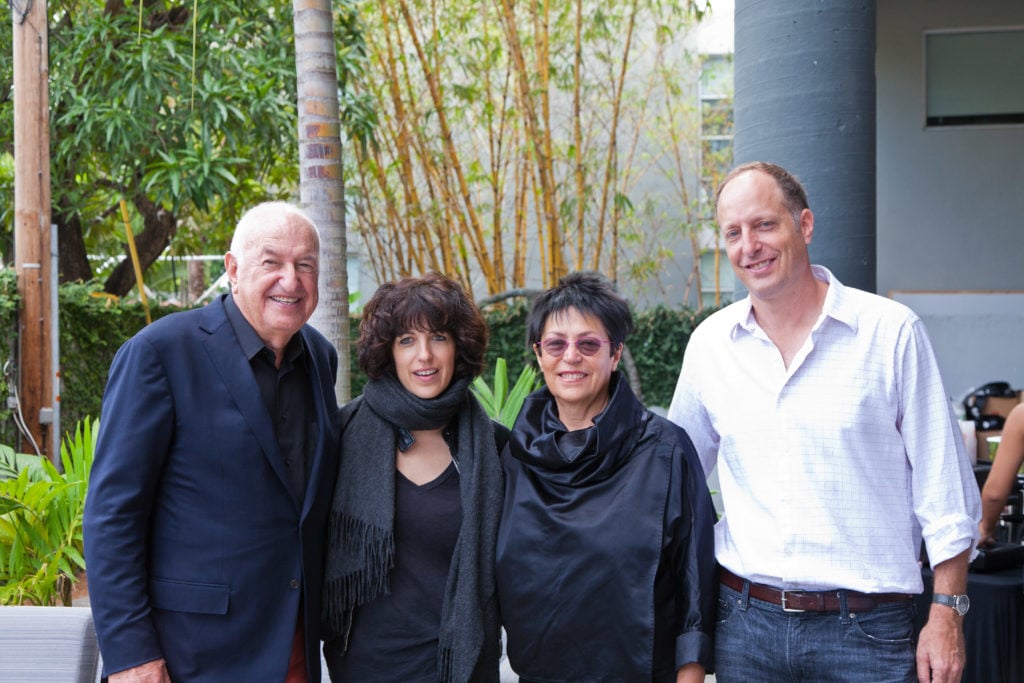
Left to right: Don, Jennifer, Mera and
Jason Rubell. Photo courtesy of the Rubell Family Collection.
Despite the Rubells’ being
earnest, diligent collectors, speculative frenzies tend to form in
their wake. They’re euphemistically described as “instilling
confidence” in a young artist’s market, while their role as
bellwether has cut a path for sheep trying to emulate their success
at unnatural speeds—the newly minted collector who is flipping
works based on their latest acquisitions, as well as the
overzealous developer hoping to gentrify working-class Allapattah.
For better or worse, as the art world hits record size and speed,
the Rubells’ influence now has greater repercussions than
ever.
The Rubell Effect
According to Mera, the Rubells
bought their former DEA warehouse looking to consolidate their
collection, not to show it. At the time, maintaining their
constellation of storage units in New York “was costing us a lot of
money,” she recalls, “and it was literally like having your
children in an orphanage.” Their son Jason, who had just exhibited
his own collection as his senior thesis at Duke, encouraged them to
open a private museum, and today, each acquisition requires the
unanimous approval of all three.
Despite the Rubells’ trove of
early blue-chip works, collecting is not the family business. The
Rubell Museum functions as a nonprofit, and Don once estimated
that they had only sold
a total of .4 percent of their holdings ever. The family income
comes from a modest real estate portfolio that includes
hotels in South Beach,
Baltimore, and Washington, DC.
They’re easily outspent by
wealthier buyers; Mera names George Condo, whose work they first
collected in the ’80s, as impossibly out of range today. But much
like their Wynwood properties assured their recent $16 million
loan, the content of their collection wields tremendous bargaining
power: The Rubells enjoy the standard institutional discount of 20
percent, sometimes more, as they buy early and in bulk, sometimes
taking sweeping shares of emerging artists’ markets before they’ve
had their first gallery shows. They still sometimes negotiate
payment plans—five monthly installments for 35 works from an artist
they began collecting last year, for example—because artists and
dealers, eager to share in the prestige the Rubell Collection has
accrued, are willing to comply.
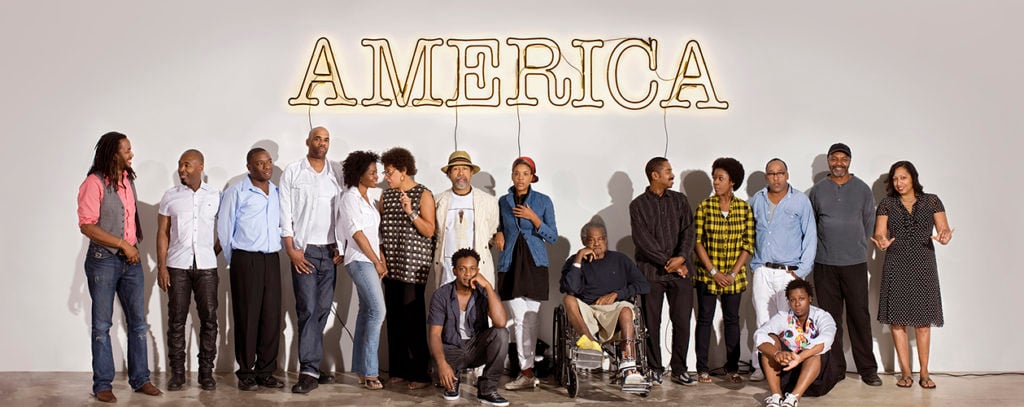
30 Americans Artists, December 5, 2008.
Left to right: Rashid Johnson, Nick Cave, Kalup Linzy, Jeff
Sonhouse, Lorna Simpson, Carrie Mae Weems, Barkley L. Hendricks,
Hank Willis Thomas (front row), Xaviera Simmons, Purvis Young, John
Bankston, Nina Chanel Abney, Henry Taylor, Mickalene Thomas (front
row), Kerry James Marshall, and Shinique Smith. Photo: Kwaku
Alston. Courtesy of Rubell Family Collection
Fellow collectors want in, too.
“People follow them around fairs—they want to see who’s next,” says
artist Dan Levenson, who likens being the subject of the Rubells’
attention, however brief, to the Midas touch. On the last day of
Art Basel Miami Beach in 2014, Don placed a hold on one of
Levenson’s works at Susanne Vielmetter’s booth, which suddenly
generated a waiting list. “Somehow word got out that the Rubells
were interested,” Vielmetter recalls, “and then we had a second, a
third, and a fourth hold.” At the time, “I had had very little
exposure in commercial galleries,” Levenson says, “so it proved to
a lot of people that my work was collectible. It changed by
life.”
Public Versus Private Benefits
The Rubell Family Collection was
one of the first private museums of contemporary art in America, a
phenomenon that’s been growing more prominent around the world,
even as public museum funding is on the decline. In Miami
especially, where private museums abound, museum leaders expressed
fears of such institutions cannibalizing opportunities for public
institutions. “We’re all looking at the same piles of dollars,
we’re all looking at the same corporate sponsors,” Silvia Karman
Cubiñá, the executive director of the
Bass, said in 2017.
Cubiñá does, however, credit the
Rubells and other private collection owners with building the
bedrock of Miami’s cultural landscape. “The private collectors were
the first ones to make contact with Art Basel,” which came to Miami
Beach in 2002, she says. “It really creates a richer ecosystem for
all of us,” she adds. “We finally have an entire generation of
people has grown up with culture happening in their
city.”
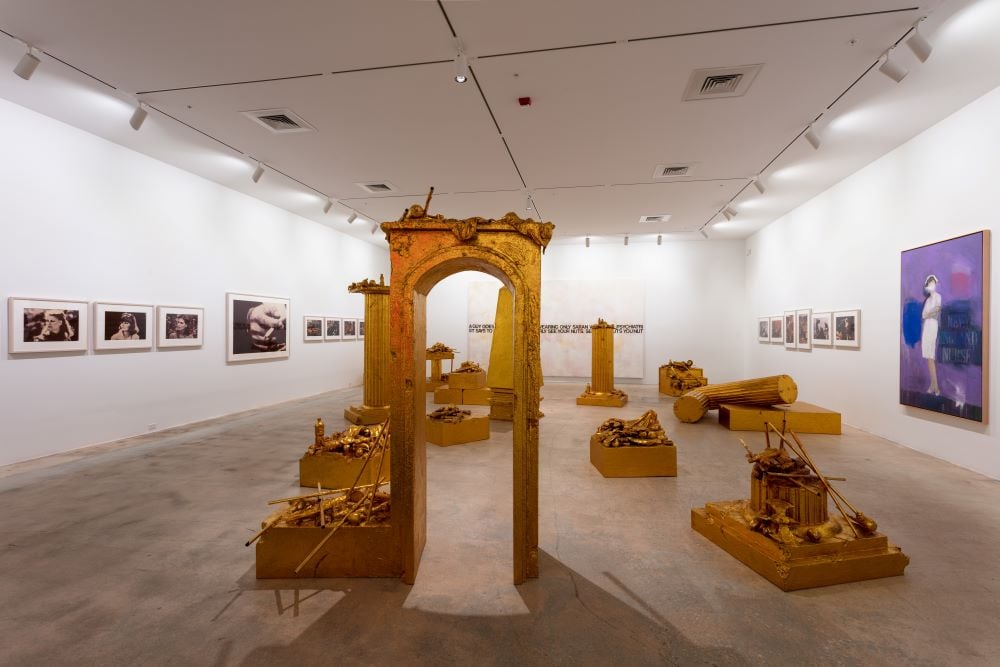
Installation view of John Miller, A
Refusal to Accept Limits (2007) at the Rubell Museum. Photo by
Chi Lam. Image courtesy of the Rubell Museum.
Opening a private museum offers
myriad benefits to the private collector, too. There are the tax
breaks, for one thing. The ordinary costs of collecting—the
purchasing, shipping, and storage of art—are all tax deductible. In
2015, the Senate Finance Committee’s inquiry into
whether the benefits for
museum owners like the Rubells, Eli Broad, and Peter Brant
outweighed the benefits to the
public proved to
be largely inconclusive. “I think it had a sobering effect on many
of these entities, reminding them of their absolute obligation to
be creating a public benefit,” Stephen Urice, a professor at the
University of Miami School of Law, says of the inquiry.
(Incidentally, his statement
echoed a line from a recent Rubell press release, which reads: “The
Rubell Family Collection has formally been renamed the Rubell
Museum to emphasize its public mission.”)
Arguably the greatest advantage
of a private museum, however, is the ability to maintain total
control over the acquisition and display of art, plus the outsize
power it affords individuals to steer the attention of the art
world. A residency or solo exhibition with the Rubells comes with
the exposure and validation of a traditional museum—and often
magazine profiles, new gallery representation, and solo booths at
the coinciding Miami fairs, even for artists who are only recently
out of school. In 2017, the Rubells bought 22 works from
then-27-year-old artist Allison Zuckerman and offered her a solo show and residency in their space.
Before that, according to her gallerist Marc Wehby, “She had never
sold anything. Ever.”
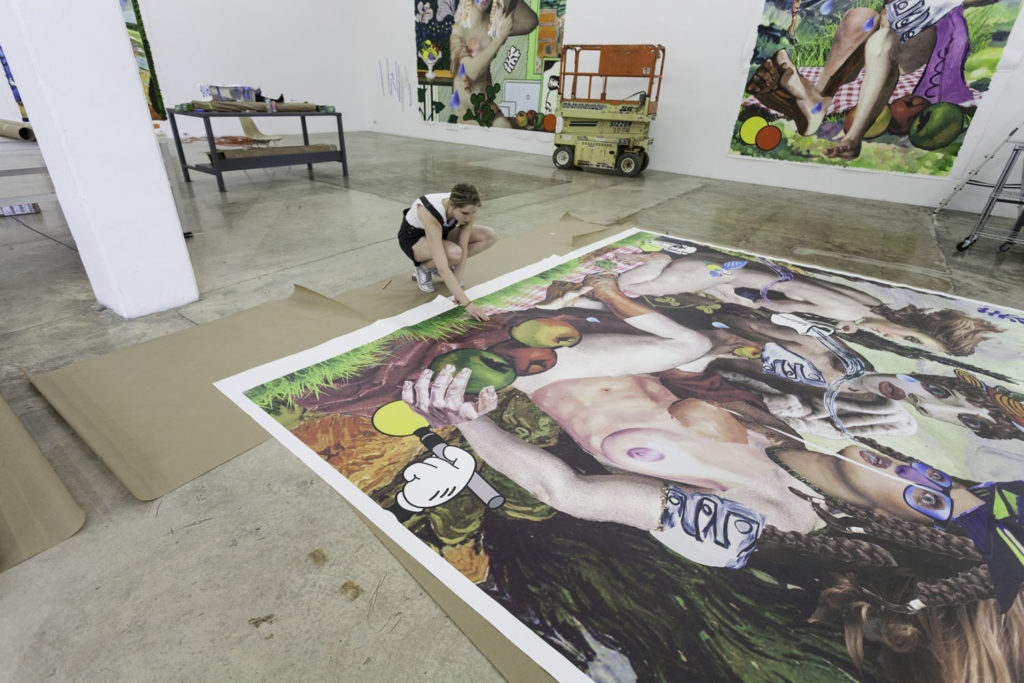
Allison Zuckerman at the Rubell Family
Collection in the summer of 2017. Courtesy of Kravets Wehby Gallery
and the Rubell Family Collection.
Without the delays of museum
bureaucracy, private museums have a way of fast-tracking prominence
in the art world at ungainly speeds. Following Oscar Murillo’s 2012
residency and solo exhibition at the Rubell Family Collection,
works by the artist (who was also 27 at the time) racked up an
astonishing $4.9 million in auction sales the following year, and
representation by mega-gallery David Zwirner followed the year
after that.
All the while, however, art
press derided his paintings and installations as “obvious and
generic” and
“student
work,” and the artist
himself became the poster child of the Zombie
Formalism Apocalypse—a symbol of a dynamic in which
hollow market plays push an
artist’s career into the stratosphere before they can be vetted or
validated by critics and museums. “Almost any artist who gets that much attention
so early on in his career is destined for failure,” art advisor
Allan Schwartzman’s said in an article about Murillo in
2014. “The glare is simply
too bright for them to evolve.”
Mera is quick to come to
Murillo’s defense. “Oscar’s a very talented artist,” she says. “He
went from absolute poverty to really having a tremendous successful
career, and I want to celebrate that.”
“There’s just a million reasons
why people attack you for becoming overly successful,” she adds. “I
remember the first time a Marlene Dumas painting sold for $3
million, and everybody was so antagonistic towards her. Marlene
Dumas! But then they come around.”
A New Home
The Rubell Museum’s new home is
in Allapattah, Wynwood’s neighbor across Interstate 95, where the
family already owned property. In 1993, the same year that the
Rubell Family Collection opened, it’s also where Trujillo & Sons
Quality Food bought a cluster of warehouses for $600,000 for their
own family business of food distribution. (“You’ve heard of cutting
drugs, but this was about cutting beans!” Mera quips.) The Rubells,
taken by its 80-by-80 square feet of column-free space, bought the
Trujillos’ space in 2015 for $4 million. “It was remarkably
inexpensive, especially compared to Wynwood,” Mera says. In 2016,
they also bought the property across the street for $8.4
million.
The transformation of Wynwood
was a slow burn that took place over the course of decades, thanks
to other collector-developers like Martin Z. Margulies of the
Margulies Collection and Tony Goldman, creator of the highly
Instagrammable Wynwood Walls. While the growth of Allappattah had
remained relatively stable during this time, its real estate has
recently caught fire. From 2014 to 2018, according to the
Biscayne Times, land prices in Allapattah rose from $58
per square foot to $275, stoking fears of gentrification as major
Miami developers started making sweeping purchases of area
properties. One notable new project is El Espacio 23, a new private museum
for Jorge Pérez, the developer-collector namesake of the Pérez Art
Museum Miami.
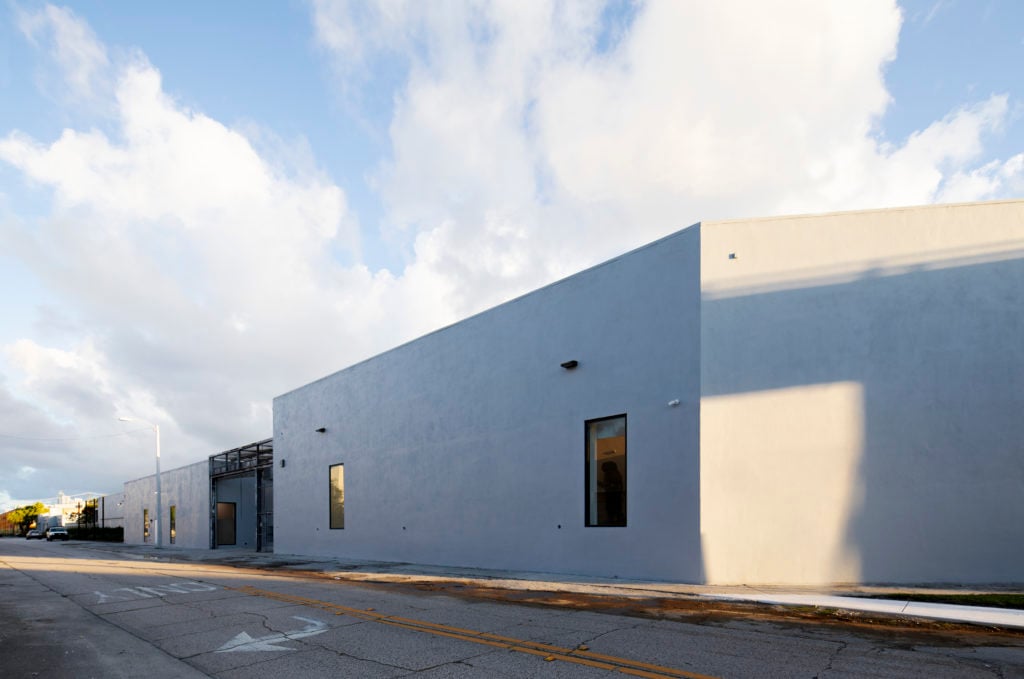
Exterior view of the Rubell Museum.
Photo: Nicholas Venezia, courtesy of Selldorf Architects.
Interest in Allapattah had been
growing organically due to many factors, says Carlos Fausto
Miranda, the realtor who brokered the Rubells’ purchase—recent
rezoning laws, its proximity to the airport, its higher elevation
in the face of rising sea levels. But the interest of tastemakers
like the Rubells and developer Robert Wennett, who hired Danish
starchitect Bjarke Ingels to convert a produce market into a 1.4
million-square-foot mixed-use development, had a big impact,
too.
“While they were not alone, the
Rubells certainly did put the area on the map for some people who
had never interacted with it before,” he says. “They’re pioneers.
They are visionary people, absolutely.”
“Things Change, and You Have to Adapt.”
Jeffrey Deitch places the
Rubells in the same historic league as legendary collectors
Gertrude Stein and John Quinn. “The number of collectors who create
an important, coherent statement, who have total engagement with
the work, and who make a major contribution to the history of
art—it’s tiny,” he says. And in the ’80s, when Mera would make a
giant vat of pasta at their Madison Avenue apartment after Whitney
Biennial openings, “it showed a kind of engagement and generosity
that was really unique. The entire art world was invited, and in
those days, the entire art world could fit in their living
room.”
The art world remained small
even when the Rubells left New York for Miami in 1990: there were
no private museums and no art fairs, and Wynwood was still an
expanse of derelict warehouses. Since then, the Rubells’ biennial
spaghetti dinner has evolved in tandem with the art world, and now
accommodates the throngs of fairgoers who descend on Miami for the
December fairs. This week, the Rubells expect to host thousands
during their annual public breakfast, which features edible work
created by their daughter, artist Jennifer Rubell.
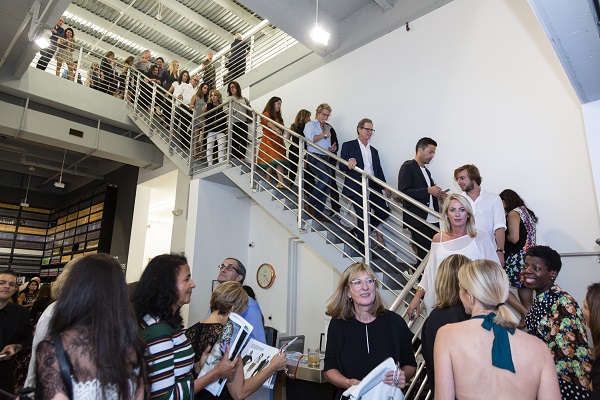
Opening party, NO MAN’S LAND, Rubell
Family Collection, Miami, Dec 2, 2015.
Photo: © Chi Lam.
Mera doesn’t question anyone’s
motives for coming into the fray. “Yeah, some people come to the
art strictly for the appreciation of value,” she says. “Does it put
more pressure on us to collect early? Yes, that’s true, but it
represents a big opportunity for the artist. I think like
everything else, things change, and you have to adapt to
it.”
For Mera, Don, and Jason,
curating the inaugural shows across the Rubell Museum’s new
galleries has been an important opportunity to look back on an
illustrious family history. “This is a story of collecting, you
know, and what we’re trying to do is bring that memory to bear,”
Mera says. “These are not just names,” she adds, vividly recounting
her first encounters with works by Jeff Koons, Robert Gober, Philip
Taaffe. “These are intense relationships that go back so many
years, and it’s not enough to just know the artist and to own the
work, but to place it so that in some small way, our witnessing of
that work in its original context brings the installation
meaning.”
As she and Don continue business
as usual, collecting remains a pricey labor of love. “Most of the
time, we can’t really afford to keep going,” she says, “but we try
to go as long as we can.”
The post The Rubell Effect: How the Miami Couple Brought the
Midas Touch to Generations of Young Artists appeared first on
artnet News.
Further reading


Leave a comment