
‘I Only Really Have Fun at My Own Parties’: Meet Tolga, the Man Who Throws the Wildest Ragers in the Art World
With the proliferation of art fairs around the world, the
traveling band of its best and brightest goes from one city to the
next, cohabitating the classic redoubts of one city one week, and
another on the other side of the world the next.
The circuit is an unending cocktail bar, only slightly tweaked
from stop to stop, continent to continent, accessed easily through
the miracle of private air travel. There have been times when I
could have sworn there was a wormhole that sends collectors from
Bemelmans Bar on the Upper East Side to Dukes in London to the
Captains Bar in Hong Kong, given how quickly they shuttle from one
to the next. And it’s the same for dinner, too: the same crowd at
their same usual tables at the Daniele in Venice or Chez Donati in
Basel or the Chateau Marmont in Los Angeles.
But after dealers and collectors break bread over hours-long
dinners at swank boîtes, there’s another global circuit: a
series of earsplitting all-night bangers thrown around the
world by one guy, Tolga Albayrak, the man who makes the art world
party. For the better part of the past decade, Tolga (everyone just
calls him Tolga) has thrown bashes at nearly every major art fair,
flying in famous DJs to spin for the cult of art collectors and
gallery owners who let loose after a long day of making millions of
dollars offloading contemporary art. This is not a cocktail affair
at Harry’s. This is a midnight-til-dawn blitzkrieg of
death-from-above electro-noise that keeps even the most buttoned-up
old-timers boogieing until the sun rises.
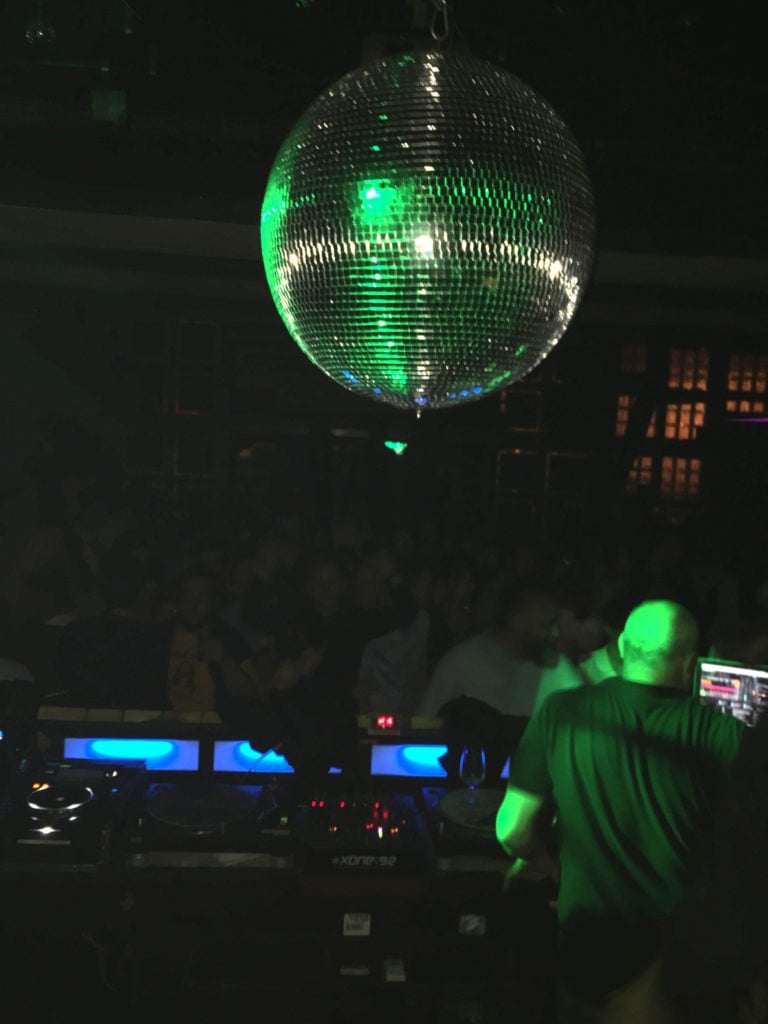
The view from the DJ booth at the party
at Hinterhof in Basel. Photo: Nate Freeman.
“You find yourself in an environment where everybody—whether
they like each other or not, whether they’re rivals or not—they’re
just having this time,” Tolga told me recently. “It’s a little
aggressive. You have to accept the music, accept the venue, but
then you’re there.”
“This might be pompous to say,” Tolga added, “but I only really
have fun at my own parties. Because I do them.”
We were chatting a few days before the opening of the Miami
edition of Art Basel, the first fair that bet that contemporary art
collecting could be more than just a hobby for the tippy top
of the moneyed elite: it could be a lifestyle—now an Instagrammable
one—that could attract non-collectors who just want a piece of the
action. It’s also the site of one of Tolga’s Director’s Cut
parties—the crown jewels of his party empire—which he throws with
Marc Spiegler, the director of Art Basel.
When it came time to talk again, Tolga and I were on different
continents—he was in Paris, I was in Washington, DC—so we spoke on
the phone. I’ve known him for years, and have had the pleasure of
attending a dozen or so of his parties. In November, he threw a
party at the Public, a hotel on the Lower East Side, for Performa,
the performance art biennale. I found him in the middle of the DJ
booth. A house remix of an ASAP Ferg track was sending
wob-wob-wob thuds blasting over the speakers. The sound
rattled empty champagne flutes on tables. Waitresses were carrying
vodka bottles in steel ice buckets, and the bottles were outfitted
with sparklers that flickered in the air. As a miasma of art
dealers and Performa patrons swanned around him, Tolga—who has long
lived in France but is Turkish by birth, and possesses the sly,
crinkly-eyed smile of a bad guy in a Godard flick—brought me into
the DJ booth to survey his domain of raging. Suddenly he grabbed me
by both shoulders and yelled, “Great party, right!”
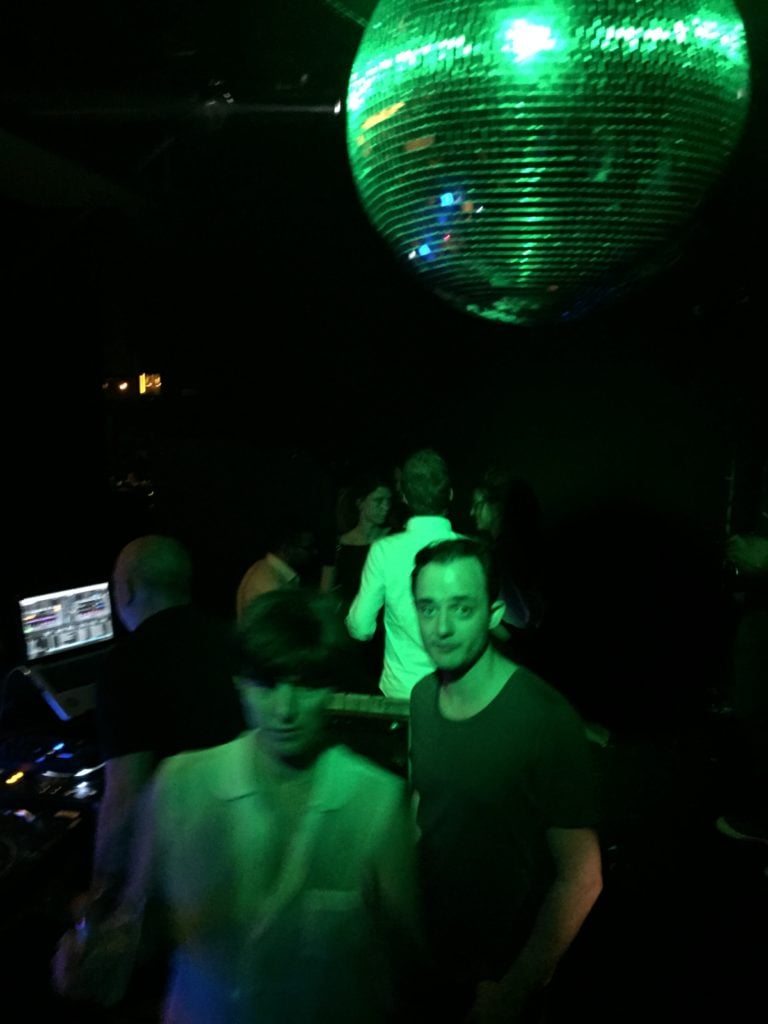
Tolga at Hinterhof, in Basel,
Switzerland. Photo: Nate Freeman.
“Complete Debauchery”
Many in the art world have wondered where, exactly, Tolga came
from. After graduating from school, he worked as a party promoter
in Paris, principally with graffiti artist André Saraiva at Le
Baron, a club Saraiva opened in a former strip joint in 2004. By
2007, Saraiva had partnered with Art Basel global director Sam
Keller and French mega-dealer Emmanuel Perrotin to open Le Baron
pop-ups in Venice during the Biennale, in Miami during the fair,
and in Basel on Das Schiff, a moored boat on the river on the
outskirts of town that hosted parties raucous enough that it always
felt like the whole thing was one sick DJ drop away from snapping
off its chains and floating down the Rhine.
Tolga helped stage those pop-ups, running the music and busing
in scruffy models and hip artists. In 2012, he was called to New
York to open a permanent Le Baron on the edge of Chinatown. (That
Le Baron, along with the original Paris locale, have since closed.)
But Tolga left after six months, and by 2013 he was feeling
restless. In May, during the second edition of Frieze New York, he
set up a project with the artist Tobias Rehberger, a
bar/performance at the Hotel Americano in Chelsea where he rebuilt
a watering hole he likes in his hometown of Frankfurt, but this
time in the middle of New York’s main gallery district.
By then, the Le Baron outposts were flagging. Saraiva’s original
partner-in-crime, Sam Keller, had left Art Basel to head up the
Beyeler Foundation, and handed the mantle to Marc Spiegler. And
Tolga said that, when Le Baron did show up, the exhibitors and
dealers couldn’t even get in.
“There was something missing. You were doing a party, but there
were a bunch of people who were treating Miami Art Basel as a
festival, just a thing to go to at that period of the year,” Tolga
said. “None of the real people—the artists, or the galleries, or
the real participants who were in the fair—they weren’t coming.” He
added: “We hated the music.”
As it happens, Spiegler is, like Tolga, a dance-music fanatic
and connoisseur of the world’s top DJs. So they thought of a way to
bring these elements to art fairs.
“We just sat down and we said, ‘Why should we not create what we
want, tailored to our aspirations?” Tolga said. “So we said, ‘We’ll
do a private party, only invite my friends, and Marc’s friends’—and
also Marc’s clients, the galleries—and we’re going to have our
music, dictated to the crowd, whether they like it or lot. We pick
the best specimens. We got the best DJs in the world. But they play
with fake names, so nobody knows who they are until they show up.
Even if you don’t like that, you come, you listen, you be present,
and you can’t help yourself because it’s so good. We have the best
people in the world that do that.”
But while Spiegler is still a strong supporter, he told me that
when it comes down to it, the whole thing is Tolga’s show. And
nowhere is that more clear than at the party in Basel. Tolga found
the venue in 2013, when he was asked to do the music for a party
thrown by Keller’s museum to honor Maurizio Cattelan, who had a
show up that year. Called the Hinterhof (German for “backyard”), it
was a warehouse bar down a lonely highway that shoots out of Basel,
and it was done up into different theme rooms: a love-themed room,
a tiki-bar room, and so on. Tolga and Spiegler liked the venue, and
decided the next year, he would take over the Hinterhof for what he
called “Tolga’s Fair Club.”
I was there in 2014. It was my first exposure to the rare charm
that Tolga’s events can have, the way his parties can turn the
well-heeled dealers and collectors who just hours earlier stalked
the aisles of the world’s most prestigious art fair into dancing
madmen, many chaining cigarette after cigarette, dancing
beside bottles of tequila in buckets behind the DJ booth.
“Nobody did that in Basel, nobody was doing a party like that,”
Tolga said. “There were some parties, but it was civilized—it was,
like, dancing after a dinner. The party we did at Hinterhof was
complete debauchery.”
A scene from the party at Hinterhof in
Basel. Photo: Nate Freeman.
“I Actually Do It for Myself”
Tolga threw other parties besides those at the three branches of
Art Basel, mostly because friends (and paying clients, such as BMW)
wanted to retain his services. There were parties at the Boom Boom
Room and Happy Ending, the now defunct Chinatown nightclub. In
2015, there was a party at That That, a Dallas apartment gallery
that acted as a salon for those in town for the Dallas Art Fair.
There were Tolga’s Fair Club parties at the Condesa Hotel in Mexico
City during Zona Maco, and Scotch of St. James in London during
Frieze.
In 2016, he launched a Director’s Cut party in Hong Kong at
Volar, a famous after-hours spot in Lan Kwai Fong. The Hong Kong
edition has become particularly notorious. In 2018, I arrived to
see that a massive police raid had been sicced on the nightclub,
forcing myself and those in my car—some editors, a prominent fair
director, and the director of a very important Chinese museum—to
wait out the authorities by drinking cans of Sapporo at the
7-Eleven across the street.
In Miami—a city where the mania of the lifestyle birthed by the
fair’s arrival has now drowned out the art itself—Tolga bends over
backwards to cater to Basel’s exhibitors and their staff by having
the party on Sunday, after the crowds have left. Spiegler said that
it’s critical to have such a party fall at the end of the week.
“The idea for the event was to do an informal night towards the
end of the fair with great music, no guest list, and no door
policy—a place where all of our gallerists, their staffs, the Art
Basel team, and all the other people who work all week can relax
and have fun together,” he said.
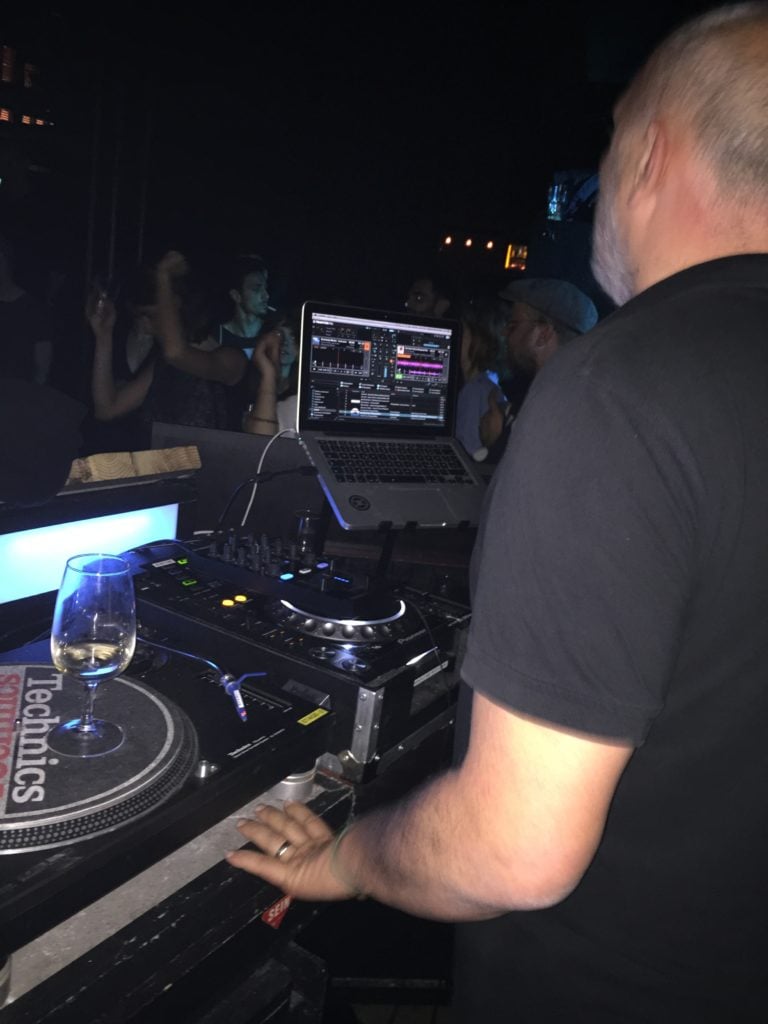
The DJ booth at the party at Hinterhof
in Basel. Photo: Nate Freeman.
It’s held at Wall, the venue deep inside the W’s South Beach
complex that plays host to some of the week’s starriest events, and
boasts one of the best nightclub sound systems in a city with a
hell of a lot of nightclubs.
“It’s a bottle club, they sell tables, and two nights before my
party, Paris Hilton is fucking DJing there,” Tolga said.
And all the parties stay true to the original mission of
prioritizing the music over anything else. (Sorry, Paris.)
“You’re sipping on Casa Dragones and you’re listening to Dixon
or DJ Terrence and you didn’t even know they were going to be
there—and they’re playing together, which has never been
seen before,” Tolga said. “It’s this thing now. Even the biggest
collectors in Germany and whatnot, they’re telling me, ‘Oh I went
to see Dixon.’ It’s like going to a three-star Michelin
restaurant.”
It’s those three Director’s Cut parties—in Miami, Hong Kong, and
Basel—that will remain the crux of Tolga’s empire going forward.
And he wants to keep them going for as long as the fairs are
going.
“I actually do it for myself,” Tolga said. “I’m a little bit
egotistical about it, because this is what I like, and I want to
live it.”
He paused, and the phone line went silent for a second.
“But, it’s not that serious,” he added. “It’s just a party.”
The post ‘I Only Really Have Fun at My Own Parties’: Meet
Tolga, the Man Who Throws the Wildest Ragers in the Art World
appeared first on artnet News.
Read more https://news.artnet.com/art-world/tolga-albayrak-interview-party-1720266
Further reading


Leave a comment