
The Art Industry Is Grappling With How to Shrink Its Carbon Footprint. But Will Collectors Do Their Part?
This past Friday, hundreds of
thousands of people marched around the world for the global climate strike.
Around that same time, convoys of artworks crossed the Florida
border for Art Basel Miami Beach, where they will stay for just
under a week before being scooped up and shipped out again to
various collectors’ storage nodes and homes around the
world.
Despite the art world’s
self-image as a socially conscious avant-garde, its structure is
becoming increasingly untenable. Jet-setting from fair to fair is
an obvious polluter (and the private jet travel preferred by
collectors is by far the most polluting),
but the shipping of artworks, which tends to be done by truck and
air freight, is also a major culprit. Dietl International, a prominent shipping
company, will generate 1,000 metric tons of carbon dioxide due to
its shipment to Miami this year alone. For comparison, the average
US car emits about 4.6 metric tons of carbon dioxide… in a
year.
With this reality increasingly
impossible to ignore, many in the art world are trying to make
changes to the way they do business. Some artists are offering compelling
work on themes dealing with the climate; galleries are trying
to trim their waste and reuse where they can afford to; Art Basel
Miami Beach will hold a symposium on how to respond
to challenge climate-change denial this coming Saturday. Many
members of the art industry have become vocal about the
wastefulness woven into the very fabric of doing business in art.
But where, exactly, are the collectors in our current wave of
ecological awareness?
A reciprocal relationship exists
between those who buy art and those who supply
it. Greener alternatives are
needed—but the art industry can’t always afford to make changes
until collectors demand them.
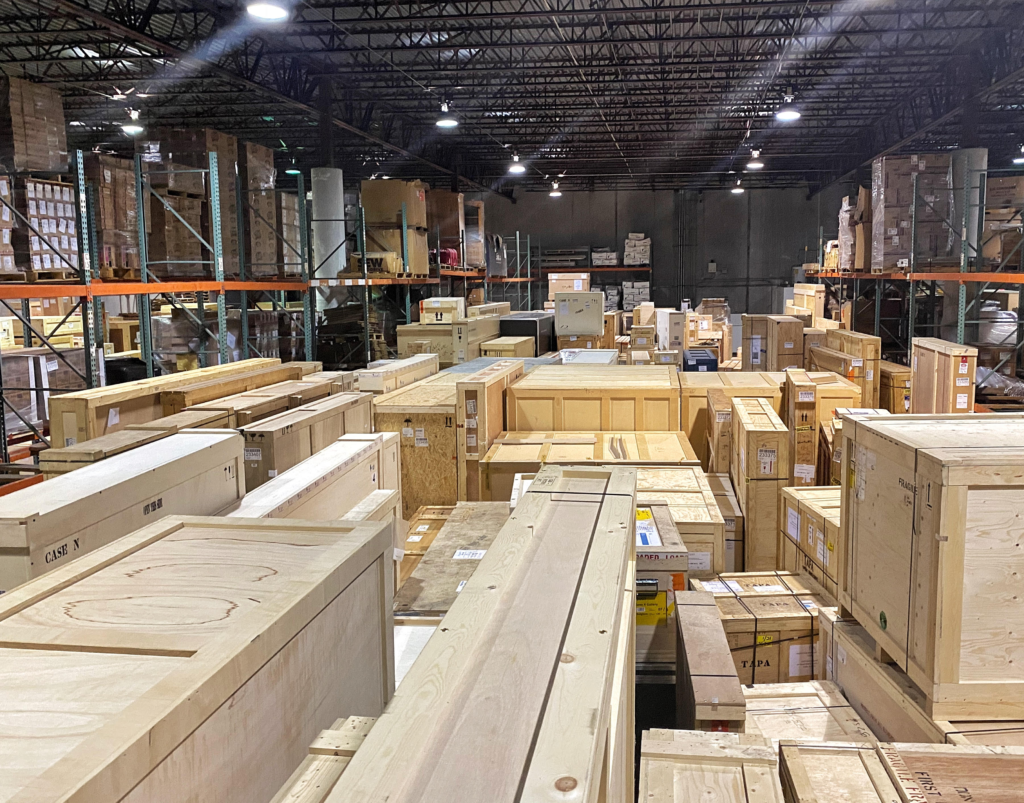
A look inside of one of Dietl
International’s warehouses.
Who Cares?
Up until now, there has not been
any serious overhaul of the way galleries and art fairs—or even
artists, save for a few—are delivering messages to collectors about
sustainability.
“From a communications
perspective, we know that people are motivated when they feel an
issue and related action connects to and supports their identity
and value system,” Christine Larivière, a climate change
communications specialist, tells me. “Many economists—and
others—believe climate action could be accelerated once the right
financial incentives are put in place.”
However superficial
transformation at the consumer level may be in the battle against
climate change, rapidly changing customer choices offer some some
modest good news: Single-use plastics have become intolerable to
today’s vanguard and short-haul flights have become positively
uncool. But, at the top end, shifting awareness and
tastes is more than a matter of a few dollars.
“Buying art is expensive. When
you first start collecting, it’s shocking just how expensive it is,
in terms of shipping, insurance, and storage,” says Lisa Schiff, an
art advisor who has been vocal about climate change. As one example
of a proactive approach, I ask what she thinks about carbon neutralizing
costs being tacked onto gallery invoices. She says that to work,
such added fees would need
to be buried in the price rather than presented as an additional
cost.
“I know plenty of collectors who
are huge environmentalists and who are changing the world, but when
they’re buying art, that’s just not where he or she may be putting
their energy,” Schiff says. She stresses that, in her mind, the
onus is on galleries, the suppliers, rather than on collectors,
their consumers.

Installation view of Jamie North’s
exhibition “Inflection” at Informality, London.
To be sure, consumers play a
small role in the massive upheaval needed to slow the climate
crisis, but they are nonetheless a force for change. Collectors are
the ones who ultimately support all the ideas and objects being
flashed across iPads at Art Basel. In turn, it should follow that
their demands might incentivize galleries to make changes that
would otherwise feel unwise in a very high-stakes market,
especially for small to mid-range galleries with perilously thin
profit margins.
“A lot of these conversations
may move forward if started by the collectors,” says Bruno Brunnet,
a veteran dealer and co-founder of Berlin’s Contemporary Fine Arts,
who represents artists like Georg Baselitz and Huma Bhabha. But he
admits that collectors have, so far, been mute on the subject: “We
have not had any requests for greener shipping or hesitation to
travel on sustainable grounds from any collectors, though these are
conversations we would be open to.”
He’s far from the first gallery
owner to tell me that. Some 15 art dealers said that not
once had a collector
inquired about more environmentally efficient shipping options and
only a few had asked about reusable packaging.
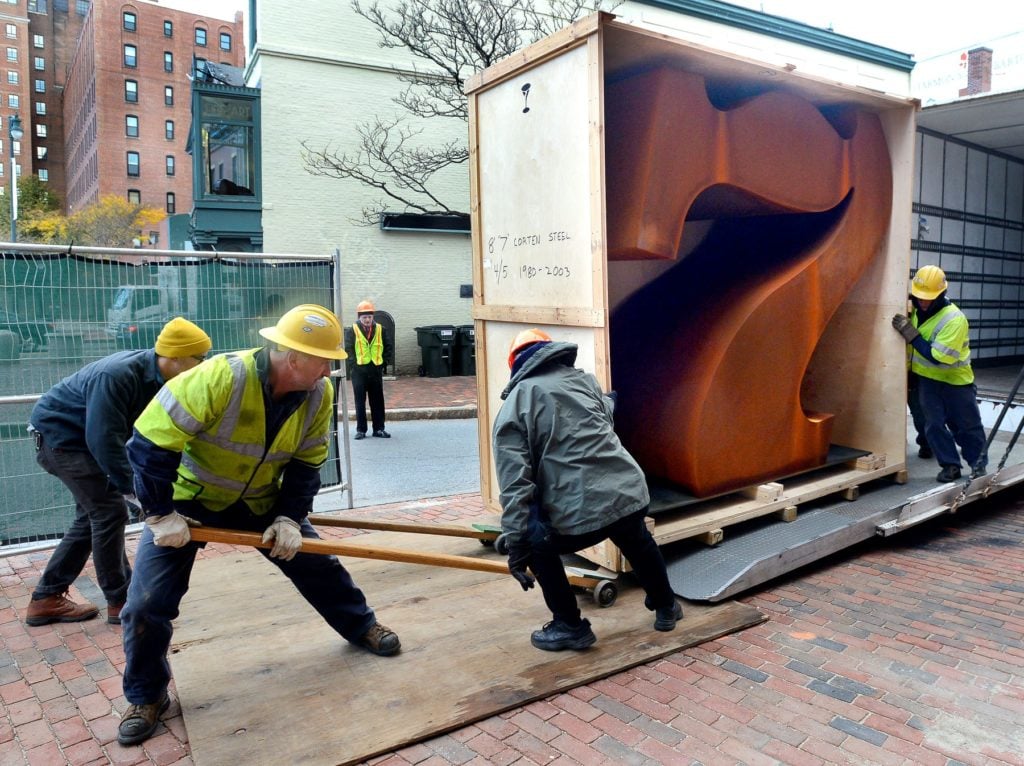
Workers remove the sculpture from its
packing crate as the Portland Museum of Art installs an 8 foot tall
steel “Seven” sculpture by Robert Indiana. Photo by John
Patriquin/Portland Portland Press Herald via Getty Images.
The Problem of Moving Art
You can worry about plastic
straws at fair cafes and bleached paper press releases all you
like, but shipping art around the world (and art-goers—but
that’s a story for another day) may be art’s dirtiest
secret.
“No one’s going to pay twice for
an organic banana—to be sustainable, it has to be reasonably
competitive,” Fritz Dietl tells me over the phone from New York.
Dietl is president of the eponymous art shipping company Dietl
International, one of the largest in the art industry. He is
optimistic that his sector can become more sustainable, pending
demand for more ecologically-minded shipping, which he says is
growing. Ahead of Art Basel Miami Beach, Dietl’s team has organized
a 747 charter to fly from Luxembourg directly to Miami, as opposed
to going through Atlanta or New York, the usual art transportation
route that requires more carbon dioxide-emitting ground
travel.
Products like RokBox, a reusable
crate that is lighter (and safer) than a wooden box, are also
popping up. These can make a big difference. “The total weight
of the combined shipments is approximately 60 tons. If all items
had been packed in reusable lightweight RokBoxes the actual weight
would have been reduced by about 20 tons,” says Dietl. “The CO₂
emissions would have been reduced by about 75 to 100
tons.”
Dietl is organizing about half
the floor at Art Basel Miami Beach, so it’s crunch time when I talk
to him. Still, he seems eager to take the time to parse out the
details of CO₂ emissions in the art industry. “This is not
something talked about a few years ago, and in the art world you’d
be hard-pressed to find a climate change denier,” he says. “But
this comes down to the bottom line: When we offer green solutions,
we need to find cost-effective ones, especially for galleries who
are on the edge of profitability.”

Christine Wang’s Oscar (2019).
Acrylic on canvas. Courtesy Nagel Draxler.
A Learning Curve
Young galleries are just as
concerned as larger and more established ones, despite concerns
over expenses. Every gallery I spoke to expressed a sense of
urgency about addressing the question of short-haul flights and
short-term fair attendance, and discussed different ideas for how
to minimize waste, from ditching bubble wrap to offering virtual
exhibition spaces.
When it comes to shipping, most
galleries seem unsure what the extra expenses might be and unaware
of greener options, a point echoed by collectors as well
(shipping costs for a
purchased work are usually always covered by the collector). If
that price is deemed prohibitive, then galleries, who tend to
organize the shipping, pushing more expensive options could
alienate clients. This is part of why the conversation has not
yet made the leap from galleries’ offices onto the fair
floor. Two collectors told me they had never been offered
CO₂-neutral shipping options or alternatives to the usual
disposable crate and air freight option.
The onus may then fall on the
collector to ask for these numbers, but also on shipping companies
to make clear what options are even available. It’s a feedback
loop, but it needs to start somewhere. “I think that the collectors’ impact could be
huge,” says Johannes Sperling, a young dealer from Munich. “Imagine
them not flying around the globe anymore; or boycotting galleries
that go too crazy when it comes to shipments and
flights. It would also
be possible to give better prices to galleries who are not shipping
tons of works around the globe.”
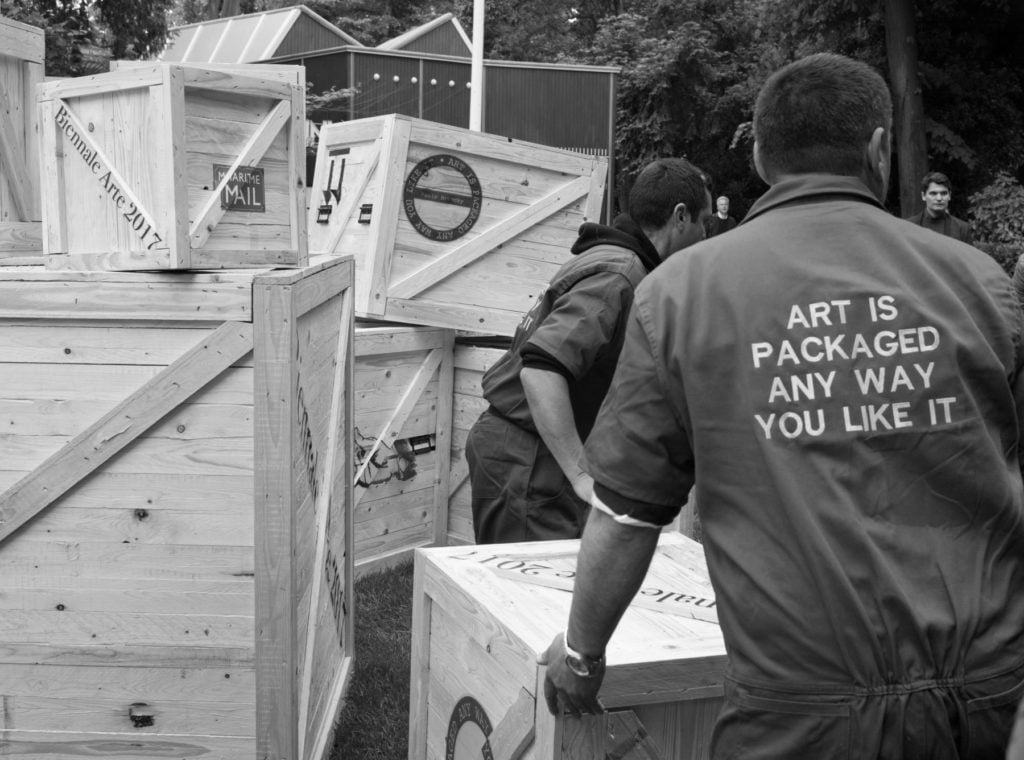
Workers transport wooden crates
containing artwork at the Biennale Giardini on May 11, 2017 in
Venice, Italy. Photo by Marco Secchi/Getty Images.
“We aren’t yet at the point
where collectors expect any details from us related to our carbon
footprint or how their acquisitions with the gallery might affect
their own footprint,” says Thaddaeus Ropac. This year, his gallery
invested in additional storage space so it can re-use bespoke
crates that are typically disposed after each
use; the shipping
companies they work with, he notes, only share the carbon footprint
after the shipment’s completion. “I’m aware that there will be
additional costs incurred to get the results, but I’m willing to
swallow this out of principle,” he says.
Dietl will be at the fair during
the preview days meeting with clients, and greener shipping is
going to be one of his talking points. But he says it is harder to
woo collectors on the subject, particularly because in the majority
of cases once they own a work, the piece does not travel that much.
Most of the shipping is to and from the fair, and not much beyond
it, so reusable crates and CO₂-neutral considerations may not be
the first concern that comes to mind.
Hopefully, with a little bit better branding, perspectives can
be shifted and awareness raised about transport costs at every
stage of an artwork’s life.
“To be honest, no, I never asked about [alternative shipping
methods], mainly because I didn’t think that there would be an
option,” collector Christian Kaspar Schwarm says. Still, as with
other collectors I spoke to, even the suggestion of better
choices brought an encouraging response. “I think I’ll ask for more
sustainable shipping options in the future,” he concluded. “No
industry should be too small to take care of our planet.”
The post The Art Industry Is Grappling With How to Shrink
Its Carbon Footprint. But Will Collectors Do Their Part?
appeared first on artnet News.
Read more https://news.artnet.com/art-world/art-shipping-carbon-emissions-collectors-1719063
Further reading


Leave a comment