
Museums Have Yet to Embrace Augmented Reality. But Microsoft Wants to Help Them Use It as a Tool for Education and Social Justice
In the art world, it’s hard to say whether folks are
legitimately thrilled, frightened, or simply perturbed by the
overwhelming rise of AR/VR and AI technologies.
Certainly, these sentiments have been explored ad nauseam by
both artists and critics over the past decade, and perhaps even
more prominently in the past few years. Moreover, the inclination
to make art that speaks to ills and tribulations of AI in our
society is fairly common. (Take American Artist and Lynn Hershman
Leeson’s insightful works about the draconian practices of predictive policing
technologies as a recent example.)
As for art institutions, perhaps not surprisingly, they have
taken a more optimistic and, of course, pragmatic approach to these
burgeoning technologies. Leading the way to creating a happy and
symbiotic relationship between art and tech—at least
hypothetically—is Microsoft.
Just last month, in conjunction with the release of the HoloLens
2, the company’s latest mixed-reality headset device,
Microsoft, in partnership with the Museum of History and Industry
(MOHAI) in Seattle, opened the exhibition “Mont-Saint-Michel: Digital
Perspectives on the Model,” an immersive, mixed-reality
experience of the titular UNESCO World Heritage Site. It was a
chance, perhaps, to get a glimpse of what a tech-augmented future
might hold in the galleries.
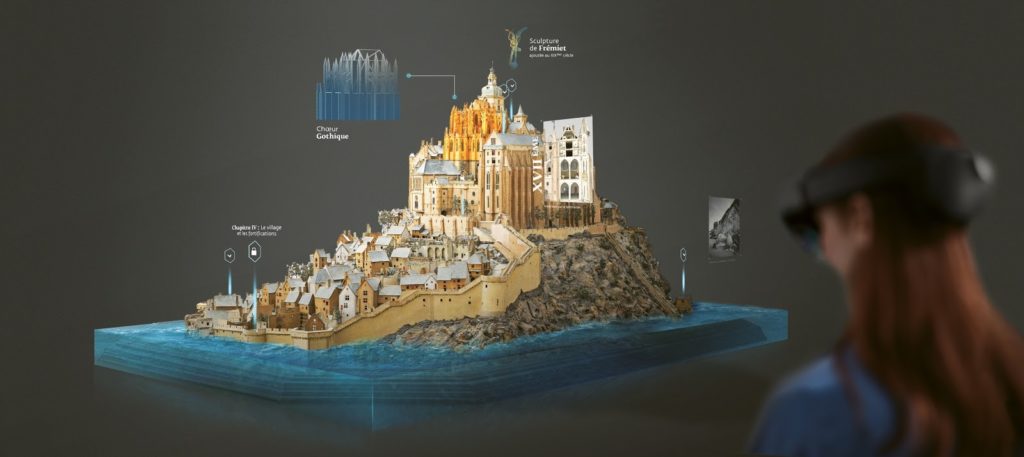
Detail of the digital rendering for the
model of Mont-Saint-Michel. © Microsoft – Iconem – Musée des
Plans-Reliefs
A New Window on History
The exhibition, powered by Microsoft AI and mixed-reality
technologies, takes as its starting point a 17th-century maquette,
or three-dimensional map of Mont-Saint-Michel. The 3D military map,
made by hand by Benedictine monks and gifted to Louis XIV, is on
loan from the Musée des Plans-Reliefs in Paris. It is the
first time it has ever left its home country. The 1/144-scale model
sits in the middle of a small room of the museum, inside a large
custom-built vitrine.
The model is impressive on its own, but to experience the piece
through the HoloLens 2 device is worth the visit, not only because
of its tech innovations and cool visual effects, but for the
effective ways it relays information to the viewer. As a way to
learn about history, it surely beats sifting through long and dry
wall texts.
A previous version of the exhibition debuted at the Musée
des Plans-Reliefs. Apart from the upgrade in the device—the
HoloLens 2 is less clunky and more comfortable than its
predecessor, and has more interactive capabilities (which this show
does not utilize lest it overwhelm new users)—MOHAI’s is not all
that different. A docent gets you situated and set up with the
HoloLens 2, just as if you’re getting ready for a rollercoaster
ride. Then, after a short series of exercises to get you oriented
with the device, the program starts.
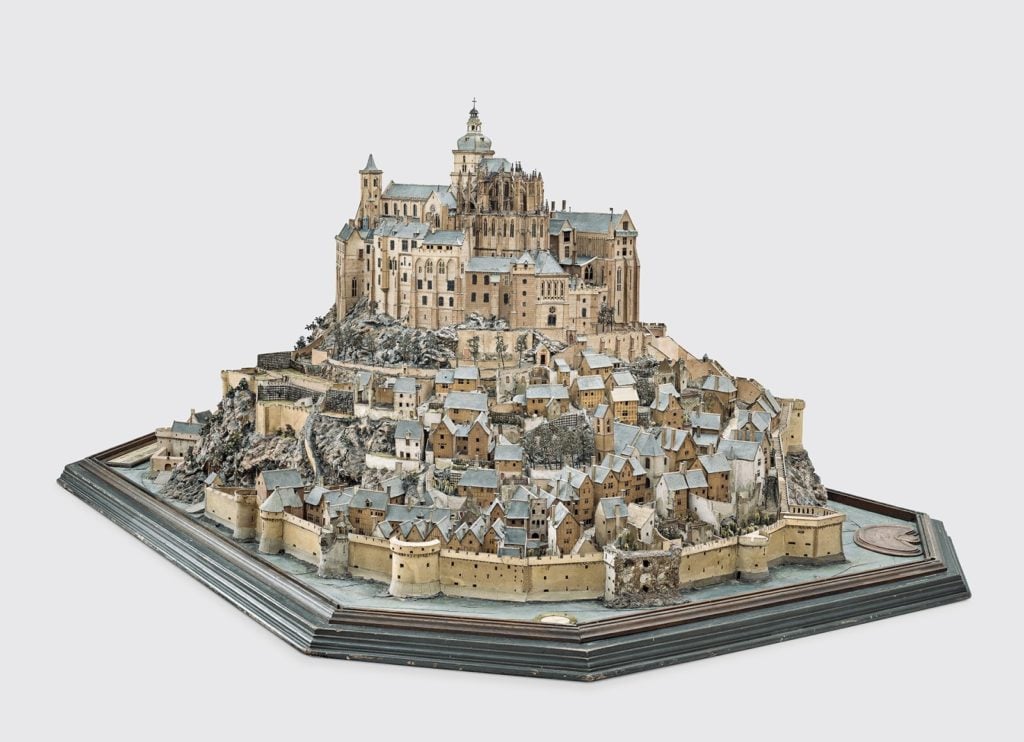
View of three-dimensional map of
Mont-Saint-Michel, ca. 1691. © RMN – Grand Palais (Musée des
Plans-Reliefs) / Adrien Didierjean
Lasting roughly 15 minutes, which is not long but not short
either, the device overlays holographic images on top of the 3D
model, with audio detailing the history of the object and the site
itself. At one point, the device overlays the entire gallery space
with a holographic copy of the abbey of the church, digitally
transporting you into the architectural space. The experience
overall is enjoyable and informative.
Augmenting the Narrative?
This is not the first time Microsoft has partnered with art
institutions and artists using its AI tech. There was, for
instance, the artist Mel Chin’s Wake and
Unmoored (2018), a two-part mixed-reality
experience (using HoloLens 1) that envisioned a future where
New York City was submerged underwater due to climate change. And
there is also Microsoft’s continued partnership with MIT and the
Metropolitan Museum of Art to create new ways for
audiences to experience the Met’s collection through AI.
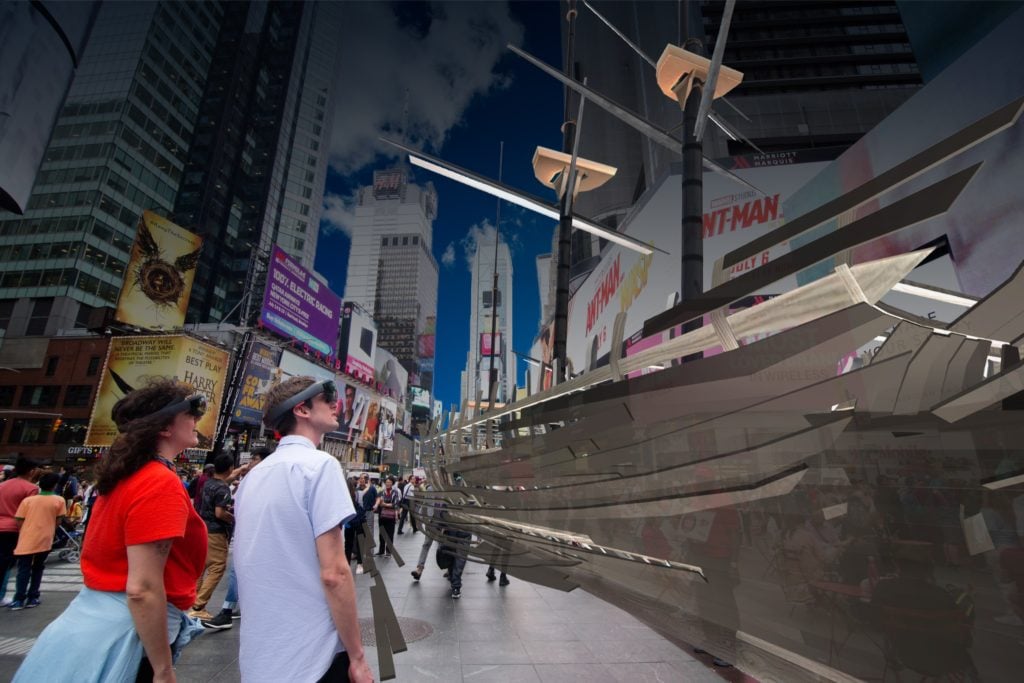
Rendering of the rebuilt USS
Nightingale in Mel Chin’s Unmoore. Image courtesy of
Mel Chin.
In Chin’s work, the subject matter was imaginative yet bleak,
which is not, perhaps, the best demo material if what you are
looking for is happy stories about the technology. Meanwhile, the
Met’s initiatives mined personal data to engage viewers with its
collection. Given paranoia about tech and privacy, it therefore
did not provoke a lot
of confidence in the positive impact of AI for its many users.
Perhaps to change the narrative around AI, Microsoft started the
AI for Good Program, a “$125
million, five-year commitment to use artificial intelligence to
tackle some of society’s biggest challenges.” Microsoft has for
some time been using AI to preserve endangered languages around the
world, and this past summer, it announced the fourth pillar of this
initiative: AI for Cultural
Preservation.
Although the Met’s collaboration with Microsoft is part of this
initiative, the Mont-Saint-Michel project feels more prescient,
using historical and architectural data to digitize endangered
historical sites, while also creating interactive experiences for
audiences to see firsthand the breadth of these developments.
Just the Beginning
But where does the technology go from here? What’s next after
this relatively modest application? More importantly, how can these
technologies make lasting impressions across different communities
and cultures? And what does that mean specifically for museums and
cultural institutions today?
This visualization of Mont-Saint-Michel is interesting as a hint
of how AR might enter into traditional museum outreach and
education initiatives in the future. But it is only a hint—and the
leading edge will be using the technology not just for education,
but also “for good.”
Recently, the Knight Foundation awarded five art institutions
$750,000 to share in the creation of “experimental projects that
explore new ways to engage audiences through immersive
experiences.” Knight partnered with Microsoft to allow these
institutions to access its AI technology and receive coaching from
AR/VR experts. The five organizations are the American Museum of
Natural History, New York; the Museum of the Moving Image, Queens,
New York; the Museum of Art and Design at Miami Dade College; the
Japanese American Museum in San Jose; and the Colored Girls Museum,
Philadelphia.
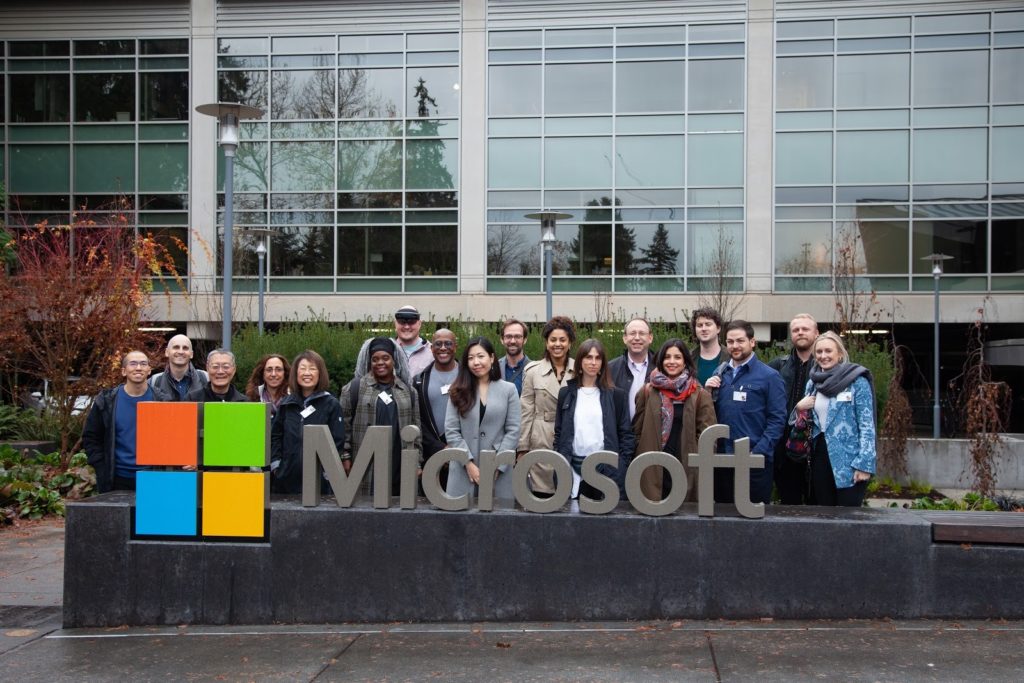
Representatives from organizations
selected for the Knight Foundation technology initiative meet and
learn from Microsoft teams in Redmond, WA. Photo: Nicole Ryan,
courtesy Microsoft.
Interestingly enough, the majority of these projects are
noticeably socially and community driven, and pretty exciting—at
least in theory. For example, the Japan American Museum will create
an AR experience that reveals the complex and multi-ethnic history
of San Jose’s Japantown, from WWII-era Japanese Internment to the
present. The museum plans to work closely with community members on
projects that will take place both inside and outside the museum,
bringing AR experience to the streets of San Jose.
Other examples include MOAD’s proposed project with collective
Forensic Architecture that will create a meta-exhibition
investigating the intersection of art, social justice, and
immersive technologies. Meanwhile, the Museum of the Moving Image
will partner with the Brooklyn-based AR/VR company Scatter to
create a volumetric immersive film about the lives of community
members in Queens.
As of now, based on the sample of what’s on show in Seattle,
it’s hard to say what these projects might look like in the future,
or if they will be successful in their respective missions. Still,
the ideas in and of themselves seem quite promising. Ultimately,
there’s no way of knowing the impact that they might have on a
given community, or how these immersive technologies may have
positive effects on the way we consume culture on a institutional
level. Perhaps it can convince the most reliable skeptics that, at
least, it doesn’t have to be all bad.
The post Museums Have Yet to Embrace Augmented Reality. But
Microsoft Wants to Help Them Use It as a Tool for Education and
Social Justice appeared first on artnet News.
Read more https://news.artnet.com/exhibitions/microsoft-ar-vr-art-museum-1737159
Further reading


Leave a comment