
The Smithsonian Just Opened a Manila Envelope and Discovered Four Yayoi Kusama Paintings It Had No Idea Existed
We don’t need to tell you how famous Yayoi Kusama is. You know
that people wait for hours to see the Japanese artist’s
gallery shows, and to take selfies in her “Infinity Rooms.” You
read about how the Smithsonian Institution’s Hirshhorn Museum and
Sculpture Garden increased membership by 6,566 percent by
staging a Kusama exhibition. You might even know that a MoMA
curator penned a children’s book devoted to her.
Now, another Smithsonian museum, the Smithsonian American Art
Museum, has stumbled upon four Kusama paintings that, strange as it
may seem, were already on the museum’s grounds, and are now the
first Kusama works to formally enter its collection.
It’s doubtful that these small pieces, none exceeding a foot
wide, will bring thousands of visitors flocking to the museum. But,
though small, they have an outsized backstory.
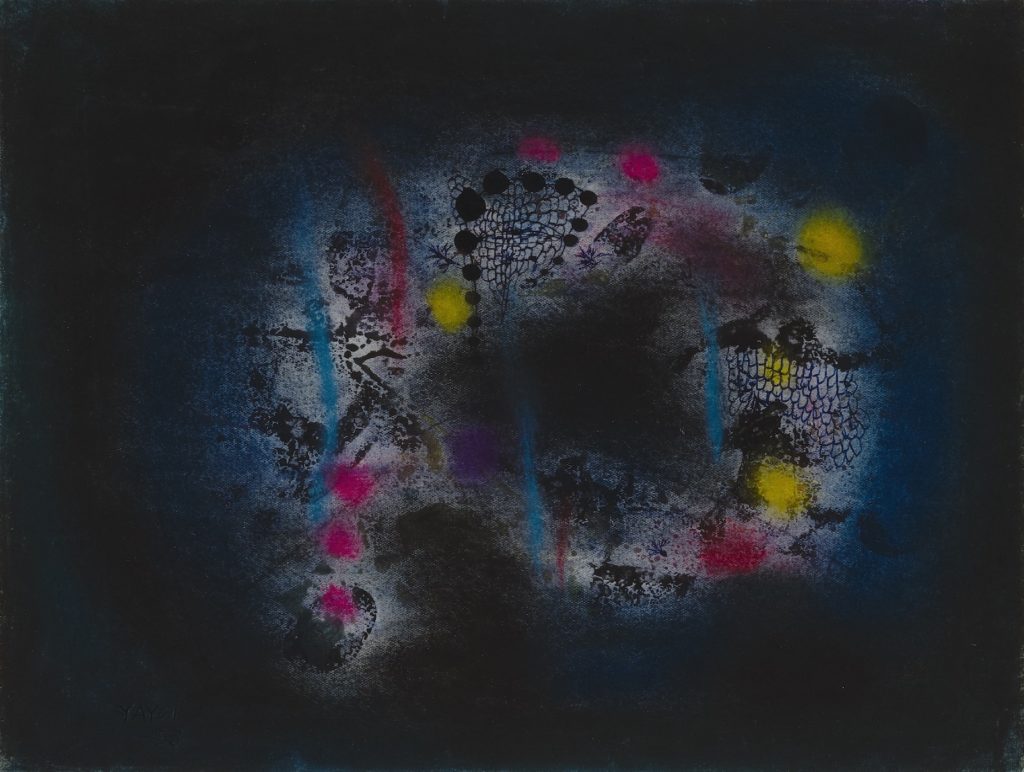
Yayoi Kusama, Forlorn Spot, 1953.
Courtesy Smithsonian American Art Museum.
Archivist Anna Rimel came upon the four pieces, executed in
watercolor, ink, pastel, and tempera paint, in a manila envelope
while sifting through the museum’s Joseph Cornell Study Center,
where they were hidden among correspondence and ephemera, said
Melissa Ho, the museum’s curator of 20th-century art.
“I got an email saying ‘You need to come look at this right
now!’” said Ho in a phone conversation.
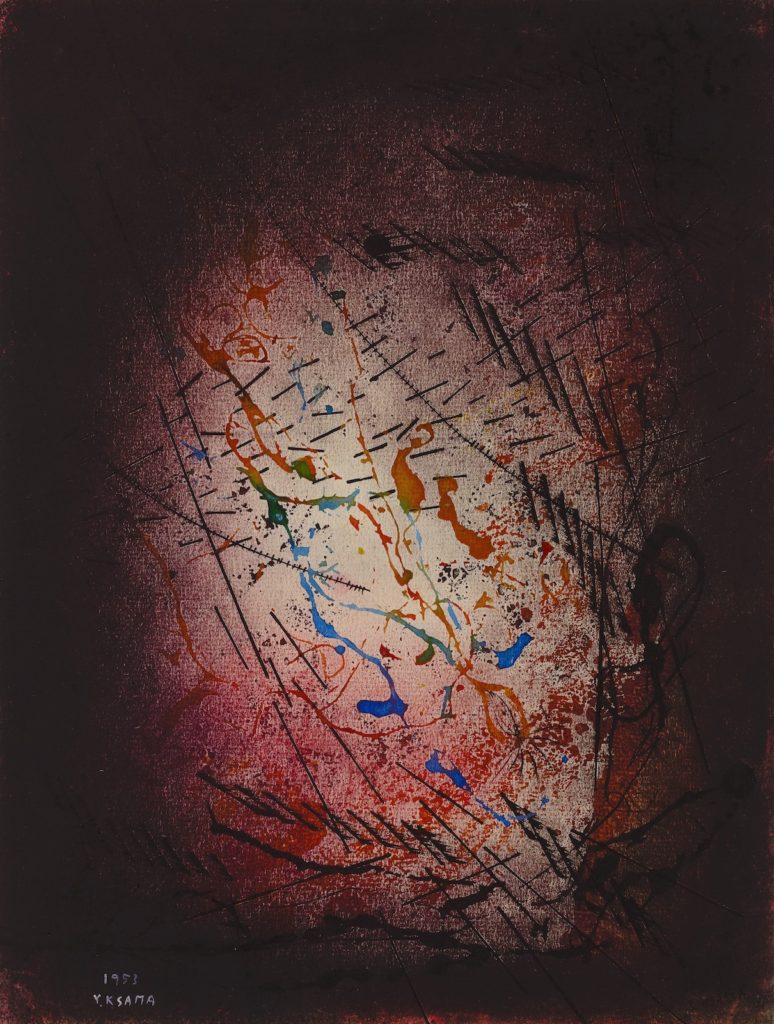
Yayoi Kusama, Autumn, 1953.
Courtesy Smithsonian American Art Museum.
Cornell helped to support the young Kusama, buying the four
newly discovered works on August 22, 1964, as recorded on a receipt
that accompanied them. He paid $200. (Accounting for inflation,
that would be about $1,660 today.) While many of Kusama’s works
express joy and are likely to produce bliss in the viewer, these
early works, dating from 1953 and 1954, when the artist was just in
her mid-twenties, are considerably more downbeat, with titles like
Deep Grief and Forlorn Spot. They are mostly
dominated by dark hues, with imagery recalling nebulae and other
cosmic phenomena.
“To me they feel like enclosed worlds, and I am thinking a
little bit of Cornell’s boxes, with these secret, hidden universes
in a very dark package,” said Ho. “Of course I’m being completely
ahistorical, since they were created earlier. But then, one
wonders, did she guide him toward these choices?”
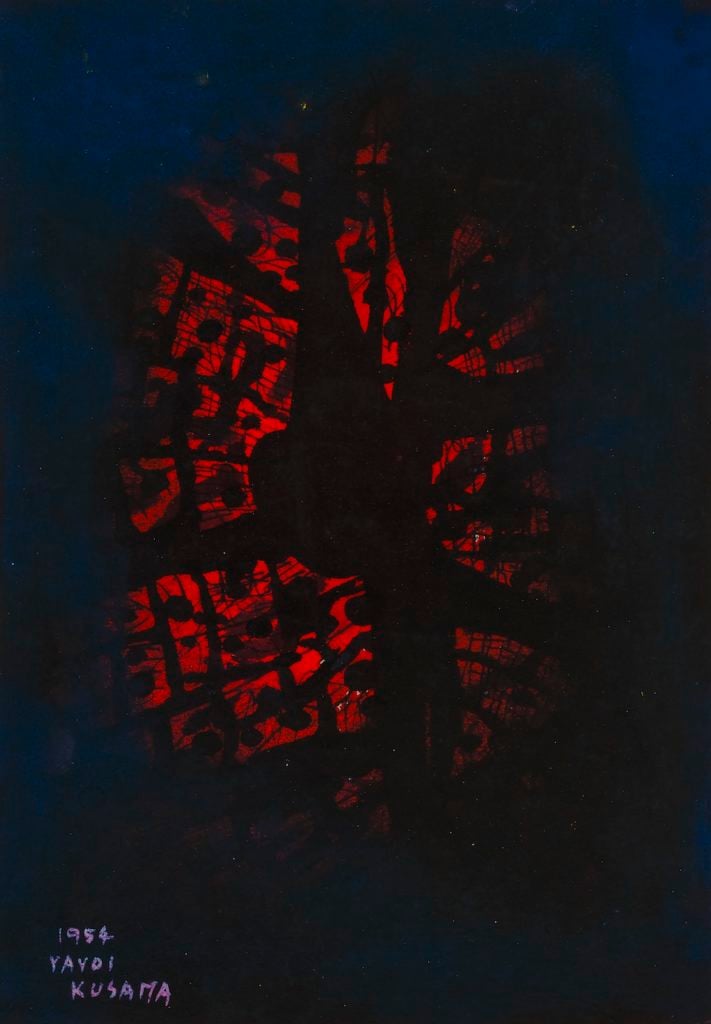
Yayoi Kusama, Deep Grief, 1954.
Courtesy Smithsonian American Art Museum.
Believe it or not, Kusama was once a struggling artist, having
come to New York with no connections but with massive ambitions and
a portfolio of about 2,000 artworks that she hoped to sell to
support herself. “I’ve seen images of her before she left Japan, at
her parents’ home with these works arrayed around her,” said Ho.
“It was through these that she had been in correspondence with
artists in the US, like Georgia O’Keeffe and Kenneth Callahan. With
that support, she was able to make it to Seattle, where she had her
first show.”
She moved to the Empire City in 1958, going on to be a prominent
figure in the New York art scene in the 1960s and ’70s, creating
sculpture and organizing Happenings and forming relationships with
many other of the major figures of the time. Four years after
arriving, she formed an intense bond with Cornell, known for his
collages as well as mysterious and beautiful assemblages contained
within wooden shadow boxes.
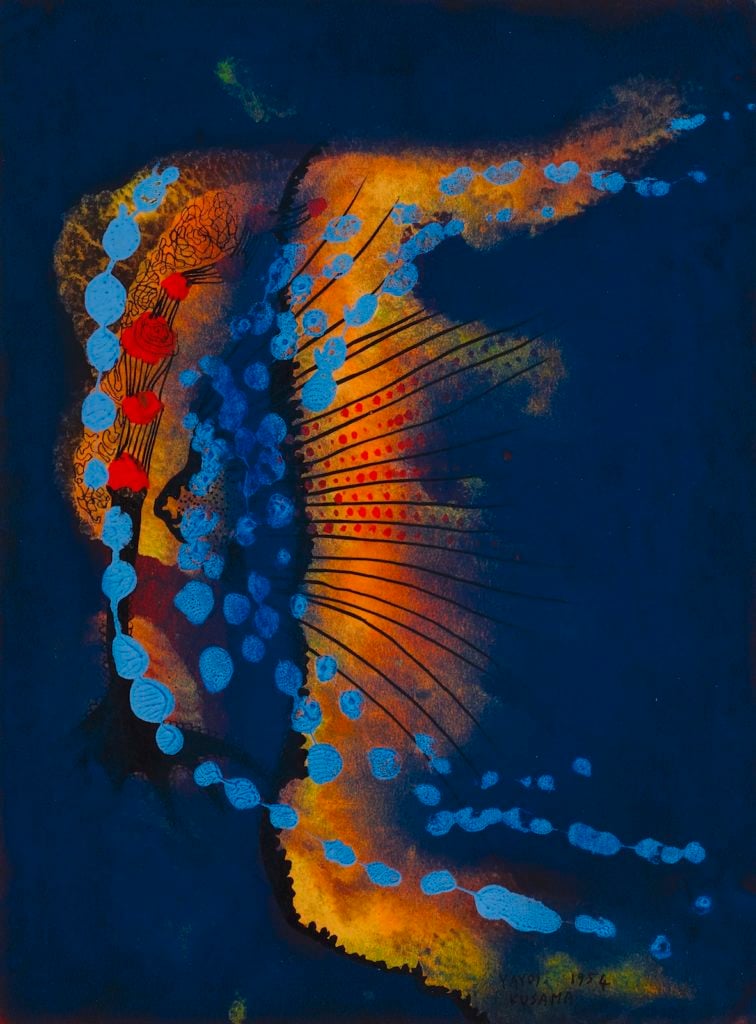
Yayoi Kusama, Fire, 1954.
Courtesy Smithsonian American Art Museum.
She was in her thirties, and he was twenty-six years her senior;
their relationship, she has said, was passionate yet platonic (“He
didn’t like sex and I didn’t like sex. So we didn’t have sex!”).
She spent days on end with Cornell at his home on Utopia Parkway in
Queens, where he lived with his mother. “These two obsessives,
spending time together!” Ho exclaimed.
The museum’s ownership of the Cornell archives, Ho pointed out,
owes to the legendary museum administrator and curator Walter Hopps
(dubbed “sort of a gonzo museum director” in the Washington
Post obituary), who worked for the museum in the 1970s and,
when he was invited to inspect the contents of Cornell’s archive,
urged the museum’s director to snap them up.
Ho tipped her hat to Rimel’s thoroughness in exploring the
archives.
“I think we know everything that’s in there at this
point?” she said. “But never say never.”
The post The Smithsonian Just Opened a Manila Envelope and
Discovered Four Yayoi Kusama Paintings It Had No Idea Existed
appeared first on artnet News.
Further reading


Leave a comment