
Computer Scientists Say They’ve Solved the Mystery of the Orb in Leonardo da Vinci’s ‘Salvator Mundi’
Computer scientists from the University of California, Irvine,
have created a virtual copy of the world’s most expensive painting,
the Salvator Mundi. And they are claiming that
science can solve one of the greatest mysteries of one of the
world’s most famous paintings.
In 2017, the painting sold at Christie’s for $450 million at
Sotheby’s only to disappear from the public eye. Given the
incredible price and the geopolitical mysteries surrounding its new
ownership (it is reported to have been purchased by Saudi Arabia as
a gift to the Louvre Abu Dhabi), all manner of conspiracy theories
have surfaced around
the painting. Among these, much attention has focused on whether
the extensively restored painting can be considered a Leonardo
original at all—and one of the most hotly debated aspects
of the painting concerns the crystal orb that Christ holds, which
symbolizes the earth and is an key element of any composition
featuring the “Salvator Mundi,” Latin for “Savior of the
World.”
For instance, Michael Daley, director of ArtWatch UK, noted that one of his
reasons for thinking the painting was not a Leonardo original was
the fact that the orb didn’t refract light realistically, even
though supposedly later copies of the painting did. Given the
Renaissance artist’s keen interest in science, Daley said that it
was unlikely that “Leonardo knew all about the optics, but just
decided not to bother.” Forced to address the issue, Christie’s
countered that Leonardo’s paintings were “known for their mystery
and ambiguity,” positing that “he chose not to portray it in this
way because it would be too distracting to the subject of the
painting.”
Now, however, a paper by Marco Zhanhang Liang, Michael T.
Goodrich, and Shuang Zhao claims to have determined that the
mysterious translucent globe in Christ’s hand may be scientifically
accurate after all. Using “physically based rendering,” a
sophisticated computer graphics tool that simulates light, as well
as Maya, a 3-D modeling and animation software, the team
synthesized how the figure of Christ would have been viewed through
orbs of varying materials.
If the globe were a solid mass, it would act like a convex lens,
inverting, reversing, and magnifying anything behind it, qualities
not seen in Salvator Mundi. However, the rendering in the
painting could still be optically accurate—if the glass orb
depicted is hollow. This would explain the minimal distortion in
the way Christ’s robe, seen through it, is painted.
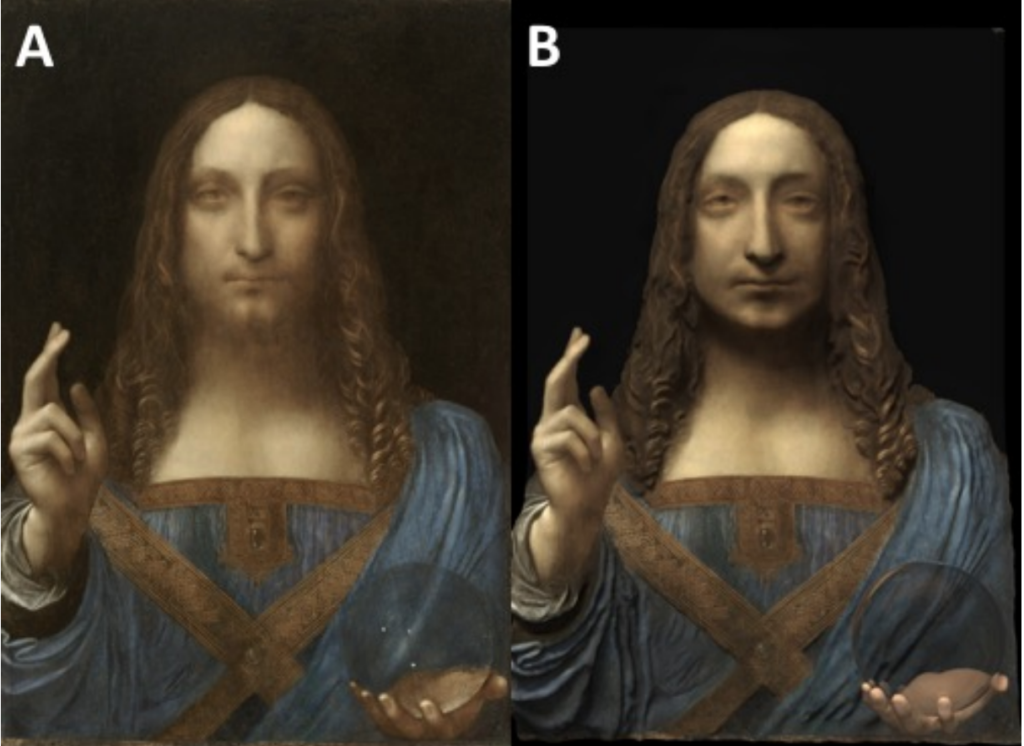
Leonardo da Vinci, Salvator
Mundi and a PBR rendering of the painting using a hollow orb.
Courtesy of University of California, Irvine.
“A hollow orb… does not cause such distortion,” notes the paper,
published on arXiv. After studying how
light would refract through different types of orbs, they estimated
that the glass of the orb in Salvator Mundi was a fraction
of an inch thick, accounting for its ethereal optical quality.
Leonardo was fascinated by the way that glass interacted with
light, and kept notebooks recording diagrams about light and
optics. So it stands to reason that the Renaissance great would
have understood how light interacted with glass orbs and have been
able to depict one with total optical accuracy.
The new finding changes the way people look at the painting,
from all sides. While some have argued that the oddity of the glass
ball is evidence that the work is actually by a lesser painter, the
orb itself convinced Leonardo scholar Martin Kemp of the work’s
authenticity. He believes that it was made from rock crystal,
noting the artist’s careful depiction of subtle “inclusions” in the
material, and possibly a double refraction as would occur within a
calcite sphere.
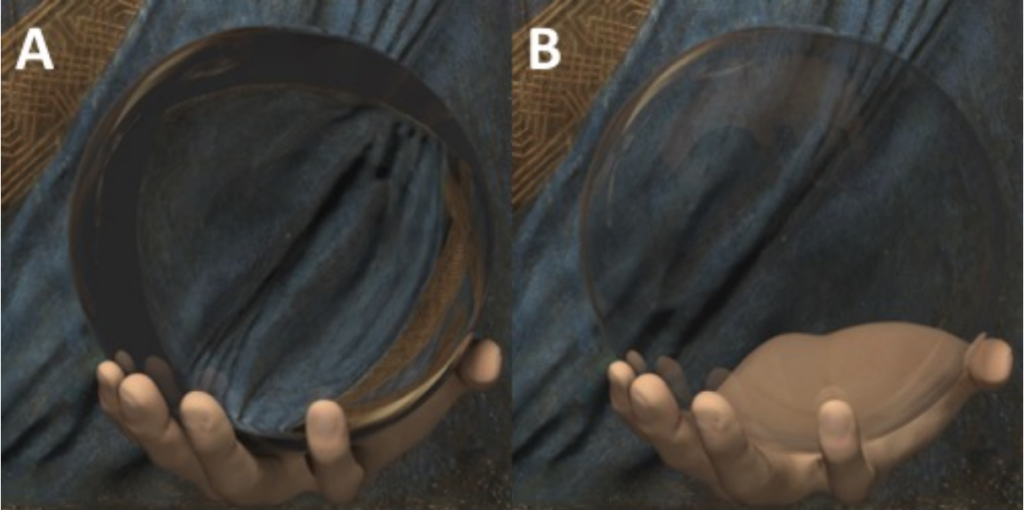
Rendering of a solid orb and a hollow
orb in Leonardo da Vinci’s Salvator Mundi. Courtesy of
University of California, Irvine.
To assume that Leonardo would have also rendered the inversion
one actually experiences when looking through a solid crystalline
orb “is to misunderstand Renaissance painting: it’s not a
photograph,” Kemp told Artnet News. “It’s a
question of good manners. If you can imagine a baptism of Christ in
which Christ’s legs are refracted by the River Jordan—they just
wouldn’t do that. It’s pictorial bad manners. So here, he’s saying,
‘this is a rock crystal sphere,’ but he’s not following through on
the implications of that to the bitter end.”
Yet if the scientists are correct and the depicted orb is
hollow, rather than solid, then the Salvator
Mundi actually would be true to life after all—a
possibility already pointed out by Leonardo biographer Walter
Isaacson, who made waves by noting the irregularity in the painting
in the first place. “Leonardo failed to paint the distortion that
would occur when looking through a solid clear orb at objects that
are not touching the orb,” he wrote in his book. “Leonardo painted
the orb as if it were a hollow glass bubble that does not refract
or distort the light passing through it.”
Then again, the sphere’s appearance might still also be an
artistic choice, Isaacson argued in a Facebook post refuting the possibility that
the orb offered any reason to doubt the painting’s authorship: “I
believe [Leonardo] made a decision to paint the crystal orb in a
way that is miraculous and not distracting.”
The post Computer Scientists Say They’ve Solved the Mystery
of the Orb in Leonardo da Vinci’s ‘Salvator Mundi’ appeared
first on artnet News.
Read more https://news.artnet.com/art-world/scientists-solve-mystery-salvator-mundi-orb-1745037
Further reading


Leave a comment