
Spirituality Has Long Been Erased From Art History. Here’s Why It’s Having a Resurgence Today
What to do when, in the words of Karl Marx and Friedrich Engels,
“All that is solid melts into air?” Times of upheaval inspire a
search for alternative understandings of reality. This was as true
a century ago as it is today. In a prefiguring of our own troubled
moment, the rise of modern capitalism undermined long established
social systems while new scientific discoveries challenged long
accepted religious beliefs. Then, as now, those dissatisfied with
mechanistic explanations of life and society had two choices:
retreat back to now discredited philosophies or seek other ways of
understanding the forces reshaping human life.
In the late 19th century, two phenomena emerged from this
confusion. Many of the era’s leading thinkers embraced the new
science while rejecting a purely materialist vision of human
existence. At the same time, artists moved beyond conventional
representational strategies toward a radical new approach to art.
In 1986, a now legendary exhibition at the Los Angeles County
Museum of Art proposed a link between these two developments. “The
Spiritual in Art: Abstract Painting 1890-1985” challenged
prevailing formalist histories of modernism by tracing the origins
of Western abstraction to a confluence of ideas about spirituality
current at the turn of the last century.
Maurice Tuchman, the exhibition curator, threw down the gauntlet
in the first line of his catalogue essay. He declared, “Abstract
art remains misunderstood by the majority of the viewing public.”
In a sprawling exhibition of works by more than 100 artists, he
presented both canonical figures and little known practitioners,
early modernist masters and contemporary artists, in each case
revealing deep connections to spiritual, utopian, or metaphysical
beliefs.
At the time, his radical reconceptualization of the history of
modernism landed like a thud. In 1998, author Charlene Spretnak
interviewed him about the show’s effect on art-world attitudes. He
responded: “None, whatsoever.” But that assessment is no longer
accurate. Where once it was, in the words of Rosalind Krauss,
“embarrassing to mention art and spirit in the same sentence,”
today it could not be more au courant.
Cases in point: Massimiliano Gioni’s 2013 Venice Biennale,
titled “The Encyclopedic Palace,” was dedicated to spiritualist
cosmologies. Since that time, a steady drip of rediscoveries of art
with occult themes has been felt, with figures like Marjorie
Cameron (1922-1995), aka Cameron, having her occult art showcased
at LA MoCA’s Pacific Design center and Jeffrey Deitch in New York.
A 2016 exhibition of British artist Georgiana Houghton’s “spirit
drawings” at the Courtauld in London drew huge crowds, the same
year that “Language of the Birds” at New York University’s 80WSE
Gallery presented a cross-historical exploration of art inspired by
Kabbalah, alchemy, hermeticism, and Tarot. Self-taught painter and
telepathic healer Emma Kunz was featured at the Serpentine just
last spring. And, of course, the Guggenheim’s Hilma af Klint show
broke records for attendance last year—perhaps the moment it became
clear to all that the new interest was truly a juggernaut.
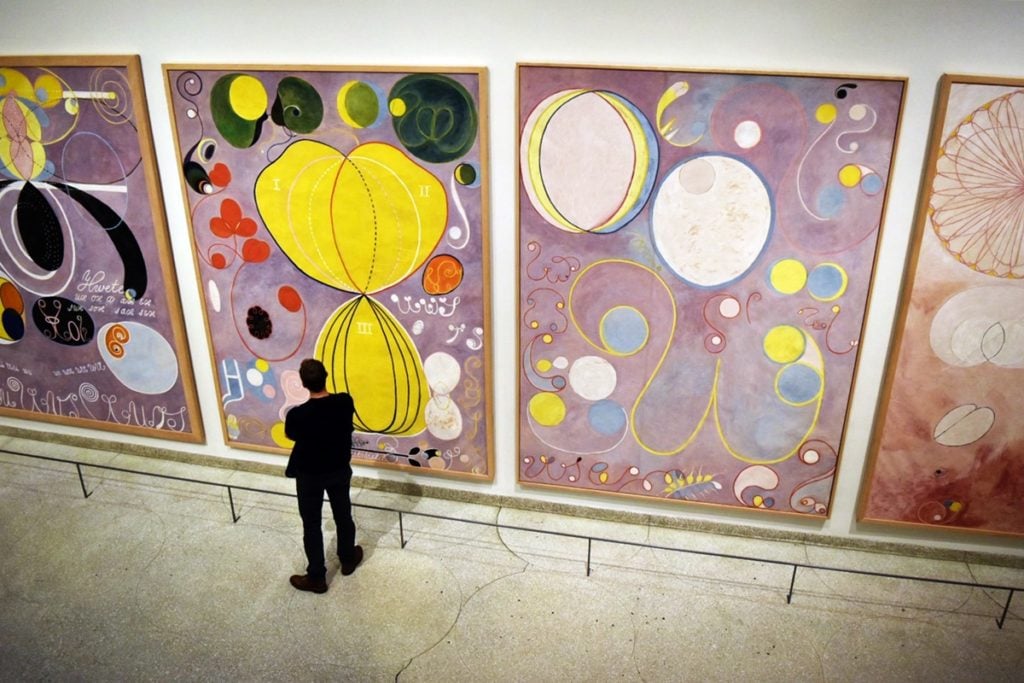
Installation view of Hilma af Klint’s
“The Ten Largest.” Image courtesy of Ben Davis.
Spiritual Science
This build-up of exhibitions has shed a light on an important
aspect of the modernist embrace of spirituality, a phenomenon that
has to be views in a wider context. In the early modern era, the
boundary between science and faith was far more porous than it is
today. Charles Darwin, who did so much to shake the foundations of
19th-century religion, was adamantly opposed to the supernatural.
Yet Alfred Russell Wallace, who simultaneously and independently
conceived of the theory of evolution and was originally listed as
its co-discoverer, was a true believer. His embrace of spiritualism
may account for the degree to which he has been erased from the
history of science.
Arthur Conan Doyle, now mostly associated with his creation
Sherlock Holmes, was a fervent Spiritualist and in fact devoted
many more books to spiritualism than to his hyper-rational
detective. Thomas Edison was keenly interested in occult motion and
invented the telephone to talk to the dead. William James, one of
the fathers of modern psychology, conducted experiments to confirm
the existence of life after death and the persistence of
spirit.
The receptivity of these and other 19th-century intellectuals to
spiritual concerns was no doubt encouraged by new technologies and
discoveries. The telegraph, x-rays, radioactivity, and the
possibility of non-Euclidan geometry and a fourth dimension (after
Einstein this came to be defined as spacetime) all seemed to
confirm the existence of an invisible, non-material realm.
Conversely, even the wonkier proponents of the spiritualist view
couched their ideas in scientific terms. Madame Blavatsky, founder
of theosophy, a doctrine influential on many artists of the age,
situated her synthesis of Hinduism and Buddhism within the
scientific world, applying the new concept of evolution to the
spiritual evolution of humanity. Rudolf Steiner’s anthroposophy, an
outgrowth of and reaction against theosophy, was also concerned
with psychic and cosmic evolution to be achieved by the application
of what he called “spiritual science.”
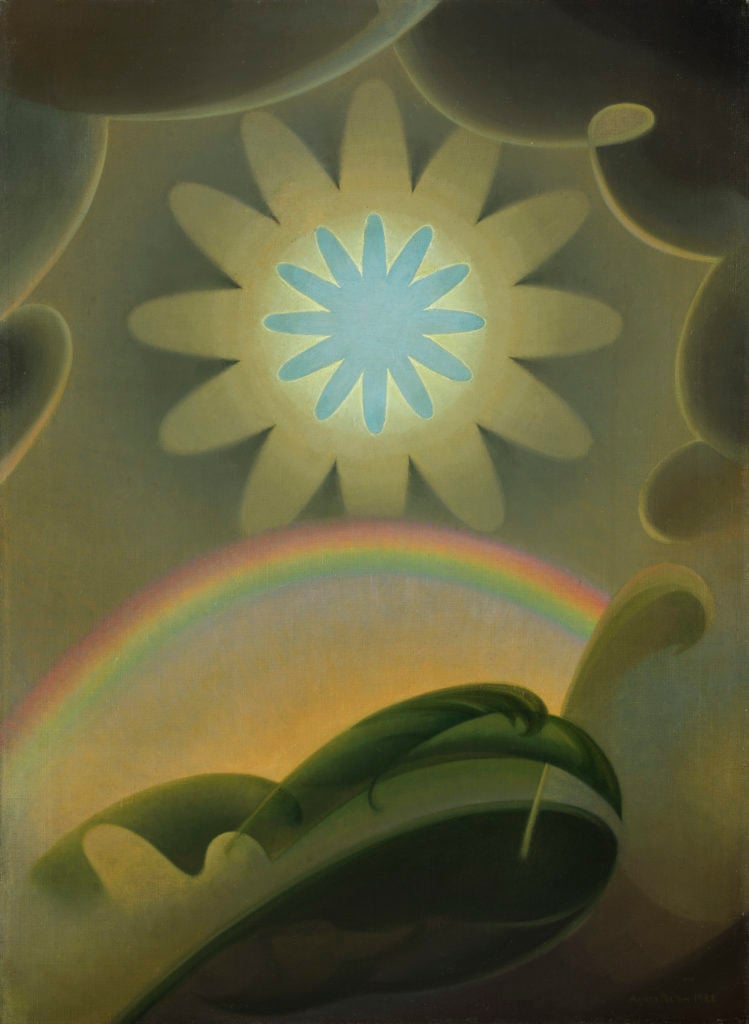
Agnes Pelton, Sand Storm
(1932). Photo by Edward C. Robison III, courtesy of the Crystal
Bridges Museum of American Art, Bentonville, Arkansas.
Modernism and Mediums
What has until now been underappreciated is just how pervasive
such ideas were, especially among the artists who formed the
modernist avant-garde.
In her 2014 book, The Spiritual Dynamic in Modern Art,
Charlene Spretnak expands on the ideas in Tuchman’s “The Spiritual
in Art” exhibition, taking it beyond abstraction to suggest the
spiritual underpinnings of a wide swath of modern and contemporary
artists. Her book, based on painstaking research into the
motivations of artists from 1800 to the present, proposes a radical
revision of our understanding of the history of modernism.
Spretnak argues that spirituality is at the heart of the
established canon and that mystical and occult ideas run through
the works of artists as diverse as Kandinsky, Malevich, Mondrian,
Beckman, Miró, Dove, and Klee.
Spretnak builds her argument around broadly recognized artists.
The exhibitions cited above, by contrast, focus on figures who have
been more marginal to art history. As a result, there has been some
debate about their legitimacy as artists.
Hilma af Klint, for example, was an established and recognized
member of the Swedish art community. However, the works for which
she is now being celebrated were done privately, as part of her
involvement with a group of four other spiritually inclined women,
created at the direction of a spirit guide. These paintings, which
the spirits decreed should be displayed in a specially designed
temple, would provide knowledge necessary for the coming New Age.
Anticipating critical hostility, af Klint decreed that her works of
visionary geometry were not to be unveiled to the public until 20
years after her death. In fact, it took more than 40 posthumous
years for these works to enter the art discourse through Tuchman’s
1986 exhibition.
The paintings were unlike anything being done at the time. Their
spirals, circles, calligraphic notations, and esoteric symbols were
deeply indebted to af Klint’s study of theosophy. As a result, even
today the curators of the Guggenheim show seem uncertain how to
situate this work. In a round-table discussion published in the
exhibition catalogue, a group of eminent writers, artists, and
curators debate questions about af Klint’s intentionality, the
authorship of works produced under the influence of a spirit guide,
and whether a painting that is a diagram of a higher reality
qualifies as an abstraction. In the New York Review of
Books, Susan Tallman raised similar issues, asking, “To what
degree does celebrating these things as works of art, and
celebrating af Klint as their creator, invalidate everything she
was hoping to achieve?”
However, the notion of the artist as channel for otherworldly
forces is hardly unique to af Klint. Artists as comfortably
canonical as Whistler, Mondrian, Kandinsky, and Malevich were also
inspired by theosophy and anthroposophy. None of them created the
kind of “pure abstraction” extolled by mid-century critics.
Kandinsky, for one, produced controlled explosions of color that
bear a striking resemblance to images that appear in Thought-Forms,
a standard theosophical text. Mondrian’s geometric compositions
were meant to express the “dynamic equilibrium” of the immaterial
realm. And, of course, the Surrealists were entranced by automatic
drawing as a way to connect with the unconscious.
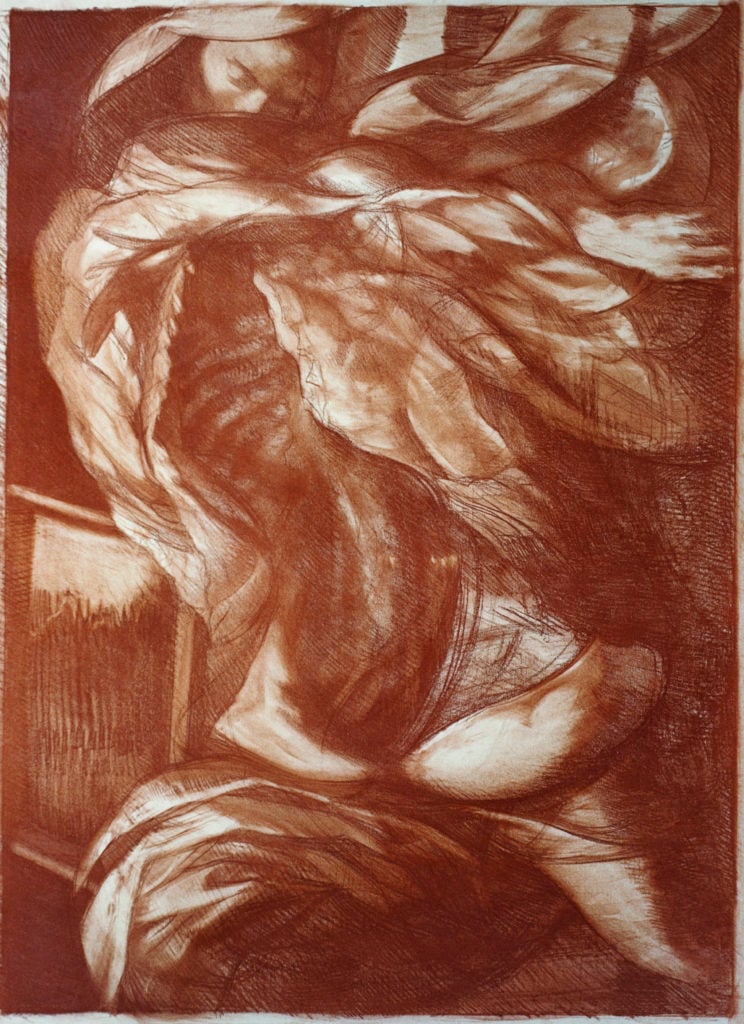
Hyman Bloom, Cadaver. Courtesy
of Getty Images.
The Inner Realm
Agnes Pelton, whose work will be showcased at the Whitney Museum
starting in March, has a clearer claim to conventional art history.
Another follower of theosophy founder Madame Blavatsky, she was
included in the 1913 Armory show before moving out west.
There, she joined a community of like-minded artists who shared
not only her interest in spiritualism, but also her more liberal
views on gender and sexual practice. Visitors to her Whitney
exhibition will see dreamlike semi-abstractions that mingle
evocations of desert landscapes with ethereal and vaguely
representational forms.
Pelton was concerned with the metaphysical properties of color
and their ability to bring the viewer into a state of
enlightenment. In Enchanted Modernities: Theosophy,
the Arts, and the American West, a new book on Spiritualist
movements, she is quoted as saying, “These pictures are like little
windows opening to the view of a region not yet much visited
consciously or by intention—an inner realm, rather than an outer
landscape.”
While Pelton has been little known outside the western US, Hyman
Bloom was once prominent enough to be dubbed the “first Abstract
Expressionist artist” by Willem de Kooning and Jackson Pollock. The
artist, who was raised as an Orthodox Jew, fell out of the
limelight for a variety of reasons. Not least of these was his
involvement with spiritual concerns.
His paintings present jewel-like surfaces that are engulfed by a
struggle between light and darkness. The work is indebted to a
moment of mystical illumination he experienced as a young man
during a period of extreme isolation and financial hardship. As he
described it, “I had a conviction of immortality, of being part of
something permanent and ever-changing, of metamorphosis as the
nature of being.”
His recent show at the Museum of Fine Arts Boston is centered on
his paintings of cadavers, which, along with lushly painted near
abstract representations of synagogues, rabbis, chandeliers,
seances, and archaeological digs, were part of his exploration of
the astral plane. This concept posits a state of being that exists
between life and death and is informed by Bloom’s deep reading of
theosophical texts, as well as his interest in mysticism, kabbalah,
and other esoteric religions.
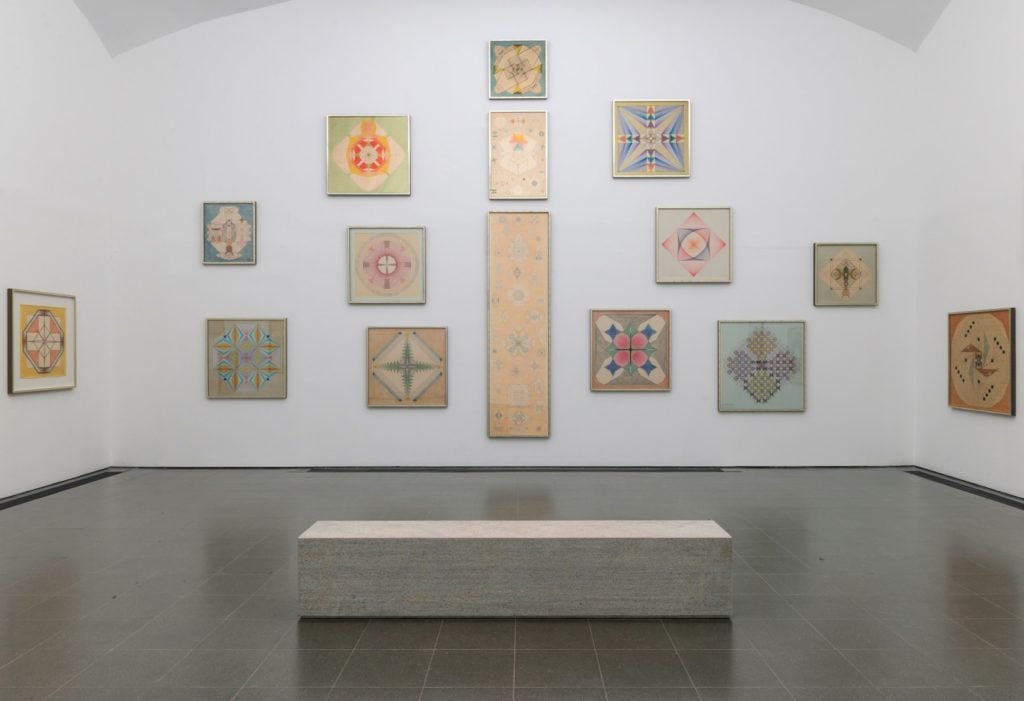
Installation view of “Emma Kunz –
Visionary Drawings: An exhibition conceived with Christodoulos
Panayiotou” at the Serpentine Galleries. Courtesy of the
Serpentine.
A New Age for Spiritualism in Art
Why are these figures, once quite marginal, moving into
spotlight?
One explanation may be the breakdown of the canon under pressure
from feminism and multiculturalism. Indeed, it is noteworthy how
many of these artists are women or, like Bloom, members of
marginalized groups. (While many Jews participated in the
mid-century avant-garde, Bloom was unusual in his overt reference
to his devotional practice.)
Another factor in the surge of interest may be a revulsion
against today’s over-the-top commodification of art. There is
something very appealing about art that resists the market through
its appeal to secret knowledge.
But the new receptivity to spirituality also reflects our
current state of upheaval. Once again, we face destabilizing
forces, among them a yawning inequality that attests to the
failures of neoliberal fantasies about the rationality of the
market. New technologies like AI and ever more sophisticated
corporate and government surveillance threaten our very sense of
self and society. And there is widespread recognition that
materialism has produced a climate crisis that may spell the end of
life as we know it.
Once again, a search for alternatives has manifested itself in a
surge of interest in spiritual and spiritualist concerns.
Astrology, the New Yorker
notes, is hot right now. The New York Times reports
that millennials are very into witches and “witch parties.” But along with
astrology, the occult, magic, and alchemy, the new spirituality
also manifests itself in a longing for restorative politics, and
human-centered social attitudes.
Who are the contemporary equivalents to af Klint, Pelton, or
Bloom? Today plenty of artists are willing to cop to spiritual
influences on their work. Some go further, attempting to channel
unconscious or even supernatural energies through drugs, hypnosis,
or seances. Yet others seek portals through technology. In place of
the spiritual progress promised by esoteric philosophies like
theosophy and anthroposophy, they grapple with the Singularity and
its assertion that artificial intelligence is the next state in
(non)human evolution. Though none of this has yet gelled into a
recognizable movement, it would seem that contemporary art and the
spirit have once again made a tentative peace.
The post Spirituality Has Long Been Erased From Art History.
Here’s Why It’s Having a Resurgence Today appeared first on
artnet News.
Read more https://news.artnet.com/art-world/spirituality-and-art-resurgence-1737117
Further reading


Leave a comment