
The Gray Market: What the Debut of a $5 Billion ‘Post-Shopping Mall’ Does—and Doesn’t—Mean for Art (and Other Insights)
Every Monday morning, artnet
News brings you The Gray Market. The column decodes important stories from the
previous week—and offers unparalleled insight into the inner
workings of the art industry in the process.
This week, investigating art’s
overlap with the experience economy…
DREAM A COLOSSAL DREAM
Over the holiday break,
Amanda Hess of
the New York
Times weighed in on
her experience inside American Dream, the $5 billion New Jersey
development aiming to be the world’s first and greatest (in Hess’s
words) “post-shopping mall.” If you’re puzzling over the meaning of
that curious phrase, she notes that more than half of American
Dream’s three million acres
are “allotted not to retail but to entertainment,” making it a
complex tailored to an era in which “the psychic center of American
social life has shifted from buying things to feeling
them.”
In short, it’s a mall for the
so-called “experience economy” we’ve increasingly been living
inside over the past few years, and at first glance, it seems to
add new urgency to the knotty questions about 21st century
audiences, aesthetics, and appeal raised by wildly successful
pop-ups-turned-corporate-powerhouses Meow
Wolf and the
Museum of Ice
Cream. But on
reflection, I don’t think the art industry needs to start breathing
into a paper bag over this development just yet.
Allow me to flesh out American
Dream’s concept a bit. Attractions either opened or announced by
the time of Hess’s early December visit include Big Snow, the
largest indoor skiing and snowboarding hill in the western
hemisphere; Nickelodeon Universe, a theme park based on
intellectual property from the legendary children’s cable network
that brought you SpongeBob SquarePants; an accompanying water park
from blockbuster film and animation studio DreamWorks; and a
mini-golf course branded by the Angry Birds mobile-game franchise.
Even American Dream’s anchor
retail space begs the question of whether it’s mainly chasing sales
or selfies. The IT’SUGAR store, the largest “non-manufacturer”
candy emporium known to humankind, could be a pre-fab unit for a
Museum of Ice Cream location, except that nearly everything on its
premises is available to buy. I say “nearly everything” because… well, here’s
Hess:
At the entrance to IT’SUGAR—a
brand name styled like a desperate scream—stands a 60-foot replica
of the Statue of Liberty constructed from green jelly beans. She
holds a lollipop for a torch and wears a sash that says: “You know
you want it.” At her feet is written: “Give me your tired, your
poor, your huddled masses yearning for the sweet life, and I will
give you IT’SUGAR.”
Now, I can understand if you,
the readers of this column, don’t react to that description by
thinking, “OMG a new profile pic with that thing would SLAY!” But
I’m willing to bet that plenty of visitors to American Dream will.
And either way, if getting on the ‘Gram isn’t the reason the
store’s owners shelled out the cash to create this patriotic
monument to diabetes, I’ll spend the rest of my apartment lease
sleeping on my fire escape. In this sense, even the shopping at
American Dream seems geared to generate a currency beyond hard
cash, suggesting the complex is a different species from the malls
that defined American suburbs for the past few
generations.

A view inside Minnesota’s Mall of
America in 2018, featuring the Nickelodeon Universe indoor theme
park. Photography by Runner1928. Courtesy of Wikimedia Commons.
CULTURE CLASH?
What does American Dream’s
existence mean for art, though?
My colleague Ben Davis cut a
valuable path through this territory in 2017 via his State of the
Culture series. One of
the animating forces behind it was the world’s pivot toward
experiences and the breakdown of “culture” as an elevated concept.
A central plank in his opening argument was a study by Culture
Track that found
audiences had dismissed the old distinction of “high versus low”
and are now evaluating activities based on “relevance versus
irrelevance.” Other data showed that, in Davis’s words,
“sharing photos of things
has now become the main driver of the outside-the-home experience
economy, with design implications for everything from
restaurants to architecture to vacation
resorts, which are being
reworked around the principle.”
When I first thought about the
preference for experiences reflected by American Dream’s
square-footage breakdown, my mallet-to-kneecap reflex was to see it
as the next big push in the culture-creep Davis addressed above. If
an entire generation of consumers—a global generation, if the developers behind American
Dream have their way—grows up in an environment where attractions,
not products, dominate our biggest commercial centers, might it
condition them to default toward art experiences that are equally
based on the moment rather than merchandise? Wouldn’t that have
tremendous consequences for everyone from the most time-honored
museums to the most commercially minded galleries?
I do think the trend is real. On
reflection, though, I also think American Dream is no more than a
nudge in that direction, rather than a full-force shove into a new
reality.
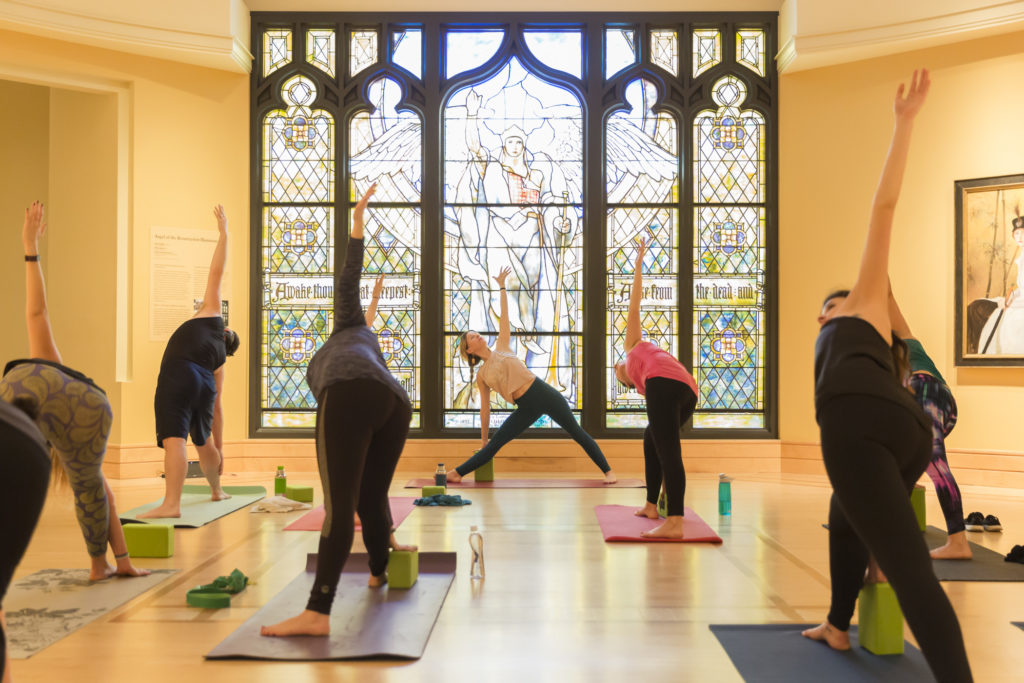
The Yoga at Newfields program takes
place in the museum’s galleries, and is part of the sweeping
experience-economy-based rebrand of the institution formerly known
as the Indianapolis Museum of Art. Image courtesy of Newfields.
The main reason is this: the
attractions sucking up most of the oxygen at American Dream are
all… well, kinda old-school. Think about it: roller coasters, water
parks, and mini-golf have all been around for decades. Even an
indoor ski slope isn’t revolutionary. Vienna built what seems to be
the first example, known as the Snow
Palace, all the way back
in 1927. Adelaide, Australia operated another in the 1980s, and
dozens more have cropped up around the world since, including in
the malls of Dubai.
American Dream’s innovation, if
there is one, is simply bringing all of these different
recreational experiences under one roof. But this, too, has been
done before, most notably at Minnesota’s sprawling Mall of America,
which was also developed by Triple Five Group, the same firm that
took over the troubled money pit
once known as Xanadu in
2011 and transformed it into American Dream.
Originally opened in 1992 as a
strictly retail complex, the Mall of America has evolved over the
years to offer a conceptually similar—and in some cases, literally
identical—menu of
non-shopping attractions as its freshly opened New Jersey cousin.
Experiential headliners at the Mall of America include the Sea Life
Minnesota Aquarium (whose tanks hold 1.3 million gallons of water
and 10,000 aquatic creatures), another Nickelodeon Universe theme park (which
stretches across seven acres), multiple mini-golf options (would
you prefer the Rock of Ages blacklight course or the Moose Mountain
Adventure course?), the colorful and
interactive Crayola
Experience… the list
goes on.
And all of these activities are
integrated with millions of square feet of classic retail space,
just as American Dream’s attractions will be. In this context,
Triple Five’s New Jersey post-mall looks less like an inflection
point in the evolution of western commerce and more like an
extension of the same trajectory the culture has been on for
years.
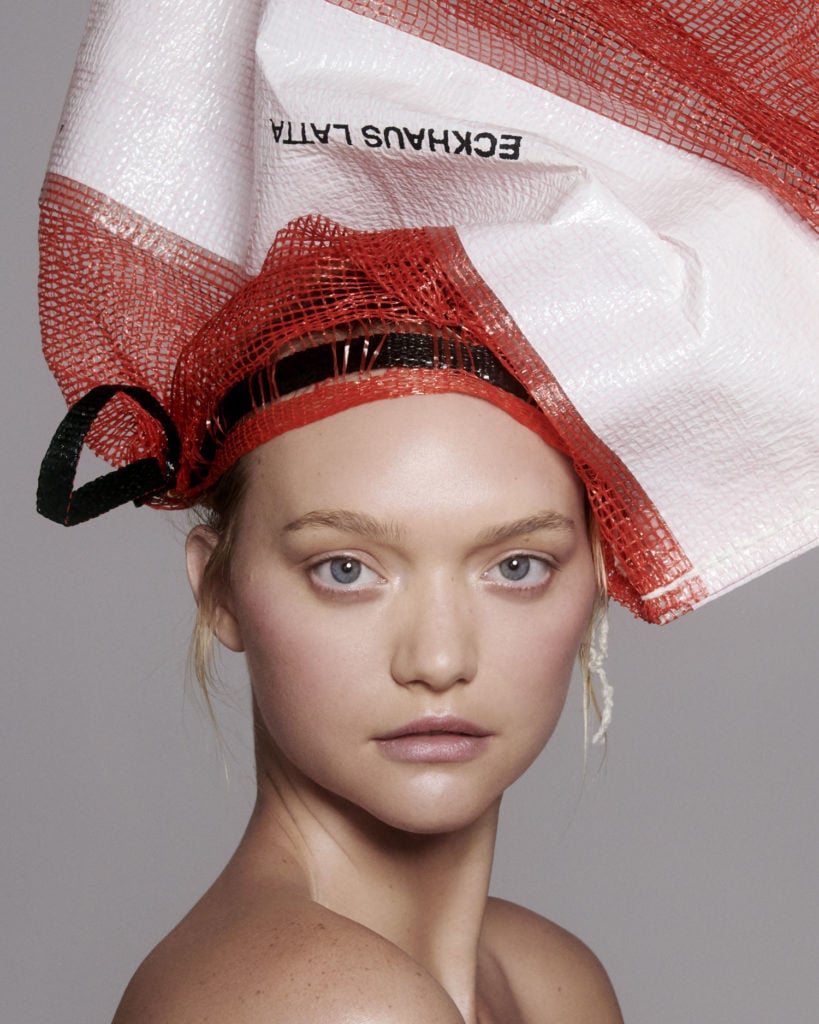
A version of an image on a lightbox
included in “Eckhaus Latta: Possessed.” Courtesy of the Whitney
Museum of American Art. Photo: Charlotte Wales.
DREAM INTERPRETATION
Does that mean the art world
should ignore what’s happening at American Dream, though? Not
quite.
In my mind, the lesson is this:
for the largest, best-funded arts entities seeking the largest,
freest-spending audience, the key might be to offer ticketed
experiences and traditional sales in nearly equal measure. Resources and the passage of time will likely
demand tweaks to the ratio between these two elements. But rather
than experiences replacing acquisitions outright in any high-value
art program, neither will likely be able to exist without the other
for the foreseeable future—if ever. At least, that’s the idea
merchants in the wider world are pumping billions of dollars into,
as evidenced by American Dream and its Minnesotan
predecessor.
Players in the for-profit and
nonprofit arts sectors are already probing this borderland. Just
look at Pace’s exploration
of ticketed shows for new-media studio
teamLab, or the
hybrid exhibition-boutique
produced by the Whitney in conjunction with avant-fashion duo
Eckhaus Latta. Expect to
see more and more entities at the top of their sectors inch into
this mixed soil soon in pursuit of the right
balance.
But what about the institutions,
galleries, and artists without the same funding firepower, prestige
level, or interest in attracting the widest possible audience?
Should they pursue a similar strategy of blending experiences and
sales in similar proportions (assuming they even can)? That’s a
much more difficult question to answer—and likely one that will
lead to more risk-taking and more innovation than in those entities
that can afford to do it all. Because in the end, not everyone
dreams the same dream.
That’s all for this week. ‘Til
next time, remember: a capitalist’s dream journal is called a
business plan.
The post The Gray Market: What the Debut of a $5 Billion
‘Post-Shopping Mall’ Does—and Doesn’t—Mean for Art (and Other
Insights) appeared first on artnet News.
Read more https://news.artnet.com/opinion/gray-market-american-dream-1745754
Further reading


Leave a comment