
Iran Was on the Hunt for a Stolen Persian Book Worth $1.1 Million. But the ‘Indiana Jones’ of the Art World Beat Them to It
Dutch art detective Arthur Brand, lauded as the Indiana Jones of the art
world, has solved another major case, recovering an ancient
manuscript known as the Diwan of Hafez.
Featuring the collected works (or diwan) of the
14th-century Persian lyrical poet Hafez, the handwritten and gold
leaf-embellished book was stolen in 2007 and is worth €1
million ($1.1 million), according to German authorities.
Despite Brand’s extensive experience in the field, locating it
was particularly challenging because of the Iranian government
agents who were also hot on its trail.
“We understood that the Iranian government was after it, but
luckily they didn’t know I was after the book,” Brand tells Artnet
News. He took on the case in late
2018, when an Iranian contact in Germany was approached by men
he believed were Iranian secret service agents, asking questions
about the stolen manuscript.
Before it was stolen, this Diwan of Hafez belonged
to Djafar Ghazy, an Iranian collector who lived in Munich.
When he died in 2007, at the age of 86, he left behind a valuable
collection of ancient Islamic and Persian manuscripts, but Ghazy’s
relatives soon realized they had all been stolen.
The police were able to crack the case and arrest the thief in
2011, recovering a cache of 175 books and manuscripts—but not the
Diwan of Hafez, the most important of the lot.
“They call Hafez the Shakespeare of Persian literature,” Brand
says. “He’s incredibly important for hundreds of millions of people
in the Arab world. There’s a joke: people in Iran only have
two books, the Diwan of Hafez, and the Koran, and they only read
one of them.”
This particular copy of his collected works dates to about 1462
or 1463, and Hafez died around 1389, making it one of the
oldest—and therefore most accurate—copies of the text.
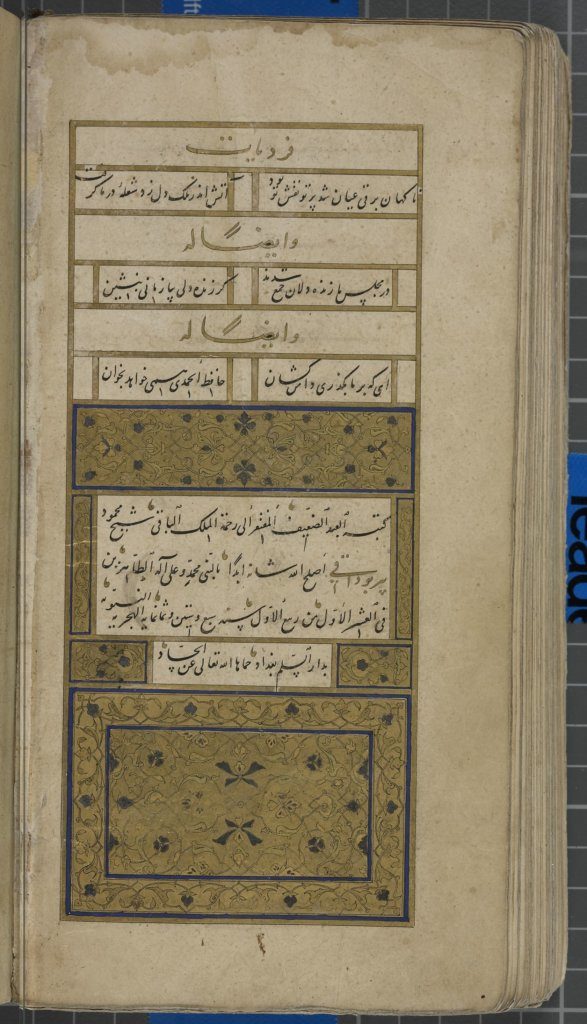
The Diwan of Hafez. Photo courtesy of
Arthur Brand.
“That makes it so important,” Brand says. “Hafez only had an
oral tradition, he didn’t write anything down. The handwritten
books that appeared soon after his death are the most
reliable.”
In his will, Ghazy donated two books to the Iranian government,
which subsequently demanded the repatriation of the entire
collection—a demand dismissed by the German courts.
Soon after, Iranian agents turned up in Germany asking questions
about the still-missing Diwan of Hafez. “It seems that the Iranians
thought, ‘Let’s try to find that one, and if we find it, we’ll take
it back.’” says Brand, who during his year-long search spoke to
several contacts who were approached by the Iranians. “You could
see in their eyes that they were pretty scared.”
After putting out the word to various contacts, Brand’s search
led him to England, where William Veres, an antiquities
dealer, put him in touch with someone who eventually admitted to
having seen the book. The man first demanded proof that
the Diwan of Hafez was stolen, and Brand produced a wanted
poster and a news article, both in German. The man then admitted
that a deceased colleague had sold it to an important Iranian
collector in London.
“We said, ‘Go and tell him the book is stolen and the Iranians
are after it, so he better talk to us,’” Brand recalls. “The
owner was flabbergasted. He was shocked that he had a stolen book
in his possession, he was shocked that the Iranians were asking
around, and he was shocked that I was after him.”
Luckily, Brand was able to convince the collector to give up the
book.
“Stolen art does wind up in the hands of people who are
completely innocent—especially with small, lesser-known works,”
Brand says. “We once discovered a stolen icon on the wall of the
English singer Boy George, and he had no idea.”
The post Iran Was on the Hunt for a Stolen Persian Book
Worth $1.1 Million. But the ‘Indiana Jones’ of the Art World Beat
Them to It appeared first on artnet News.
Read more https://news.artnet.com/art-world/diwan-of-hafez-recovered-1756098
Further reading


Leave a comment