
Poland’s Museums Are Taking a Radically Conservative Turn—and the Fight Over Who Gets to Control Them Is Only Beginning
At the beginning of the year, a
divisive new director assumed the top job at one of Poland’s most
internationally renowned institutions, the Ujazdowski Castle Center
for Contemporary Art in Warsaw (CCA). His appointment at the
state-run museum is at the center of a nationwide battle over who
shapes Poland’s cultural institutions, with both sides claiming
that they are being silenced. The stakes are high: the dispute has
the potential to shape the art shown in Poland and the history
taught to the public for decades to come.
When Piotr Bernatowicz’s
selection as head of the state-run art center was first announced
back in November 2019, the Polish cultural scene reacted strongly
and quickly. Petitions and open letters were signed by leading
Polish and international cultural figures, with one drawing almost
1,600 names. The Berlin-based Polish artist Agnieszka Polska
published a grave
op-ed in
Frieze magazine, alerting international readers to the
fact that “an ultra-conservative, homophobic-platforming curator is
set to helm Poland’s leading artistic
institution.”
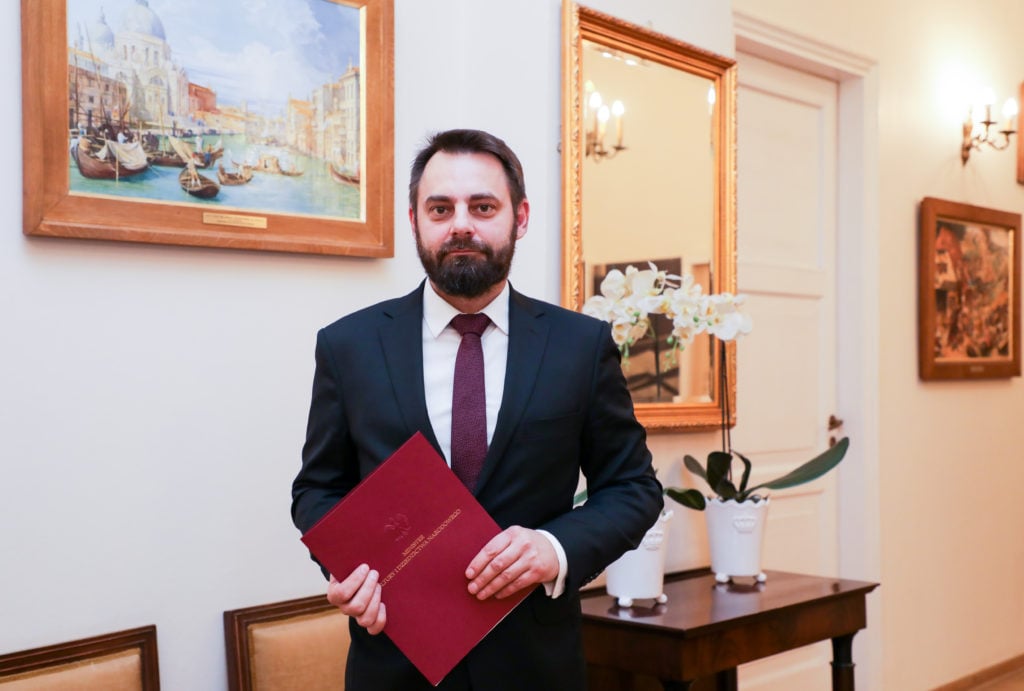
Piotr Bernatowicz, the director of the
CCA in Warsaw. Photo: Danuta Matloch
Even the watchdog branch of the
International Committee for Museums and Collections of Modern Art
published a statement saying that “a key institution for Polish
cultural heritage of the post-Cold War era is under
threat.”
The arguments against
Bernatowicz are twofold. First, with only three years as the
director of the municipal gallery Arsenal in Poznań under his belt,
he lacks the experience required to run an internationally renowned
institution. And then there’s his politics. He is accused of
promoting hate speech and offering a platform for revisionist and
antisemitic language. During his term in Poznań, Berantowicz
organized a group show titled “Strategies of
Rebellion,” which
featured posters by designer Wojciech Korkuc featuring with slogans
including “Women burn faster” and “Gay, don’t faggot the
minors.”
In Bernatowicz’s telling,
however, he is the subject of a coordinated left-wing art-world
campaign that seeks to marginalize any idea it deems unseemly. “I’m
currently attacked by the cultural mainstream in Poland,”
Bernatowicz wrote in an email to Artnet News. “They accuse me of
despising contemporary art. However, what they really object to is
my worldview rather than my expertise.”
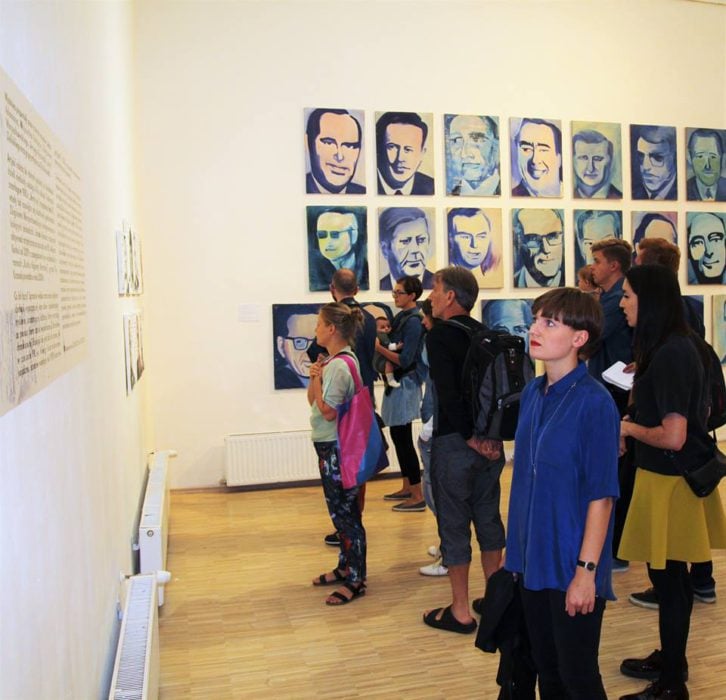
An installation view of “Strategies of
Rebellion,” organized by Piotr Bernatowicz at Arsenal in 2015.
Photo: Arsenal.
His vision for the CCA, where he
will remain for a seven-year term, is to give voice to views that
he argues are unpopular in the art world, including “conservative
artists, but also those who refuse adopting trendy ideological
themes, are kept aside by the curators, and stay on the margins of
art institutions.” It remains to be seen how exactly he will apply
this agenda; his first program as director is due to be announced
in March.
Controversial Appointments
Bernatowicz’s is only the latest
in a series of disputed appointments made by the minister of
culture, Piotr Gliński, to
public museums. Over the past five years, Poland’s art institutions
have increasingly become a vehicle for the ruling right-wing Law
and Justice party’s (PiS) cultural reform efforts.
When PiS came to power in 2015,
it announced its vision for a cultural narrative of commemoration,
celebrating Polish heroism, heritage, and folklore. Such focus on
the glorification of a country’s history is typical of
nationalistic, right-wing movements, and has led to the promotion
of alarming
revisionist narratives in Poland.
At first, the ministry of
culture fired directors whose views it deemed too progressive:
Paweł Potoroczyn, who had led the Adam Mickiewicz Institute—which
promotes Polish culture abroad—since 2008, was unceremoniously
fired in 2016. (He sued the government and won a financial
settlement.) The director of the institute’s Berlin branch,
Katarzyna Wielga-Skolimowska, was also let go in 2016 for
programing that the government criticized as too focused on the
Holocaust. Her
dismissal, too, drew international attention.
“After a couple such cases, the
government realized it’s better to just let contracts expire,” says
Magdalena Ziolkowska, curator and former director of the Bunkier
Sztuki Gallery of Contemporary Art in Krakow.
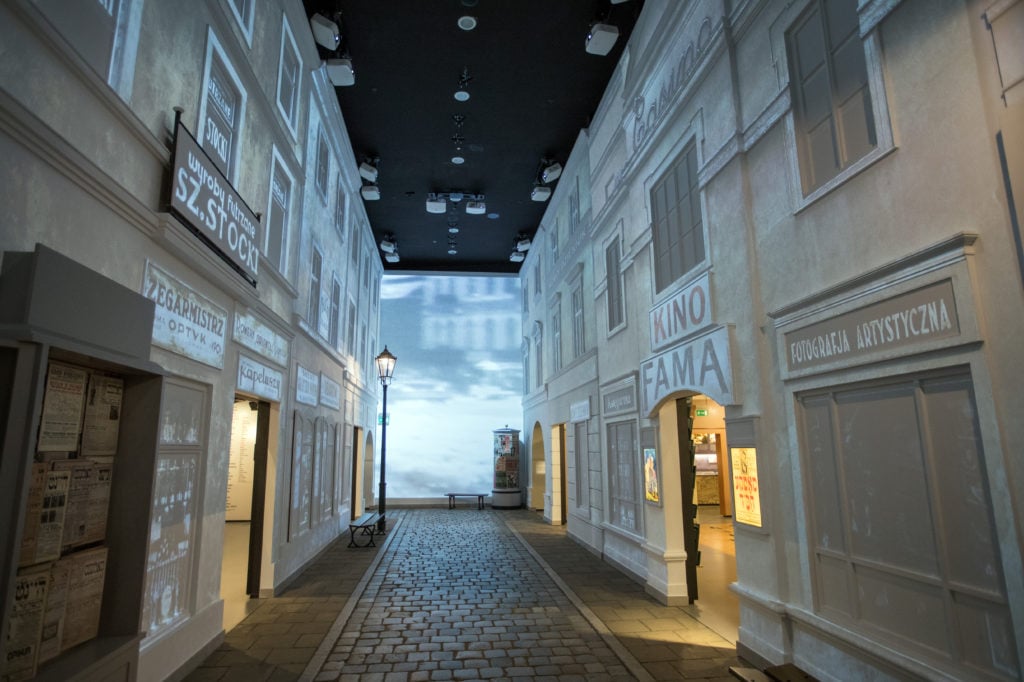
The Polin Museum in Warsaw. Photo: Jens
Büttner/dpa-Zentralbild/ZB via Getty Images.
But that strategy is starting to
draw opposition, too. In the case of Polin, a museum of
Jewish-Polish history in Warsaw, the minister of culture has
neglected to formally appoint its chosen director, Dariusz Stola,
since last February, even though the institution is a
public-private partnership and therefore not entirely controlled by
the government.
In an interview with the
New
Yorker this past
September, Stola said, “Every morning, I wake up, have a cup of
coffee, and wait for the phone to ring and the minister to tell me
he is appointing me because I won the competition.”
On January 30, the city of
Warsaw and the Association of the Jewish Historical Institute of
Poland came together to demand the government formally allow Stola
to begin work. “We can no longer accept the situation in which one
of the most important institutions of culture in Poland remains in
a state of limbo,” the city’s mayor and the institute’s board
chairman said in a joint
statement. (A
spokeswoman for the culture ministry told the
AP that the situation is stable; the acting
director’s one-year term expires in late February.)
Public institutions in Poland
must hold a competition to appoint directors, with strict
regulations regarding the makeup of the jury that reviews
applications. But in recent cases, the government simply ignored
this mandate: Bernatowicz was appointed without a competition, as
was Jerzy Miziolek, who became director of the National Museum in
Warsaw last April. Miziolek resigned in December amid a labor
dispute, but he will be remembered for his removal of works by
three female artists from the museum’s permanent display, including
a photographic series by Natalia LL, Consumer Art (1972), that inspired a much-publicized
banana-eating
demonstrations.
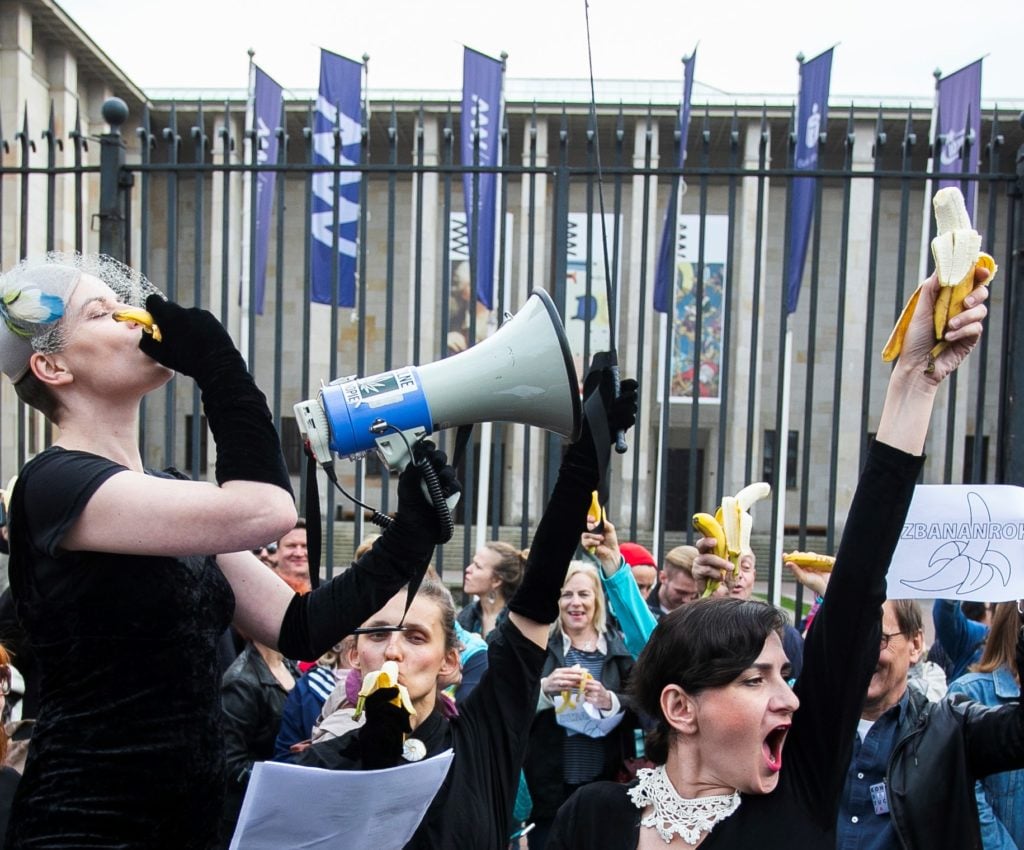
People with bananas demonstrate outside
Warsaw’s National Museum. 29 April, 2019, Warsaw, Poland after
gallery removes feminist art featuring bananas. Photo by Krystian
Dobuszynski, NurPhoto via Getty Images.
A competition to find Miziolek’s
replacement has yet to be announced; an interim director, Łukasz
Gaweł, is helming the institution for one year. As for the works
that were removed, they have not yet been rehung because the
galleries dedicated to 20th- and 21st-century art are closed for
refurbishment until the fall. “We can’t promise this particular
work by Natalia LL will come back on display,” said a museum
employee who wished to remain unnamed, “but we have other works by
her, which have never been displayed, and definitely her name is on
our list.”
The broader dispute over the government’s involvement in
staffing was reignited last week, when Alicja Knast, a high-profile
museum director who built two major museums in Poland, was
fired from her post at the helm of the Silesian Museum in Katowice.
She plans to protest her dismissal in court.
A Fight Over the Future
However, it’s not only the
right-wing politicians who are interfering with appointments. In
2017, Bernatowicz won the competition for a second term at the
Arsenal gallery in Poznań, where he had worked since 2014, “but the
mayor refused appointing me due to political reasons,” he told
Artnet News.
Marek Wasilewski, who took over
Arsenal instead, confirmed that he had come in second, winning one
fewer vote than Bernatowicz. “It’s the prerogative of the mayor of
the city whether or not to accept the jury’s recommendation,” he
explained. “Bernatowicz wanted to show artists who were not shown
enough in his opinion, meaning he wasn’t giving the audience in the
city the opportunity to see what’s happening in contemporary art.
The mayor preferred my proposal.” (As Arsenal is a municipal
gallery, rather than a state-run institution, the mayor had the
power to overrule the decision.)
The mayor’s priority, Wasilewski
added, was to keep the museum engaged with its peers and with the
international cultural sector. “After Bernatowicz took over,
Arsenal isolated itself in many aspects from the network of
cooperations between different institutions,” Wasilewski pointed
out, “and the educational program was very
limited.”
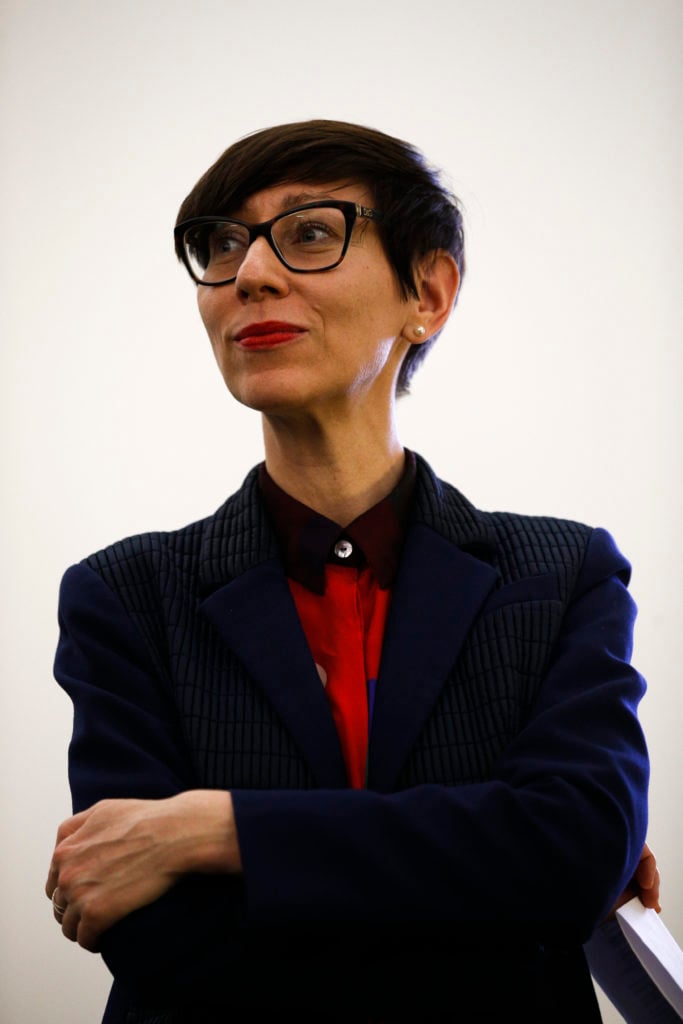
The former director of the Center for
Contemporary Art Ujazdowski Castle, Magorzata Ludwisiak, at the
opening of the third edition of the Night of Ideas in Warsaw on
January 31, 2019. (Photo by Jaap Arriens/NurPhoto via Getty
Images)
A descent into isolation and
irrelevance is exactly what the Polish art world fears would become
the CCA’s fate—a loss for a cutting-edge institution that, since
the 1990s, has established itself as a reliable partner in an
international network. This year, for example, shows already
scheduled by the outgoing director include collaborations with the
Kiasma Museum in Helsinki and the KW Institute in
Berlin.
“What we were trying to do
during my five-year directorship was to professionalize and
internationalize the CCA, looking for the most contemporary
discourses in the art field,” said Malgorzata Ludwisiak, whose
contract as director was not extended by the government at the end
of 2019.
At the beginning of the year,
Ludwisiak began a two-year term as a member of the content
committee for the International Committee for Museums and
Collections of Modern Art, which is tasked with shaping the agenda
for CIMAM’s annual conference addressing pressing issues facing
contemporary art museums worldwide. This fall, for the first time
since the 1960s, CIMAM is holding its international conference in
Poland; dozens of museum leaders will gather in the cities of Łódź
and Gdańsk to discuss the state of the field. But the divisive
state of affairs within Poland’s own museums could become the
elephant in the room.
“We’re now starting to discuss
to what extent and by which means would the conference address the
situation in Poland,” Ludwisiak told Artnet News. “You can’t ignore
the specific local context within which the conference is
happening.”
The post Poland’s Museums Are Taking a Radically
Conservative Turn—and the Fight Over Who Gets to Control Them Is
Only Beginning appeared first on artnet News.
Read more https://news.artnet.com/art-world/poland-museums-conservative-1767513
Further reading


Leave a comment