
How One Artist Hacked Google Maps to Fake a Traffic Jam and Make a Point About the Flaws of Big Data
Armed with nothing but a little red wagon filled with 99
secondhand cellphones, artist Simon Weckert
managed to cause a sprawling traffic jam—a very 21st-century
virtual traffic jam, that is.
The Berlin-based artist simply turned on all the phones with the
Google Maps app launched, and strolled down quiet city streets with
his handcart. The blocks he walked down weren’t congested, but what
Google Maps saw was a signal cluster. Typically that would indicate
a traffic jam or some other mishap, which prompts the app to
transmit that information so that users can avoid the area and seek
alternative routes.
Weckert’s intervention was born from a simple question. Google
Maps functions by aggregating data from multiple sources, but
mainly relies on actual users who have location services turned
on—so what would happen if you created a literal scrum of digital
devices? The idea first came to Weckert when he was attending a May
Day demonstration in Berlin, when, among the throngs of people, he
realized that Google Maps was visualizing the concentration of
people (and their phones) as vehicles on the street.
The project has been in the works for about two years, with most
of that time spent researching the nature of maps and systems. But
the most important part, he said, is the performative nature of his
Google Maps Hack.
“It really became more powerful as a performance of activism,”
Weckert said, describing what he calls “one man’s literal
intervention against a huge tech giant.” The ease with which he
upended Google Maps “shows you how rudimentary these systems
are.”
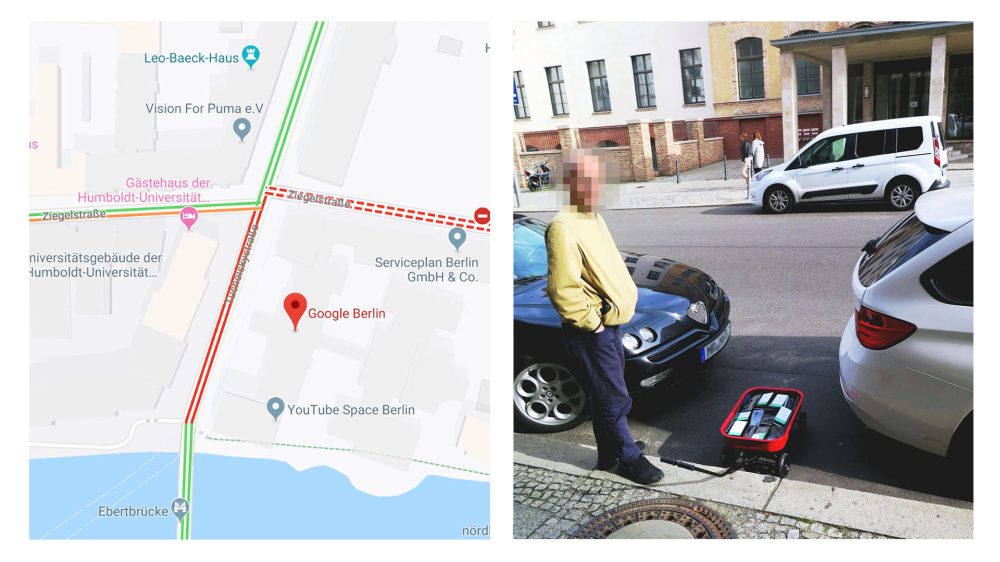
Simon Weckert, “Google Maps Hack,”
Berlin 2020. ©Simon Weckert.
In a video posted to YouTube, you can watch the wagon’s route as
it slowly turns streets classified as green (smooth sailing!
continue on your path) into red zones (traffic! avoid!), as the
data is fed back in a closed-system to real-time users.
Weckert timed his hacktivism to coincide with the upcoming 15th
anniversary of the launch of Google Maps. One of his walking routes
actually passed by the company’s headquarters in Berlin, which
feeds into his larger mission.
“Even if you don’t have location services on, or you’re not
using the app, data is still being collected,” Weckert told Artnet
News by phone. For those who understand the pervasiveness of data
mining, it can still be hard to opt out completely. Like the email
listserv you can never manage to unsubscribe from, complacency
often makes our decisions for us.
Weckert described his ideas in terms laid out by the theorist
Marshall McLuhan, “the interaction between how technology shapes
human behavior, and now, how human behavior can, in return, shape
technology.” He references a paper by Moritz Alhert’s called “The
Power of Virtual Maps,” which analyzes how maps are not as neutral
as we might think. “There’s a real tension, because maps are not a
territory at all, they are a different version of reality,” he told
Artnet News. “Data is always collected for a specific purpose, for
an entity, using instruments created by a company.”
Google, for its part, responded to the act in good humor,
telling the website 9to5Google:
Whether via car or cart or camel, we love seeing
creative uses of Google Maps as it helps us make maps work better
over time.Traffic data in Google Maps is refreshed continuously thanks
to information from a variety of sources, including aggregated
anonymized data from people who have location services turned on
and contributions from the Google Maps community. We’ve launched
the ability to distinguish between cars and motorcycles in several
countries including India, Indonesia and Egypt, though we haven’t
quite cracked traveling by wagon. We appreciate seeing creative
uses of Google Maps like this as it helps us make maps work better
over time.
The post How One Artist Hacked Google Maps to Fake a Traffic
Jam and Make a Point About the Flaws of Big Data appeared first
on artnet News.
Read more https://news.artnet.com/art-world/artist-simon-weckert-google-map-hack-1769187
Further reading


Leave a comment