
A Groundbreaking New Survey of Abstract Painting From the Arab World Adds a Vibrant Chapter to Art History
The middle of the 20th century
was a tumultuous time for the 22 countries of the Arab world. It
was a period of decolonization and industrialization, of war and
mass-migration. It saw the rise of socialism, the global oil boom,
and the formation of new nations.
“Because many of these countries
were entering the world arena as independent nations and young
nation-states, one of their primary objectives was to begin
defining themselves as being distinct peoples. A good way to do
that is through culture and through art,” says Suheyla Takesh, a
co-curator of “Taking Shape:
Abstraction from the Arab World, 1950s–1980s” at New York University’s Grey Art
Gallery.
As its name suggests, the show
charts the rise of non-figurative art produced in—and by artists
from—Egypt, Iraq, Lebanon, and other countries of North Africa,
West Asia, and the Arab diaspora. Nearly 90 paintings, sculptures,
and other works populate the exhibition’s walls and floor, all of
which were taken from the collection of the Barjeel Art Foundation, an independent
organization dedicated to Arab art located in Sharjah in the United
Arab Emirates (UAE).
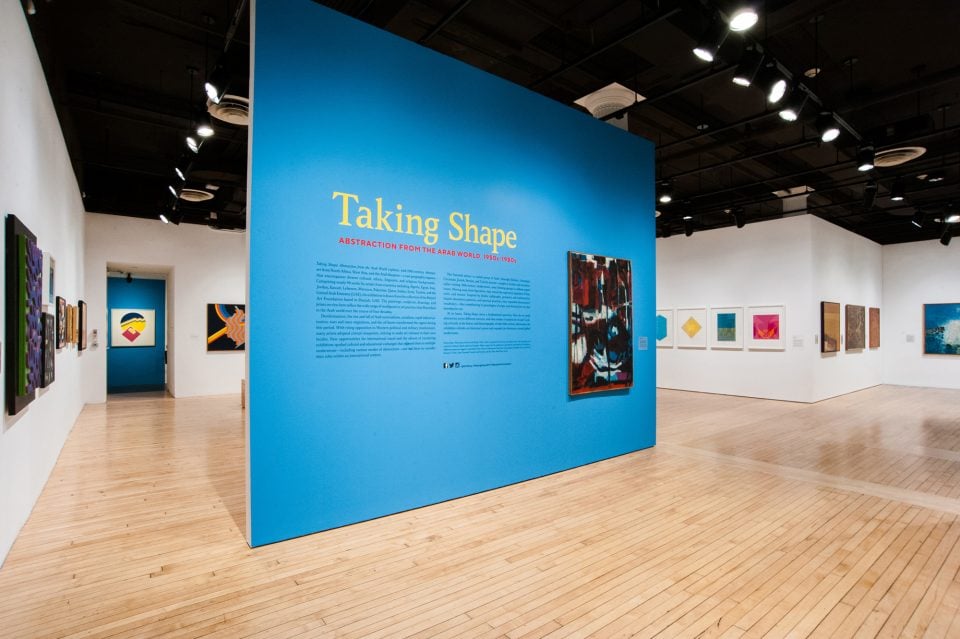
Installation image of “Taking Shape:
Abstraction from the Arab World, 1950s–1980s.” Photo: Nicholas
Papananias, Courtesy of the Grey Art Gallery, New York
University.
“Many art schools and
collectives were being formed during this time as people tried to
come up with what it means to be, say, an Iraqi artist or an
Egyptian artist,” Takesh adds. “Much of this time period found
artists going back to their local histories and heritage to revive
innovative ways to create a new, site-specific
modernism.”
Takesh, the sole curator at the
foundation, teamed up with the Grey’s director, Lynn Gumpert, to
realize “Taking Shape.” The ambitious topic hadn’t been tackled in
detail before and necessitated a great deal of new scholarship,
starting more than two-and-a-half years prior to the opening. (A
hefty catalogue edited by Gumpert and Takesh was published
alongside the exhibition.)
Despite the considerable
investment of resources required, Gumpert says, such work is vital
now as we rewrite our collective understanding of modernism through
a global—not strictly Western—lens.
“We all were trained in Western
art history; there was no other art history for us to turn to,”
says the Grey director. “That’s finally starting to break down and
there are other histories being written. We hope that this show
adds to that momentum.”
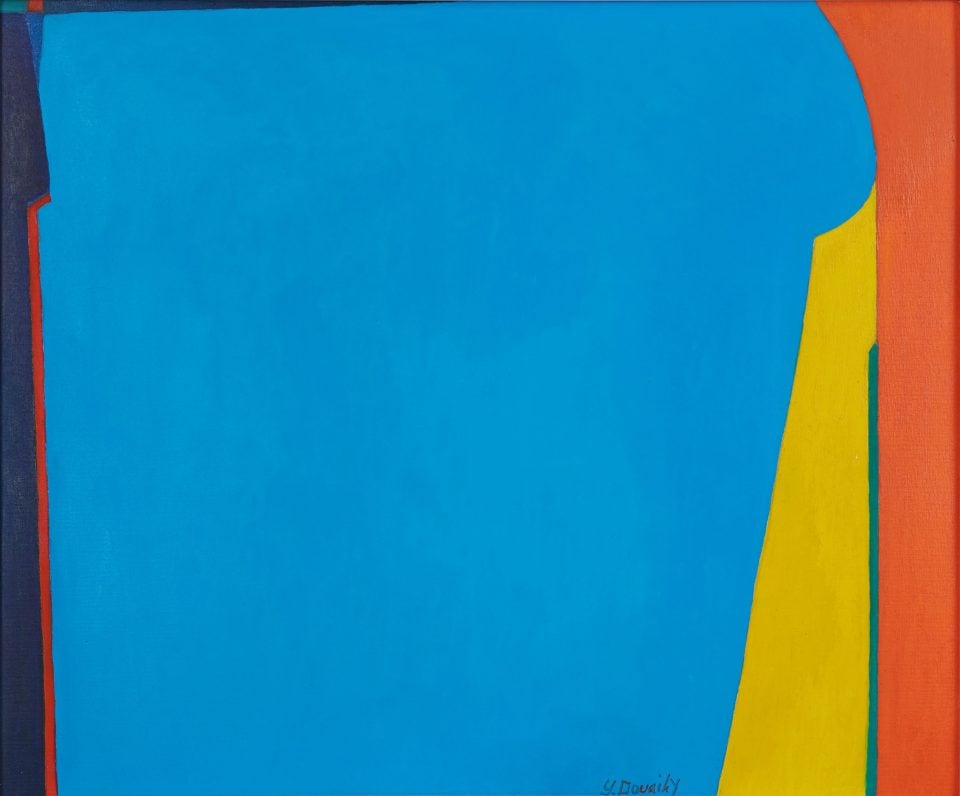
Saliba Douaihy, Untitled (c.
1960–1969). Courtesy of the Barjeel Art Foundation, Sharjah,
UAE.
Founded around the personal
collection of sultan Sooud Al Qassemi, a member of the Sharjah
ruling family known for his globe-spanning efforts promoting Arab
art and culture, the Barjeel Art Foundation counts more than 1,000
artworks in its holdings.
“We were lucky that the body of
work was so diverse,” says Takesh. “It forced us to look into the
differing, more specific histories as well as the artists’ personal
histories and their development as individuals.”
Indeed, a wide variety of
approaches to abstraction is represented in “Taking Shape,”
inspired by everything from mathematics, geometry, and spiritualism
to Arabic calligraphy and Islamic decorative patterns. Often,
formal techniques can be traced back to regional
heritage.
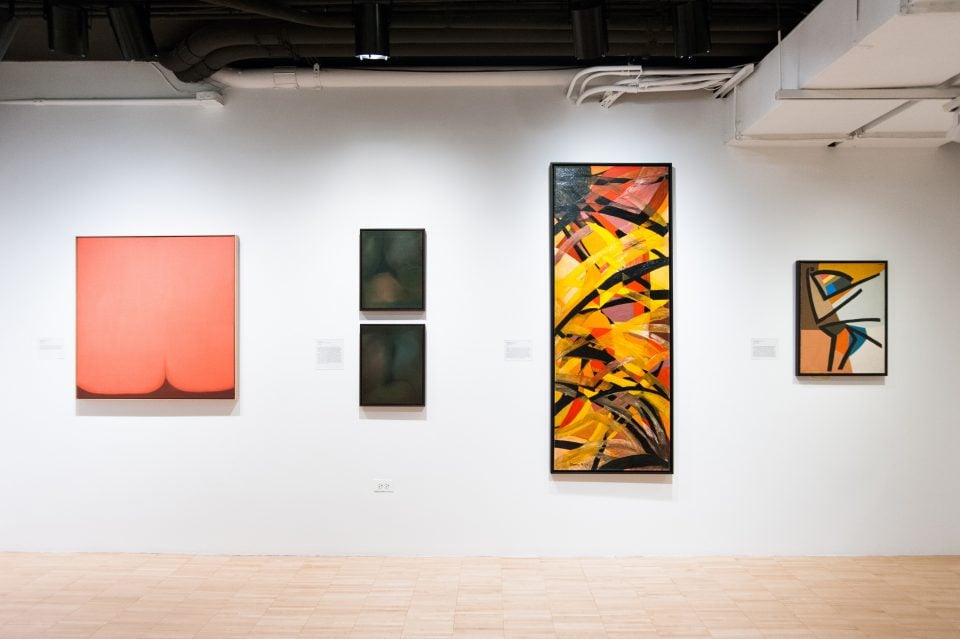
Installation image of “Taking Shape:
Abstraction from the Arab World, 1950s–1980s.” Photo: Nicholas
Papananias, Courtesy of the Grey Art Gallery, New York
University.
For instance, cuneiform was a
big influence for Iraqi artists, while traditional amazigh patterns
can be seen throughout art made in North Africa. For other artists
represented in the exhibition, the turn to abstraction was a
political gesture, intended to contradict the popularity of social
realism that came with the rise of communism and
socialism.
The deconstruction of the Arabic
alphabet is another theme that courses throughout the show, as is
the desert landscape and its monochromatic pallet.
There’s a temptation to read the
developments in these countries against the well-charted evolution
of abstraction in Euro-American art, from Wassily Kandinsky to
Picabia, Picasso, Pollack, and so on. The comparison may be
problematic insofar as it defers to Western art as the dominant
narrative. Yet at the same time, Gumpert notes, many artists in the
Arab world were very much aware of developments in modern art
elsewhere.
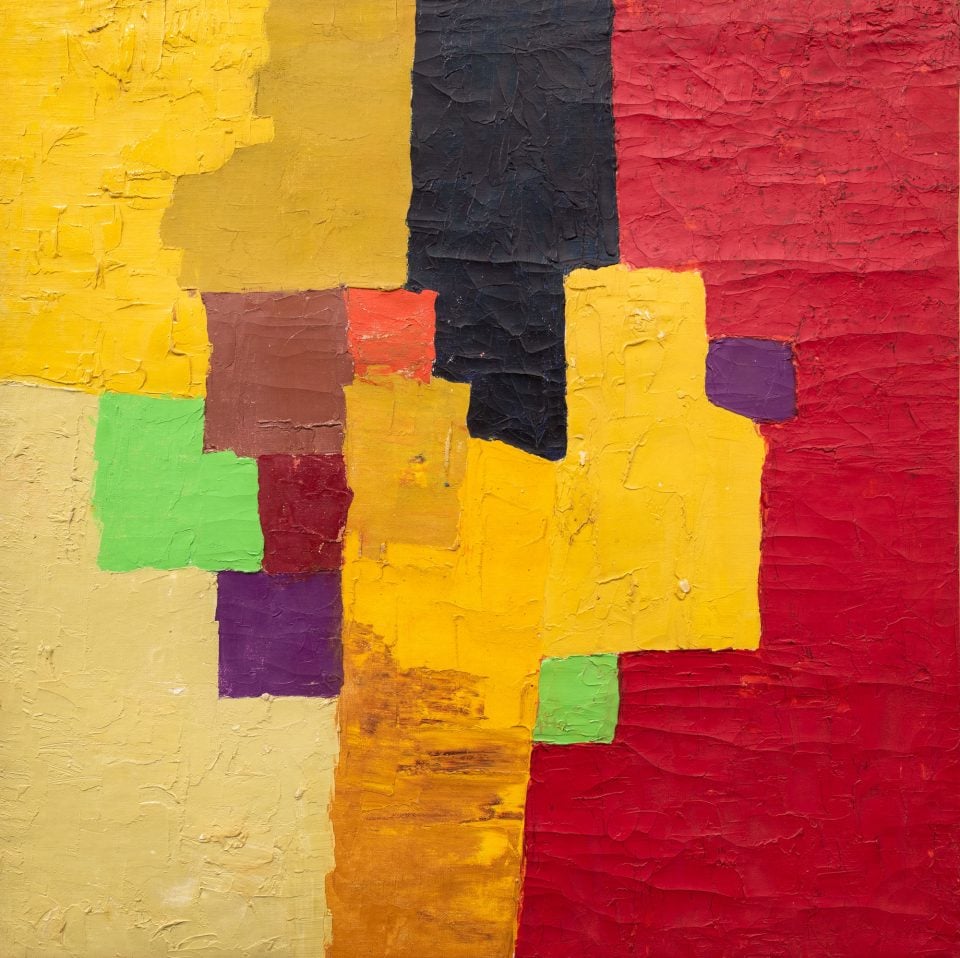
Etel Adnan, Autumn in Yosemite
Valley (1963–1964). Courtesy of the Barjeel Art Foundation,
Sharjah, UAE.
“One of the things we found was
that many of these artists themselves were aware of [the
cross-cultural conversation] because they attended Western-style
art academies,” she explains. Many artists sought inspiration from
both Europe and their own country’s heritage of architecture,
textiles, and other applied arts.
“It just so happens that a lot
of their sources are already non-representational,” adds Takesh.
“So the work that came out is what people trained in Western art
history would call abstract, even though some artists have said
that abstraction as such wasn’t their goal. The goal was making
work that was relevant to their context, which a lot of the time
happened to be non-representational.”
Ultimately, “Taking Shape” shows
that art history itself is abstract. It’s as hard to define as any
painting on the walls of the Grey.
“Art history likes to make
categories that are nice movements, one following and reacting to
the other,” says Gumpert, “but the art itself is much
messier.”
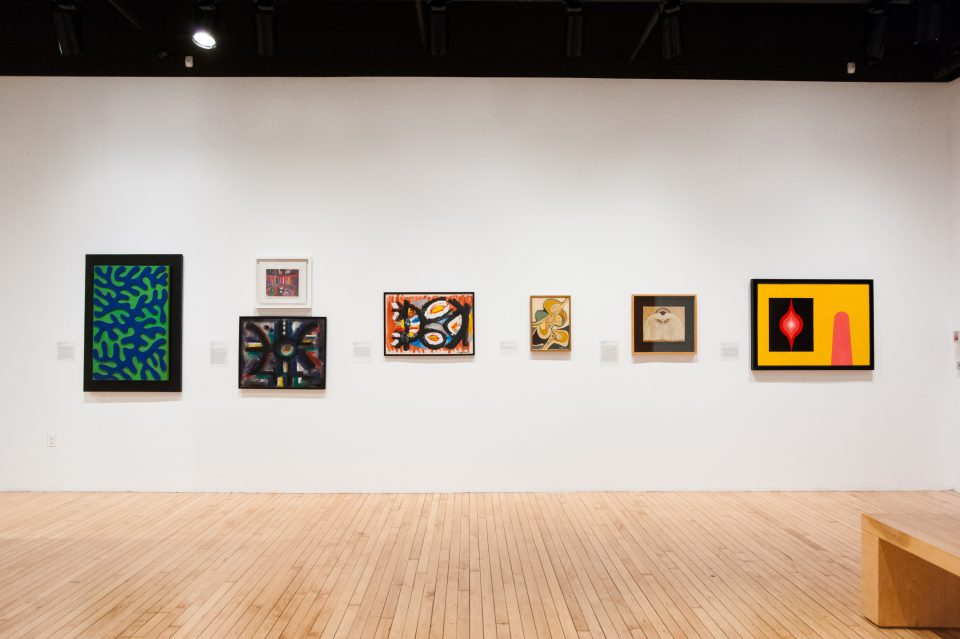
Installation image of “Taking Shape:
Abstraction from the Arab World, 1950s–1980s.” Photo: Nicholas
Papananias, Courtesy of the Grey Art Gallery, New York
University.
“Taking Shape:
Abstraction from the Arab World, 1950s–1980s” is on view through April 4, 2020 at New York
University’s Grey Art Gallery.
The post A Groundbreaking New Survey of Abstract Painting
From the Arab World Adds a Vibrant Chapter to Art History
appeared first on artnet News.
Read more https://news.artnet.com/exhibitions/arab-abstraction-1770720
Further reading


Leave a comment