
‘We Had the Guts to Say Yes to This’: Artists Explain Why They Ignored Widespread Censure to Participate in Desert X’s Saudi Edition
Seated atop a big anamorphous rock in AlUla, an ancient oasis in
the Medina region of Saudi Arabia, is an electric blue sculpture of
a woman seated in the meditative yogic position called “lotus.” Her
legs are crossed while her hands extend out with her palms open on
either knee. Her eyes are closed as she connects with the silence
and nature that surrounds her.
The work, NAJMA (She Placed One Thousand Suns Over
the Transparent Overlays of Space) by Los Angeles-based
artist Lita Albuquerque, could be the first time in over 1,000
years that a figurative female sculpture has been displayed in
Saudi Arabia, where Islamic art forbids figurative
representation, especially of women.
Staged as part of the inaugural Desert X AlUla, Albuquerque
tells how her fictional female astronaut arrived on earth to spread
knowledge and understanding throughout the planet.
“This is a historic moment,” says the artist, who also
previously participated in Desert X in Coachella, where the
biennial originated. “The doors have finally opened to something
collaborative like this bringing international, Middle Eastern and
Saudi artists together.” It is historic, she says, not only that
the figure is being shown, but that “it is accepted.”
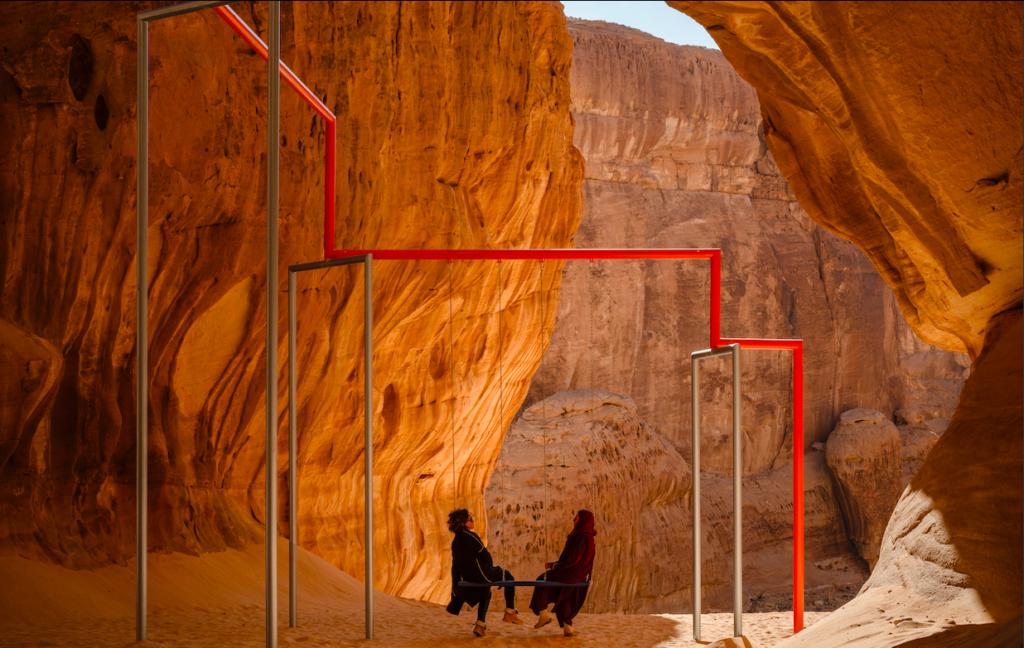
Superflex, One Two Three Swing!
Installation view at Desert X AlUla, photo Lance Gerber, courtesy
the artist, RCU and Desert X
There was a revolutionary spirit in the air last weekend as the
inaugural edition of Desert X AlUla unveiled 14 massive structures
in the mystical desert lands of Saudi Arabia. The artworks, created
in accordance to the unique natural landscape of this ancient
region, characterized by sand valleys, high sandstone cliffs, and
enormous rocks that were reportedly once under water. Time seemed
to stop momentarily in AlUla as the formidable presence of the
landscape united with contemporary artworks in a most magical
manner.
As human and natural creation joined in dialogue, guests moved
from one artwork to the next like wide-eyed children. The
interactive works offered chances to play—like jumping on Manal Al
Dowayan’s trampoline’s in Now You See Me, Now You Don’t,
or swinging in glee on Superflex’s One Two Three
Swing!—and chances to contemplate, as in Muhannad Shono’s
The Lost Path, an installation of empty oil pipes wrapped
around several large crevices which led, if one followed the pipes
to their origin, to a secluded space where “guests can find
themselves,” the artist says.
Several works commented on AlUla’s significance as an ancient
crossroads for commerce and culture. It is situated on the Incense
Route, connecting Asia, Africa, and Europe for thousands of years.
Saudi artist Rashed AlShashai’s A Concise Passage, a
gigantic pyramid made of blue plastic crates reflects on the
passage of goods from AlUla’s ancient past to its present. The
pyramid, says the artist, is a universal form offering a bridge
between the landscape and economic systems that affect present day
national borders.
Political Struggles
Inevitably, there were political overtones to the exhibition, on
multiple levels. Before it even opened, organizers sparked a
firestorm of criticism for announcing their decision to mount the
show in Saudi Arabia, just a year after the murder of dissident
journalist Jamal Kashoggi at the Saudi consulate in Istanbul.
The Los Angeles Times art critic Christopher
Knight called the show “morally
corrupt” and three of its board members resigned in
protest.
“Some people wouldn’t talk to me and other people were
absolutely shocked that I would do it,” says Albuquerque. “When
Christopher Knight wrote that article I felt very pressured
and for three days I decided not to do it. I was so depressed and
then I said, ‘Wait a minute, I can’t let that kind of [critique]
stop me from being part of a historic moment.’”
Due to the current geopolitics and long-held stereotypes about
Saudi Arabia, many artists felt immense political pressure when
they decided to take part in Desert X. “A few people said ‘Are you
sure you want to take this risk and be criticized?’” remembers
Gisela Colon. “I said ‘Absolutely, I don’t have any fear.’”
Colon’s work, The Future Is Now, a tall monolith metal
projectile-shape sculpture, shoots up into the sky. It’s an object
with a dual purpose, one that is primitive, recalling ancient
objects, and contemporary, referencing the future. “The fact that
me as a woman originally from Puerto Rico can put a gigantic object
that has references to projectiles, bullets, and military power in
the desert in Saudi Arabia is revolutionary,” she says. “They
allowed me to exhibit what I wanted and there was no
censorship.”
Adding another level of complexity to the show is Saudi Arabia’s
history as a place that previously forbid outsiders from entry. “It
is revolutionary that they [Saudi Arabia] has opened the doors and
said ‘yes’ to these works,” says Albuquerque. “This is the
beginning of 2020 and there is so much political pressure on this
[show] and we had the guts to say ‘yes’ to this as artists. We are
not going to bury are heads in the sand. We are going to hold
hands, open this up, and stay together in the unknown.”
Telling Stories in the Land
At the heart of artistic director Neville Wakefield’s mission in
Desert X AlUla is cross-cultural exchange. “This is a continuous
legacy of site-specific artwork that began nearly 50 years ago by a
group of men going against the institutions of the time,” Wakefield
says. “Here its legacy is continued through the multicultural.”
The show, while co-curated by Wakefield and Saudi curators
Raneem Farsi and Aya Alireza, is in a way curated by
the land itself, Wakefield says. “The landscape is so rich in the
broader socio-historical way,” he says. “These shows are curated by
the place. Desert X signifies several firsts. Notably, it’s the
first site-specific show in Saudi and the first site-specific
exhibition set up as a cross-cultural dialogue.”
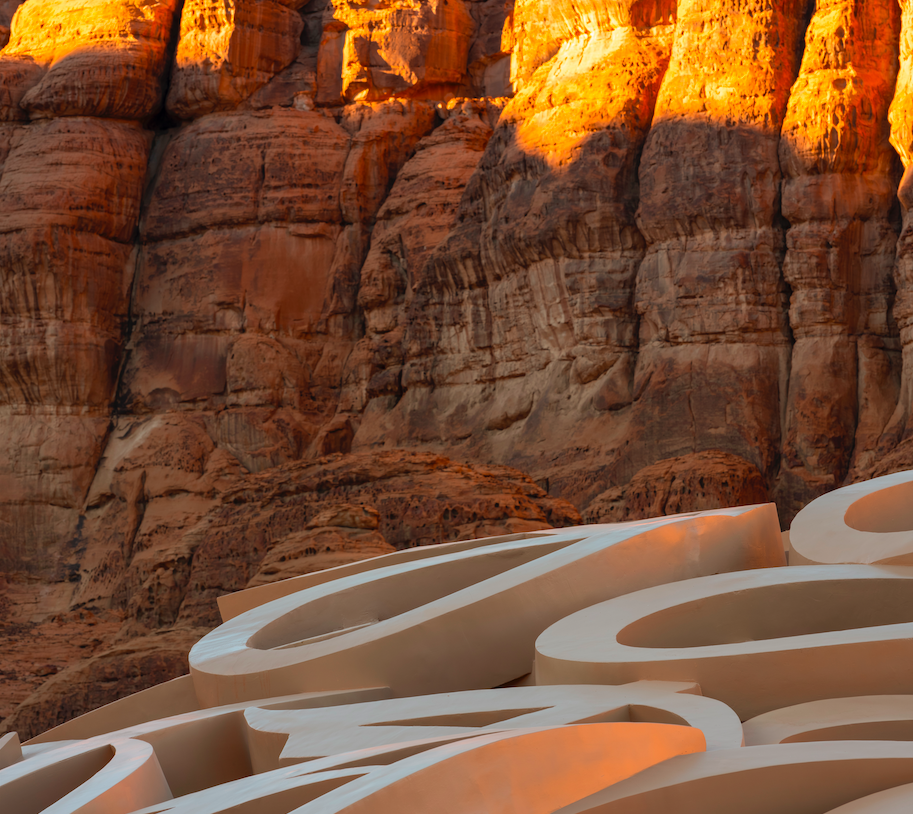
eL Seed, Mirage installation view
at Desert X AlUla, photo by Lance Gerber, courtesy the artist, RCU
and Desert X.
AlUla is a land that offers many stories. One is a love story
dating back to the 7th century between Jameel Bin Ma’amar and Lady
Buthayna from a neighboring tribe, the subject of French-Tunisian
artist eL Seed’s large calligraphic
sculpture, Mirage.
Buthayna’s people refuse Jameel’s marriage proposal because they
feel Jameel’s verses praising their love have compromised her
honor. At that time, saying that a woman loved a man was considered
an act of shame in ancient Arab tribal society. Buthayna is then
forced to marry another man, yet she and Jameel continue to love
each other, even though their love is never consummated.
According to the story, Jameel continues to visit Buthayna in
Wadi ‘I-Kura, modern-day AlUla, and complains in verse of his
longing to be with her. The poetry is as much an ode to lost love
as it is for the beauty of the AlUla landscape. The sand-colored
calligraphic form of el Seed’s Mirage, glistens in the
desert and then disappears, surrendering itself to the landscape
just as Jameel surrendered himself to his ineffable love for
Buthayna.
“When I arrived in AlUla, I realized it would be impossible for
me to compete with the environment,” says eL Seed. “So I decided to
create a work that would blend into the desert. Jameel and Butheyna
were never able to be together. That’s also a mirage. Love is
universal. It unites us all.”
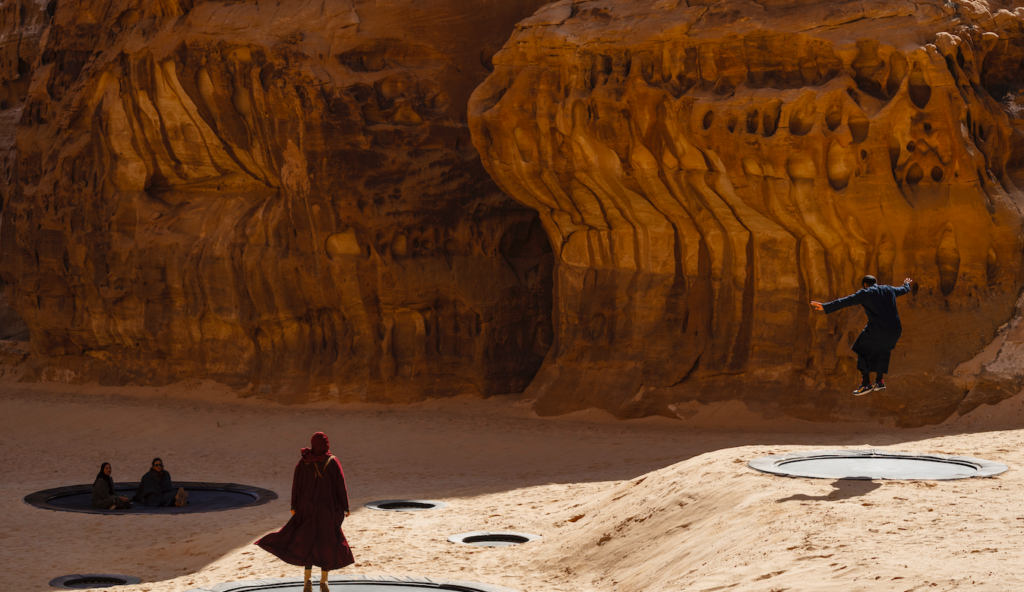
Manal AlDowayan, Now You See Me, Now
You Don’t, installation view at Desert X AlUla. Photo by Lance
Gerber, courtesy of the artist, RCU, and Desert X
A moment of sheer play can be had in Saudi artist Manal Al
Dowayan’s Now You See Me, Now You Don’t, an installation
made of several black trampolines referring to Saudi Arabia’s
silent water crisis. The country has used 1,056 percent of its
total renewable water sources, far exceeding the
conservative global water-scarcity threshold of 20 to 40
percent. Al Dowayan refers to the crisis through the installation
recalling the humble puddle through the form of the trampoline.
“We were asked to make work in a really tough environment that
competed with beauty,” says Al Dowayan. “The conceptual execution
of this project came through to everyone, even the local community,
which was my focus. This is my country and I have immense pride and
I want everybody to engage with it.”
“I was not making artwork that had to be sold,” she continues.
“The artwork allowed us to address the important concern of the
environment. There are no gallery or museum walls here. We were
completely free to do as we wanted.”
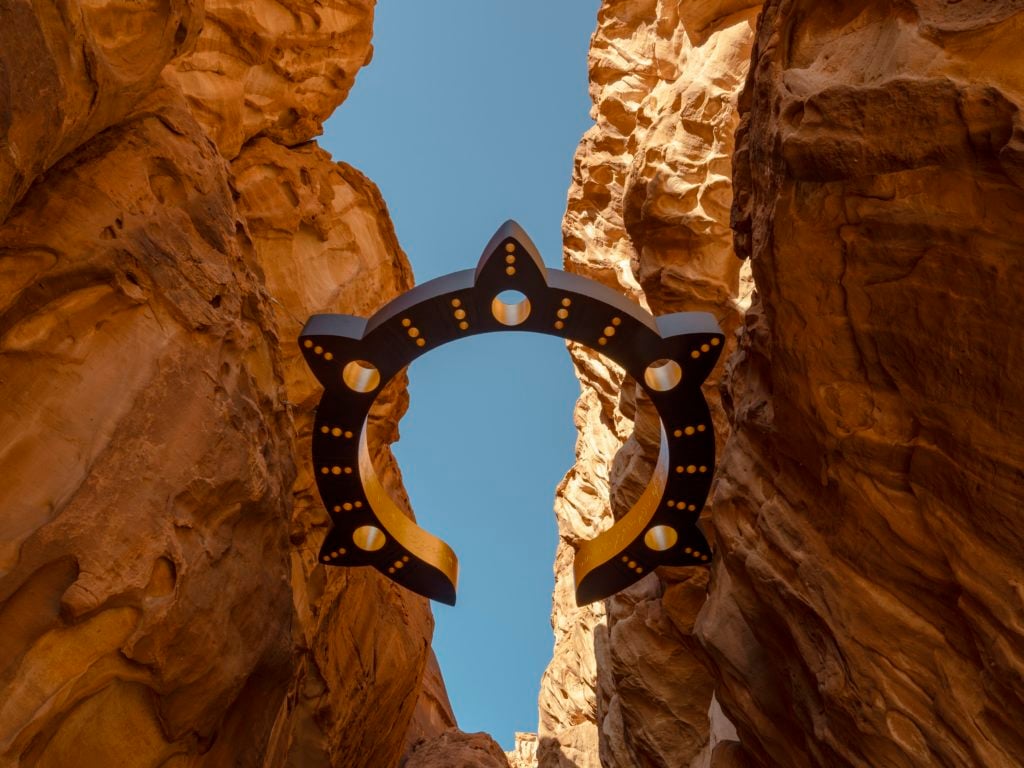
Sherin Guirguis, Kholkhal Aliaa
installation view at Desert X AlUla, photo by Lance Gerber,
courtesy the artist, RCU and Desert X.
Wedged high up within a rock crevice is Los Angeles-based artist
Shirin Guirguis’s Kholkhal Aliaa, a Bedouin anklet given
to the artist by her mother. Glistening with gold embellishment and
Arabic script, the object represents cultural knowledge passed from
a mother to a daughter and the idea of linking individuals across
time and space. It also represents female power.
“The story of women is not often told,” says Guirguis. “I did
face some backlash in the Los Angeles community but I decided to go
forth because I felt it was an important initiative, specifically
for a brown woman like me in an international exhibition whose work
addresses the invisibility of women’s work.”
“I want to celebrate the long history of cultural work produced
by women in the Middle East that has been marginalized, lost, and
forgotten,” she adds. “I wanted to remind women of the impact that
they have in their own community and then maybe we start seeing the
Middle East in a new light and our vision of the region can evolve.
You cannot have empathy for another people or culture if you don’t
engage.”
The post ‘We Had the Guts to Say Yes to This’: Artists
Explain Why They Ignored Widespread Censure to Participate in
Desert X’s Saudi Edition appeared first on artnet
News.
Read more https://news.artnet.com/exhibitions/desert-x-alula-opens-saudi-arabia-1770465
Further reading


Leave a comment