
Trump’s Impeachment Lawyer Alan Dershowitz May Have Owned Looted Antiquities, an Art Crime Expert Says
Standing before the United
States Senate last week, the lawyer Alan Dershowitz argued that his
client, President Donald Trump, should be acquitted of all
impeachment charges, because the commander-in-chief’s conduct with
Ukraine did not rise to the level of criminal activity.
On Wednesday, the Senate voted
to acquit Trump of all charges. But impeachment has also reignited
harsh questions about Dershowitz himself, particularly with respect
to his art collecting. Some experts are now revisiting claims that
looted antiquities may potentially have passed through Dershowitz’s
eclectic art collection, which also includes Judaica, prints, and
Impressionist art.
If so, it’s a story that
historians and archaeologists say is all too common in the art
market, where illicit artifacts can recirculate through the major
auction houses, which have a motivation to obscure the potential
weakness of provenance in pursuit of profits.
Last week, Erin Thompson, an art
crime professor at John Jay College, raised questions on Twitter
about Dershowitz’s antiquities, alleging that of 27 antiquities
that he sold for a total of $155,250 at a 2012 Christie’s auction,
only two of them are listed with any indication of a pre-1970
provenance. In an interview with Artnet News, Dershowitz said that
it was “categorically false” that he owned anything illicit, adding
that he sold virtually his entire collection of ancient works in
2012 through Christie’s, where the company’s head of antiquities
certified his ancient objects as genuine.
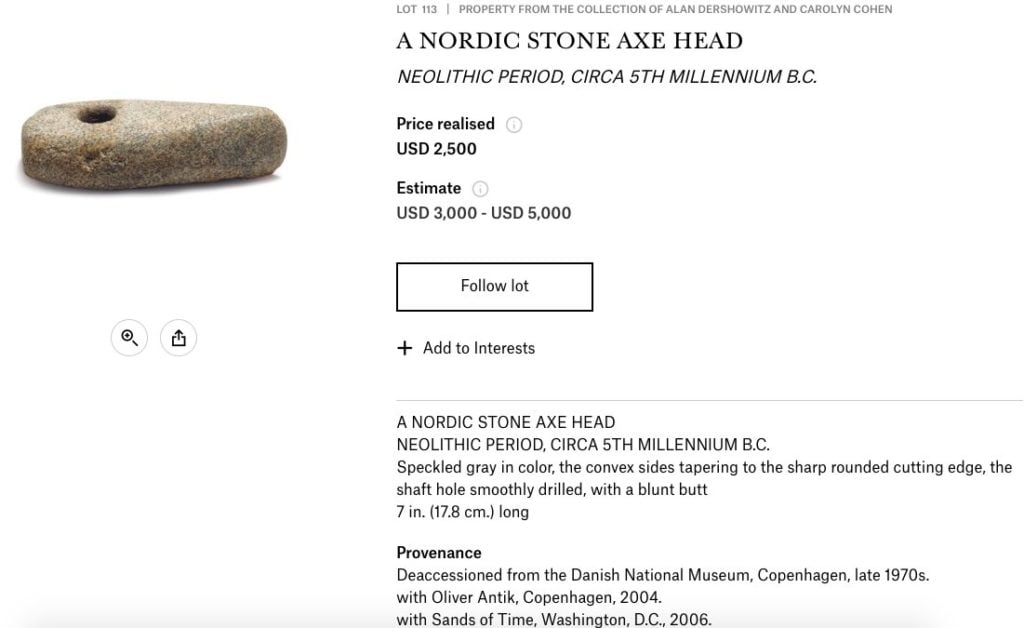
Screenshot of Christie’s sale of
Property from the Collection of Alan Dershowitz and Carolyn
Cohen.
“I would never, ever purchase or
own anything that was in any way suspicious,” the lawyer said.
“Everything I bought was through Christie’s and Sotheby’s, and
everything I sold was through the auction houses, as well.” He
added that he relied on the auction houses for
provenance.
A Fraught Market
Thompson notes that the major
auction houses have improved their practices in recent years,
even withdrawing from
sale and facilitating the
return of some artifacts
when issues arise (though not always without putting up
a fight). Still, the
market for antiquities remains fraught, especially when it comes to
low-value artifacts that rarely receive the same provenance and
forensic research as high-value works.
“Auction houses want to assure
clients that they are buying genuine antiquities,” Thompson told
Artnet News. “They have an interest in assuring buyers … that
everything is kosher.” But in her opinion, relying on an auction
house is a bit like “buying a used car, and when it breaks down,
saying that the salesman told you it was in great
condition.”
Responding to a request for
comment, a Christie’s spokesperson said the auction house would not
sell any work it believes has been stolen. Its cultural stewardship
policy says that Christie’s devotes “considerable resources to
investigating the provenance of objects we offer for sale” and has
a program “of specific procedures, including the requirement that
our sellers provide verifiable evidence in order to ensure that the
works in our sales have not come from conflict zones.” (Sotheby’s
did not immediately respond to a request for comment.)
The push for stricter guidelines
surrounding the trade of antiquities began in 1970, when UNESCO
developed international protocols that lay out preventive measures
and restitution provisions for member states. Under the terms of
the convention, source countries that believe there has been a
theft of an antiquity must initiate restitution requests and
furnish evidence that the objects were looted.
Following the UNESCO convention,
dealers and collectors began becoming more careful with their
provenance documentation. But because the black market for
antiquities proliferated in the decades leading up to the 1980s,
most provenance experts, as well as American museums, now insist on
having documentation of ownership that can be traced prior to
1970. (Although such lack of pre-1970 documentation is common
and does not necessarily mean an artifact is fake or stolen, it can
be a sign that an artifact was looted or the subject of illegal
export.)
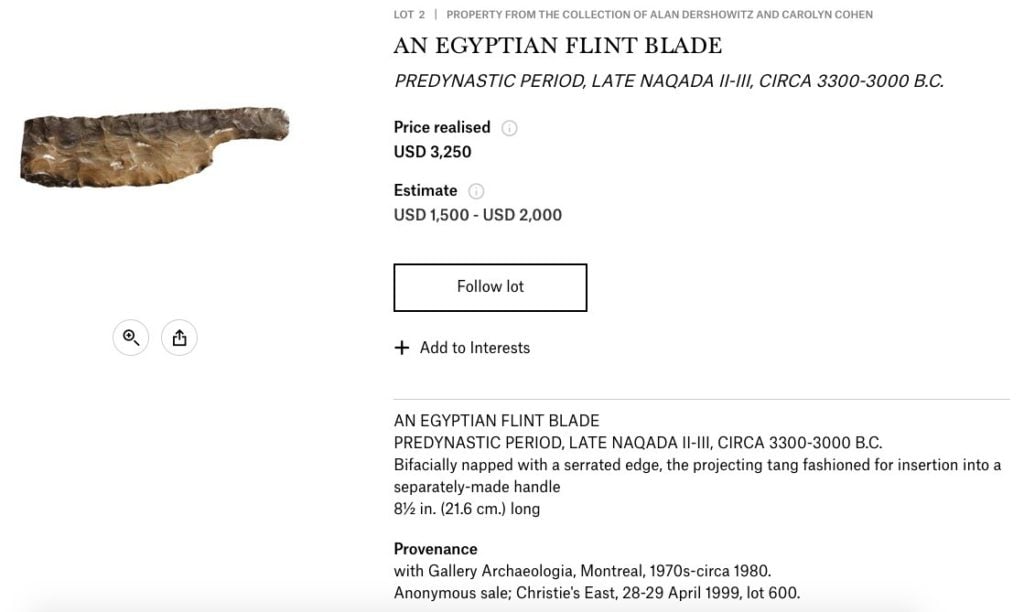
Screenshot of Christie’s sale of
Property from the Collection of Alan Dershowitz and Carolyn
Cohen.
“I don’t think Dershowitz has
purchased anything especially suspicious,” said Thompson, “but he
has participated in a marketplace that many—including
myself—believe to have serious ethical issues.” When the professor
examined the Dershowitz collection on the Christie’s website, most
of the antiquities listed had no indication of a pre-1970
provenance, including an ancient Egyptian painted wood coffin
fragment that could only be traced to the European art market in
the 1980s.
The same year Dershowitz
auctioned off his collection of ancient artifacts, he appeared in
a New York
Times article
that discussed how stricter museum
standards made it difficult for collectors like the celebrity
lawyer to donate or sell their ancient wares. He had trouble
selling an Egyptian sarcophagus he bought from Sotheby’s in the
early 1990s because of the tighter rules that auction houses placed
on accepting consignments.
“I can’t get proof of when it
came out of Egypt,” Dershowitz said at the time, though he recently
confirmed with Artnet News that he no longer owns either of the two
sarcophagi mentioned in the article, and that they were sold at
auction.
Warning Signs
In cases where documentation is
spotty, some in the trade also use forensic testing to help support
an artwork’s authenticity and history. According to Thompson, the
12 terracotta oil lamps that Dershowitz sold could have been tested
for thermoluminescence, a method of dating ancient ceramics and
pottery by the last time an object experienced the extreme heat of
something like a kiln. Such processes, however, are costly,
disincentivizing auction houses from performing such an analysis on
cheaper lots. (Thompson said that the lamps, which sold for $8,750
at Christie’s, would have been unlikely to receive
thermoluminescence testing; Christie’s did not comment. The
combined sum from the Dershowitz sale was $155,250.)
But beyond expensive tests,
there are other indicators within established provenance records
that experts say could indicate a problematic past. In 2017, the
British archaeologist Paul Barford noticed
something peculiar about a Bonhams
sale of bronze “erotic” sculptures, which included at least one
item from Dershowitz’s 2012 Christie’s sale: a second-to-first
century B.C.E. artwork depicting a man and woman having sex in an
upright position.
Provenance for the sculpture
only went as far back as an anonymous sale in 1999 and was
described as coming from “Southern Arabia,” which Barford described
as a common euphemism in the art trade for Yemen. In a blog
post, Barford opined
that the Bonhams catalog reference to the Christie’s 2012 sale was
insufficient “to assert an easily smuggled object like this came on
the market licitly,” especially when Yemen’s 1994 civil war emptied
the country’s museums. (Bonhams did not immediately reply to a
request for comment.)
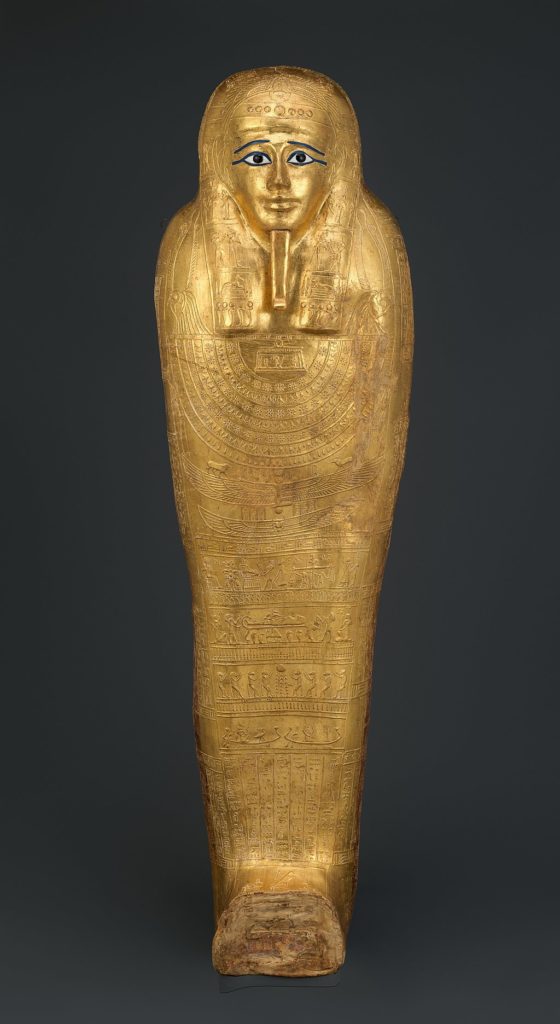
The gilded coffin of Nedjemankh, which
was returned to Egypt last year. Photo courtesy the Metropolitan
Museum of Art.
For Tess Davis, the executive
director of the Antiquities Coalition, a nonprofit lobbying against
the trafficking of ancient objects, the revived scrutiny on
Dershowitz’s collecting history may serve as a wake-up call to
others in the sector to remain vigilant. Even the Metropolitan
Museum of Art recently
relinquished antiquities based
on evidence that they
had been stolen. “If major institutions, with their unparalleled
expertise and resources,” Davis said, “can’t guarantee that their
purchases are legal, ethical, and authentic, how can an individual
collector like Dershowitz?”
A Wake-Up Call?
Making matters more difficult,
experts say, is the fact that most antiquities collectors lack the
training to conduct provenance research themselves, and there are
few independent third parties that can provide such a service.
“When it comes to due diligence, there really is no standard,” said
Leila Amineddoleh, a lawyer specializing in art crime and cultural
heritage who worked with the Manhattan District Attorney on the
repatriation of an Egyptian coffin from the Met last year. “But the
problem with looted objects is that if you keep selling them, it
shows that there is a market for objects without good
provenance.”
Experts like Amineddoleh, Davis,
and Thompson agree that the market can sometimes facilitate the
recirculation of illicit artifacts without the full knowledge of
buyers. And for owners of forged antiquities, there can be an
immense financial loss when collectors eventually set out to sell
their wares only to be rejected by an auction house during the
vetting process.
But the ultimate price is paid
by the people living in war-torn areas where looting and forgeries
can proliferate. “These people are victims in so many ways,”
Amineddoleh said, “and then their heritage is being
destroyed.”
“Given his public prominence,
Alan Dershowitz has an opportunity here,” added Davis. “I hope
he’ll take it and make himself an ethical leader in the
field.”
The post Trump’s Impeachment Lawyer Alan Dershowitz May Have
Owned Looted Antiquities, an Art Crime Expert Says appeared
first on artnet News.
Read more https://news.artnet.com/art-world/dershowitz-antiquities-art-crime-expert-1772157
Must-See Art Guide: Mexico City
Further reading


Leave a comment