
Art Fairs May Be Getting Blander, But Mexico City’s Zona Maco and Material Offer a Model for Regional Events to Thrive
As
Latin America’s leading art fair, Zona Maco, welcomed invited
collectors on Wednesday there were two very different things on
international gallerists’ minds. Would Mexican collectors be in a
buying mood one year into the socialist presidency of
Andres Manuel Lopez-Obrador, better
known as AMLO? And looking further afield, would Art Basel in Hong
Kong be postponed amid fears of the fast-spreading
coronavirus?
Within
hours of the fair’s opening in Mexico City on February 5, the
answer to the first seemed a definite ‘yes,’ with early sales made
by Lisson Gallery, Sean Kelly, Pace, and Kurimanzutto, among
others. (As for ABHK, a lack of updates from Basel meant
gallerists’ shipments for its Asia edition remained on hold, with
the rumor mill running full-speed. Twenty-four hours later
the news arrived that the fair was indeed
cancelled.)
At
Lisson’s booth, the London and New York gallery’s executive
director Alex Logsdail stood beside a new sculpture by the Mexican
artist Pedro Reyes; the piece had been snapped up by a Mexican
collector who acquired it for his foundation. Logsdail described
Zona Maco as being a regional fair, but “in a good way.” He’s been
showing there for the past decade—building relationships with
collectors from Mexico, as well as with regular attendees who fly
in from across South America as well as Texas, California, and New
York. Logsdail said there are a handful of collectors willing to
spend millions of dollars on a must-have work, but for many,
budgets max out around the $250,000 to $300,000 mark. Reyes’s
volcanic stone column, Siete Piedras (2000), went for $160,000, arguably a bargain
for such an impressive piece.
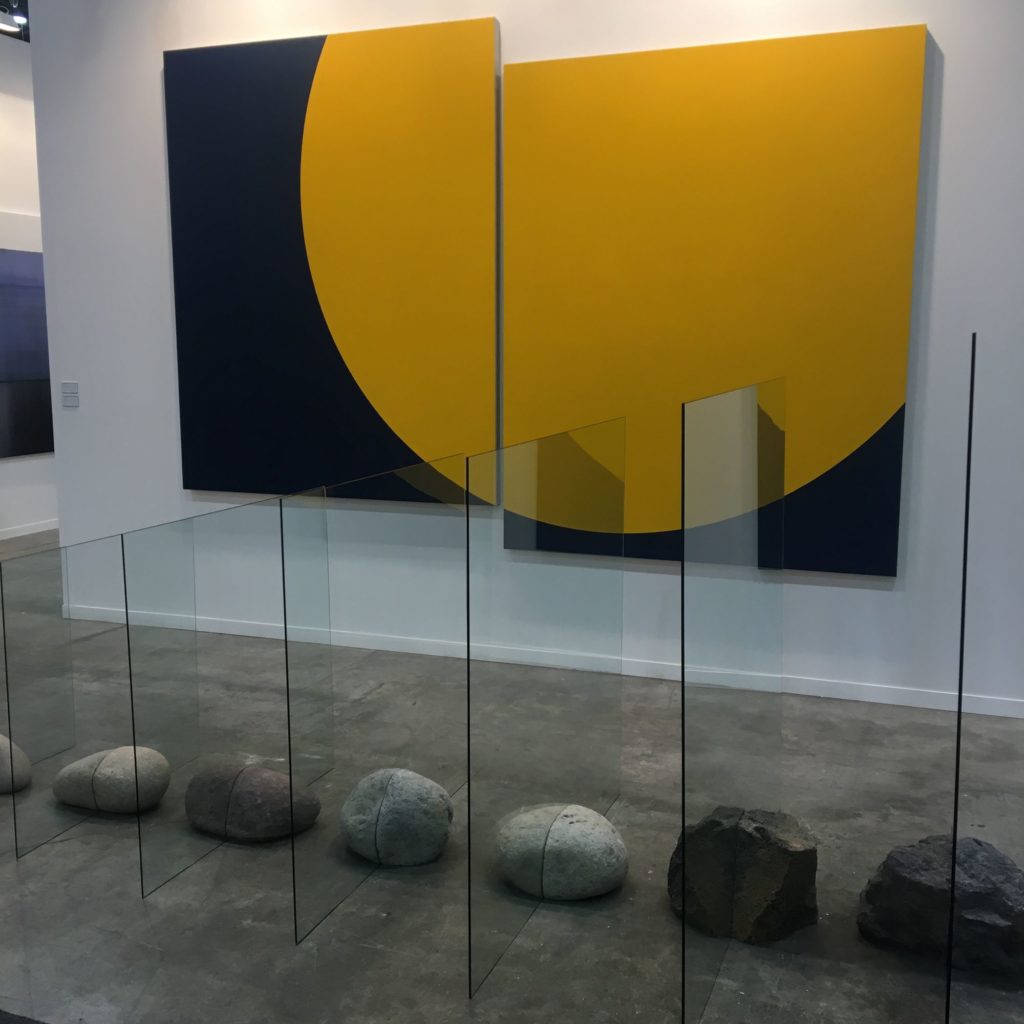
Jose Dávila’s work at Sean Kelly, Zona
Maco 2020. Photo by Javier Pes.
Another Zona Maco veteran, Sean
Kelly, said the fair is important on the global map partly because
of Mexico City’s well-established artistic culture, which is as
lively as ever. He also praised the sophistication of the city’s
collectors, who match nicely with the New York-based gallery’s
mantra: Collect wisely. “There is a lot of wealth here, a bit like
Brazil,” Kelly told Artnet News. “Mexican collectors use their
knowledge and education. They are not flashy.” He expects many to
return at the weekend to make their purchases, although early sales
already included a sculpture by Antony Gormley and pieces by Jose
Dávila. There was special interest from collectors and curators in
the Mexican artist’s elegant stone-and-glass sculpture, priced at
$150,000, offset by a vibrant, large-scale graphic work, both
Untitled (2020).
Opening day business was also brisk at Pace. The gallery found
buyers for a Loie Hollowell painting, a Joel Shapiro sculpture, a
mirror work by Song Dong, and a James Turrell hologram. (Prices
were not disclosed.) Zona Maco newbies Xavier Hufkens of Brussels
set out its stall with a solo presentation of work by Matt Connors.
After testing the water in Mexico City, the gallery will head north
of the border to show at Frieze LA next week.
José
Kuri sounded upbeat after the uncertainties of 2019. The co-founder
of Kurimanzutto—perhaps the leading gallery in Mexico City, which
now also has a New York space—reported a strong start at Zona Maco.
Allora & Calzadilla’s creepy, petrified petrol pump dominated the
booth. Part of a series first shown at the Venice Biennale in 2011,
it feels as timely as ever.
The
number of acquisitive collectors and interested curators at Zona
Maco also bodes well for the Material Art Fair, which opened
Thursday. Kurimanzutto, along with Mexican heavy hitters Labor and
OMR, have booths at both fairs. Gabriel Orozco has created a
standout installation for Kurimanzutto at Material. Called
Tracing Money (2020) it features an array of paper
bills, plus drawings and transparencies of small details that have
caught the eye of the Mexico- and Japan-based artist. A comment on
the fluctuating value of paper money, it would be ideal for a
museum anxious about the value of its endowment (or the intricacies
of ethical fundraising). Individual drawings and photographs are
priced at $15,000 and $1,500, respectively.
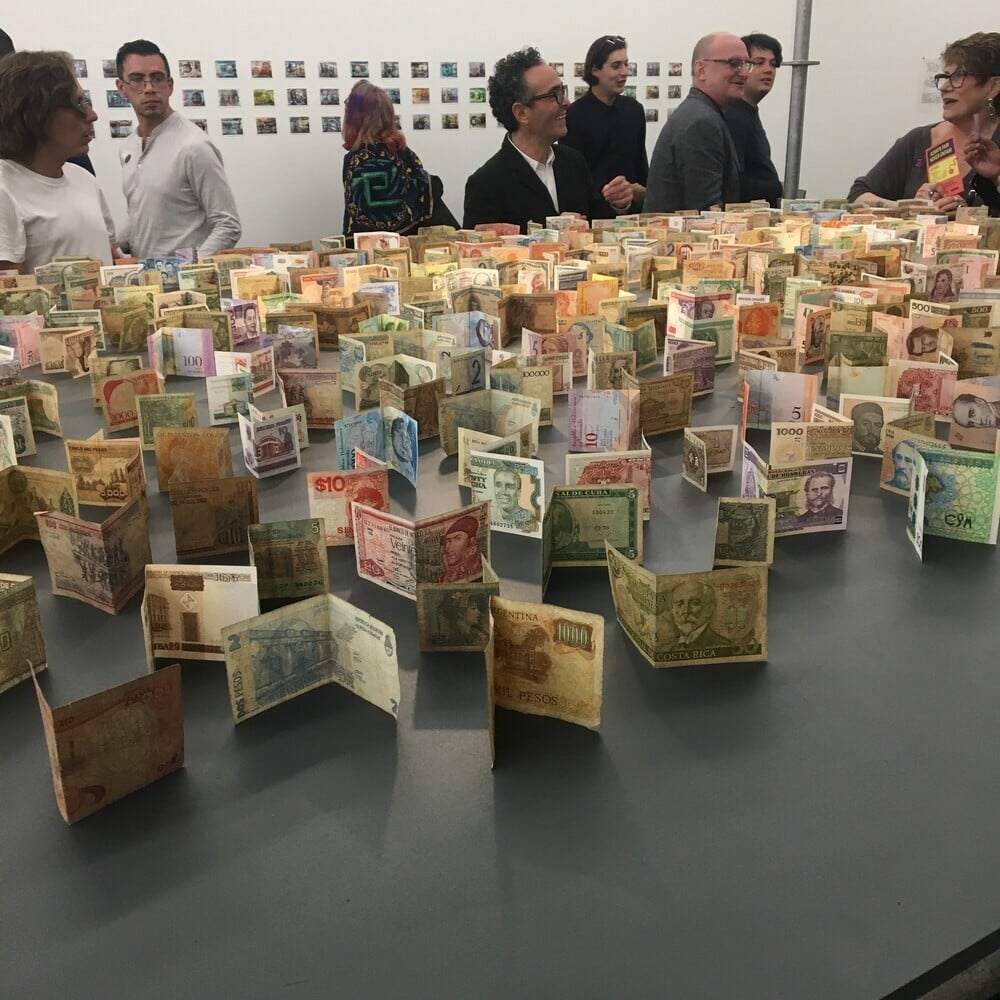
Gabriel Orozco’s Tracing Money,
on view at Kurimanzutto’s booth at the Material Art Fair. Photo by
Javier Pes.
Kuri explained that Mexico
City’s appeal this week goes beyond the two fairs and the slew of
gallery openings. There’s also Salon Acme, a selling show featuring
work by mainly younger and self-represented artists, held in funky
old mansions that are a short walk from Material’s venue, the
Frontón sports hall. Meanwhile, the design-meets-sculpture gallery
and platform Masa has taken over another old mansion stripped to
its bare bones. And the city has a growing number of artist-run
spaces that should be on any Zona Maco collectors’ itinerary—such
as M74, in the gritty Guerrero neighborhood, which is hosting a
trio of group shows.
Also
worth a trek are the historic Luis Barragan-designed stables at San
Cristóbal, which play host to a solo show of site-specific work by
the veteran British sculpture, Richard Long. (The presentation is
co-organized by Lisson, who have an example of Long’s mud works on
offer at Zona Maco.) At the stables, Long has gathered together
stones from across Mexico to create works that echo his ephemeral
pieces from back in 1979, made on epic walks to the country’s
highest peak and deepest gorge. He is only the second contemporary
artist to show at the unique venue, following Sean Scully in
2018.
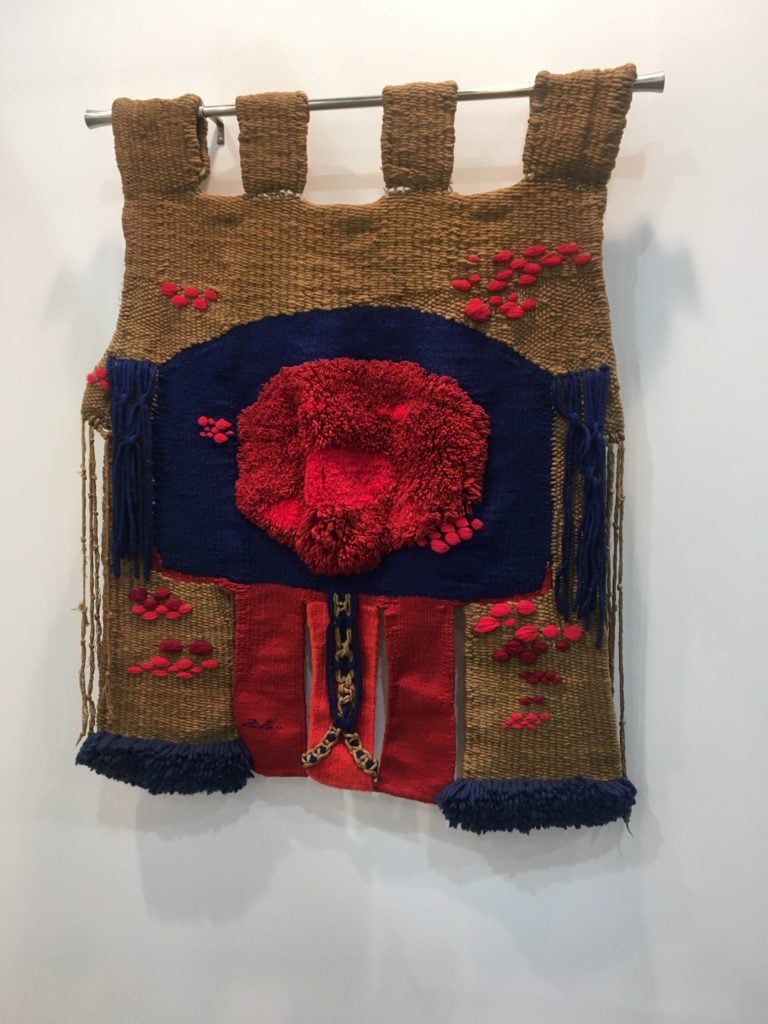
Marta Palau, Amore nuevo
(1972), shown by Walden Gallery at Zona Maco 2020. Photo by Javier
Pes.
Returning to the fair proper: The strong
presence of work by radical female artists at Zona Maco, many from
Mexico, will appeal to collectors and institutions looking to
correct any gender bias in their holdings. Head to Walden Gallery
of São Paulo for work by three Mexican artists, Maris Bustamente,
Marta Palau, and Magali Lara, all featured in the “Radical Women”
show, the Hammer Museum’s groundbreaking contribution to Pacific
Standard Time: LA/LA in 2017. On offer is Bustamante’s witty
subversion of the patriarchy and Freud’s theory of penis envy.
Photographs of her 1982 performance piece—for which the artist
produced self-portrait masks, featuring her sporting an oversized
penis-shaped nose—are priced at $30,000. Nearby are a pair of
vibrant textile wall works from the 1970s by Palau, priced at
$60,000 and $100,000.
As
Logsdail noted, Zona Maco is truly a regional fair in the best
possible way, with its strong showing of galleries from South and
Central America supporting an international roster. That said, the
fair cannot afford to rest on its laurels. The standard of the
booths is uneven, and the fair has never made up the loss of the
many smaller galleries that have decamped to Material. “Mexico City
has everything: great art schools, artists, non-profits, museums,
and galleries,” said the Brussels-based collector Alain Servais.
“Zona Maco gives international collectors a reason to visit,” but
it needs to focus on quality. What the city doesn’t need, he
cautioned, is another “art fair shopping mall.”
The post Art Fairs May Be Getting Blander, But Mexico City’s
Zona Maco and Material Offer a Model for Regional Events to
Thrive appeared first on artnet News.
Read more https://news.artnet.com/market/zona-maco-mexico-fair-1771575
Further reading


Leave a comment