
Veteran Dealer Margaret Clinton on Why She Closed Her Brooklyn Gallery—and Why the Art-Market Ecosystem Is in Need of an Overhaul
Many in the art world were surprised to receive an email late
last month from gallerists Margaret Clinton and Leo Koenig
explaining their decision to close after seven “productive and
rewarding years working as collaborators and partners.”
Since it opened in 2013, Koenig & Clinton had become a reliable
venue for emerging figures who would go on to prominence, including
American Artist, Maria
Hassabi, Olivier Mosset, and Javier Tellez. But ultimately, the
status quo in the art market made it untenable—not to mention
undesirable—to maintain the gallery, Clinton told Artnet News in a
frank, wide-ranging conversation. “We’re in a perfect storm with a very rapidly
changing ecosystem,” she said.
Koenig & Clinton isn’t the only midsize gallery to close its doors
recently. Chicago’s Shane Campbell Gallery, Los Angeles’s
Richard Telles Fine Art, and New York’s Julie Saul Gallery have all
closed or transitioned into private practice in the past year due
in part to rising rents, reduced gallery foot
traffic, and what some perceive as an increasingly
profit-oriented collector base.
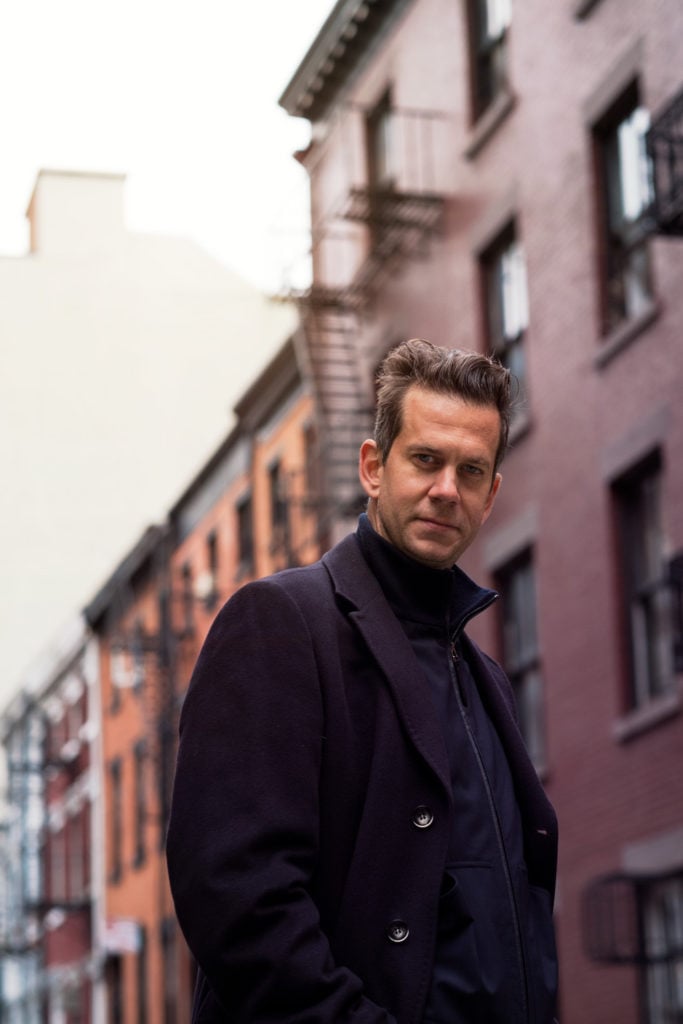
Leo Koenig. Photo by Ilka Grüneberg.
While Koenig (who established his eponymous gallery in 1999,
which later became Koenig & Clinton) will maintain an exhibition
space and continue to focus on secondary market sales and artist
projects, Clinton says she is going take a break after leading
Koenig & Clinton’s program and going “nonstop” for more than a
decade.
Speaking to Artnet News, Clinton discussed the difficulties of
balancing a primary market business focused on emerging artists
with secondary market activity; the changing landscape of
collectors and philanthropy; and the challenges facing female
gallerists in particular. Though she is far from pessimistic, she
is certain the current model is in need of a rethink. (Koenig
declined to comment for this story, directing inquiries about the
gallery’s closure to Clinton.)
“I was very enthusiastic
about trying to have a cross-generational program. And I also think
I was naive about that,” Clinton said. “The resources that one
needs to work with an artist in their 60s, 70s, or 80s, is very
different than the resources that one needs to work with artists
that are in their 20s, for example. I really wanted to have some
sort of viable alternative space, but you’re either tiny or have a
large model. I wanted something in between, and it’s really hard to
do.”

Installation view of “Steven Baldi: Life
as Cannon Sees It” (2018). Image courtesy the artist and Koenig and
Clinton, Brooklyn. Photo: Jeffrey Sturges, Brooklyn.
Before she joined forces with Koenig, Clinton worked at a number
of galleries with a reputation for scholarly programming that
eschewed established market trends, including Miguel Abreu Gallery
and Alexander Gray Associates.
Clinton said the couple’s personal reasons for initially
partnering—they married in 2011—“had to do with the simple
circumstance of just not seeing each other very often” when she was
working for another gallery. At the beginning, she said, “we were
often in the same room whether we were working primary or secondary
market.”
But that changed as the art market evolved. “We found that our
lifestyles were changing and that frankly, there was just less and
less time spent in the same room as the collectors and their
markets changed,” she said. The two divorced in late 2018, but
remain close.
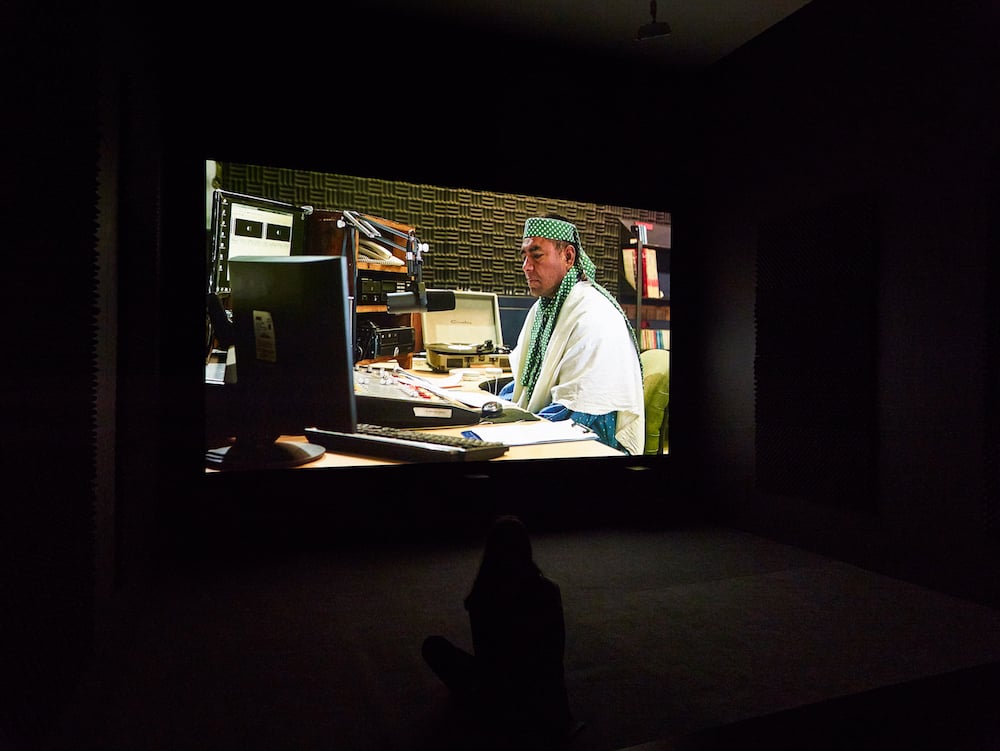
Javier Téllez, To Have Done with the
Judgment of God (2016). Image courtesy the artist and
Koenig & Clinton, New York Photo: Jeffrey Sturges, Brooklyn
(installation view, Koenig & Clinton, New York).
Their early days were not without challenges either. The launch
of their venture was delayed in part because their 23rd Street
gallery was flooded during Hurricane Sandy. Their decision to move
further inland from the Hudson River coincided with Postmasters’
relocation to Tribeca, so they took over that gallery’s West 19th
Street space.
But after four years there, a combination of soaring rents and
rampant High Line-adjacent condo construction prompted another
move, to Bushwick, Brooklyn, in mid-2017.
As Koenig went deeper into secondary market dealings, Clinton
worked to add new elements to the gallery’s primary program,
including conceptual art, video, and performance. Together,
they focused on being “a very solid, mid-field gallery, but we
essentially had to downscale in order to keep doing the work I
wanted to do,” she said.
In order for Clinton to foster “practices that were not so
object-oriented,” the gallery required considerable institutional
support at a time when the philanthropic landscape was shifting.
“We see the rise of the private museum and the highly mobile
collector living between multiple cities,” she said. The result is
a class of collector who is less dedicated to supporting an
individual local art scene. “When
you look at the generation of Chicago collectors that have kind of
retired now, it’s an incredible group of people that are very proud
of their institutions and listening and being with curators,” she
noted.
Nowadays, many collectors are
coming to collecting “quite late in their lives. That is a very
different thing than the upper-middle-class professional who lived
in New York City and went to museums and galleries on the weekend
and who became involved in collecting in a way that allowed them to
see the growth of a career.”
Furthermore, the preponderance of art fairs means that
many people “who are
encountering art in the experience economy of the art fair don’t
realize that they’re in a food court,” she said. As a result, they
may not understand that galleries, museums, and artists all exist
in “an interdependent ecosystem.”

Brandon Lattu, Column, Stella’s
Dilemma, Colors 1958-66, Even Progression (2016).
Image courtesy the artist and Koenig & Clinton, New York. Photo:
Jeffrey Sturges, Brooklyn
For all the talk of mutual support between galleries—and she’s
not denying that incredible examples exist—”I find it to be really
competitive and an outdated model,” she said. Even attempts to reduce the
rates smaller galleries pay to participate in major art fairs
has not made a major impact.
“It just fails at the level of
small,” Clinton said. “There is no actual support. I have
personally seen an entire generation of future female gallerists
disappear due to the cost of child care in New York City, and
really a lack of support from mentors and amongst each
other.”
What’s next for Clinton? “It’s still so fresh right now,” she
said. “I’m going through eight years of accounting for artistic
production that I helped sponsor. I’m going to allow myself to have
some time for the next few months. I need to slow down enough to
pull my perspective out of this particular context.”
But, as always, her wheels are turning. “I’m thinking of ways in
which we might be able to help artists beyond bricks and mortar,”
she said. She plans to take on consulting work and continue to
advise artists while she plans her next move.
“At present, I just don’t see how I can avoid the outcome of
incubating artists and employees for larger galleries while trying
to retain the integrity of a mid-scale or smaller-scale space,” she
said, “and until our industry actually starts valuing the roots of
the ‘creative supply chain’ and we prototype viable alternatives
that do not rely on vague ‘noblesse oblige’ declarations from
larger galleries, I’m all right with aligning with Melville’s
Bartleby when I say that, for now, ‘I prefer not to.’”
The post Veteran Dealer Margaret Clinton on Why She Closed
Her Brooklyn Gallery—and Why the Art-Market Ecosystem Is in Need of
an Overhaul appeared first on artnet News.
Read more https://news.artnet.com/market/gallerist-margaret-clinton-exit-interview-1773012
Further reading


Leave a comment