
Malaysian Artists Cry Foul as the National Gallery in Kuala Lumpur Censors Four Artworks for Their Political Content
Four artworks by
the Malaysian artist Ahmad Fuad Osman were removed from his
mid-career survey at the National Art Gallery in Kuala Lumpur
after an unnamed board member complained about their political
content.
Among the works censored by the
museum is a 2002 installation of missing-persons posters featuring
the face of Malaysian politician Anwar Ibrahim, as well as a
triptych of portraits depicting Ibrahim and prime minister Mahathir
Mohamad.
“It is arbitrary, unjustified,
and an abuse of institutional power,” Osman wrote in a
letter published on
his personal Facebook page on Sunday.
The artist says his show, titled
“At the End of the Day, Even Art Is Not Important (1990–2019),” was
originally intended to run through January 31, but was extended
through February 29. All the works included in the exhibition were
approved by the museum.
But on January 21, the
administration informed him that they had removed the offending
objects.
“So why remove these four works
after they had already been discussed, approved, and on display for
months?” Osman asks in his letter. “[The museum] justifies their
decision on the basis of a single board member complaining that
these works are obscene and political. This makes no
sense.”
Osman requested that the museum
“close the entire exhibition immediately, rather than let it remain
open in its compromised state.”
As of Tuesday morning, the show
remained open. The museum did not immediately respond to Artnet
News’s request for comment.
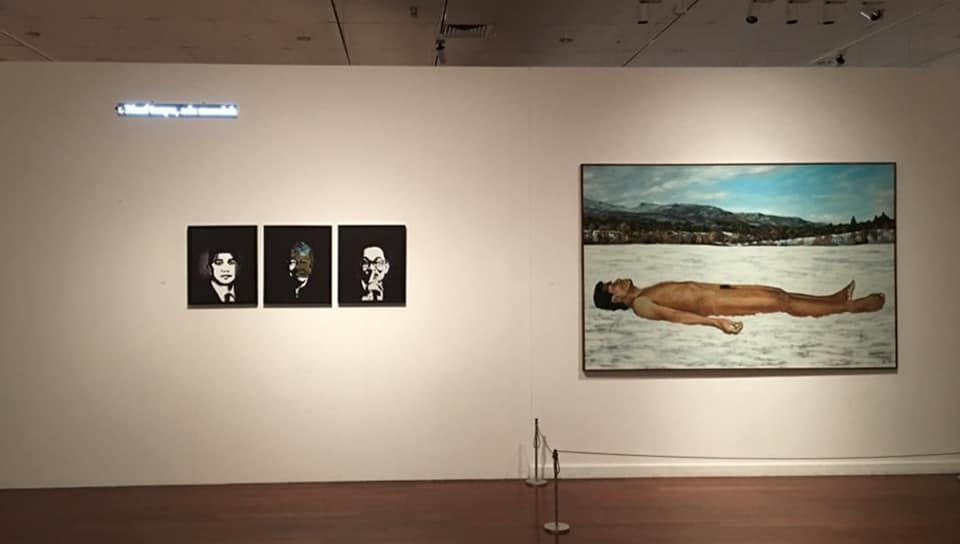
An installation view of Ahmad Fuad
Osman’s exhibition “At the End of the Day, Even Art Is Not
Important (1990–2019),” at the National Art Gallery, 2020. Courtesy
of the artist.
“The role of this gallery is an
‘institutional gallery’ funded by the government and therefore must
act according to its norms,” Amerruddin Ahmad, the museum’s
managing director, said in a statement released
yesterday.
Calling the exhibition a
“continuous process and not a final product,” Ahmad said the museum
retained the right to remove any work that “touches the dignity of
any individuals, religion, politics, race, culture, and the
country.”
The censorship episode caused an
uproar on social media throughout the country. Pakhruddin Sulaiman,
a prominent collector who lent five works to the exhibition, took
to his Instagram account to demand that the works be returned to
him immediately, saying: “I don’t want them involved in an
exhibition that has been compromised,” according to the
Star, a Malaysian news source.
Yesterday, a group of Malaysian
artists published an open
letter addressed to the
13 members of Malaysia’s National Visual Arts Development Board
demanding that the censored works be reinstalled by the museum and
the name of the anonymous board member be revealed. As of Tuesday
morning, 396 people had signed the document.
“The arbitrary censorship of
artwork is a serious public matter, unbefitting to the values of a
democratic, modern nation,” the letter reads. “The National Art
Gallery represents the pride and integrity of Malaysian visual art,
nationally and internationally. Unless this matter is addressed
with full transparency and accountability, the standing of both
will be irreparably damaged.”
The post Malaysian Artists Cry Foul as the National Gallery
in Kuala Lumpur Censors Four Artworks for Their Political
Content appeared first on artnet News.
Read more https://news.artnet.com/art-world/national-art-gallery-kuala-lumpur-censorship-1774974
Further reading


Leave a comment