
Legendary Art Philanthropist Agnes Gund Is Lauded as a Quiet, Yet Powerful, Force for Good in a New Documentary
If you’ve been to the Museum of Modern Art in New York at any
point over the last fifty years, chances are, you’ve seen a work
donated by Agnes Gund—after all, she’s given more than 900 works to
the institution.
Known fondly as Aggie, Gund is a quiet force who prefers to
avoid the spotlight. So why did she allow her daughter to make her
the star of a new documentary? According to director Catherine
Gund, Aggie’s answer was simple: “Because you asked.”
Titled simply Aggie, the film debuted at this
year’s Sundance Film Festival, and has been described as a love
letter between the generations. (For her part, and perhaps in jest,
Aggie said she “hopes not too many people see it.”) On Tuesday
evening, the film was shown at MoMA, followed by a celebratory
reception.
As Catherine Gund addressed the packed audience, she described
the New York City premiere as a homecoming of sorts: “I thought it
was daunting and exciting to have the world premiere at Sundance,
but that was nothing compared to this!” The theater was studded
with MoMA board members, as well as many artists whose work
features in the documentary, including Teresita Fernandez, Lyle
Ashton Harris, Glenn Ligon, Julie Mehretu, Clifford Ross, and Phong
Bui.
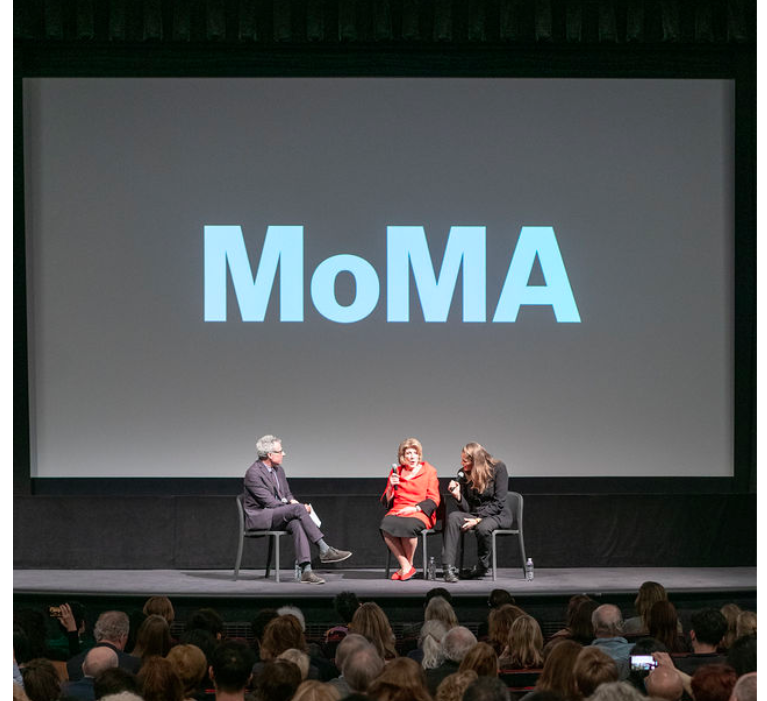
Jack Shear, Aggie Gund, and Catherine
Gund at the premiere of Aggie (2019) at MoMA.
A stalwart of the philanthropic scene in New York, Gund has
spent the last fifty years putting her money where her passion is,
helping to enhance museums and arts education. Among most people in
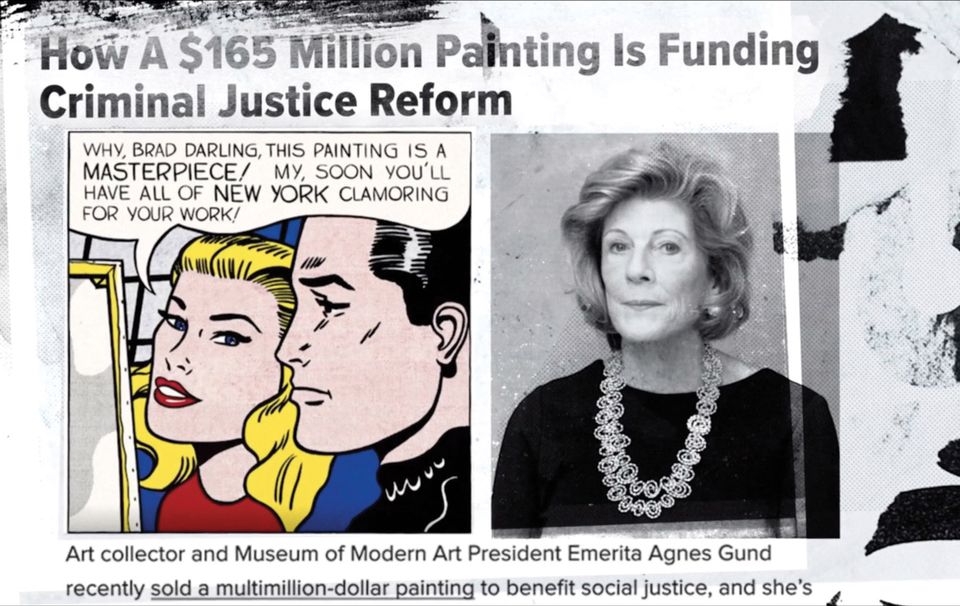
the art world, she needs no introduction. In 2017 she sold Roy
Lichtenstein’s painting Masterpiece (a personal
favorite of Gund’s, it had been hanging in her own home for
decades) for a staggering $165 million to kick off the Art for
Justice Fund.
Upon its creation, the Fund announced its intention to disperse
all of Lichtenstein funds within five years, meting out chunks of
money to individual artists and organizations. It’s core mission is
“disrupting mass incarceration by funding artists and advocates
working together to reform our criminal justice system.” Together with the Ford Foundation’s president
Darren Walker (and with a little help thanks to celebrity
endorsements from Oprah, Ava Duvernay, and Brian Stevenson) the
fund is making major inroads to redress the systematic abuses of
mass incarceration.
Aggie tells a deeper story that goes well beyond such
headline-grabbing milestones. The documentary, for instance,
explores Gund’s founding of the Studio in a School program in
the 1970s, with the goal of ensuring that arts education remained
in New York City schools. Testimonials from former students of the
program are an affecting addition to the film, giving a face to
those who have benefited directly from Gund’s largess.
Poster image of Aggie by
Catherine Gund, an official selection of the Documentary Premieres
program at the 2020 Sundance Film Festival. Courtesy of Sundance
Institute.
The film is soundtracked with an original score composed by jazz
musician and artist Jason Moran, and features curators, artists,
and patrons speaking one-on-one with Agnes in her home. We’re privy
to a slew of interesting tidbits. Catherine Opie describes Gund as
“breaking the mold of the traditional housewife” when she moved to
New York City to raise her children alone, after leaving an unhappy
marriage. In a conversation with Glenn Ligon, Aggie bemoans that
MoMA—where she is now President emerita, having previously overseen
the board from 1991 until 2002—only acquired Faith Ringgold’s
arresting mural American People Series
No. 20: Die in 2016, almost 50 years after it was painted
in 1967.
Ultimately, what shines through brightest in the film is not the
scope of Gund’s generosity, but her true and persistent love of
art. She recalls visiting the Cleveland Museum as a child and first
understanding “what I could do in life was to figure out art.”
After becoming a mother, she went back to school to earn her
masters in curating at Harvard’s Fogg Museum. At 81, she still
regularly visits artists’ studios to see their work in
progress. As for the fund, Catherine said they hoped to extend
its original timeline, carrying on charitable giving for a sixth
year.
At one point in the film, Ligon quipps that the “most powerful
tool we have right now in the art world is shame.” That shame might
be directed at museum board members with questionable business
ties, or toward wealthy collectors who aren’t willing to give back
for the greater good. At least in Aggie, we find a shining
example of generosity, one that other would-be patrons would do
well to follow.
“Aggie” will be showing at Film Forum beginning in
September.
The post Legendary Art Philanthropist Agnes Gund Is Lauded
as a Quiet, Yet Powerful, Force for Good in a New Documentary
appeared first on artnet News.
Read more https://news.artnet.com/art-world/aggie-documentary-2019-premiere-1780494
Further reading


Leave a comment