
Artists From the Arab World Face Countless Hurdles. That’s Why This Organization Is Helping Them Bring New Work to the West
It’s not easy for a young artist to make a name for herself. But
it can be even more of a struggle for non-Western artists,
like emerging Palestinian talent Dina Mimi, who lives and
works in Jerusalem. It may be similarly challenging for Tunisian DJ
and producer Deena Abdelwahed, a woman immersed in the
male-dominated electronic music industry.
Mimi and Abdelwahed have been named alongside 6 other artists
from the Arab world for major solo commissions over the next two
years across Europe and the US, thanks to the nonprofit
foundation Mophradat. The Brussels-based
organisation’s so-called Consortium Commissions, now in its second
run, aim to create opportunities for emerging Arab artists. As
opposed to the more typical set-up—a juried award followed by a
single show at a host museum—the pioneer platform lets
international institutions foster their own relationships with the
nominees by co-commissioning the works in tandem with
Mophradat.
Alongside Mimi and Abdelwahed, this iteration’s selection
includes Lebanese artist Haig Aivazian; Inas Halabi, an artist and
filmmaker from Jerusalem; Joe Namy, an artist and composer based
between Beirut and London; Lydia Ourahmane, an artist based in
Algiers, Algeria; Maan Abu Taleb, a Palestinian writer and editor;
and Makimakkuk, a Palestinian performance artist and musician.
Their individual exhibitions will be slowly rolled out over the
next two years, beginning in June. The program of exhibitions,
performances, and musical events will be held at nine high-profile
locations, including De Appel in Amsterdam, Haus der Kulturen
der Welt in Berlin, Portikus in Frankfurt, and the Renaissance
Society, Chicago. Each artist’s show travels to two
institutions.
“What we are seeing is an art world that has become heavily
commercialized,” explains Cairo-born, Athens-based curator Mai
Abu ElDahab, who heads Mophradat. “Within institutions, private
money is often dominant, which means that museum curators may not
have access to more experimental projects. And, especially in
Europe and North America, [where] racism is on the rise, artistic
projects like these may have no other way to get in the door
otherwise.”
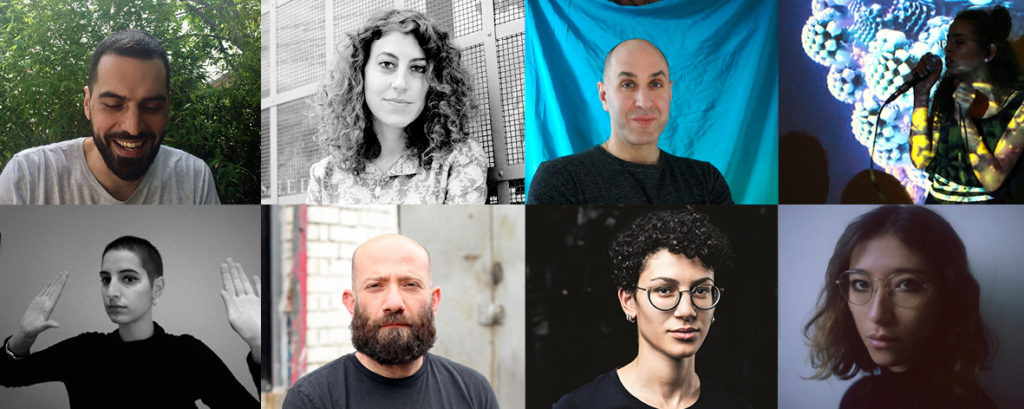
Mophradat’s artists for the 2020-2022
Consortium Commissions. Courtesy Mophradat.
Since taking over Mophradat in 2015, Abu ElDahab says that the
goal of the Consortium Commissions is to create a discourse with
other curators in institutions throughout Europe and the US. “There
is no denying that the center of the contemporary art context is in
the West,” she says. “And the institutional situation is pretty
dire in the Gulf. There are big museums, but they often require
working directly with authoritarian regimes. We consider ourselves
progressive, and so a lot of the projects we do would not find a
home there.”
Palestinian artist Mimi, for instance, makes challenging work
that explores human remains in the public sphere, and the
normalization of death in public sites; her practice also explores
martyrdom and self-immolation, specifically in Palestine. She will
be showing at the Kunstenfestivaldesarts in Brussels in May
2021 and at Spielart in Munich, Germany in November of that
year.
The participating museums are often directly involved in the
jury process, including the naming of nominees and winners, and
have curatorial control, together with the artist, over the
execution of the resulting exhibition. Mophradat takes a supportive
role. Monika Szewczyk, the director of De Appel, has chosen to work
with Inas Halab and Lydia Ourahmane in 2021. She says the selection
process itself has left an indelible mark on her.
“[The artists] have already began to make an impact on our
institutional thinking. We consider how to engage Arab cultural
vocabularies in all their plurality. And it has become clear
already in this early stage how these incredible young women will
inspire our public with their unique, worldly aesthetics,”
says Szewczyk. At De Appel, Ourahmane will present City of
Demons, a project that follows a pilgrimage to Tassili
N’ajjer, a vast desert plateau on the border of Algeria and Libya
which houses over 15,000 ancient cave paintings and is one of the
last places on earth to refuse militarization. Halabi’s film We
No Longer Prefer Mountains offers a surrealist view of
the Druze town of Dalyet el Carmel, in northern Palestine.
Meanwhile, almost all of Mophradat’s previous slate of 2018–2020
commissions are almost completed, with a few remaining exhibitions
on the horizon. The presentations of Egyptian-Polish filmmaker
Egyptian-Polish filmmaker and Syrian artist Yazan Khalili both open
at KW Institute for Contemporary Art in Berlin on March 14.
Khalili’s commission then heads to the Museum of Contemporary Art
in Toronto in the spring.
The post Artists From the Arab World Face Countless Hurdles.
That’s Why This Organization Is Helping Them Bring New Work to the
West appeared first on artnet News.
Read more https://news.artnet.com/exhibitions/mophradat-consortium-commissions-1778418
Further reading


Leave a comment