
‘We’re Partners, But We’re Also Best Friends’: Tschabalala Self and Mike Mosby On the Rewards of Artistic Love
Historically, the lore of
romantic relationships between famous artists has long been
marked by infamy, jealousy
and, more often than not, the interference of a third person.
There’s Cristina Kahlo, who briefly romanced Diego Rivera and drove
her sister, Frida, a little mad in so doing; Dorothea Tanning, who
lured Max Ernst away from Peggy Guggenheim after a single game of
chess; and Françoise Gilot,
Pablo Picasso’s ultimate obsession and muse, who brought an end to
his habit of trading one lover for another by eventually walking
out on him. And should we be surprised? Governed by passion
in their profession, it’s no wonder that artists, encouraged to
explore human desire in their work, allow that fiery energy to
spill over into their personal lives.
For a new series,
“Portraits of
Love,” Artnet News
decided to learn about how present day, very-much-in-love art world
couples navigate their relationships in a healthy way.
Last week, we sat down with artist Tschabalala Self—a young art
star whose market has exploded since she graduated from Yale in
2015—and her boyfriend, Mike Mosby (an art therapist, independent
curator, and DJ) to learn about how they navigate their partnership
as two creative souls in love.
Below, in their first joint
interview to date, Self and Mosby share what it’s like to date your
best friend, how they cultivate balance in their relationship, and
how they support each other through it all.
Tell me a little about your backgrounds and how you decided
to pursue your interest in the arts.
Tschabalala: I grew up in
Harlem, New York. I always had an interest in art, and then I
studied studio art in college and painting in grad school [at
Yale]. After leaving grad school, I started pursuing it more
professionally. It’s something that I’ve always had an interest in
and, through school and work, I’ve been able to turn that interest
into something greater.
Mike: I became interested
in creative fields through my family—I grew up in a very
fashionable and creative household, between my grandmother and my
mother. My mother was a model when she was a teenager in Manhattan.
I loved freehand-drawing on cereal boxes as a child, and I got into
art films as a teen. My family moved to upstate New York from the
city. Up there, I was pretty much surrounded by artists, which was
pretty powerful.
So you’re both New Yorkers.
Tschabalala: Yeah. We
both have family in Harlem. I went to Bard for college, and I
hadn’t really gone back up there until we started dating, maybe 10
years—actually, no, not 10 years, I’m not that old [laughs]—I guess
six years after I graduated.
And did you like Bard?
Tschabalala: I did. I
didn’t really like the area at the time, though. I didn’t really
appreciate it until I got older.
Did you both know that you wanted to pursue art
professionally from a young age?
Mike: Actually, I was a
pretty serious athlete growing up. I played football for 12 years
of my life. I got badly injured in high school, though, and tore
two ligaments in my ankle, so that sort of stopped my football
career. But I still had art at the back of my mind—it was always
with me. It was my Plan B in that sense, and I started to get into
it more seriously. I got a job doing art therapy, working with
autistic kids and adults, teaching them to express themselves and
communicate through art, particularly when there’s a lack of
language skills. The arts are very calming, centering, and
therapeutic for the individuals I work with.
Tschabalala: I guess when
I was younger I considered doing other things, but I never really
applied myself that seriously to anything other than the arts. I’ve
always focused on it. I don’t really know what else I could have
done. I think if I wasn’t an artist, I would definitely be doing
something else that’s trade-oriented…something maybe in design, or
even—
Mike: Medicine?
Tschabalala: I mean, I
did say that I would love to be a plastic surgeon. Also, because
I’m a hypochondriac, I sometimes wish I had gone to medical school.
But yeah, maybe something trade-oriented where I could work with my
hands and interact with a lot of people. I do enjoy that a lot
about art—that it’s public-facing.
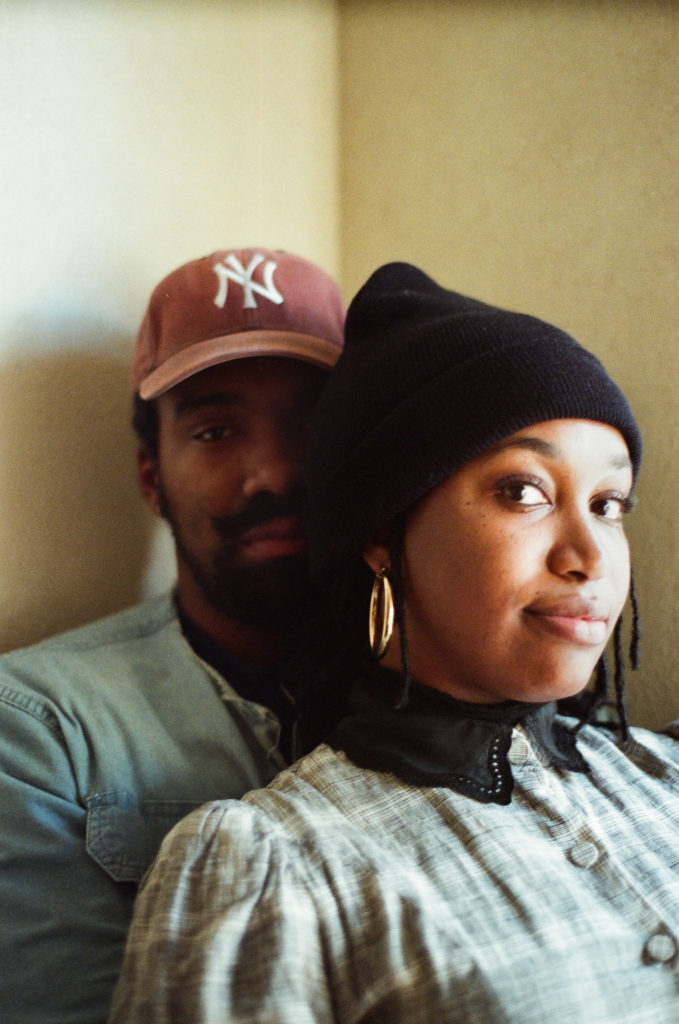
Self and Mosby. Photo courtesy Araba
Ankuma.
Were there any artists—fine artists, actors, musicians or
anyone in a creative industry, really—who influenced you
significantly growing up?
Mike: I would have
to say Denzel Washington, first and foremost. He can play any role,
he’s a very versatile actor. He can play a doctor or gangster cop
or a radical activist. And he’s a New Yorker, which is the icing on
the cake.
Tschabalala: Oh, he is? I
didn’t know that.
Mike: Yeah, he’s from
Mount Vernon. And he was very involved in the Boys & Girls Clubs
programs.
Also a guy named Reggie Madison.
He’s an older gentleman that I grew up knowing while living upstate
in Hudson. He’s a sculptor and he paints. He also incorporates a
lot of jazz in his artwork—he can hear a Miles Davis or Sun Ra
track, and he’ll paint or sculpt something around it. He blends
music and art together.
Tschabalala: I would say
a significant influence for me growing up was a woman I used to
work for named Montgomery Harris. She had a boutique in Harlem
called Montgomery that housed all her own bespoke designs. I worked
for her pretty much every summer in high school. I really admired
her because she had opened her business on her own, as a black
woman creative, and she’d brought something so interesting and
unique to the neighborhood. It was amazing to see what she was
doing on an entrepreneurial and artistic level; it was just such a
brave thing to do. So for me to see that model at that time, and to
work for her, was really motivating. I got to see what it was like
to live the life of a creative…all the glory of it and all the hard
parts, too. She was a huge influence, and she taught me so much
about fashion, art, and design. She’s still a very close friend of
mine.
Is there a piece of advice that she gave you that you’ve held
onto over the years?
Tschabalala: I can’t say
that it was just one piece of advice, but just how she moved in the
world and how she carried herself through the trials and
tribulations. I took a lot from that.
And Mike, was there anything that your mentors imparted to
you that’s stayed with you?
Mike: Definitely. Back to
Reggie, he sort of always told me, “Be free with your mind.” And to
do what makes you happy as far as art goes. He collects all these
found objects—old books, old pieces of furniture—and builds these
beautiful art objects and pieces. And he’d just tell me to keep
pursuing what I wanted to pursue, and to be inspired by my
surroundings. He’s like over 70 years old—it’s not about the money
for him, it’s about having a say in the art world and the world in
general. About having a voice.
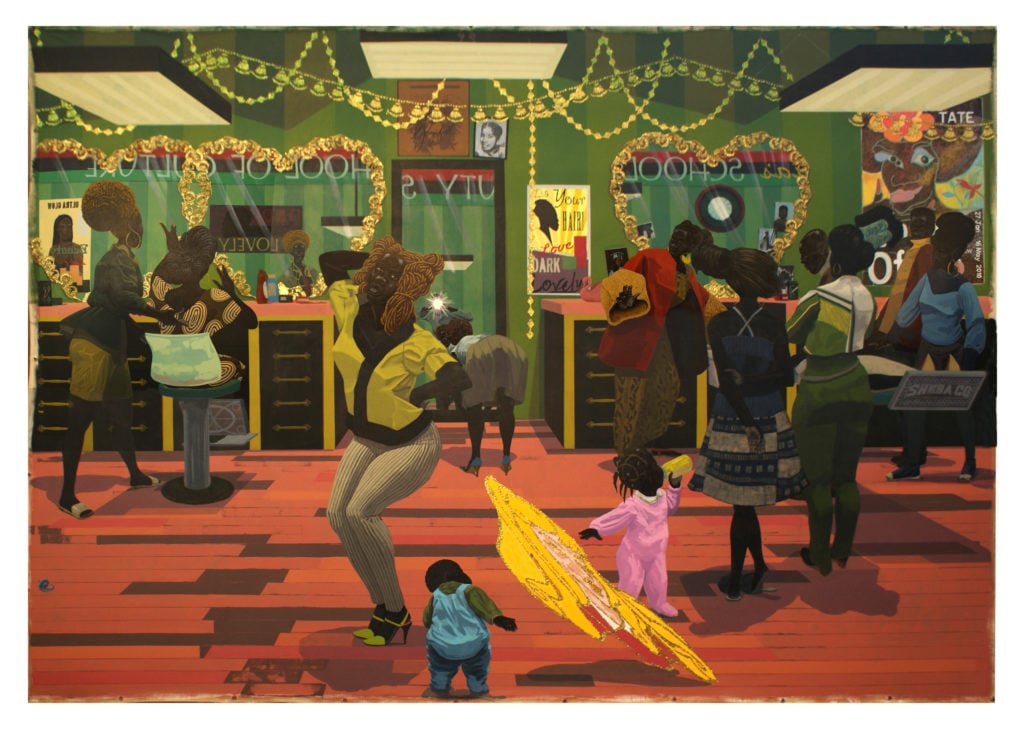
Kerry James Marshall. School of Beauty,
School of Culture. Courtesy of the Met.
How did you two meet?
Tschabalala: Through
mutual friends.
Mike: At an art show!
Again, in part because of my mentor and my good friend, Reggie
Madison. It was the last day of Kerry James Marshall’s
“Mastery”
show at the Met. So on that day, I
was on social media, but—to backtrack, I’d been following Tschaba’s
work for a few years from her show at the Studio Museum in Harlem.
She was in a group show there with some people that I knew. So,
fast forward to the day. I DM’d her. I sent her a message and I was
like, “Oh hey, there’s a guy having a show in Harlem named Derek
Fordjour.”
Tschabalala: It was
a group show, but I can’t remember who else was in the
show.
Mike: But it was
definitely Derek, and I was like, “I’m coming up.” That was
overwhelming, the “Mastry” show, by the way. After seeing that, you can’t
see anymore art, you sort of need time to really digest what you’ve
seen. But I said, “You know what, I’m intrigued.” So I went up
there [to the group show in Harlem], and I saw her outside and I
was like, “Wow, who is this beautiful lady? This is her?!” And
Reggie’s like, “Oh man, she’s beautiful.” And then we had a
conversation for the whole time at the show, while we were looking
at the art. We just connected. And we had mutual friends, too, and
a lot of things in common, so it sort of felt like dotting the i’s,
in that sense.
Tschabalala: It was sort
of the perfect place to have a first date, because all my friends
were there for the show.
Mike: It was a very
comfortable setting in that way.
Tschabalala: And I think
we all went out afterwards to Corner Social. And then I left for
four weeks after that for a residency.
Mike: In
Detroit!
Tschabalala: So we didn’t
see each other for another month, but we talked every
day.
Mike: We did the phone
thing.
Phone calls or FaceTime?
Tschabalala: We did
calls.
Mike: I had a flip phone,
remember? iPhones are very distracting and, yeah, it would have
been nice to see each other, but that would have changed the whole
energy. You’re not really here you know?
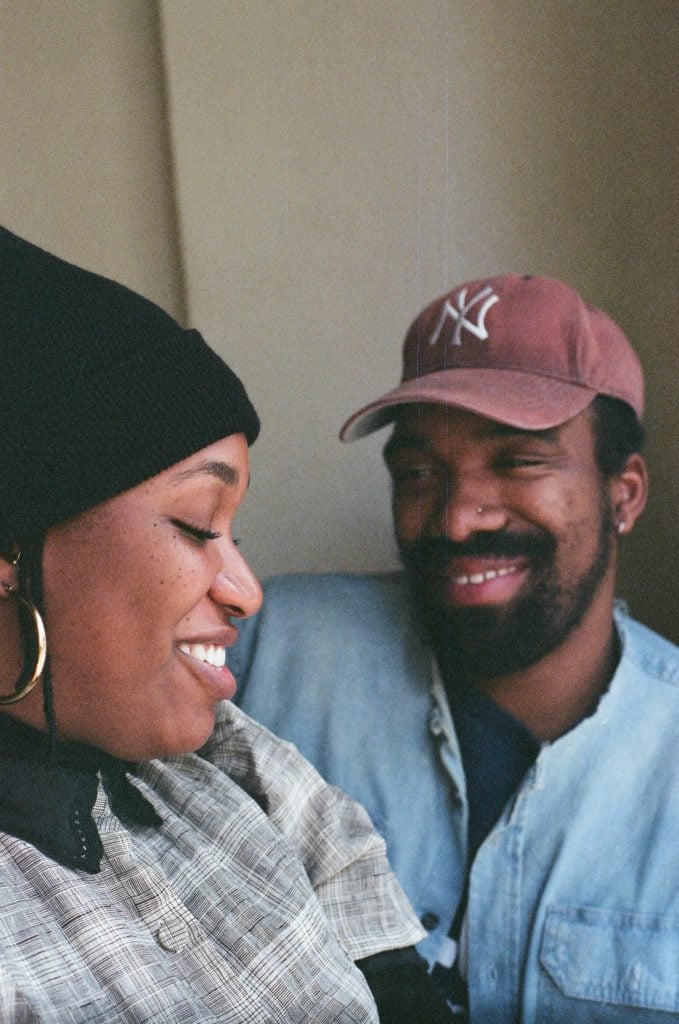
Self and Mosby. Photo courtesy Araba
Ankuma.
Totally. Did you go out to visit her at all when she was over
there?
Mike: No, because she was
working pretty much all the time.
Tschabalala: Yeah, and my
family’s out there. My aunts and my cousins live there—so I was
catching up with them.
Mike: But then when she
came back to New York, we just connected.
How long have you been together now?
Tschabalala: I know we
first spoke on the day of the [Trump] inauguration…so as long as
that.
Oh, god. No way.
Mike: I had to support
her that day. So we’re going on three years!
A historic day for many reasons, in that case. How would you
describe the nature of your relationship in a couple of
words?
Mike: Very vibrant. Fun.
A lot of teachable moments. Very spontaneous at times, but in a
good way. You know every couple says, “We’re friends.” But I could
really say this is my
friend. We do all the things that friends do
together. We go on a lot of journeys together, we have a lot of
good times. There’s no pressure, no one’s really getting dragged
into things they don’t want to do. Everything is mutual, so we do a
lot together.
Tschabalala: I feel like
I can’t beat that [description]. I would say that Mike feels very
familiar and he reminds me of all the best parts of my life before
I met him. I can carry all the best things with me moving forward
because of him.
Sort of like your anchor, in a way.
Tschabalala: Yeah, but he
encompasses all the best qualities of all my loved ones. He has all
their best traits.
Mike: And she also has
all the best qualities of the women in my life, my grandmother and
my mother. She’s very driven—I tell her that she’s the hardest
working woman I know, alongside my grandmother and my mother. This
woman right here, she’s literally a workaholic, but she makes it
look fun. And once you get into that world, you understand how hard
it is. People have no idea. It’s seriously a ton of work. And
outside of the art world, your personal life is your own life. It
can be very complicated.
How have you managed to support one another through such a
momentous time in both of your lives?
Mike: Communication. Just
listening and trying to understand. And patience—you’ve got to have
patience, too, especially for a relationship like this. You’ve got
to understand the person and who you’re with. You have to give them
space and time, you can’t be too clingy. You’ve got to let that
person be who they’ve got to be.
Tschabalala: I would
agree, it’s a balance between working on building a life together,
but also making sure you’re working on your individual identity at
the same so that you can be fully present in your
relationship.
Is it ever hard to navigate the slipping on and off of those
identities, those hats, as a creative and as a significant
other?
Mike: I think it’s very
easy for me. I don’t think I’ve ever really struggled with that.
And we’ve also collaborated on a few things
together.
Tschabalala: Yeah, I feel
like you don’t have to take that hat off. We like to keep it on.
But also relationships get really complicated, so you have to
figure out ways to problem-solve creatively. But yeah, I
don’t think you ever really have to take that creative hat off. I
guess it’s good to always be open-minded about what’s
possible.
Mike: I guess some people
are afraid of compromise, but it’s really just about being
understanding. You can keep your creative hat on at the same time
and navigate life together. Of course you want to have your own
identity and your own thoughts; you don’t want to blur everything
together. But if you have an idea, you can share those ideas
together.
Tschabalala: And I think
that creatives understand that—even within their relationships to
their work, there’s sacrifice and compromise, there’s some push and
pull. If you apply that same logic to your relationship—and allow
there to be some imperfection—I think that makes things simpler. I
think that’s how I relate to my practice, and my relationships to
my other loved ones as well. I think you have to allow for things
to sometimes be nonsensical.
Mike: Perfection…I mean,
come on, there’s gotta be flaws there. What’s the fun in
perfection?
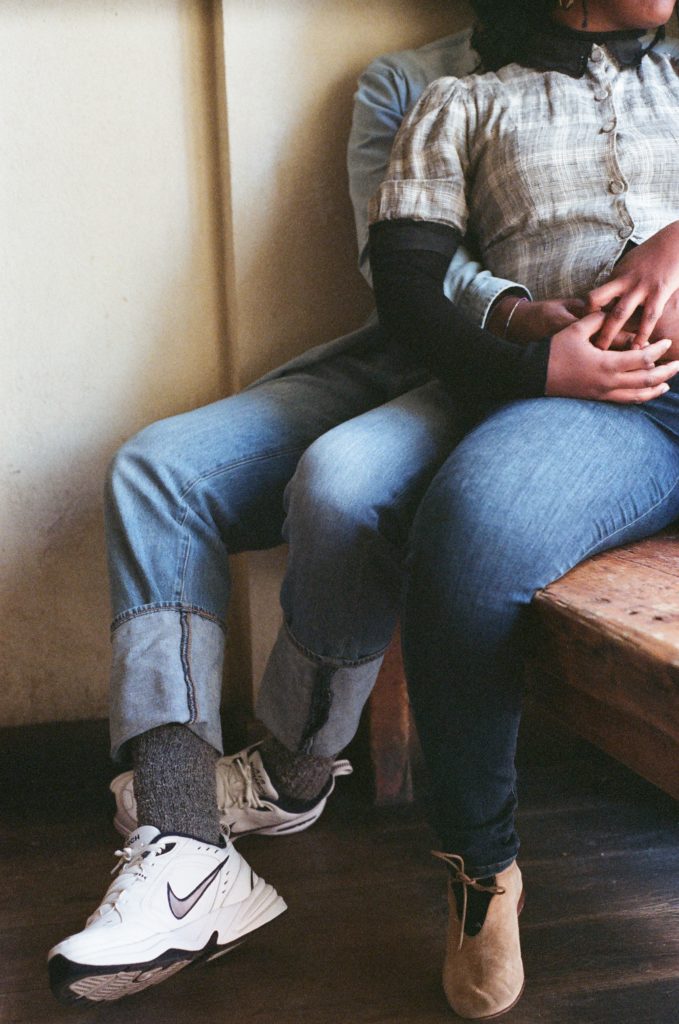
Self and Mosby. Photo courtesy Araba
Ankuma.
Walk me through what it’s like for you to collaborate on a
project. How do you come up with an idea and then how do you see it
through?
Tschabalala: A lot
of times when we’re working on something together, Mike comes up
with the idea and I figure out how to actualize
it.
Mike: Yeah, Tschaba’s
definitely…she’s the one to sort of bring it to life. What’s an
idea without any real substance? You need the action behind it, to
make it something you can see.
Tschabalala: And the only
thing we’ve actualized so far, really, has been our party series,
Free Range. And it was really Mike’s idea to do something like that
in Hudson, and then I worked to build up the infrastructure for it,
and we also had one other collaborator, our friend Shaneika, who
helped to form the concept. She’s a writer and a curator, so she
helped to establish the vibe and mood. It was
cool.
Mike: Yeah, I mean we all
have our own ideas, so of course sometimes there’s friction. It
happens, but we support one another. Tschaba’s been very supportive
in my new venture. I’m embarking on a curatorial project, a
four-person show in Hudson opening in October this year. It will be
at a beautiful space—a great place to explore yourself and art. So
that’s very exciting.
That’s great. Could you guys ever see yourselves living up
there in Hudson together?
Tschabalala: Mike lives
there, and I want to eventually transition up there from
Connecticut. Because I don’t imagine myself moving back to New York
City. I need so much space, and because it’s so expensive here, New
York isn’t so conducive to having a studio in addition to an
apartment. So for me, I need a place that’s cheaper, where I can
get more space for less money. I’ve been living in Connecticut for
seven years now, so I’m going to maybe move back to New York state
soon, maybe somewhere in the Hudson Valley or in Columbia
County.
How often do you see each other?
Tschabalala: We see each
other a lot, when I’m here. When we don’t see each other is when
I’m traveling for work.
Mike: And that’s where
the relationship has to come with understanding. We both like our
space. So we know how to separate and come back
together.
So you both really value your freedom and ability to live
separately, sometimes, when you’re pursuing your work?
Mike: Oh, definitely. And
then when we’re back together, it makes us much more appreciative.
It’s fun and we have fun together, like 8 out of 10 times.
[laughs]
Tschabalala: [laughs] 8
out of 10 times, like a B+.
Mike: No, but I’m being
real! It’s great most of the time, but occasionally you’re going to
have debates, you’re going to have stuff to work
on.
Tschabalala: Right, some
of the time it’s about relationship-building.
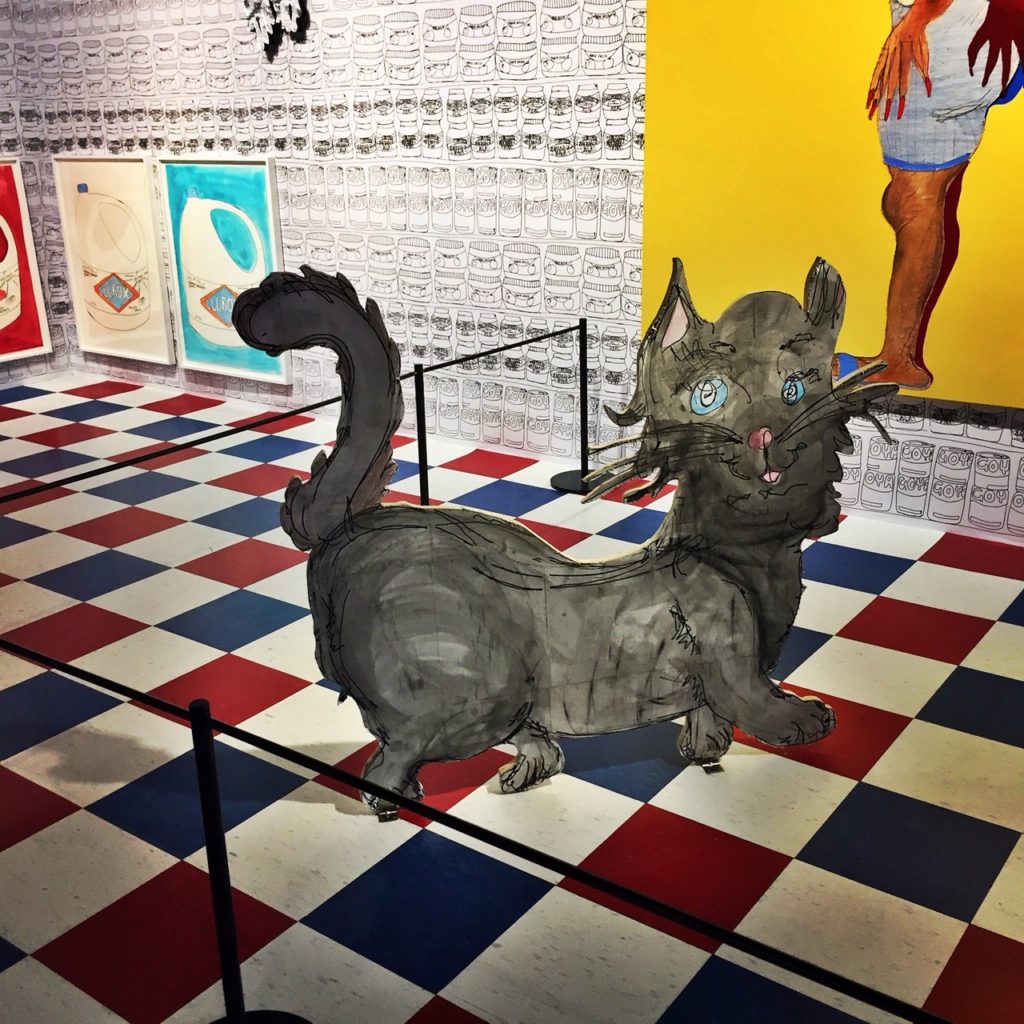
Tschabalala Self, Bodega Cat,
part of “Bodega Run” at the Yuz Museum, Shanghai. Photo by Eileen
Kinsella
How do you guys weigh in on each other’s work? What have you
learned about how you each like to receive feedback?
Mike: Tschabalala’s still learning about my work within the field of
autism-spectrum disorders, because it’s a very complex thing. But
because she has a very high understanding of art, she definitely
understands how much I care about using art as a form of therapy.
Both of our jobs are very demanding and require a a lot of
sensitivity. In the arts, people seem less friendly, and it’s this
idea of “fake it till you make it.” And that’s fine, whatever, so
I’m learning about all of that, and the intensity of all
that.
Which must be so cutthroat, I’m sure.
Mike: Yeah, it’s really
about having a wolf mentality sometimes. A survival mentality. You
have to be like a shark in that sense, to have
longevity.
Tschabalala: In
terms of Mike, I’ll give him opinions about things and I’ll say,
“This is a good idea,” or “Maybe it would be better if it was
executed this way.” I think Mike is pretty receptive to my ideas,
but he’s very much an independent thinker, too. He goes about
things his own way, which I actually admire. I think I’m
similar.
Mike: Oh, yeah. And I’m a
social person, and she’s not really. I’ll say, “Tschaba, go say hi
to that collector, or that curator!” And she’s like,
“Hmmm…”
Tschabalala: We saw John
Waters at the New Museum opening for Jordan Casteel and Peter
Saul—I’m a huge fan of his, but I couldn’t manage to walk over to
say hi.
Mike: Not a
peep.
Tschabalala: Yeah. But
Mike is great at parties, he’ll talk to everyone. He’ll do all the
introductions and then I don’t really have to break the
ice.
Mike: I think when you’re
working with kids and adults who have unique needs you have to
develop really strong communication skills. So I can go up to
anyone, if I’m interested in that person, and have a conversation
with them. And they can turn out to be cool people—you’d never know
if you didn’t talk to them! Tschaba, you should try it, but then
again you’ve made it this far without it.
What are you focusing on in 2020?
Tschabalala: I’m focusing
mostly on my solo shows. I just opened up a show at the ICA Boston,
which I’m very proud of. It’s a very mature overview of my practice
thus far, and points to where my work is going. I am also currently
working on my show opening at Eva Presenhuber Gallery in New York
this May and preparing for my next institutional show at the
Baltimore Museum of Art opening in the summer. So I’m focusing
mainly on those projects, experimenting in my studio, and further
developing my sculptural works. Those are my main objectives for
2020. I feel like it’s already zipping by.
Mike: I’m going to focus
on curating the show in Hudson this fall and making sure it’s a
success for all the artists involved. So yeah, just more exposure
to art and learning about art as I pursue this next step. I want to
keep learning about artists—their personalities and people in that
world. Thank god I have the patience for that.
Tschabalala: Yeah, ’cause
of me.
Mike: Yeah! And artists
are like the customers—they’re always right, you know? You have to
be like, “I’m not about to have a power struggle.” I’m the curator,
for me it’s about working together and making their vision come to
life. So that’s definitely my biggest goal for
2020.
"background:#FFF; border:0; border-radius:3px; box-shadow:0 0 1px 0 rgba(0,0,0,0.5),0 1px 10px 0 rgba(0,0,0,0.15); margin: 1px; max-width:500px; min-width:326px; padding:0; width:99.375%; width:-webkit-calc(100% - 2px); width:calc(100% - 2px);">
View this post on Instagram
What art-related activities do you guys like doing
together?
Tschabalala: We like to
see shows. We go to MASS MoCA a lot, because it’s close to
Hudson…Art Omi. We’re going to go to Dia:Beacon and Storm King this
spring. We haven’t gone together; we’ve actually never been to
Dia:Beacon at all. And then friends’ openings.
Mike: And we watch a lot
of films together, too.
Who are your favorite directors?
Tschabalala: My favorite
is Abel Ferrara. I went to see his MoMA retrospective last year
with my sister.
Mike: Mine is definitely
early Spike Lee. The Mo’
Better Blues era,
Do The Right Thing, Crooklyn.
Clockers. Spike was
super into art. I love John Singleton. And Quentin
Tarantino. Once Upon A
Time In Hollywood, I was
like, “Wow, I wish this did happen.” Of course, there are many more directors that I
like, but those are my top three.
You guys mentioned that you like traveling together. Where
have you gone together recently?
Tschabalala: I think our
best recent trip was to Joshua Tree. We actually went to Twentynine
Palms, that’s where we stayed. And we went to the Yucca Valley. It
was really cool.
Mike: We went to
Pioneertown, where they shot a lot of old Westerns. Noah Purifoy’s
outdoor art museum is definitely something you have to
see.
Tschabalala: That’s
actually why we went out there, to see that.
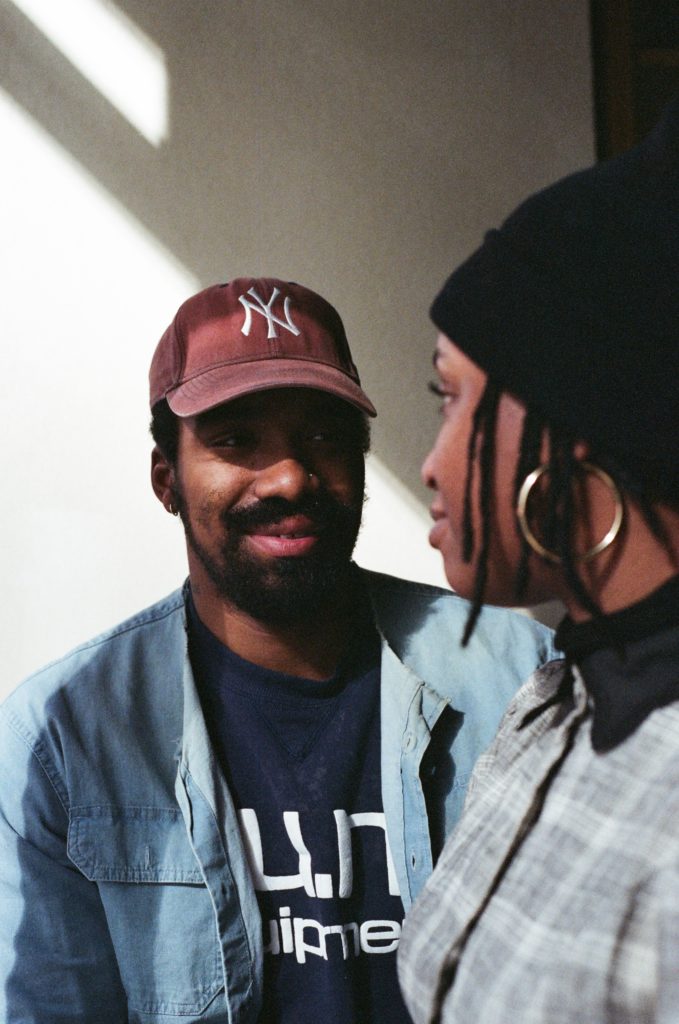
Mosby and Self. Photo courtesy Araba
Ankuma.
Who are some of your favorite artists now? Do you ever think
about jointly acquiring a work from a particular artist you both
love?
Tschabalala: Together,
we’d probably say Kara Walker, David Hammons, Mickalene Thomas,
Derrick Adams…
Mike: Kerry James
Marshall.
Tschabalala: Nina Chanel
Abney. There are so many people. Warhol…maybe one of the celebrity
portraits like Muhammad Ali. Faith Ringgold.
Mike: I love Barkley L.
Hendricks. Oh my goodness, he’s so good. There’s so much beautiful
work. And obviously Tschabalala Self, you know?
Tschabalala: But…I have
my own work already.
You guys have a great dynamic.
Tschabalala: Yeah, it’s
been a fun three years together. And we’re looking forward to many
more.
Mike: Are you bored?
Because I’m not.
Tschabalala: No! I
think it’s like what Mike was saying earlier: We’re partners, but
we’re also best friends. And that makes a big
difference.
The post ‘We’re Partners, But We’re Also Best Friends’:
Tschabalala Self and Mike Mosby On the Rewards of Artistic Love
appeared first on artnet News.
Read more https://news.artnet.com/art-world/tschabalala-self-mike-mosby-1785060
Further reading


Leave a comment