
How Two Laid-Back Dealers Turned $25,000, a Bunch of Unknown Artists, and Sheer Bravado Into the Global Powerhouse Blum & Poe
In the early 1990s, Tim Blum met
a guy named Jeff Poe working at the same Los Angeles gallery as his
girlfriend. At the time, Blum was living in Tokyo, immersing
himself in the Japanese contemporary art scene, and would fly back
to LA when he could and stop by the Kim Light Gallery in
Hollywood.
“I’d visit, and say ‘hey’ to
Jeff at the front desk,” Blum recalled earlier this month just
ahead of Frieze Week, sitting across from me on a stiff-looking
bench.
“We were friendly,” said Poe,
sitting on the same bench, but not really next to Blum. “He showed
up in Christmas of ‘93, and he’s like, ‘Japan’s falling apart, I’m
going to move here and open a gallery.’ And I’m like, ‘You’re out
of your fucking mind, good luck.’”
Los Angeles was not a big
gallery town at the time. The young Poe had managed to strike gold
by partnering with Kim Light, who had gained an international
reputation for hustling a new generation of LA artists. Wildly
ambitious, Light was on the verge of opening a foundation, with
family funds, which would give her partner Poe a seriously cushy
gig.
“I was gonna rent a convertible
Saab—I was on fire,” Poe said. “I was like,
‘Fucking finally.’”
“A convertible Saab!” Blum said,
laughing.
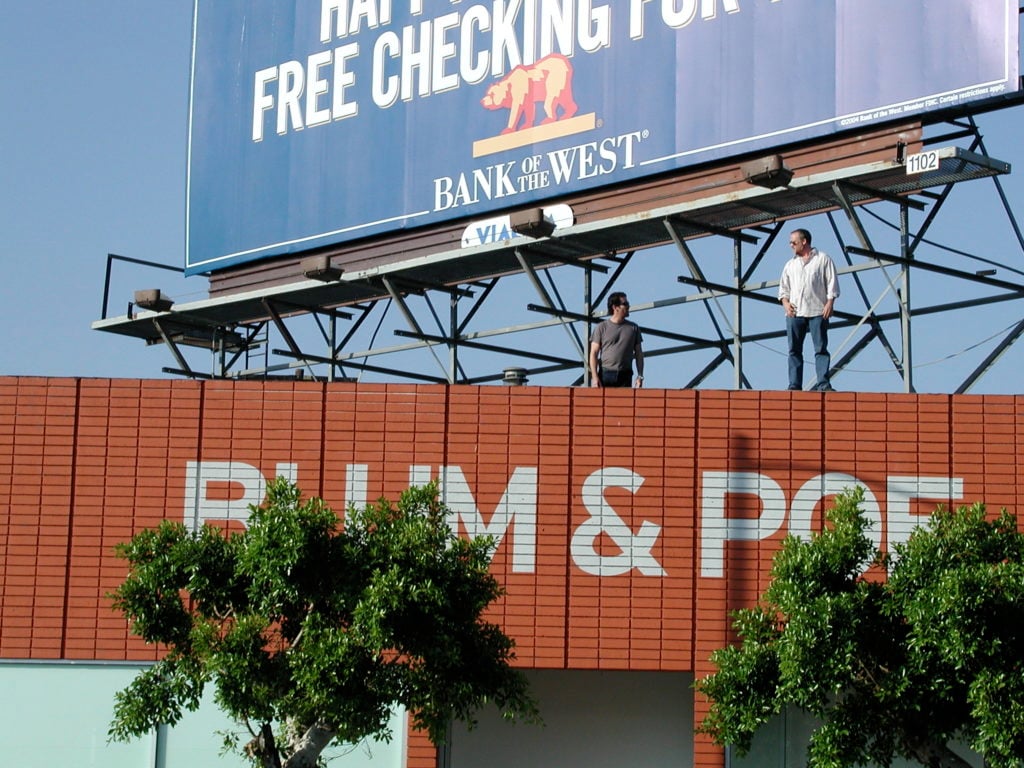
Tim Blum and Jeff Poe in 2007 on the
roof of 2754 S. La Cienega Blvd, their second space after
leaving Santa Monica in 2003. Photo courtesy of Blum & Poe.
But then it all fell apart. In
February 1994, Light’s grandfather pulled the money, the whole
operation went kaput, and Poe was out of a job. He had no real
prospects. Before working with Light, he had primarily played in LA
punk bands, most recently one called Blissed Out
Fatalists.
“A month later, I was watching
this movie Black Rain,” Poe said.
“It’s a great movie about the
Japanese mob with Michael Douglas,” Blum added.
“And I was stoned,
of course—I smoked pot all day every day at this point
in my life,” Poe said. “And I was like, what am I gonna do? And
then I was watching, and they’re in Tokyo, and I was like, ‘Oh
yeah, that fucking Blum—that dumbshit from Japan wanted to open a
gallery. Well, he must have money!
“I moved back in August of ‘94
and we opened September of ‘94,” Blum said.

Blum & Poe’s Los Angeles gallery, at
2727 La Cienega Boulevard. Photo by Joshua White, courtesy
Wikipedia.
And from those inauspicious
beginnings, Blum and Poe started Blum & Poe, a gallery that, 25
years later, would not just be one of the biggest contemporary art
meccas in Los Angeles, but the one most associated with the city’s
rise from an art-world backwater to a major hub in the global
gallery ecosystem.
We were chatting during Frieze
LA, which would be inconceivable without Blum & Poe front and
center, occupying the large corner booth at the entrance of the
fair, featuring gallery artists who have ties to the city. (More
subtle is the Blum & Poe contribution to Felix, the annual art fair
held in the Hollywood Roosevelt Hotel, where gallery artist Darren
Bader staged a booth of work by artists who don’t exist.) And at
the massive 22,000-square-foot Culver City building where the pair
opened a headquarters in 2009, they’ve staged one of the city’s
more ambitious shows: a revisiting of the landmark 1959 MoMA
exhibition “New Images of Man,” this time curated by Alison
Gingeras, featuring artists with a long attachment to the gallery,
including Henry Taylor, Mark Grotjahn, and Tomoo
Gokita.
The gallery expanded to Tokyo
and New York in 2014, but it has kept the operation relatively
lean. Along with partner Matt Bangser, who runs the New York
outpost, the operation is still over seen by Blum and Poe. They are
a true duo, not quite good cop, bad cop, not quite Hollywood buddy
comedy. Something in between all that. Over the years they’ve developed a clear
rapport, but they don’t finish each other’s sentences. They often
disagree and fall into some light bickering. They can both come off
slightly surfer dude-ish—with many sentences punctuated with a
casually tacked-on “fuck, man!”—and together they’ve nurtured the
careers of some of the most exciting and famous artists on the
planet.
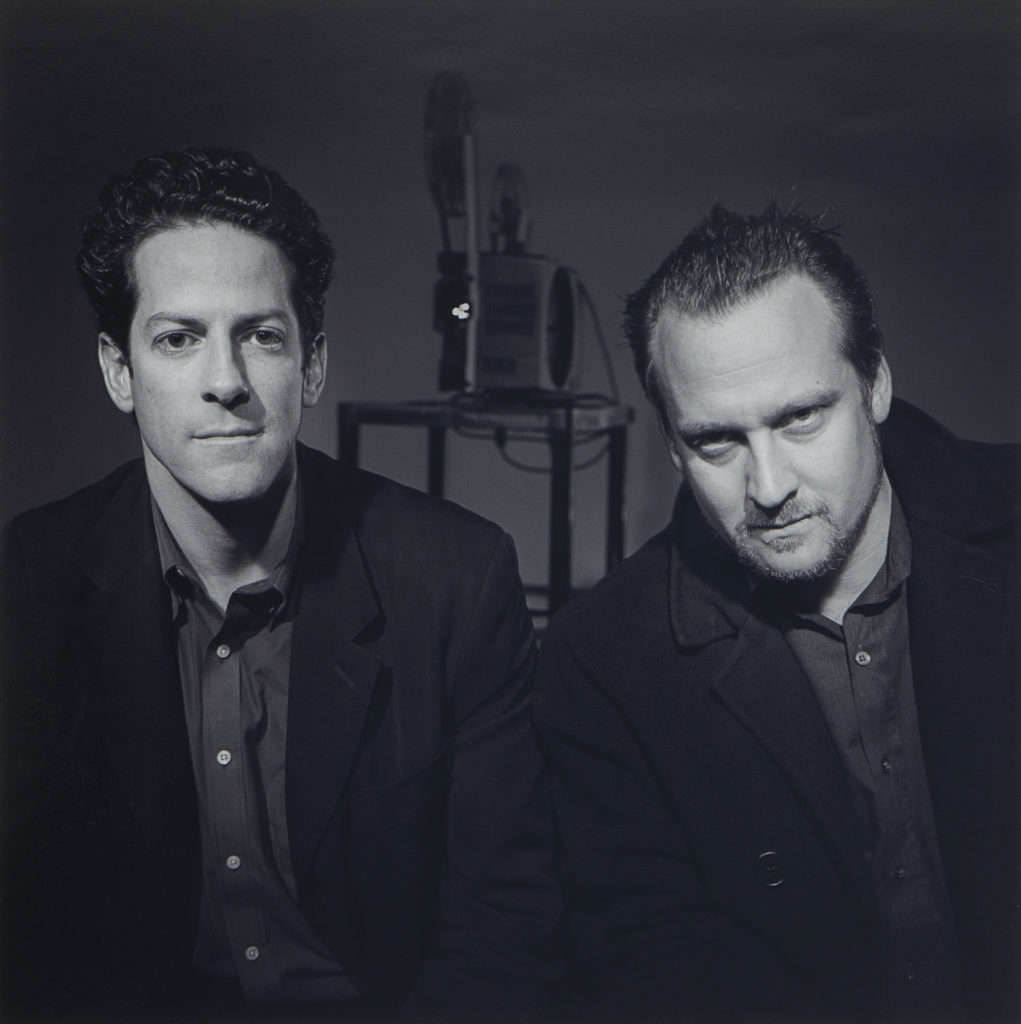
Tim and Jeff in 1999. Photo: © Fredrik
Nilson, courtesy of Blum & Poe.
‘We Were Looked at Like Fucking Idiots’
The frenzy of activity during
Frieze Week was a far cry from the Los Angeles art scene that
existed when the two opened their first space in Santa Monica in
the early 1990s, taking over a lease from a failed gallerist who
was paying just $1,200 a month.
“There was no art
world, per se,” Poe said.
“There was a cluster of… people?
There was percolation,” said Blum.
The pair had $25,000 between the
two of them, enough to just pay rent for a year and manage their
overhead—and that’s it. But there was a plan. First, the gallery
would take on the artists who Poe had become close with while
working with Light—as Poe recalled, the gallery had gone on a
22-month tear, picking up artists in Cologne and New York at a time
when scenes in both cities were hotbeds for new artists.
Early shows were given to Anya
Gallaccio, Kim Dingle, and Dani Tull, all artists who were
influenced by the generation of Los Angeles artists featured in the
landmark Museum of Contemporary Art exhibition “Helter Skelter,”
which was a sensation when it opened in 1992, the same year as Kim
Light’s space. In the years that followed, Blum & Poe would give
shows both to local legend Paul McCarthy and to a trio of very
young budding Angeleno art stars: Sharon Lockhart, Laura Owens, and
Frances Stark.
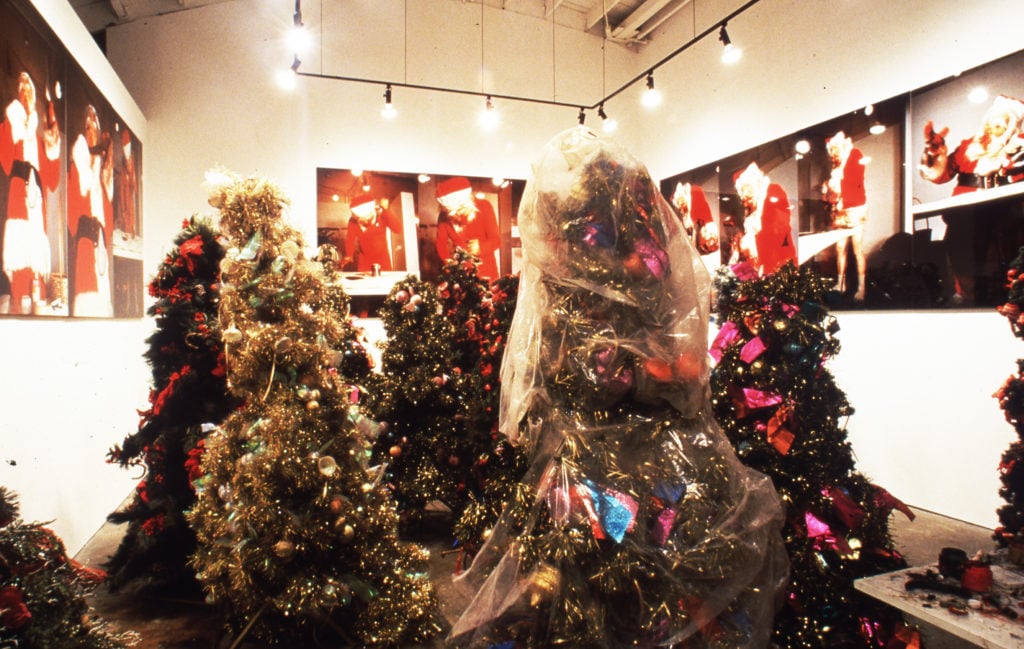
Paul McCarthy’s Tokyo Santa, Santa’s
Trees at Blum & Poe, Santa Monica, 1999. © Paul McCarthy,
Courtesy of the artist and Blum & Poe, Los Angeles/New
York/Tokyo.
The second part of the equation
was to bring artists from Japan that Blum had met during his four
years living in Tokyo. “There was an international thing happening” in
the art world, “but there was no Asian element,” Poe
said.
Local critics and collectors
didn’t immediately react well to the new Japanese artists they
started bringing over—if they reacted at
all. “It was a brutal
time because we were hard people, and we wouldn’t put up with any
shit, but we didn’t have anything to back it up with but bravado,”
Blum said. “New York didn’t give two shits about LA.”
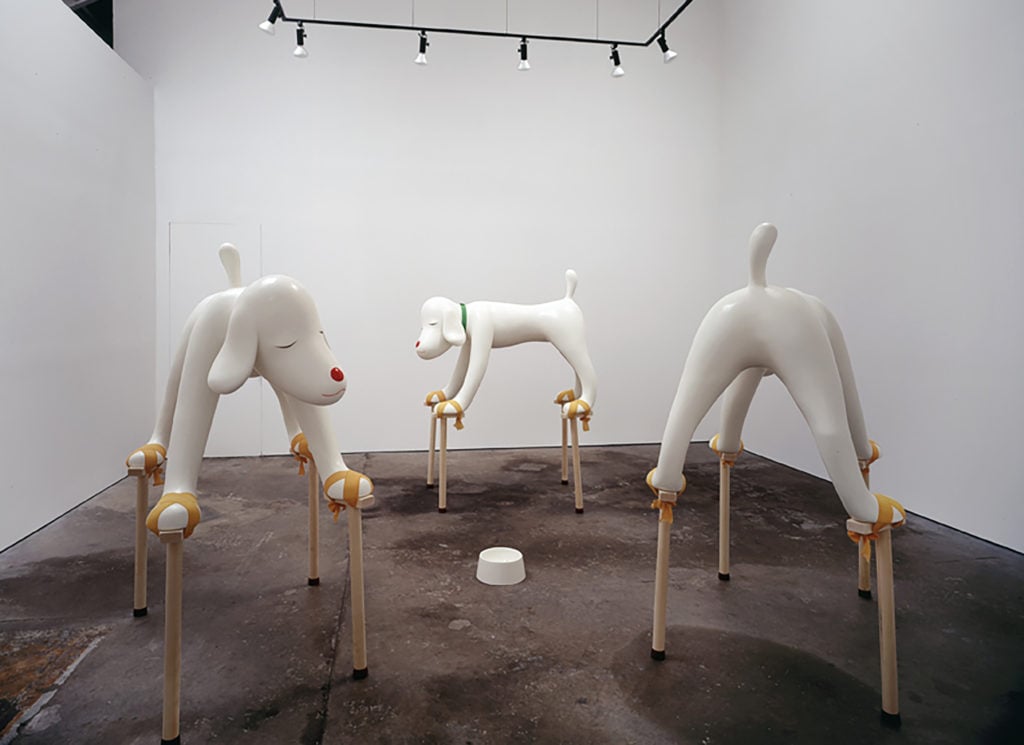
Yoshitomo Nara’s Dogs from your
Childhood installed at Blum & Poe, Santa Monica, 1999. Nara’s
first solo exhibition in the US debuted at Blum & Poe in 1995. ©
Yoshitomo Nara, Courtesy of the artist and Blum & Poe, Los
Angeles/New York/Tokyo. Photo: Joshua White.
A breakthrough came in July of
1995, when they gave the first American solo show to an artist
named Yoshitomo Nara, who had support in Tokyo, but at the time was
completely unknown in the US. He was an artist who Blum had become
passionate about while in Tokyo, drawn to his playful depictions of
kids embracing their budding punk-rock sociopathy, which was all
filtered through Nara’s obsession with H.R. Penck and Walt
Disney.
Most collectors simply did not
get it.
“We had to actually educate
people,” Poe said. “Some curators and collectors understood, but
there was an enormous amount of resistance towards us, and we were
looked at like fucking idiots. I’m not kidding. We were completely
dismissed by everyone. Not only our peers, but also older
established New York and European galleries. It was hard. But we
stuck with it.”
Last year, Sotheby’s sold a Nara
painting for $25 million.
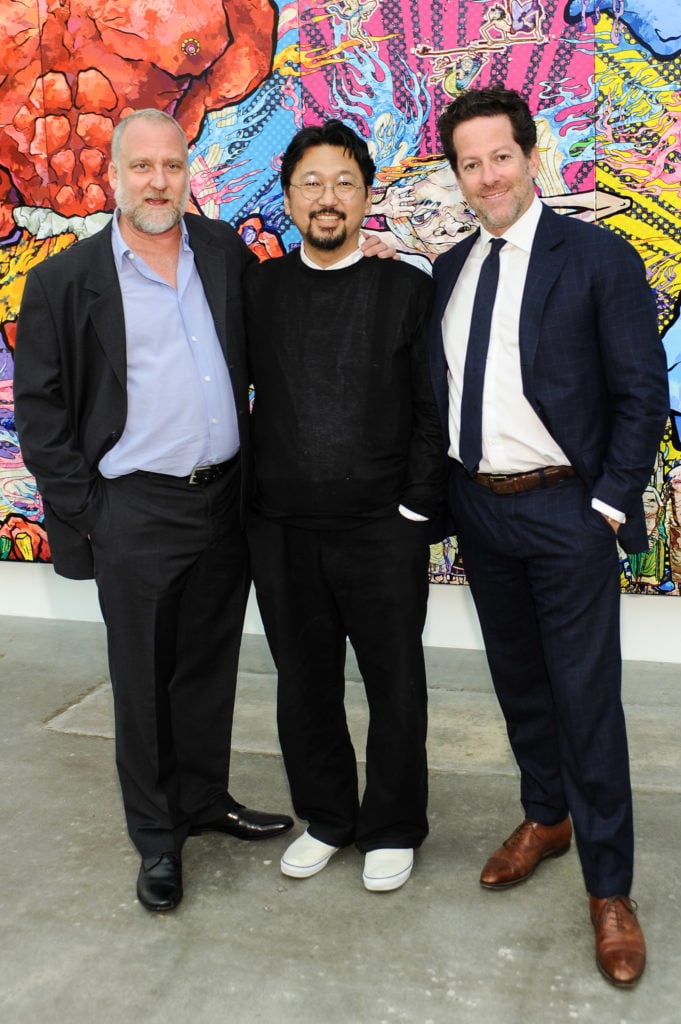
Jeffrey Poe, Takashi Murakami, and Tim
Blum at Blum & Poe in 2013 in Los Angeles. Photo by Stefanie
Keenan/Getty Images for Blum & Poe.
Guffaws, Chuckles, Chortles, and Snorts
1999 was the year that
“something broke,” as Blum put it. At the start of the decade, he
had met an artist named Takashi Murakami who was pursuing a Ph.D.
at Tokyo National University of Fine Arts and Music. They stayed in
touch, and after dipping his toe in the New York gallery scene
(with shows at Gavin Brown’s Enterprise and Feature, Inc.) Blum and
Poe convinced him in 1997 to give the then-struggling LA a shot.
While there was little to no attention from local tastemakers, the
gallery doubled down on Murakami. When Blum & Poe scored a
Statements booth at Art Basel in 1999, it decided to show the art
world cognoscenti even more of the Japanese artist, who was
associated with the “Superflat” movement.
Once again, the world wasn’t
ready.
“There were a lot of guffaws and
chuckles and chortles and snorts about that whole show,” Blum
said.
And yet a few collectors bought
work from the stand—enough to convince the two young dealers that
they were doing something right. Don and Mera Rubell, the software
pioneer Peter Norton, and the late management consultant David
Tieger were all early supporters.
“Murakami was ushering in a
whole new aesthetic, which had its roots in pop, but it also and it
had its roots in a whole deep Japanese history that people had to
be educated on,” Poe said.

Welcome to Culver City, a gallery
wasteland until Blum & Poe showed up. Photo courtesy Wikipedia.
Opening a Statement Gallery
The duo now had some confidence
and a little money in the coffers—and they immediately tried to bet
it all. They wanted to leave Santa Monica, and they wanted a bigger
space to stage more ambitious shows, so they looked around for a
building to buy. The natural choice was Chinatown, where a cluster
of galleries had settled, but instead of following the crowd they opted to go off on
their own. While driving around on New Year’s Day Poe came across a
large building in an otherwise not-so-happening stretch of La
Cienega.
“When we opened up in 5,000 feet
in 2003, it was like fucking huge statement for a young gallery to
make,” Blum said. “It was a hard run, we were fucking broke
forever.”
The two took salaries of just
$1,500 a month for years, but the bet paid off. And, soon, other
galleries followed. Dealers Javier Peres and David Kordansky moved
their spaces to Culver City and, by 2007, the New York
Times was parachuting in to talk about how the art kids in La
La Land were gallery hopping in Culver City and then hanging at the
Mandrake, a bar next to Blum & Poe.
But more than just a cool scene,
it also marked the arrival of some serious business. The spaces
were big, the dealers were ambitious, and suddenly there was a
place in Los Angeles to show international artists who were selling
for higher and higher prices.
As dealer Joel Mesler put it in
an era-recapping essay for
ARTnews, “Suddenly
everyone wanted to be in Culver City, and Chinatown regressed by
about 10 years overnight.”
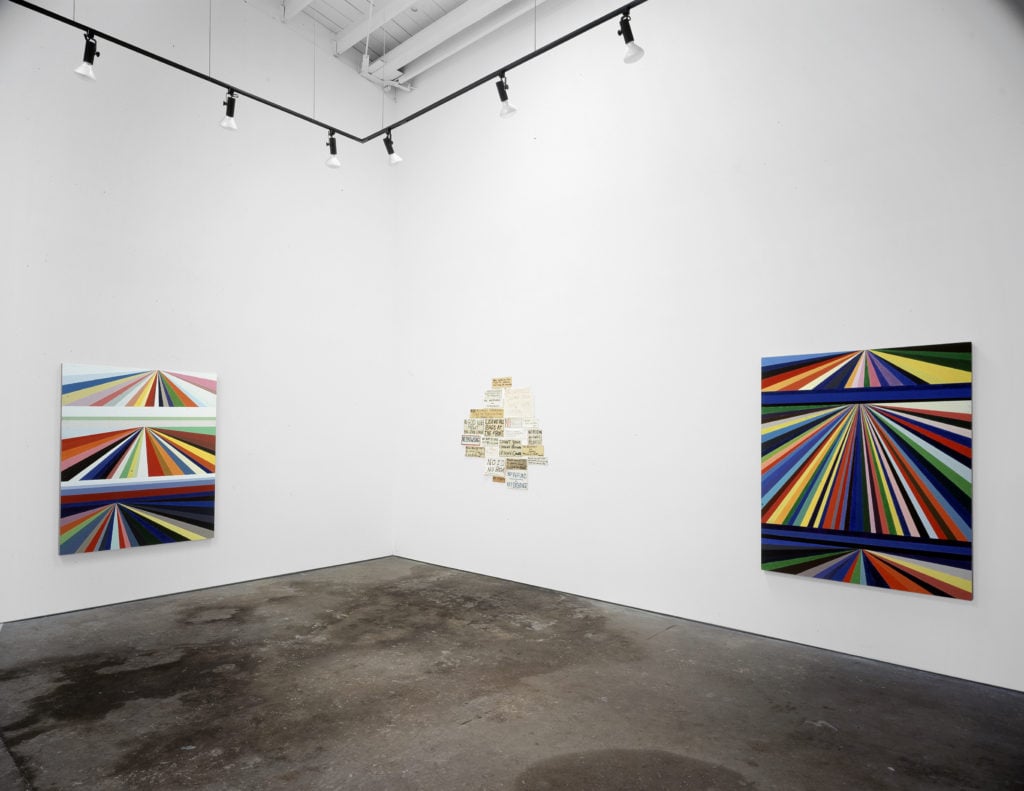
Mark Grotjahn’s first solo exhibition.
Blum & Poe, Santa Monica, 1998. © Mark Grotjahn, Courtesy of the
artist and Blum & Poe, Los Angeles/New York/Tokyo.
The shows Blum and Poe were
staging as they approached their 15th year of the gallery displayed
a keen eye toward the market, albeit one that never strayed from
the vision that guided their choices. In addition to the budding
superstars from Japan—Nara and Murakami, but also Tatzu Nishi and
the Superflat artist Chiho
Aoshima—and their longtime
LA artists—Dave Muller, Matt Johnson, Sam Durant—there was a young
man named Mark Grotjahn, who used to just hang out in the gallery
and check out shows without ever letting on that he was making his
own work.
In 2001, Grotjahn started
flipping his canvases vertically, with colorful lines coming out of
the center in thrilling, robust thrusts. These were the first fully
realized works in his now famous “Butterfly” series, many of which
were shown at the Santa Monica Blum & Poe space in 2002, and then
again at the La Cienega gallery in 2005
By 2007, the Butterfly paintings
were selling for more than $900,000 at auction, making the young
artist a human embodiment of the fast-rising LA art scene and
market.
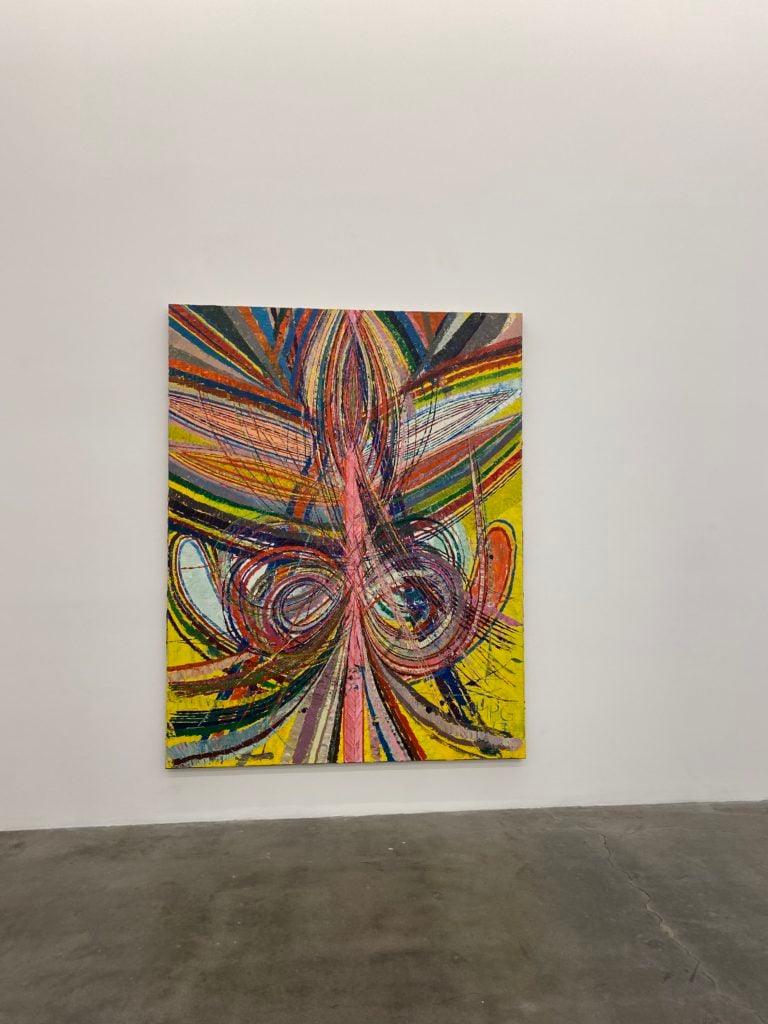
Mark Grotjahn, Untitled (Dragonfly
No. 6 Face 48.98) (2017). Photo: Nate Freeman.
Grotjahn is now one of the most
sought-after painters on Earth, with the world’s top collectors at
each other’s throats to get their hands on his primary market work.
Because of this, Grotjahn often deals with his collectors directly,
rather than through dealers—Blum and Poe included. And yet there is
a staggering, menacingly colored Grotjahn painting
Untitled (Dragonfly No. 6 Face
48.98) (2017) currently
hanging in the Blum & Poe show in Los Angeles. The painting is
arguably the most significant work shown anywhere at all during
Frieze Week, simply because no large-scale “Dragonfly” works from 2017 have
ever been seen
before—they all went straight to
private homes, without being shown by one of Grotjahn’s galleries,
which include Gagosian and Anton Kern.
And on the secondary market,
Grotjahn’s works have sold for $16.8 million at auction and
apparently for as much as $25 million privately. When asked about
Grotjahn, Poe said, “I wanna go to the unicorn store all the time,
that’s just not the way it works though.”
As success came for Blum & Poe,
in 2009 they once again decided to bet the lot and expand to a new
building across the street at 2727 La Cienega—a space more than
four times the size of their current building, spread across an
acre of land.
“It was another all-in move,”
Poe said. “It was tough; we didn’t take a paycheck for over a year,
because we had staff.”
The opening in October 2009 was
such a to-do that Artforum called it a “shock-and-awe
affair” and gave the dealers credit for revitalizing the entire
scene. The collector Alan Power called the new gallery “MOCA
West.”
“This was like a thunderclap, it
was a major announcement, as we were still considered a young
gallery,” Blum said. “It really changed the game.”
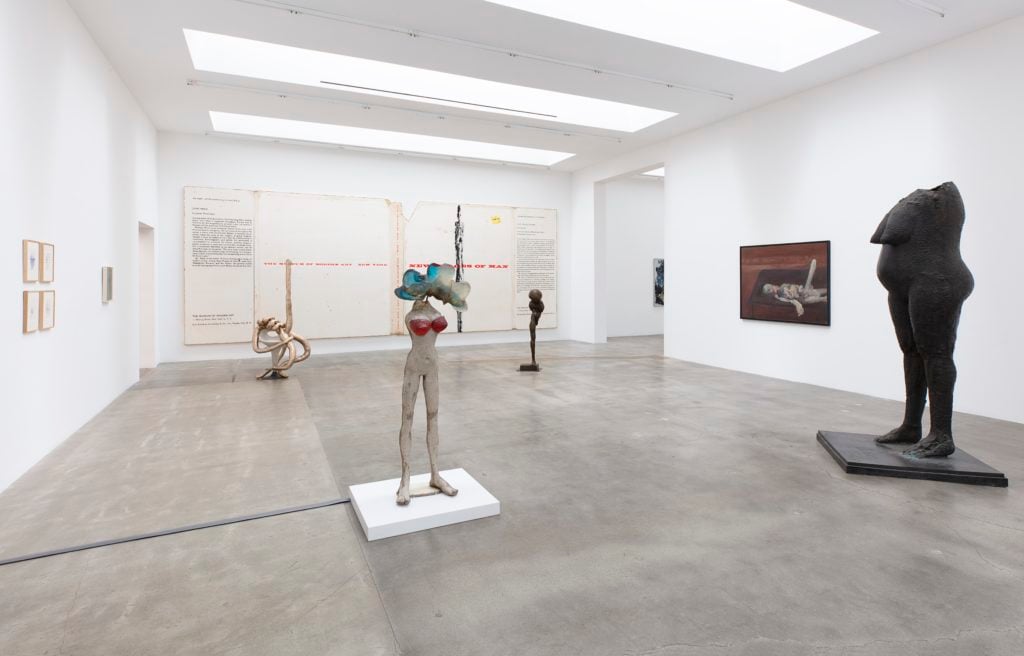
“New Images of Man,” installation view,
Blum & Poe, Los Angeles, 2020. Courtesy of the artists or estates
and Blum & Poe, Los Angeles/New York/Tokyo. César: © 2020 César /
SBJ / Artists Rights Society, New York, ADAGP, Paris Alina
Szapocznikow: © 2020 Artists Rights Society, New York / ADAGP,
Paris. Photo: Makenzie Goodman.
California Gold Rush
The new space was such a hit
that Blum had to admit, reluctantly, that it might have influenced
the gigantic spaces that European galleries would go on to
establish in LA over the next few years. Spruth Magers opened its
first American gallery across from the LA County Museum of Art in
2015 and, the next year, Hauser & Wirth opened an entire complex in
the downtown arts district.
Two years later, Frieze
confirmed rumors that another edition of its fair-in-a-tent would
grace the grounds of Paramount Pictures Studios. Despite
initial skepticism from Blum and Poe—“We were convinced it would
never work, it’s just too far-flung of a city,” Blum said—the first
two editions have been pretty much embraced by
everyone.
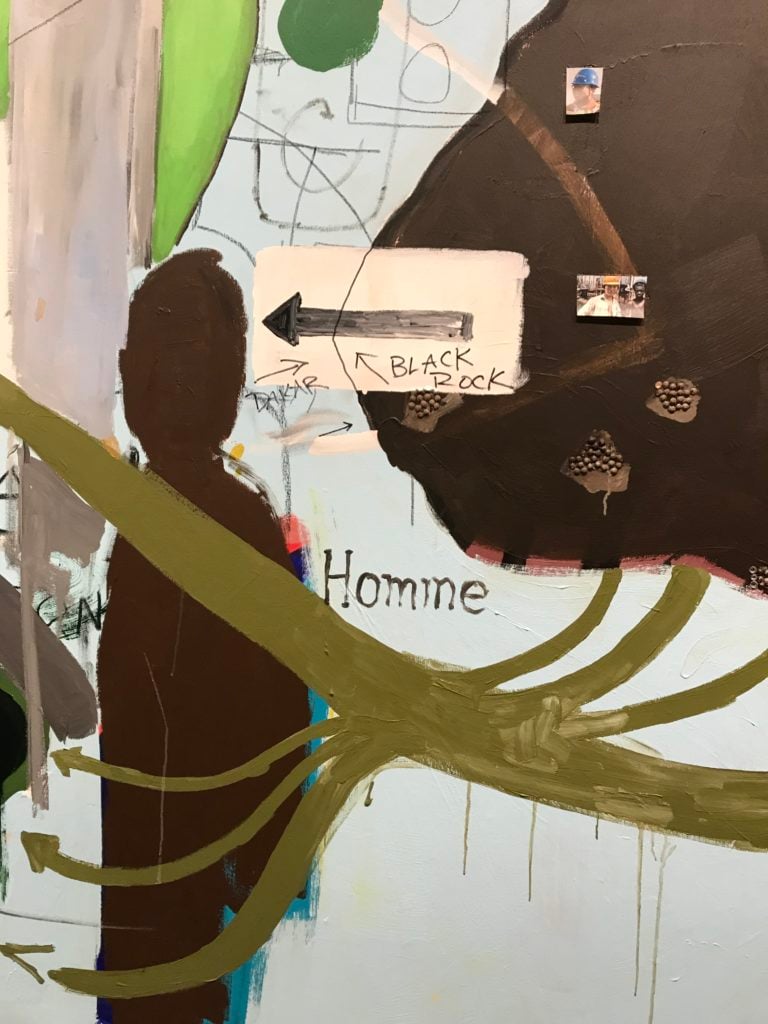
A detail of a wall at a show of work by
Henry Taylor at Blum & Poe New York. Photo: Nate Freeman.
LA might be ready for its
closeup, but the attention comes at a time when Blum & Poe’s
influence has gone global. Look no further than Murakami, who
last year left Blum and
Poe soon after having a show at the Beverly Hills outpost of
Gagosian.
And the Upper East Side
townhouse home to Blum & Poe New York is a vital part of that
neighborhood’s scene. Take the September 2019 opening for Henry
Taylor, which the gallery now co-represents with Hauser & Wirth,
which no doubt has global plans for an artist who was the
out-and-out star of the 2019 Venice Biennale. At the opening, not
only did Taylor bring out a who’s who of the city’s artists, but
Kehinde Wiley was there painting on the walls— “Kehinde, tell your
boy Barack to get at me!” Taylor shouted in Wiley’s ear—as
Metropolitan Museum of Art director Max Hollein walked around with
a smile plastered on his face, no doubt wishing he could acquire
work from Blum & Poe to add to the collection of the country’s
greatest art museum.
As my conversation with Blum and
Poe wound down, we realized how much we actually hadn’t discussed.
They are doing thrilling things with the estate of Robert
Colescott, a deeply important artist just now finding success at
auction. In recent years they’ve devoted shows to the Japanese Mono
ha movement and staged a deeply academic and universally acclaimed
survey of the postwar European movement Cobra… while also giving
the gallery over to Kanye West, who installed a sculpture of 12
celebrities done up in silicone inspired by his song
“Famous.”
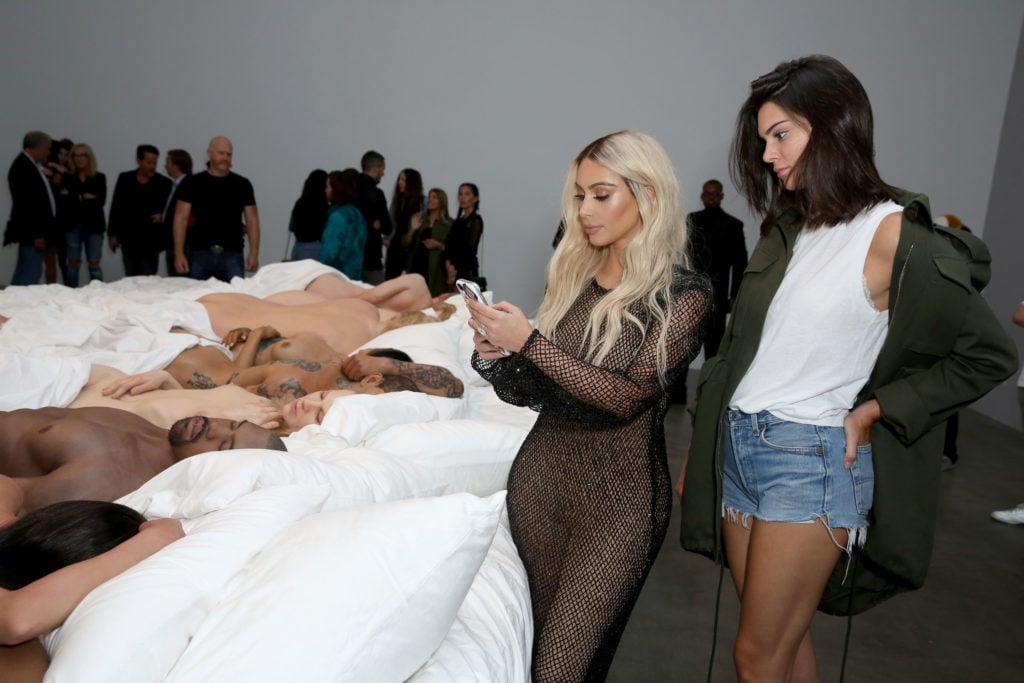
Kim Kardashian and Kendall Jenner attend
Famous by Kanye West a private exhibition event at Blum & Poe, Los
Angeles, California. Photo by Rachel Murray/Getty Images for Kanye
West.
And then we circled back to how
it all started, at a small Santa Monica space that they’ve carried
with them over the years. Like, actually, they took the
space with them—one room in the gargantuan La Cienega
gallery is the exact same specifications as that weird space in the
row of beachside office buildings.
“We really had a rough go at the
beginning,” Blum said. “But hook or by crook, we are very
authentic. There’s no script.”
Would they ever imagine that
they would be here, 25 years later—a citadel in the middle of a
global capital, one of the biggest galleries in one of the world’s
biggest art market towns?
This happened at the exact same
time: “Yeah I did,” said Blum, and Poe said, “No, I for sure
didn’t.”
The post How Two Laid-Back Dealers Turned $25,000, a Bunch
of Unknown Artists, and Sheer Bravado Into the Global Powerhouse
Blum & Poe appeared first on artnet News.
Read more https://news.artnet.com/art-world/blum-and-poe-history-1784880
Further reading


Leave a comment