
10 Practical Reasons Why We Need to Fund—and Defend—the National Endowment for the Arts
The Heritage Foundation and conservative groups like it have
been trying to kill the National Endowment for the Arts for
decades.
Last month, the Trump administration, for the fourth year in a
row, released a budget blueprint that proposed zeroing out and
winding down the NEA and other government art support. Heritage basically staffed the current Trump
administration, so it’s not a coincidence that
his budget priorities are essentially those of the anti-government
think tank, which is almost as passionate about ending the NEA as
it is about undermining the science on climate
change.
Perhaps with everything going on right now, and with the NEA
having squeaked by before, the sense of urgency around the issue
has drained. You can’t just go on writing passionate defense of it
year after year. Then too, today’s NEA itself, as even its critics
acknowledge, is not exactly a behemoth of radical
interventionist government to get inspired by.
Nevertheless, it is worth defending. The Heritage Foundation is
still promoting its
1997 report authored by “distinguished fellow”
Laurence Jarvik, titled “Ten Good Reasons to Eliminate Funding
for the National Endowment for the Arts,” as the definitive
source on “why there is no need for the
federal government to be spending your money on these programs” (as
a update now at the top of it re-promoting it in relation to
Trump’s recently proposed cuts says). It
remains a go-to
reference in debates today, and its language has sunk
into the ground water of
conservative argument about the NEA—which is, after all, the job of
a think tank.
And actually, as a distillation of anti-NEA talking points, I
find it useful. I think it’s important for NEA advocates to
actually understand the spectrum of arguments ranged against them,
and what it actually is. So I thought I would put down, here,
replies to each (the Heritage document is influential, I think,
because of its show of research, though it is not so knowledgable
as it pretends—and, after all, it is dated).
Below, each of Heritage’s “Ten Reasons,” and a gathering of
information on how to respond.
Anti-NEA
Talking Point #1: The Arts Will Have More Than Enough Support
Without the NEA
Reply: Defenders of the NEA often use
the talking point that its funding accounts for a very, very small
amount of the budget: something like 0.0004 percent. But foes can
turn this around: What is paltry is easy to cut. Trump’s 2021
budget proposal says explicitly that the NEA and NEH “make up only
a small fraction of the billions spent each year by
arts and humanities nonprofit organizations.”
But the NEA was never designed to replace
private support. The very second item of National Foundation on the
Arts and the Humanities Act of 1965 states this clearly:
“The encouragement and support of national progress and scholarship
in the humanities and the arts, while primarily a matter for
private and local initiative, are also appropriate matters of
concern to the Federal Government.”
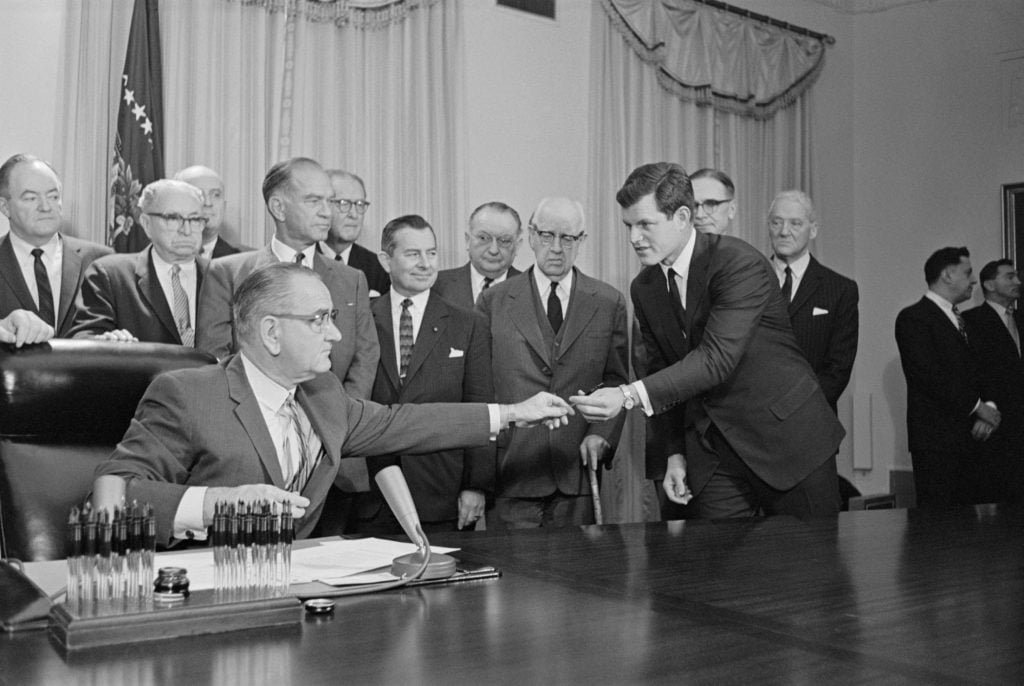
After signing a bill renaming the
proposed National Cultural Center the John F. Kennedy Center for
the Performing Arts here at the White House today, president
Johnson hands one of the pens he used to senator Edward M. Kennedy.
Photo courtesy Getty Images.
Instead the NEA was designed to help correct for the biases of
private support. It was hatched in 1964, the same year Dylan
penned The Times They Are a Changin’, and it was very
much of a piece with the spirit of Johnson’s Great Society. That
is, the idea was that government action could be used to correct
some of the problems that, left to itself, US’s affluent
society—then in the middle of a historic boom, but simmering with
unrest—let fester.
The emphasis, as you can read in its first report of
1964-65, was that the arts ought to be recognized “as a vital
part of our national life, and not a luxury.” The initial
commission that studied it had come to the conclusion that the
relentless focus on practical subjects in education had led to
widespread discontent with the materialism of US society. It thus
focused on expanding access to the arts and funding ideas and work
deemed vital but not necessarily profitable.
Let’s not be naïve about it: much like the Johnson
Administration’s eventual support of the Civil Rights Act, the
passage of the NEA was also meant as a chess move in the
Cold War. Capitalist America was in ideological competition with
the Soviet Union for global hegemony, and trying to cut against the
image of the US on the world stage as a bigoted, rapaciously
materialist society served an objective. The act itself made its
propaganda value clear: “The world leadership which has come to the
United States cannot rest solely upon superior power, wealth, and
technology, but must be solidly founded upon worldwide respect and
admiration for the Nation’s high qualities as a leader in the realm
of ideas and of the spirit.”
Flashing forward, that background impetus for government art
funding helps explain why it was after the Cold War ended in the
late ‘80s that the NEA came under withering attack, as US
politicians no longer felt the same ideological need to soften the
image of capitalism to the world; capitalism had become the only
game in town. Since then, conservatives have either demonized or
let the NEA go to seed. In 1990, the NEA’s budget
was $171 million, which after inflation adds up to something like
$338 million; for 2020, it’s $162 million.
But the problems that it was set up to address—the construal of
art as a “luxury” when left just to private patronage, and major
gaps in access to creative resources in a wealthy but very unequal
society—definitely remain. And through its modest grant-giving
today, the NEA still does what it was designed to do: attempt to
foster access to the arts for people of many different kinds,
mainly through supporting non-profit institutions that can use the
lift.
Anti-NEA Talking Point #2:
The NEA Is Welfare for Cultural Elitists
Reply: The NEA was founded in the ‘60s
with a rhetoric of promoting “progressive” and “experimental” art,
and took heat afterwards for discriminating against realists.
In the late ‘80s, it became a flashpoint of public controversy,
with “artists” proving easy to demonize as godless
deviants.
But honestly, all this is a very dated idea of what
the NEA does. The NEA is quite self-consciously
populist in focus these days. It boasts of promoting such
initiatives as the Creative Forces program, a partnership with the
U.S. Department of Defense and Veterans Affairs that, as its
website states, “increases access to community arts activities to
promote health, wellness, and quality of life for military service
members, veterans, and their families and caregivers.”
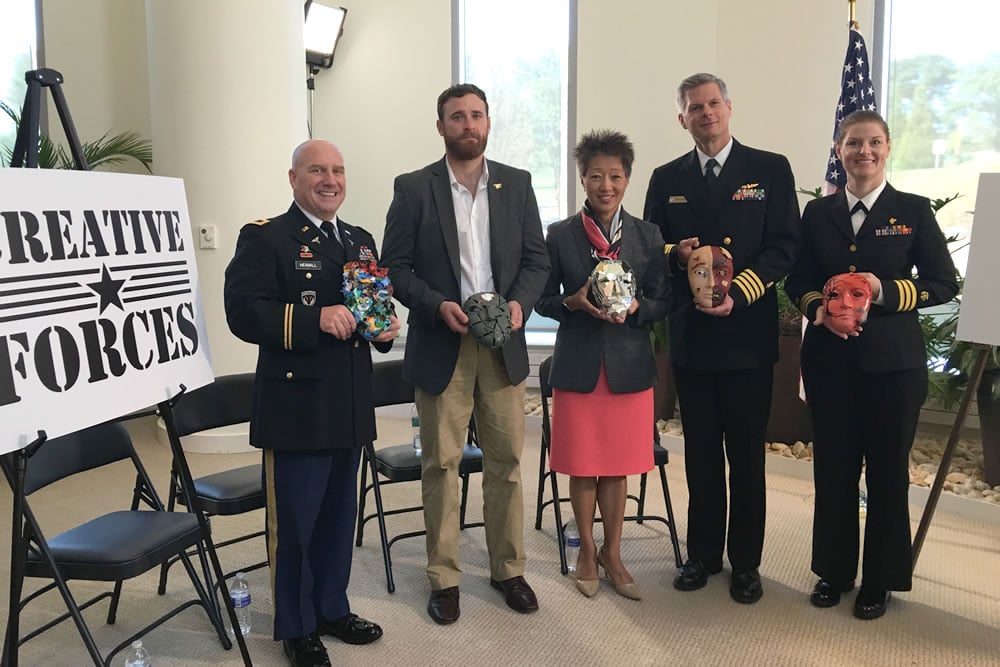
Colonel Michael S. Heimall, director of
Walter Reed National Military Medical Center; Rusty Noesner,
Retired US Navy SEAL; Jane Chu, Chairman of the NEA; Captain Walt
Greenhalgh, director of the National Intrepid Center of Excellence
(NICoE); and commander Wendy Pettit, Chief of Clinical Operations,
National Intrepid Center of Excellence (NICoE) hold up masks made
by service men and women in the Creative Forces program. Image
courtesy National Endowment for the Arts.
Last September, the Jacksonville Daily
News reported on an Open Studio exhibition for Creative
Forces, which gives a sense of the hoity-toity audience it serves.
“It’s like a safe space for me; a place I can go and express
myself,” Army vet Robert “Shrek” Harrell, an artist in the show,
said of the Creative Forces program. “It gives me time to be with
myself in my mind, and gives me some peace and a way to heal.”
The NEA also supports Challenge America, a
program specifically designed to give a helping hand to communities
that might otherwise not have access to art programming—i.e., it
is specifically targeted at non-elite communities.
Just as an example, we are talking about a grant for North
Carolina’s Tsali Care Center to support artists from the
Eastern Band of Cherokee Indians to offer art classes to the
nursing home’s residents (who are also generally tribal members).
Or a grant to support an art exhibition and other programming for a
Dia de Los Muertos festival in Milwaukee, Wisconsin. Or a grant for
the Georgia Mountain Storytelling Festival in Blairsville, Georgia,
which showcases “traditional and contemporary Appalachian
stories.”
All of these seem extremely worthy, and difficult to frame as
welfare for elitists.
I actually don’t love making such arguments, because I think
that there ought to be room to fund art that isn’t directly
justified as community service.
What I think is very important to stress is that
the NEA is modestly redistributive. Private philanthropy
is notoriously unequal, flowing to flashy showpiece institutions
and pooling in localities where rich people are concentrated. The
art market is even more a direct reflection of the concentration of
wealth, and wealth has never been more
concentrated.
“Low-dollar and mid-level donors have declined by about two
percent each year for more than fifteen years,” one report on trends in
philanthropy found recently. The result was “an increased bias
toward funding heavily major-donor-directed boutique organizations
and projects.” And so you get the mega-project of the Shed
in New York’s luxury shopping playground Hudson Yards, with its
flashy “Bloomberg Building,” at the very moment that the
comparatively ultra-modest but beloved Bushwick nonprofit
NURTUREart has to shut down due to a “confluence of
resource challenges and a shifting environment for
non-profits.”
On this level, the argument for a National Endowment
for the Arts is clearer now than it has ever been. Compared to when
the NEA was founded, the United States has grown drastically more spatially
unequal, with certain big cities and regions sucking up
investment and cultural amenities. Even experts who argue that
the NEA should be even more narrowly focused on small,
non-elite institutions—I’m thinking of Diane
Ragsdale—stress that NEA funding tends to be more
equally distributed, since that’s part of its mandate, and also see
it as a potential instrument for correcting for otherwise dire
trends in private giving.
But don’t take my word for it. Trump’s NEA secretary,
Mary Anne Carter, made the case well last
year:
For every county in America that has a high school, National
Endowment for the Arts is there, either through our Poetry Out Loud
competition or our Musical Theater Songwriting Challenge. The same
cannot be said for private foundations. A review of the art giving
of the top 1000, yes, 1000 private foundations shows that those
private dollars don’t reach 65% of American counties. In contrast,
the National Endowment for the Arts is in 779 more counties than
private foundations.779 counties, 25% of America where the National Endowment for
the Arts provides funding where the top 1000 private foundations do
not.A few examples: in Kentucky there are 59 counties that receive
funding from us that have no private dollars out of 120 counties.
In Alabama 40, in South Carolina ten, Alaska eight, and in my home
state of Tennessee 21 counties with our funding but no funding from
the top 1000 private foundations.Access to arts funding should not depend on one’s proximity to
private philanthropy. This is what makes support of the National
Endowment for the Arts indispensable.
Anti-NEA Talking Point #3:
The NEA Discourages Charitable Gifts to the
Arts
Reply: This is a bit of a wonky debate, but
argument rages over whether government funding of the arts “crowds
out” or “crowds in” private funding. Supporters like to say that
the NEA serves as a “Good Housekeeping” seal, encouraging
donations from private foundations, corporations, and individuals,
an effect that certainly feels true to a lot of small organizations
who use an NEA grant to attract the attention of other
potential backers.
When the new attempt at termination was announced last month, an
NEA spokesperson told my colleague Eileen
Kinsella that its grants “are leveraged by other public and
private contributions up to 9:1, significantly increasing the
impact of the federal investment.” (Indeed, its grants generally
require securing matching
funds.)
Opponents such as the Heritage Foundation like to say that
government support merely “crowds out” private funders, who will
take their money somewhere where they think it is more needed if
the government is present. And any “Good Housekeeping” effect,
they say, simply shifts patronage that would go to one organization
to another organization, rather than encouraging additional
giving.
I actually find it baffling to try to boil this down to a
universal law. For instance: private giving went up in the ‘90s
after the cuts to the NEA caused by the Culture Wars.
Does that therefore prove, as some economists have
argued, that government arts funding had previously been
“crowding out” private patronage?
I don’t think so, because a) the increase in private funding
happened during a huge economic boom that lasted the entire decade,
and b) the spectacular public character of the Culture Wars debates
that led to the NEA cut framed it in the public mind as a
needy cause worthy of supporting, with copious PR points and good
vibes going to the private philanthropists who stepped in as
Congress cut funding. (The way the researchers put
this, in their charmingly inscrutable way, is that “publicity”
has a “non-linear impact” on the public-private funding
calculation.)
When an economic crisis hit in the early 2000s and progressive
concern recentered around the Iraq War, the conversation moved on:
“Data from the Conference Board for 2000 to 2010 suggest that
corporate funding for the arts dropped by half after inflation over
this period.” And that’s not because George W.
Bush’s NEA stepped back in to crowd it out.
A final note: Even if there is a fixed pie of private arts
funding, and the “signal” of an NEA grant simply shifts
those donations around, it does not follow that this cannot be a
useful operation. Larger, well-endowed institutions are easier able
to court donors and to frame themselves as winners. The “Good
Housekeeping” seal of approval from the NEA most benefits
small institutions who don’t otherwise have major marketing budgets
or pre-existing reputations, providing a way to signal, “Hey, this
organization is doing good work—might you consider shifting some
money from that wealthy, highly endowed organization to a smaller
but critically acclaimed one?”
Anti-NEA Talking Point #4:
The NEA Lowers the Quality of American Art
Heritage quotes a management professor on the evils of state
arts funding: “It was the unsubsidized writers, painters, and
musicians—imprisoned in their homes if they were lucky, in asylums
or in gulags if they weren’t—who created lasting culture.”
Aside from being comically over the top (“giving out $10,000
grants to nonprofits that serve communities in need is the royal
road to totalitarianism!”), this declaration is on-its-face wrong,
unless you don’t count Velázquez or Bernini as “lasting culture.”
Most of the things you see in museums were subsidized by royal
courts or papal authorities in one way or another.
But I value the modern “artist as dissident” figure too. Does
government art funding necessarily turn artists into mediocre
propagandists?
The “New Deal produced no true masterpieces,” Heritage reports,
using the WPA arts projects as an obvious example of bad arts
policy. But “producing masterpieces” isn’t the best measure for an
arts policy designed as unemployment relief in the first place, and
arts policy in general doesn’t just support individual artworks but
helps artists sustain a career, get training, and experiment. Most
serious scholars today argue that the New Deal arts program laid
the basis for a national arts scene in the United States that did
not previously exist, producing a new sense of professional
identity and purpose for American art that paid dividends later
on.
Jackson Pollock, Alice Neel, and Charles White all cut their
teeth as WPA artists, and went on to great renown in diverse ways.
You can’t beat that record.
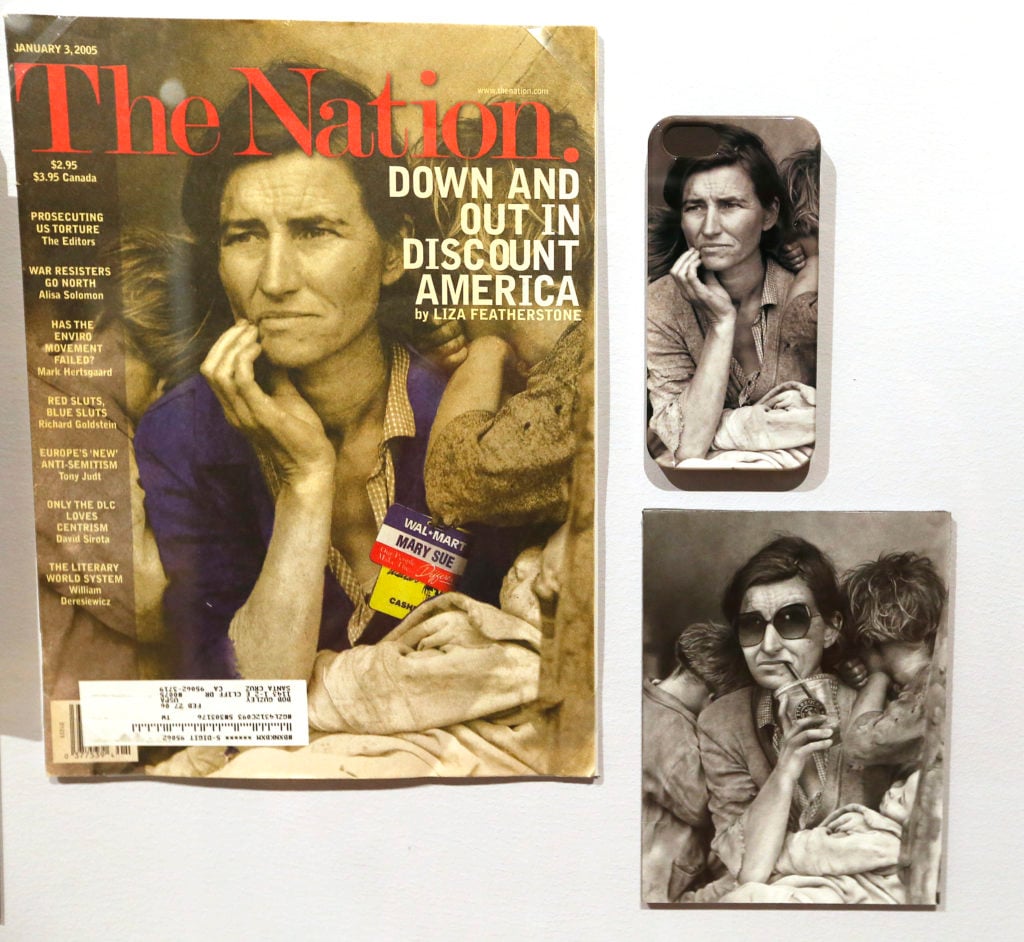
A magazine cover, cell phone case, and
postcard with versions of Dorothea Lange’s Migrant Mother
photograph are displayed during a media preview of the exhibition
“Dorothea Lange: Politics of Seeing” at the Oakland Museum of
California on Thursday, May 11, 2017. Photo by MediaNews Group/Bay
Area News via Getty Images.
As for “masterpieces,” I don’t know what else to call a work
that has entered as deeply into the symbolic vocabulary as Dorothea
Lange’s Migrant
Mother, which was created for the Farm Services
Administration’s photography section.
The NEA, back when it still had individual artist grants
(these were a casualty of the Culture Wars fight in the ‘90s), did
a pretty good job supporting artists who were in need at stages in
their career when it mattered, and who went on to make important
art. Michael Brenson looked at artists who won
MacArthur “Genius” Grants only after receiving NEA grants
first—which was almost all of them given during
the relevant time period where the two programs overlapped: Ida
Applebroog, Vija Celmins, Ann Hamilton, David Hammons, Gary Hill,
Robert Irwin, Alfredo Jaar, Kerry James Marshall, Pepon Osorio,
Martin Puryear, Cindy Sherman, James Turrell, Bill Viola, and Fred
Wilson.
In many cases, Brenson points out, they received
the NEA grant over a decade before they officially became
celebrated as “Geniuses,” and the boost helped them stick it out on
what was and is a tough path. The fact that Kerry James Marshall,
probably the most acclaimed and important living painter today, was
allowed to pursue his art full time because of his
1991 NEA grant is part of his official biography.
So you can dispense with the “government funding” leads only to
mediocrity.
On the flip side, however, it may be worth adding that I find no
evidence that the alternatives to government funding don’t produce
their own biases, particularly in the face of concentrated wealth,
the collapse of the middle of the art market, and an increasingly
inescapable corporate pop culture. The results of those pressures
include the “Zombie Formalism” painting
boom of a few years ago—where galleries were swamped with
blandly collectible copies-of-copies of past abstract paintings,
courting herd taste in collectors—or every museum desperately
trying to get a hold of a Yayoi Kusama mirror room to bring in the
crowds.
The point, again, of arts funding is to provide a small
counterweight against these other pressures
towards conformity.
Anti-NEA Talking Point #5:
The NEA Will Continue to Fund Pornography
This one dates the Heritage article. The year after it was
published, in ’98, the Supreme Court upheld an advisory “decency
standard” for NEA grants. In 2010, looking back two
decades on from that decision, the National Coalition Against
Censorship wrote:
[I]t appears the decency amendment—coupled with the removal of
individual artists grants—did not so much become a reason to censor
specific work as have a chilling effect on programming at recipient
institutions. It also seems that the amendment shifted
the NEA’s emphasis from supporting innovative original work to
supporting art and art education that would not likely disturb
mainstream standards and values.
I’m not aware of anything since that changes the calculation.
And yet, the Culture Wars permanently fixed in the public mind the
association of the NEA with Andres Serrano’s Piss
Christ and Robert Mapplethorpe’s BDSM photos. It’s part of why
it is so easy still to score points bashing the agency on Fox
News.
It’s easy to point out that that the Heritage report was more
concerned with using individual instances of controversial art to
whip up outrage against government subsidy than accurately
assessing what any of the art in question meant. Among the items
that Heritage offered—and evidently still wants to offer today,
given that they are still circulating the piece—as irredeemably
offensive is the NEA’s support of the organization Women Make Movies. The scandal was that WMM
helped distribute films that had lesbian themes.
Similarly, Heritage cheerfully classed the
fact that the NEA’s literature program had helped fund “The Gay 100,” a historical digest
of famous LGBT people, as “pornographic.” The
libertarian flacks at Heritage were happy to court homophobia to
push their anti-government agenda, which probably seemed a good bet
in the late ’90s and looks like loathsome opportunism now.
Reviewing the appendix showing the “regular pattern of support
for indecency, repeated year after year” today, a lot of it fudges
the nature of the NEA’s support, and a lot more burlesques the
works in question very uncharitably, takes hostile reviews as proof
positive of worthlessness, and shows ignorance of the field it
purports to authoritatively opine on. It refers to William
Pope L. as “William L. Pope.” It includes as “pornographic”
the scandal of MoMA showing Bruce Nauman neons that say “Shit
and Die” and “Fuck and Die,” because MoMA showed them and
received some NEA funding. The horror.
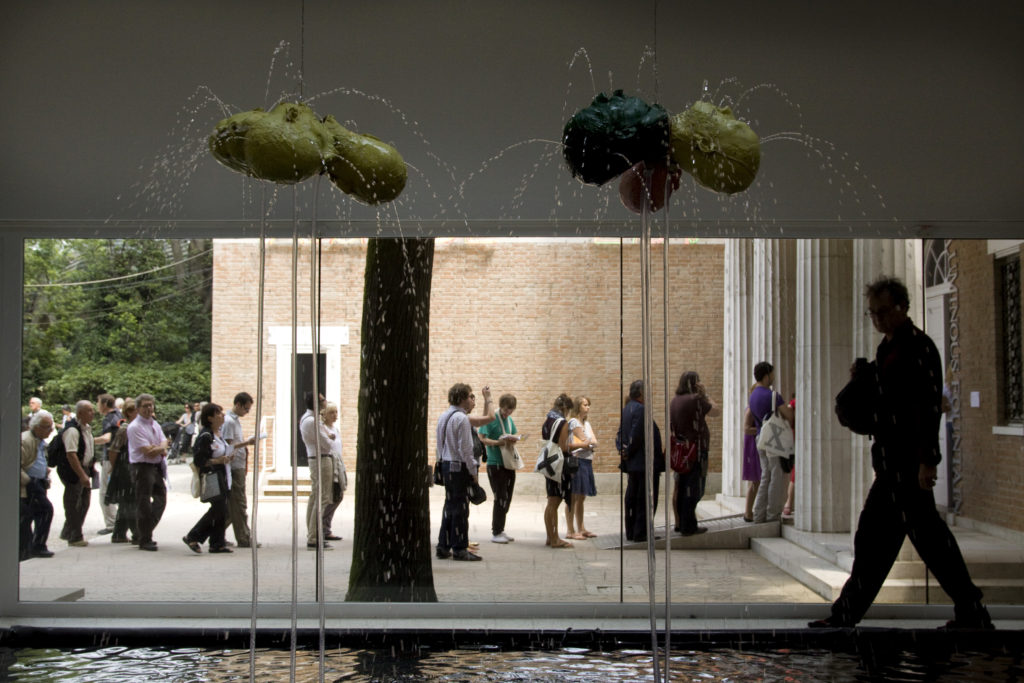
Visitors line up for the Bruce Nauman
works during the 53rd International Art Exhibition on June 5, 2009
in Venice, Italy. Photo by Massimo Di Nonno/Getty Images.
In the end, though, getting sucked into defending individual
works is a waste. Not everyone is going to be convinced to like
Bruce Nauman. I mean, he did literally represent the United States
of America at the Venice Biennale, where his acerbic, difficult
work won the Golden Lion for Best National Pavilion in
2009—something like winning a gold medal in the Olympics of Art—but
it is challenging for many viewers.
Debating the merits and demerits of individual works of art, and
even whether they were individually worth
funding? That’s a job for criticism.
Outside of that, what you have to defend is the principle of the
thing.
In 1989, the year of the NEA supernova of controversy,
panelists gave out thousands of grants
(298 in the soon-to-be-terminated artist-grants category alone!).
These included funding such decidedly non-pornographic fare as a
documentary about banjo legend Morgan Sexton and a
“radio series about women
in old-time music” in Kentucky.
The NEA could boast, that year, of having funded the
initial workshops that became the play Driving Miss
Daisy, nominated in movie form that year for Best Picture. It
gave early support to A Prairie Home Companion in the ‘70s. In the
2010s, Lin-Manuel Miranda workshopped his first
musical at the O’Neill Musical Theatre Center, partly funded by
the NEA.
Taking a few examples of things that the NEA directly
or, more often, indirectly funded that offended conservative
sensibilities, and caricaturing government art funding as
a whole as being a scheme to corrupt the youth? That’s
textbook demagoguery.
Anti-NEA Talking Point #6:
The NEA Promotes Politically Correct Art
Reply: There are interesting debates on this
score. Governmental arts-funding systems are inherently
subject to political pressures. That does tend to put pressure on
artists to make work that avoids controversy. This is, frankly, a
complaint that some artists have about more social democratic
arts-funding systems—though they usually wouldn’t give them up,
either. The International Federation of Arts Councils and Culture
Agencies has some very thought-provoking
discussion about what mix of “arm’s length” policies best
guarantee security and freedom for the arts.
As we have seen, a lot of the NEA’s intensified focus on
“community-based” arts came in the wake of the Culture Wars. So if
what you mean by “politically correct” is safe, carefully
workshopped, offends-no-one expression, there is a case to be made
that the agency does somewhat encourage this kind of work. In fact,
it is precisely the right’s efforts to demonize the NEA that have
led to such “political correctness.”
But that is not what Heritage meant by “politically
correct” art. It meant that the “radical virus of multiculturalism”
has “permanently infected the agency, causing artistic efforts to
be evaluated by race, ethnicity, and sexual orientation instead of
artistic merit.”
Yet the one big piece of evidence Heritage mustered was an
article by one-time Los Angeles Times theater critic
Jan Breslauer in the Washington Post decrying how
“race-based politics” had entered arts funding. It’s worth, then,
reading the volley of letters that
the Post received rebutting Breslauer. Calling it “a crazy
quilt of misinformation,” Olive Mosier from
the NEA wrote: “[Breslauer’s] suggestion that artists of
color have been presented more for their race or ethnicity than for
their artistic excellence is demeaning and untrue. The isolated
examples of those who contort themselves to qualify for a grant are
the exception, and certainly not part of any rule here at the
National Endowment for the Arts.”
What is true is that, as already mentioned, arts funding has
been partly a way to offer support for underserved communities:
poor communities, minority communities, rural communities, disabled
communities, veteran communities. Guaranteeing access to the arts
for a wide spectrum of the citizenry is part of what the NEA was
designed to do: “The arts and the humanities belong to all the
people of the United States,” is the first line of its founding
act. But saying that it takes those factors into consideration is
rather different than saying that it is placing “political
correctness” over “artistic merit.”
The idea that there is some easily accessed universal standard
of “merit” to judge art by is false. Cultural background matters a
lot in terms of what is considered good. The factors that make a
great fiddle player and a great violinist are a little different.
The NEA funds both.
Here is what Michael Kahn, the legendary artistic director of
the Shakespeare Theater, wrote the Post in response to the
Breslauer essay that Heritage touts:
Such policies do not result in ‘pigeonholing artists and
pressuring them to produce work that satisfies a politically
correct agenda,’ as Breslauer maintains. Rather, such policies
provide in a small measure the means through which these artists
may flourish and grow. By encouraging this dialogue, the NEA has
created artistic possibilities in an environment that had
previously not been hospitable.
Just so.
Anti-NEA Talking Point #7:
The NEA Wastes Resources
Reply: Heritage writes that, “[l]ike any
federal bureaucracy, the NEA wastes tax dollars on
administrative overhead and bureaucracy.” This is stated as a
truism.
But there is no law that makes this “private = good, public =
bad” calculation axiomatically true. In health care, for instance,
government programs like Canada’s spend far, far, far less on
administration than we do in the United States, where our welter of
private insurance companies compete to spend on advertising,
marketing, administration, executive salaries, and shareholder
profits. Just 17 percent of Canada’s health expenditures go to
administration; 34 percent of US health expenditures go to such
things.
When it comes to the arts—and arts advocates should know the
following fact, so that they can discuss it honestly—we are always
talking about a battle over how the government gives away
money to support the arts, not whether it does.
Our government gives away far, far, far more money in tax breaks
than it does in direct grants of money to the arts. The tax break
for charitable giving is the single largest way that the government
gives to the arts—orders of magnitude more important than the
NEA.
If your objection to arts funding is that it’s wasteful to spend
tax money on arts, the NEA is just an incredibly small, symbolic
fight to pick, while the tax-break model means that,
essentially, government is subsidizing the social calendar of the
wealthy, who get to write off their gala tickets and
charity-auction purchases.
This model, of course, incentivizes rich people to give to
causes that they want by allowing them to get the social and PR
boost for doing so, while at the same time making sure the
government isn’t on the hook for the whole bill, since donors can
only write off part of their contribution. In an age when, for
decades all over the world, the balance of power has shifted away
from the state towards the wealthy and corporations, this has
appeared to be a good deal. We may admire governments like
Germany for their strong public arts support, but Europeans
have been talking of the need to move towards “US-style” arts
funding for some time. (The 2017 Tax Cuts and Jobs Act
tipped the benefits of charitable giving even more towards the
top.)
There is, however, a dark side to this system. Or multiple dark
sides.
For one, it skews the priorities of institutions towards short
term thinking. It has led US arts institutions to
overbuild, for instance, as it is very hard to get private
patrons to fund boring things like operations and maintenance,
because private donations are, face it, driven by ego. What donors
want are flashy new buildings and other highly visible initiatives,
which lead to the most prestige. Just to keep up in the race to
court donors, an arts system so heavily dependent on private giving
is stuck in permanent expansion mode.
For two, cultivating patronage is not without its own wasteful
administration costs. Rich people don’t just give—they need to be
romanced. In the ’90s, for every new dollar of private giving
raised, institutions incurred 25 cents more of fundraising
costs.
Grant writing, of course, has its costs: an
often-cited figure puts
it at about 20 cents for every dollar raised, on average. The
special event/benefit
model, on the other hand, is thoroughly the worst way to raise
money for nonprofits, with an average of 50 cents spent for every
dollar raised (and plenty of events that yield very little after
the lavish amenities to lure the patron class are paid for.)
The most cost-effective way to get money is “major
gifts”—but, to repeat something that has been a theme here—it is
the glamorous, established, most-connected major institutions that
are best positioned to attract major gifts.
And finally, an arts system that tips things so far towards
private tax breaks has made US institutions ever more dependent on
currying favor with the rich—which has now left them in a terrible bind, and
the target of protest, as exposure of corporate misdoings throws a
harsher and harsher light upon the patron class. Just as dependence
on government makes institutions vulnerable to anti-government
movements, dependence on the mega-rich makes institutions
vulnerable to an animated populism—and our country has grown so
extremely skewed by extreme levels of inequality that it is about
to explode from it.
Anti-NEA Talking Point #8:
The NEA Is Beyond Reform
Reply: The only reason to believe this is if
you dogmatically believe that, by its nature, the NEA is bad.
It has reinvented itself over the years in many ways, partnered
with new organizations, and created new categories of funding. In
the recent past, these have included its Our Town grants
(established 2010) for “creative placemaking,” which is essentially
arts funding targeted at local economic development, and the
Blue Stars Museums
program (also established 2010), which makes museums free to active
duty military and their families.
There are debates about what the best forms of government arts
funding take. I, for one, hardly think that the NEA is above
criticism. You can argue over how it divides up its funds, in all
kinds of ways. You can suspect that “creative placemaking” amounts to substituting
arts policy for government economic development policy.
But, to me, the fact that foes of the NEA tend to be more
interested in debating whether it should exist rather
than to debate what it should do seems to suggest that
opposition to it is actually about something else…
Anti-NEA Talking Point #9: Abolishing
the NEA Will Prove to the American Public That Congress
Is Willing to Eliminate Wasteful Spending
Reply: This is that “something else.”
The will to cut the NEA has very little to do with the tiny NEA
itself. It is symbolic. It has everything to do with government
arts funding as a symbol of the government doing
things—something opposed ideologically by Heritage, not
because what the NEA does itself actually is provably bad or
particularly unpopular, but because conservative think tanks simply
define government spending itself as wasteful, a priori, and art
funding seems an easy symbol of this waste.
Turning the lens around, defending it is symbolic of not giving
in to the austerity-for-the-many, unchecked-capitalism-worshiping
mindset that institutions like Heritage have been pushing for
decades.
Anti-NEA Talking Point #10: Funding
the NEA Disturbs the U.S. Tradition of Limited
Government
Reply: Here’s the last thing I will say:
The NEA is not even my preferred arts policy.
My preferred arts policy actually looks just like good social
policy. It looks like robustly funding public education, including
arts programs for all students at the secondary and primary
levels—subjects that’s been cut in general, even as
affluent parents keep it for their own kids. This kind of public
funding cultivates a future audience for arts, proves the social
benefit of the arts, and, of course, provides jobs for artists that
employ their talents.
It would look like a public program of housing and an end to
turning cities into luxury playgrounds for concentrated wealth.
Having a cheap place to work and affordable places to live are what
makes art scenes thrive.
It would look like a robust social safety net—all the things
that make it easier to sustain a creative practice, if you don’t
happen to be born into a fortune.
In comparison to all these things, the NEA is an
example of limited government intervention. I’m in favor of it, I’m
in favor of expanding it, and I’m in favor of defending it as a
symbol of a much broader principal: that art isn’t and doesn’t have
to be a luxury good—rather it’s something that we all deserve to
have in our lives. The people who say that we’d all be better off
without it are frauds.
The post 10 Practical Reasons Why We Need to Fund—and
Defend—the National Endowment for the Arts appeared first on
artnet News.
Further reading


Leave a comment