
Here Are 9 of the Most Wildly Creative Ways That Artists Transformed an Office Building Into an Art Wonderland for SPRING/BREAK 2020
Filling offices, cubicles, and spilling into the hallways of
the old Ralph Lauren headquarters in New York, the SPRING/BREAK Art Show did not
disappoint in its ninth year with the over-the-top installations
for which the fair has become known.
The theme for this year’s fair, as selected by founders and
directors Andrew Gori and Ambre Kelly, is “IN EXCESS.” And given
the fair’s penchant for elaborate, immersive presentations in
unconventional environments, it’s no surprise that artists and
curators embraced this brief wholeheartedly.
Here are nine of the most show-stopping installations at this
year’s fair.
“Super Future Kid – Two for Me, None
for You: A Narrative on Excess and Wishful Thinking”
curated by Mindy Solomon Gallery, Miami, and Ché Morales
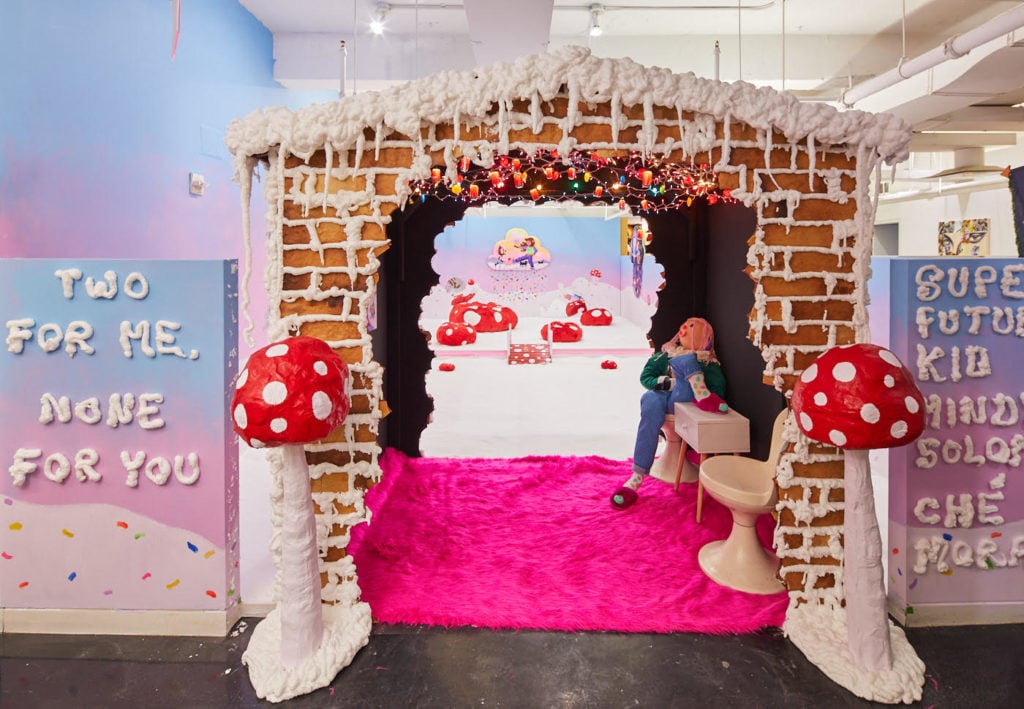
“Super Future Kid – Two for Me,
None for You: A Narrative on Excess and Wishful Thinking,”
curated by Mindy Solomon Gallery, Miami, and Ché Morales.
Photo by Sam Sachs.
Steffi “Super Future Kid” Homa has turned her corner of
SPRING/BREAK into a candy-colored fantasy land that guests enter
through a giant gingerbread house, built from 300 cookie bricks and
expanding polyurethane foam “icing.”
The artist, who conceives of her surreal paintings as sort of
emotional self-portraits, created all new work for the occasion,
inspired by the medieval poem “The Land of Cockaigne.”
“It’s a meditation on excess and abundance and how this belief
in the possibility of abundance can bring hope,” gallerist Mindy
Solomon told Artnet News.
The gallery enlisted curator Ché Morales, a SPRING/BREAK veteran
known for presenting immersive installations, to help design the
booth, which features toadstool beanbag chairs and a bright red
bridge over a pink stream. Adding to the feeling of bounty, the
floor has been covered with 2,500 pounds of salt, which reads as
sugar in Super Future Kid’s candy land paradise. Her paintings are
priced between $4,500 and $8,000.
“Jeila Gueramian: Belly of the
Beast”
curated by Sidel & McElwreath
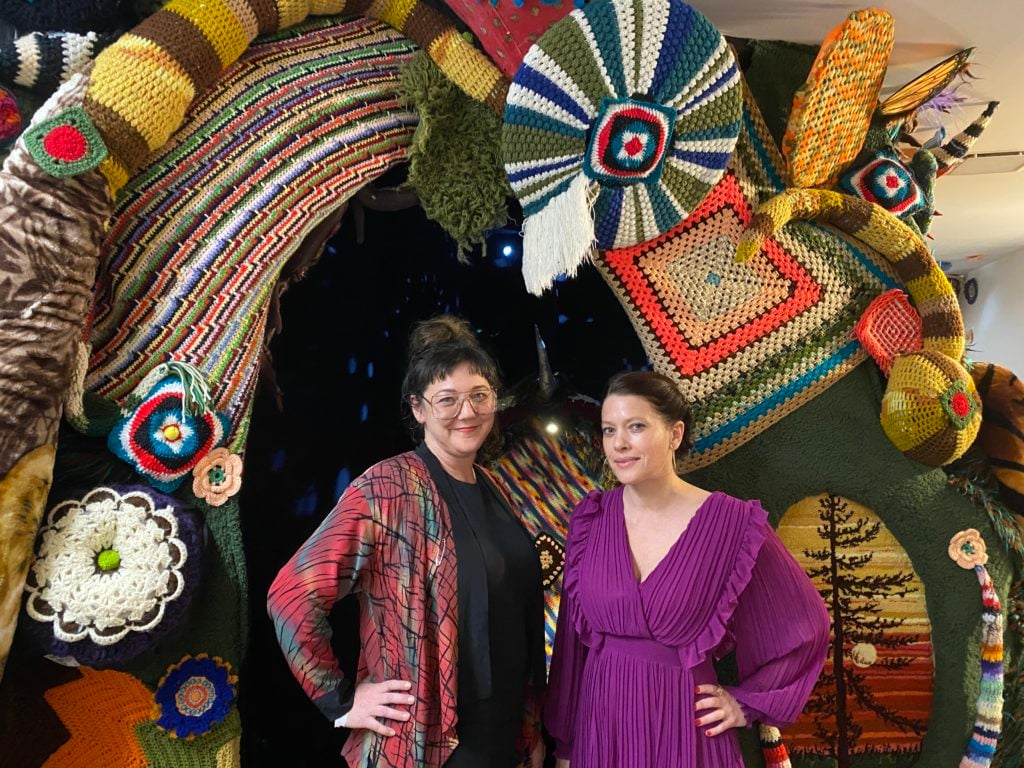
Artist Jeila Gueramian and curator Emily
McElwreath with “Jeila Gueramian: Belly of the Beast,”
curated by Sidel & McElwreath at SPRING/BREAK 2020. Photo by Sarah
Cascone.
At the entrance to the fair’s 10th floor, you can’t miss Jeila
Gueramian’s massive crochet installation Belly of the
Beast. The piece is a cacophony of pattern and color that
opens up to a darkened cave where you can sit in a cozy swing. It’s
an opportunity to get away from the stress of the fair, if only for
a moment.
“It’s a womb-like space have a meditative experience within this
excess,” co-curator Emily McElwreath told Artnet News.
Gueramian went to art school, but only recently returned to
making work after starting to raise her children. “I came to this
through craft, just making things for my family,” she said. “I
decided to merge the two worlds.”
In a commentary on waste, the artist incorporates found textiles
into the work, giving fabrics a second life. The work is
site-specific, but could be reconfigured to suit any space, should
you wish to buy it for a cool $25,000.
“Jen Dwyer: Dreamer’s Delight”
curated by Lauren Hirshfield
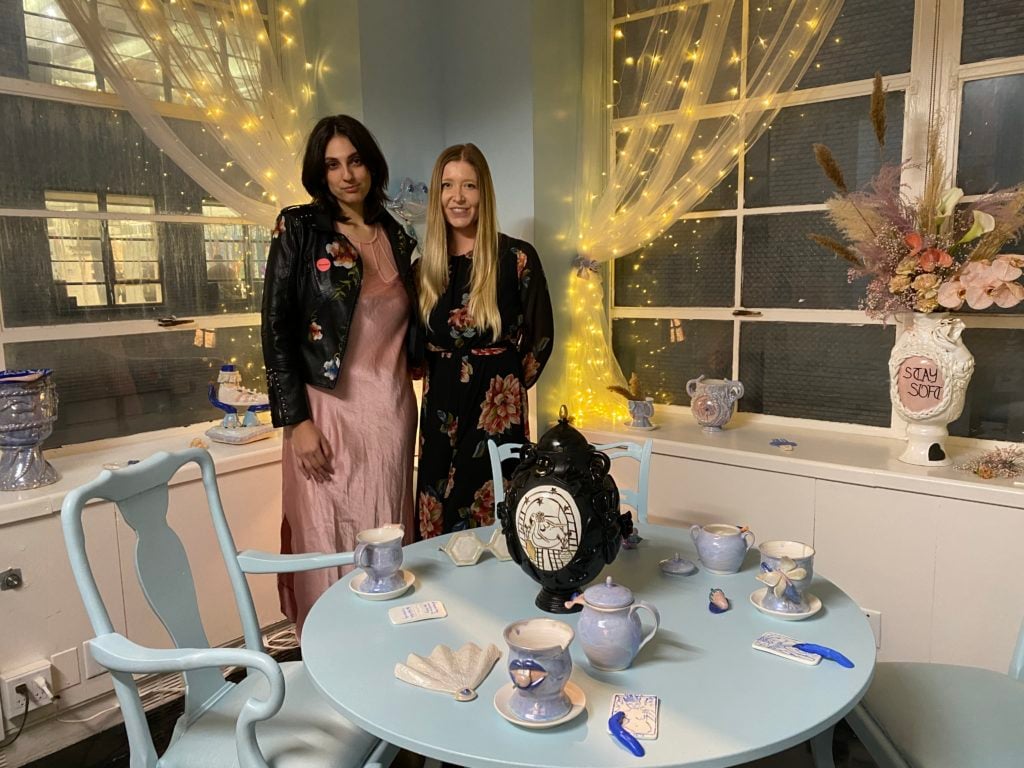
Artist Jen Dwyer and artist Lauren
Hirshfield with “Jen Dwyer: Dreamer’s Delight” at SPRING/BREAK
2020. Photo by Sarah Cascone.
Growing up in Oakland, Jen Dwyer saw a lot of ceramic art. “I
didn’t realize until I was in my 20s that it was considered a minor
art form,” she told Artnet News. Now, her work in the medium looks
to shatter gender hierarchies.
Her booth at SPRING/BREAK harkens back to the age of rococo,
presenting her ceramics in a beautiful parlor space, table set for
an elegant afternoon tea. “During the rococo period, porcelain was
called white gold,” said Dwyer, pointing out how well the
historical opulence ties into the fair’s theme of excess.
“We wanted to challenge that notion of ceramics as a lower value
object,” added curator Lauren Hishfield, who has priced the work at
$150–2,000.
Though the space is feminine and beautiful at first blush, a
closer inspection reveals quirky, unsettling details, like the
disembodied, witchy-looking blue finger on the tarot cards at each
place setting, or the sprawling, cartoon-like female nude on the
ornate vase centerpiece.
“Kate Klingbeil:
Burrowed”
Rachel Frank, Kristen Racaniello, and Jacob Rhodes for Field Projects
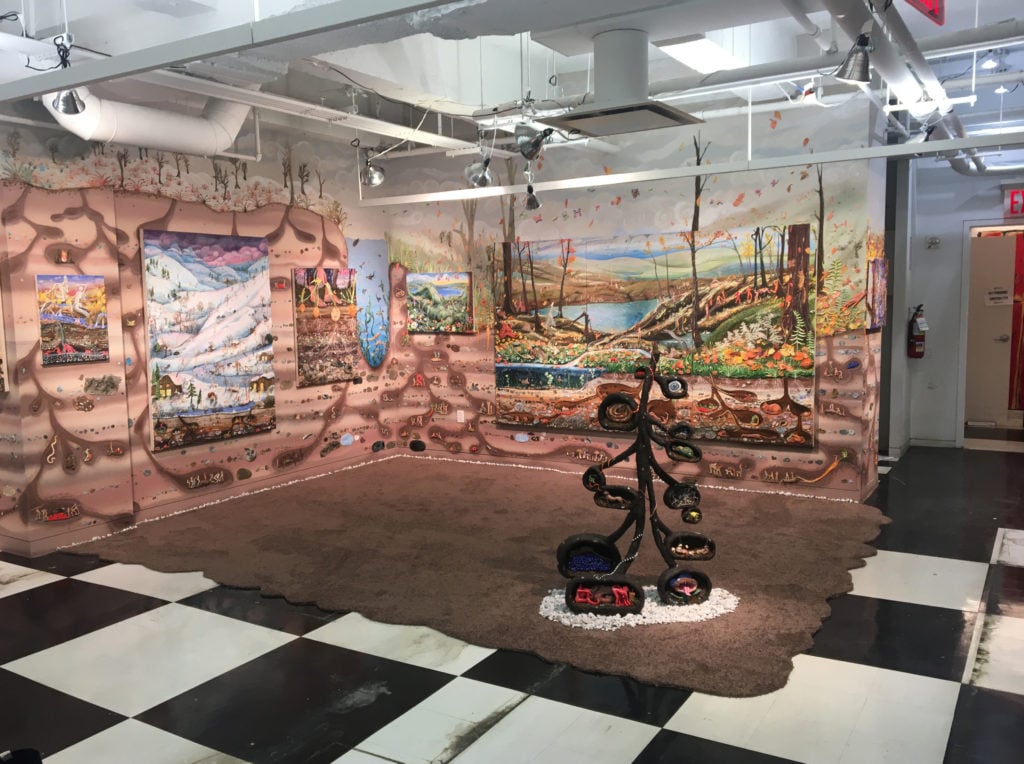
“Kate Klingbeil: Burrowed” curated by
Rachel Frank, Kristen Racaniello, and Jacob Rhodes for Field
Projects at SPRING/BREAK 2020. Photo courtesy of Field
Projects.
Kate Klingbeil’s paintings already leap off the canvas,
populated with sculptural elements she makes from molding paste and
acrylic paint.
At SPRING/BREAK, she’s extended that approach to the entirety of
her booth with a 3-D mural that transports the viewer underground,
to the secret world of ants, roots, and small burrowing
mammals.
“I was doing this residency and you had to do 12 hours of
physical labor,” Klingbeil said of her inspiration. “I was doing a
lot of digging in the dirt.”
She sees the underground as an unappreciated wellspring of life.
“The female energy is a big part of the work,” Klingbeil
added.
The booth was fast on its way to selling out during the fair’s
VIP hours, but Klingbeil’s mural, at least, will live on. The
artist will reuse the sculpted elements, returning them to her
cache until the opportunity arises to incorporate them into another
canvas, each painting almost serving as a backdrop for an elaborate
choreographed dance.
“I have a large collection that I pull from—it’s constantly
evolving,” she explained. “Each work is essentially a collage made
out of paint.”
“Jessica Lichtenstein: …Do They Make a
Sound?”
curated by Indira Cesarine for the Untitled Space, New York
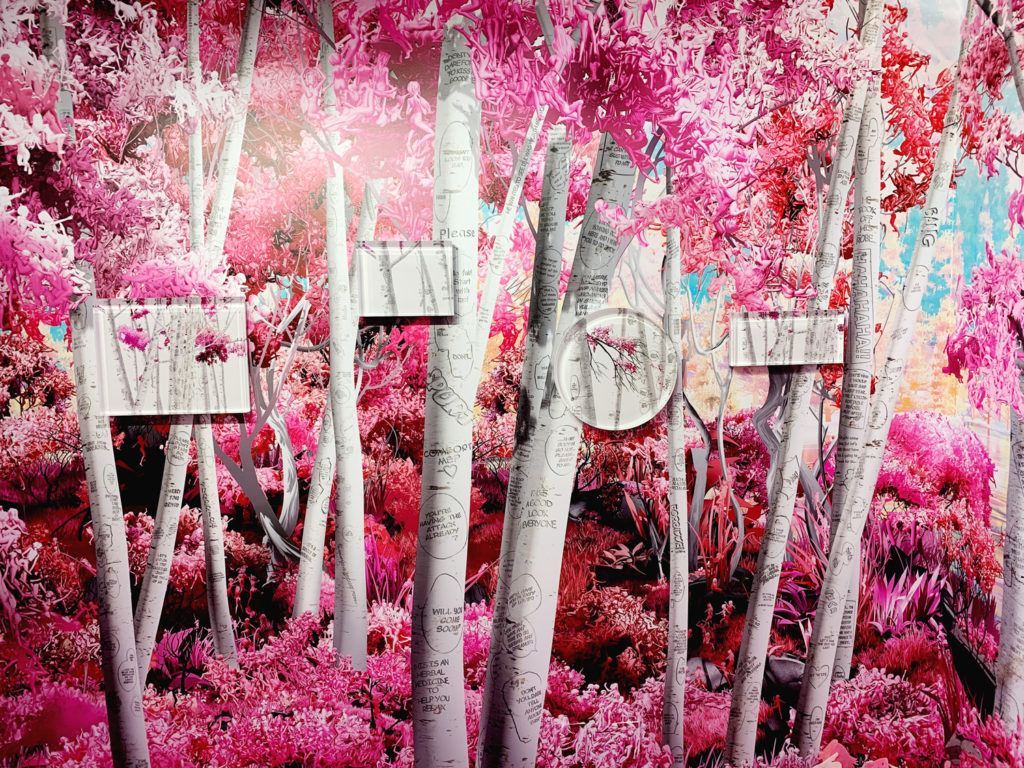
“Jessica Lichtenstein: Do They Make a
Sound?” curated by Indira Cesarine for the Untitled Space at
SPRING/BREAK 2020. Photo courtesy of the Untitled Space.
Jessica Lichtenstein may have the most Instagram-friendly booth
at the fair, with pink leaves piled up on the floor against a
backdrop of white birch trees with pink foliage reflecting in a
serene lake. But look a little closer, and you’ll see there’s a
deeper message.
Each leaf in the digitally painted scene is actually a woman’s
body, a 3-D model that Lichtenstein has posed in thousands of
positions, falling from the trees to the ground below. She was
inspired by the old saying “if a tree falls in a forest and no one
is around to hear it, does it make a sound?” The question
Lichtenstein poses harkens back to the old problem of
he-said-she-said—if a man and a woman have an intimate encounter
and come away with two different stories about what happened, who
do you believe?
On each tree, the artists has written relevant messages,
replacing carved initials with quotes about women from pornography,
Donald Trump, Harvey Weinstein, and even romantic poetry. “These
are the mixed messages we’re sending to each
other,” Lichtenstein said.
Though Lichenstein works on a computer, she hand-dyed and cut
the mulberry paper “leaves”—also in the shape of female
silhouettes—that add an interactive element to the space, which
decorates both the walls and floor. Smaller versions of the scene
are available for sale in the form of acrylic face mounted
prints, priced at $800–3,600.
It’s the artist’s biggest installation to date—she’s done
wallpaper before, but “this is the first time I’ve done the whole
floor, leaves, a room that I don’t want to leave ever!”
“Ali Shrago-Spechler: Eine Friedliche
Industrie”
curated by Tahl Mayer
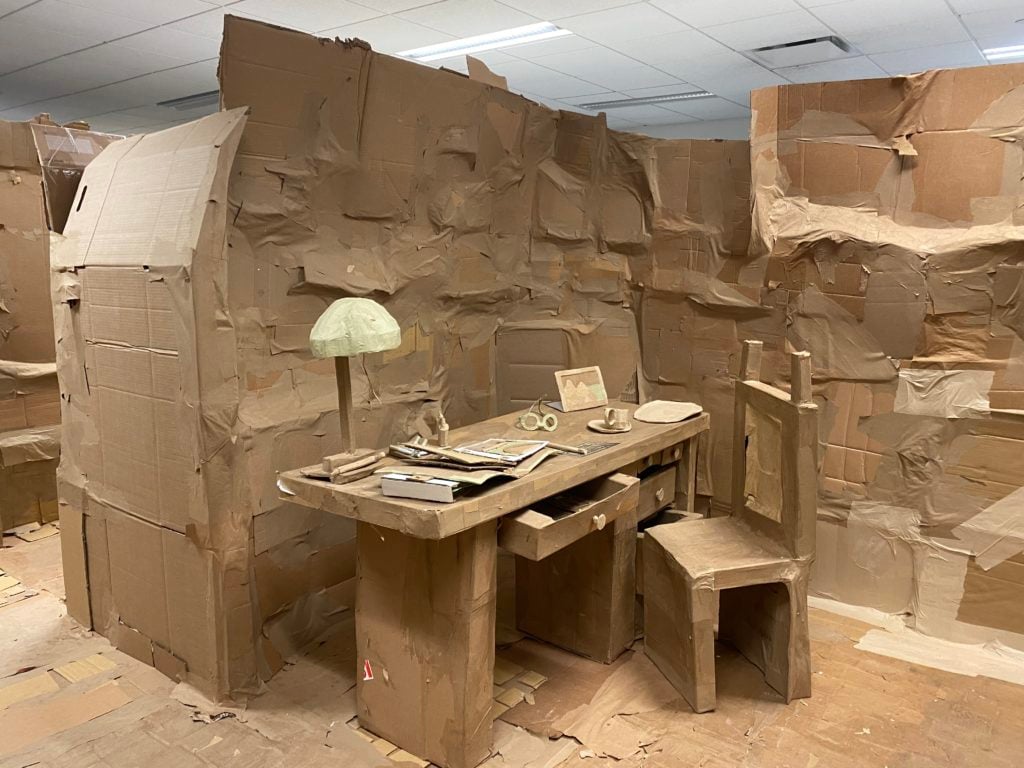
“Ali Shrago-Spechler: Eine Friedliche
Industrie”
curated by Tahl Mayer at SPRING/BREAK 2020. Photo by Sarah
Cascone.
Ali Shrago-Spechler trained as a painter before moving into
sculpture and performance art. Now, cardboard and papier-mâché
represents yet another new direction for the artist. “We had moved
and there were tons of boxes,” curator Tahl
Mayer, Shrago-Spechler’s husband, told Artnet News. “Rather
than letting it go to waste, she started to play with it.”
At SPRING/BREAK, the artist has built an entire cardboard
environment in which to house her sculptures, creating a maze
inside former cubicle spaces. Shrago-Spechler envisions the
installation as a period room, imagining what her Jewish family’s
home in Karlruhe, Germany, might have looked like before they fled
for the US in 1938.
Shrago-Spechler’s grandmother always refused to talk about life
in the old country. With this patchwork of cardboard, she’s
rediscovering her family’s past, Mayer said.
“She’s constructing this using her own memory and through
research.”
The works start at just $200—”we honestly struggled with how to
price cardboard!” said Mayer.
“Bobby Anspach: Place for Continuous
Eye Contact”
curated by BRIC, Brooklyn
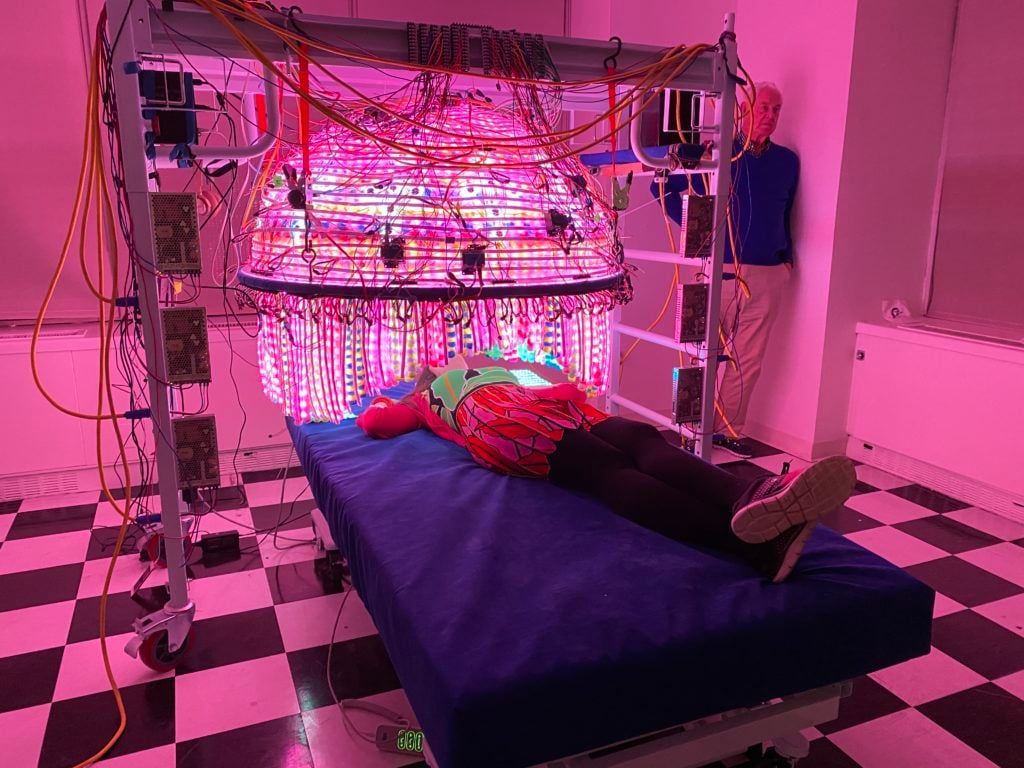
“Bobby Anspach: Place for
Continuous Eye Contact” curated by BRIC, Brooklyn, at SPRING/BREAK
2020. Photo by Taylor Maatman.
Don’t be alarmed by the somewhat clinical feel of Bobby
Anspach’s installation Place for Continuous Eye Contact.
The interactive artwork requires lying down on a hospital bed to
view it, but don’t worry, you won’t be undergoing medical testing.
The piece is designed to induce a deep meditative state by gazing
into a mirror, staring continuously at your own eye for three and a
half minutes. (Yes, you’ll have to wait in line to check it
out.)
Anspach first became intrigued by the strange effects of
continuous eye contact during an acid trip, and then became aware
of Eastern traditions of eye contact meditation. His series
of Continuous Eye Contact works—which you may have
spotted at SPRING/BREAK’s 2018 edition or at last
year’s Portal: Governors Island—seek
to heighten the experience with a score commissioned from composer
Eluvium, a pulsating light show, and by filling the rest of one’s
field of vision with brightly colored pom poms.
The piece, which Anspach estimates features some 4,000 LED
lights and 10,000 pom poms, is for sale for $100,000.
Valery Estabrook, “The
Impeachmint”
curated by Ambre Kelly and Andrew Gori
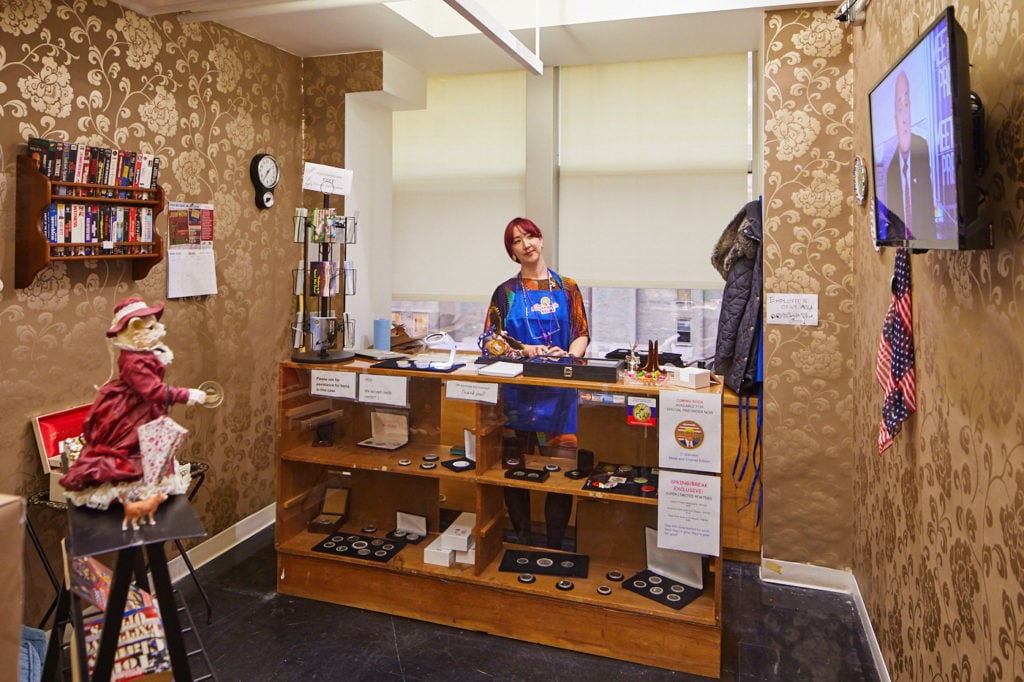
Valery Estabrook, “The Impeachmint”
curated by Ambre Kelly and Andrew Gori at SPRING/BREAK 2020. Photo
by Sammy Morgan Photography.
SPRING/BREAK veteran
Valery Estabrook is serving double duty at this year’s fair,
curating a booth by Kat Ryals while presenting her own project “The
Impeachmint.” Since 2018, Estabrook has been designing and
manufacturing commemorative coins to immortalize the misdeeds of
President Donald Trump and his administration.
She was inspired by Trump’s apparent fascination with making his
own commemorative coins, which you can buy on the White House gift
website (there was even one made for a North Korean peace talk
that saw the US walk away from negotiations). “These coins are
basically pure propaganda,” Estabrook told Artnet News.
Her concern was that with the current 24/7 news cycle, “every
two weeks there’s a new scandal and the last scandal gets buried.”
Estabrook wanted to make a “literal, material, factual record of
events that can’t be ignored.”
To that end, there is no commentary on the coins, just factual
descriptions of actual events, like a coin that lists every single
lie told on the job by former White House press secretary Sarah
Huckabee-Sanders, or another that lists the Trump campaign
operatives, including Donald Trump Jr., Paul Manafort, and Jared
Kushner, who attended that infamous Trump Tower meeting with
Russian operatives looking to undermine Hillary Clinton’s
campaign.
You can buy the full set of “Impeachmint “coins for $1,200, or
individual ones from $90 to $250.
It was Gori and Kelly’s idea to present the work in an
installation format. “I thought the most natural setting would be a
collectible shop,” said Estabrook, who designed the store to feel
like small town America, dusty and dated. She’s carefully
considered every detail—even the video tapes for sale are clues to
her feelings about Trump, with titles
like Clueless.
“Alonsa Guevara: Alumbrados por la Misma
Luna (Lit by the Same Moon)”
curated by Anna Zorina
Gallery, New York
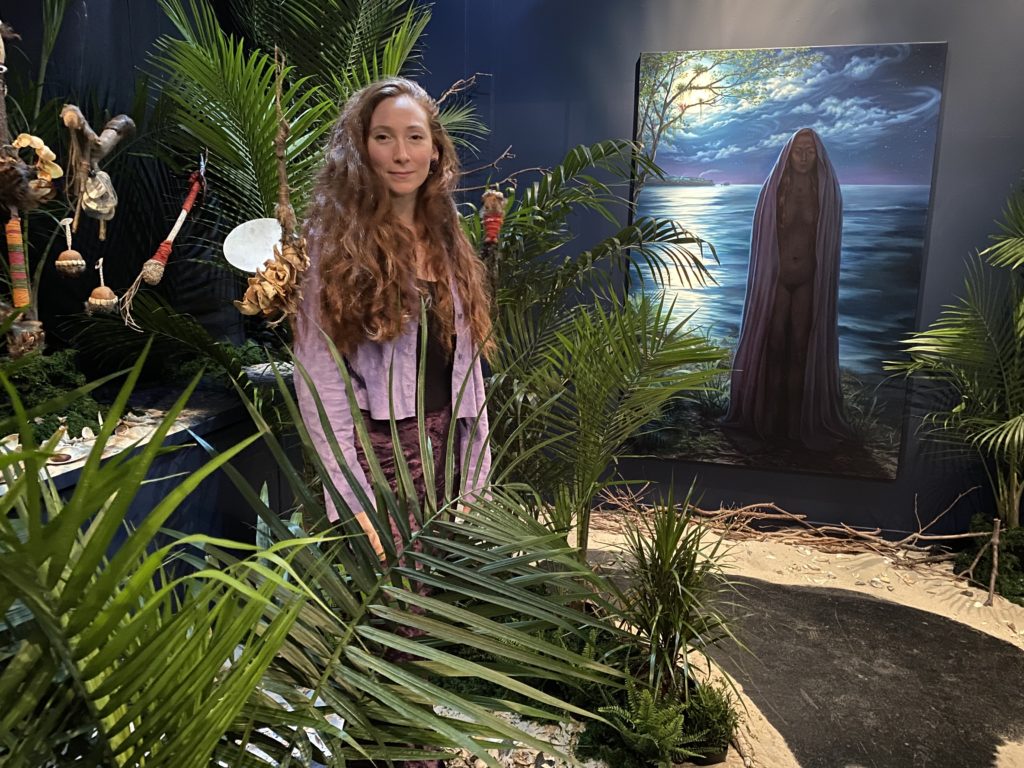
Alonsa Guevara with her installation
“Alumbrados por la Misma Luna (Lit by the Same Moon),” curated by
Anna Zorina Gallery, New York, at SPRING/BREAK 2020. Photo by Sarah
Cascone.
Born in Chile and raised in Ecuador, New York-based artist
Alonsa Guevara has drawn on childhood memories for her SPRING/BREAK
installation, which transforms a drab Midtown office into a moonlit
jungle on the edge of the ocean, with palm trees, sand and
seashells surrounding her paintings. The artist has covered the
windows with black fabric, save for a single cutout that allows the
light of the presentation’s titular “moon” to shine through.
“I thought SPRING/BREAK would be about the excess of the
contemporary world, but this is the natural excess that I think
people should embrace,” said Guevara.
Her paintings range from $1,500 to $22,000, topping out with a
large-scale self portrait. But Guevara wants her figures, seen in
the darkness under moonlight, to read as universal. “There’s more
of a tribal feeling, and they all blend with nature world,” she
explained. “It means we’re all the same, in the end.”
The SPRING/BREAK Art Show NYC will be on view at 625
Madison Avenue, New York, March 4–9, 2020.
The post Here Are 9 of the Most Wildly Creative Ways That
Artists Transformed an Office Building Into an Art Wonderland for
SPRING/BREAK 2020 appeared first on artnet News.
Read more https://news.artnet.com/market/spring-break-art-show-2020-installations-1793235
Further reading


Leave a comment