
TEFAF Is Full of Handsomely Appointed Booths and Marvelous Objects. But the Specter of the Coronavirus Loomed Over Its Opening Hours
Call it the TEFAF tap.
Instead of shaking hands at this year’s edition of the European
Fine Art Fair, some people—just a few, admittedly—were literally
rubbing elbows to avoid even the possibility of transmitting the
coronavirus during the event’s opening hours.
Yet despite a few jokes to lighten the mood, the annual fair in
Maastricht opened to thinner crowds than usual on its highly
anticipated VIP preview day, March 5.
“It’s not that it’s empty. There are people here,” one
dealer was overheard complaining on his cell phone. “It just
doesn’t feel like opening day.”
But as the day went on, attendance grew steadily.
“It looked very different at 11 a.m.” when the door opened,
TEFAF chairman Nanne Dekking conceded in an interview with Artnet
News. “It was very quiet.” But he and dealers were happy to see
that change over the course of the next few hours.
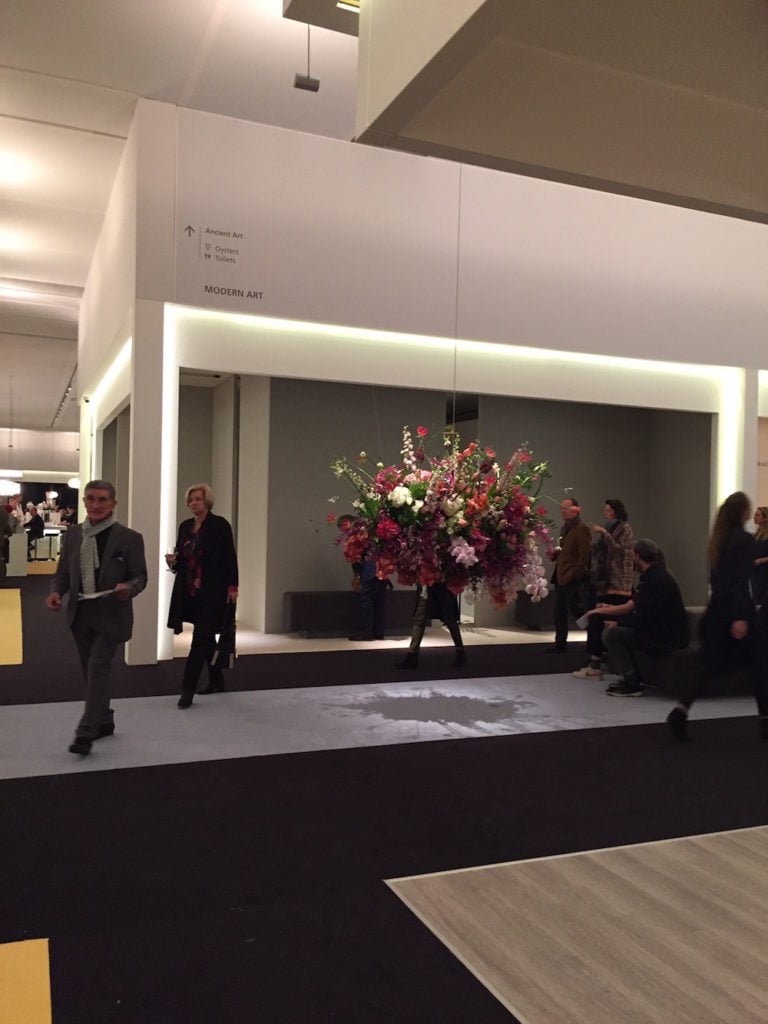
The TEFAF booth reserved for New York
dealer Fergus McCaffrey, one of three exhibitors who withdrew from
the fair. Photo by Eileen Kinsella
Taking Precautionary Measures
A representative said 4,000 people attended the opening
preview—a decrease of more than 27 percent from the 5,500 who came
last year. But considering the circumstances, perhaps it’s not such
a huge drop.
Along with an abundance of wine and canapés—and the famous
oyster shuckers who rove the aisles—there were plenty of vials of
hand sanitizer and posted signs outside the exhibition venue with
information about COVID precautions.
On Monday, March 1, the fair said it had received confirmation
from local and national authorities that the event could
“responsibly go ahead.” Representatives said they were taking
“extra precautionary measures,” such as adding “all-day cleaning
services” to the event. BMW drivers ferrying VIPs to and from
the fair were also doing twice daily car cleanings, a driver told
Artnet News.
Still, three galleries—admittedly a tiny component of the
sizeable group of 285 exhibitors—ultimately withdrew from the show.
These included one Paris exhibitor, Galerie Monbrison, and two New
York dealers, Wildenstein & Co. and Fergus McCaffrey.
The withdrawals happened late enough that their names still
appeared on the fair’s floor plans, and their booths were enclosed
by blank walls with benches placed out in front.
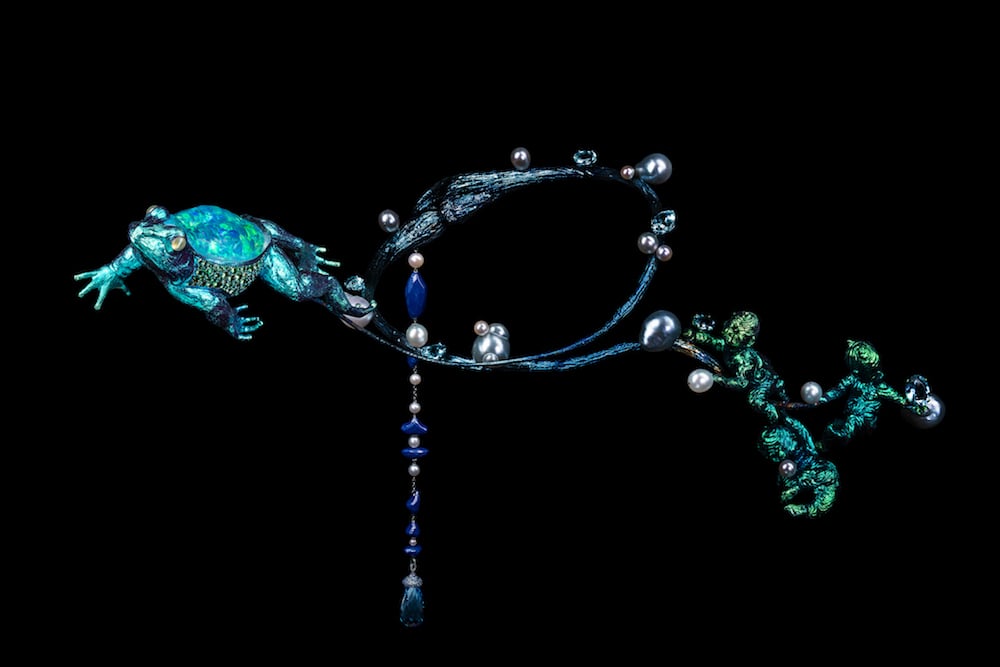
Wallace Chan, Flying Frog
necklace (2019). Image courtesy Wallace Chan.
Handsomely Appointed Booths
But overall—and as much as was possible considering the
situation—it was business as usual, with stunning displays of
Old Master paintings, works from antiquity, and examples of modern
and contemporary art, design, and jewelry.
Booths, as usual, were often thoughtfully customized. The London
specialty jeweler Didier Ltd., for example, presented a booth
titled “The Jeweler’s Guide to the Galaxy: 42 Years of Atomic
and Space Age Jewelry,” surveying items made between 1945 and 1987
in handsomely designed domes. The exhibition highlighted
unique works by Louise Nevelson that looked like miniature versions
of her signature chunky black artworks.
And Belgian dealer Axel Vervoordt pulled out the stops with a
buzzed-about booth sporting a custom-designed wood floor. The items
in the stand ranged from an ancient stone wall-hung relief, to a
chaise lounge made of bricks by Per Kirkeby, presented alongside a
painting by Gutai artist Kazuo Shiraga. As usual, the dealer made
his display of widely ranging works appear seamlessly
beautiful.
Other highlights of this year’s edition include an early Van
Gogh painting at Dickinson, Peasant Woman in Front of a
Farmhouse, from 1885. The work was rediscovered at an antique
shop in Hampstead, England, in 1968, where it was acquired for £45
and subsequently authenticated as a signature work by the
artist.
And London’s Weiss Gallery was showing Venus and Cupid with
Mercury and Psyche—An Allegory (circa 1600), a newly
discovered oil-on-canvas picture by Bartholomeus Spranger thought
to have been an imperial commission for Rudolf II, Holy Roman
Emperor from 1552 to 1612.
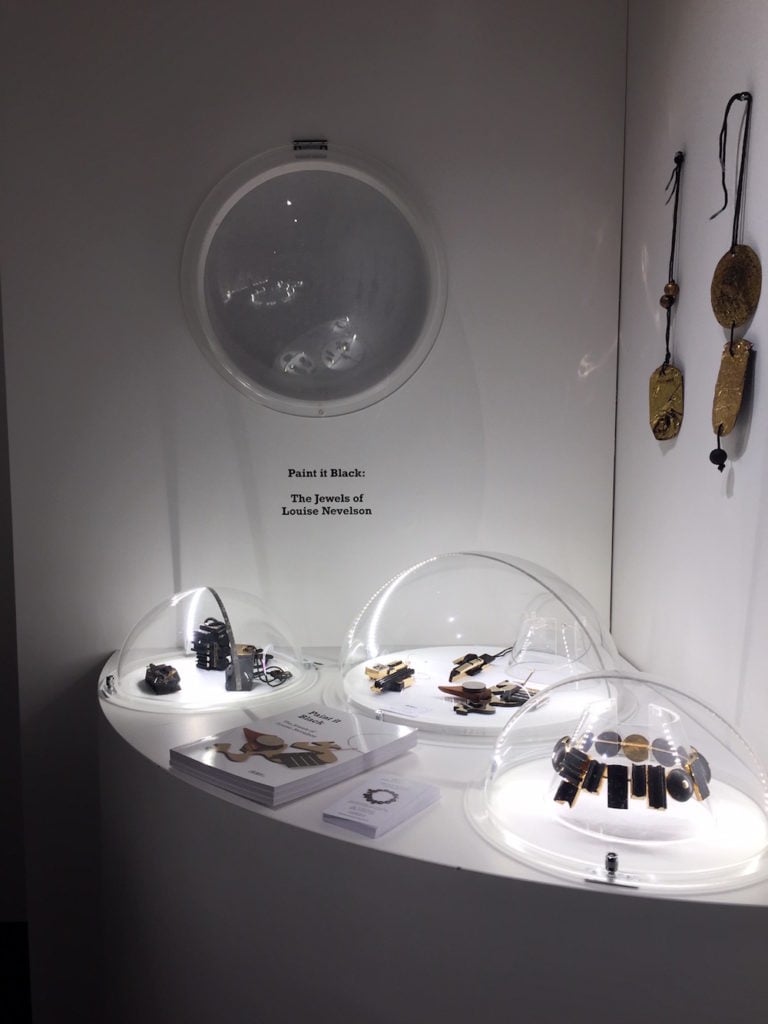
“Paint It Black: The Jewels of Louise
Nevelson” at Didier Ltd. Photo by Eileen Kinsella
And the Sales Roll in…
And collectors, in the end, did come to buy.
“The people who came are very committed,” Dekking said, adding
they didn’t come just “to have a glass of champagne.”
Early sales reports, while not as robust as in previous years,
appeared to confirm this. London’s Thomas Gibson Fine Art sold
a two-sided Alberto Giacometti drawing, Tete
(1964–65), with an asking price of $185,000.
Tomasso Brothers Fine Art reported three six-figure sales from
their eye-catching booth, which included a Northern Italian
bronze from the first quarter of the 16th century, priced in
the range of €950,000 ($1.06 million); a 17th-century Italian
Bust of a Moor, which had an asking price of €375,000
($419,000); and a circa 1720 French bronze for about €175,000
($195,000). In the works on paper section, British dealer James
Butterwick sold a 1916 self portrait by Alexander Bogomazov to
Holland’s Kröller-Müller Museum, for an undisclosed price.
Of course, there were some difficulties.
Cherry Rao, a representative for bespoke jewelry designer
Wallace Chan, who is based in Hong Kong, told Artnet News it was a
challenge preparing for the fair due to the situation back
home.
Chan’s elaborate Flying Frog necklace, which had been on display
for the past year at Naturama, the natural history museum in
Svendborg, Denmark, was among the fantastical jewels in the
dealer’s elaborately staged and lit booth.
But by the second day of the event, Rao said: “We have been
really pleased with the turn out at Wallace Chan’s booth so far
this year, despite initial concerns over coronavirus.
The post TEFAF Is Full of Handsomely Appointed Booths and
Marvelous Objects. But the Specter of the Coronavirus Loomed Over
Its Opening Hours appeared first on artnet News.
Read more https://news.artnet.com/market/tefaf-fair-quiet-coronavirus-fears-1795797
Further reading


Leave a comment