
How to Understand the ‘Millennial Aesthetic’ + Two Other Thought-Provoking Things to Read (or Watch) From Around the Art Web
Every week, we scan the media for illuminating essays,
conversations, and anything else that offers valuable new ways of
thinking about art. Up this week: taxonomizing the “millennial
aesthetic,” a provocative discussion about reforming museums, and
an effort to bring some very old film back to life.
“Will the Millennial
Aesthetic Never End?” by Molly Fischer, New
York
A great example of how naming a style is a way of trying to kill
it. Fischer’s essay surveys the cloying tropes that have come to be
the default design grammar of the last few years, from home decor
to subway ads to political logos, and throws a splash of critical
acid on them.
What characterizes the “millennial aesthetic,” in her telling?
It’s not just pinks and pale greens—though it is definitely pinks
and pale greens—or potted plants and breast-themed throw pillows,
empowerment-speak in ad copy and sans-serif fonts—though it is
definitely those too.
The word cloud of key terms in this article gives you the more
general sensibility: “gentle,” “enticing,” “placid,” “friendly,”
and “knowing.” The “millennial aesthetic” favors “chatty
positivity”; it likes “blank, clean surfaces” and soft lines; it is
“casual, friendly, and impersonal.” It’s offbeat but not weird,
while also being sexless and slightly infantilizing.
There’s a hint of a very twee bunker mentality, seeking the
mental shelter of the inoffensive and non-judgmental. I’ve actually
talked about a similar phenomenon in
relation to the craze for Instagram Trap pop-up environments
like the Museum of Ice
Cream. They’re easy to mock for their aesthetic of slightly
sedated positivity, but you can probably read their appeal to the
purely affirmative as pointing to background currents of anxiety
that are running through the culture.
Art doesn’t really figure into Fischer’s account (though she
does reference cool artist Sara Cwynar’s video Rose Gold (2017), which looks
at a rose gold iPhone as an artifact of taste destined to become a
relic of its time). Since art is by definition trying to set
itself off against the background of mass-marketable basic-ness, it
is going to exist in some kind of suspension, assimilating bits of
the dominant design language and at the same time pushing against
it.
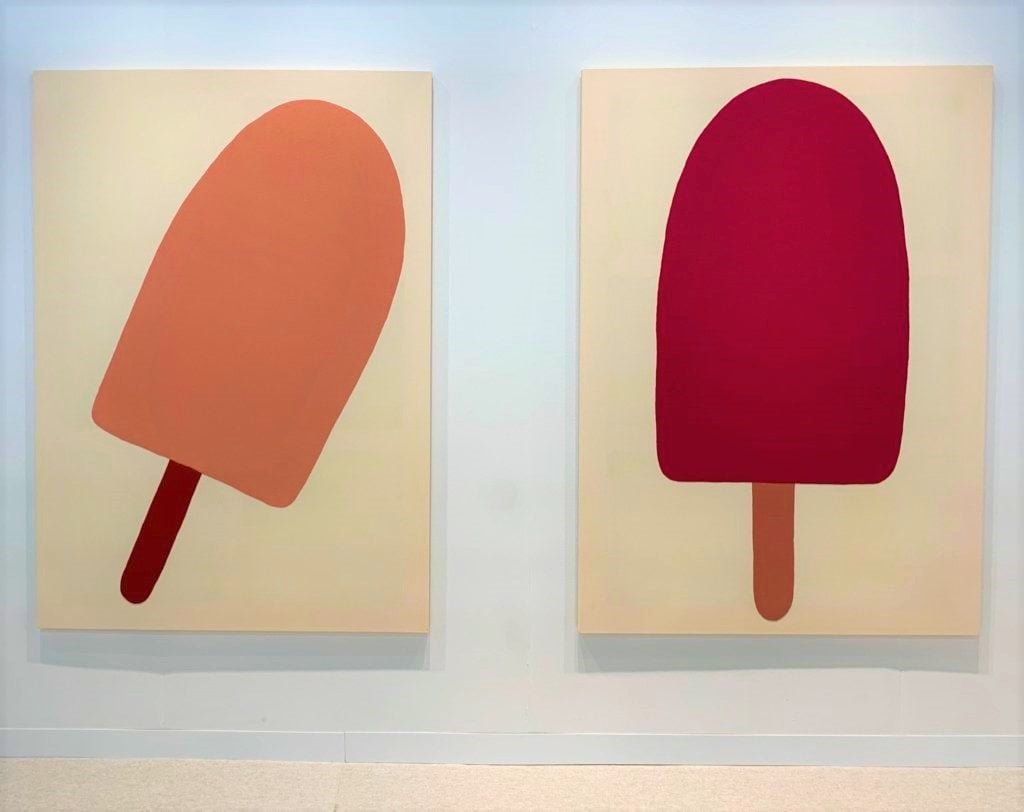
Adelaide Cioni, Go easy on me, one
pink with red stick and Go easy on me, one red with pink
stick (both 2020). Image courtesy Andrew Goldstein.
Still, Fischer’s “millennial aesthetic” idea does offer a lens
through which to look at the recent turn to easygoing cartoon
figuration and slogans of affirmation in contemporary art. Heck, of
the five best-of “picks” that my colleague Andrew Goldstein
named from this
week’s Armory Show, two—Celeste Rapone’s whimsically distorted
figuration and Adelaide Cioni’s big popsicle paintings—could
credibly fit the bill.
“Why Are Museums So
Plutocratic, and What Can We Do About It?” by Michelle Millar
Fisher and Andrea Fraser, Frieze
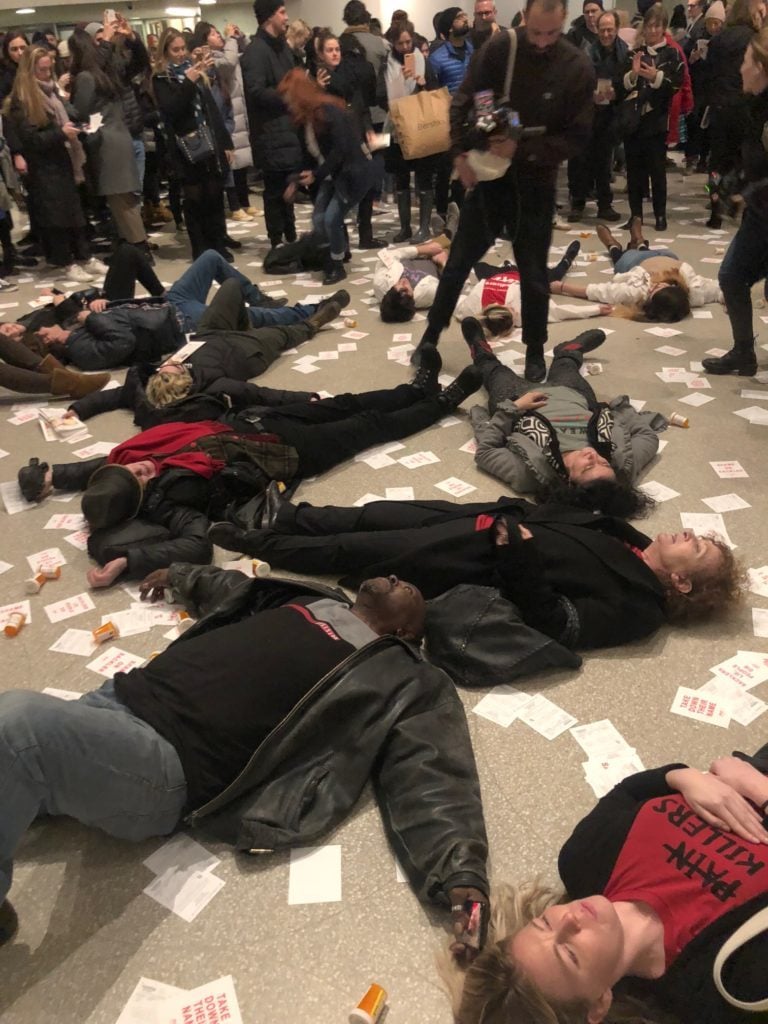
Protesters at the Guggenheim Museum
stage a “die-in” to protest Sackler funding. Photo: Caroline
Goldstein.
Fisher, the founder of the Art + Museum Transparency Group, and
Fraser, the important institutional critique artist, sat down for a
long, detailed talk in the most recent issue of Frieze
about the current wave of debate
about the politics of museums. It’s a good exchange for the way
that Fisher gives a sense of the personal and professional dynamics
fueling the increasing unrest inside museum staffs, while Fraser
keeps a sober focus on trying to come up with workable ideas
that might actually move the ball forward in terms of making museum
governance less plutocratic.
“Protest is an indispensable element of this, but transforming
organizational governance can’t just be about getting a few
toxic trustees off boards, which implies that the system is okay
without them,” Fraser concludes. “It has to be about demanding
a seat at the table.”
“A Trip Through New York City in
1911”
There’s a mini-trend in my YouTube feed right now of clips from
the earliest days of cinema, augmented with AI to boost the quality
to contemporary levels, a low-key eerie effect. In this case, a
1911 clip by the Swedish company Svenska Biografteatern gets the
treatment (and experimental colorization too, though the effect is
patchy). The result gives a charmingly vivid taste of the leisurely
street life of the Big Apple 110 years ago, with kids ambling in
the streets and horse-drawn carriages competing with early
cars.
But that’s not what I wanted to talk about. Scrolling the
comments, I came upon someone who had taken the time to track down
background on the people we were looking at in the long-ago
film—filling out the clip in another way. Here’s the comment:
In one scene of the video there is a well to do looking family
being driven around by a chauffeur. The license plate on the car
can be clearly seen as 65465, so I wondered if I could identify
them through this little piece of information.I learned through the Federal Highway Administration that there
were 81,370 auto-mobiles registered in NY by 1911. I also learned
registration was published publicly and quickly found a listing for
license plate 65465 in the Brooklyn Life Magazine showing a June
12th, 1911 registration E.M.F. – Mrs. Lochwicz 548 Eighth Street.
The car in the video definitely looked like a 1911 E.M.F. Model 30
Touring Car, so I tried to find the family in the 1910 census and
was able to find them living at 548 Eighth Street. The household
consisted of six people; Head of house Florian Lochowicz, his wife
Antoinette Lochowicz (listed as Antonie in the census), their
children Francis, Emily, and Elsie, and a servant named Mary
Moriarty.Florian Lochowicz was born in Posen in 1871 and immigrated to
America in 1890. His wife Antoinette was a distant cousin of his
and she was the daughter of Konstantyn Cornelius Lochowicz and
Julia Hectus. Konstantyn had immigrated in 1864, possibly due to
the January Uprising in Poland. Florian worked as a barber and
became very prominent because J.P. Morgan was patron of Florian’s.
Florian died unexpectedly in 1918 but was worth $70,000 at the time
of his death. His wife continued running the Barbershops into the
1950s and still lived at their Brownstone home in NYC at 548 Eighth
Street.
(You can see a video explaining the full story from Jarrett
Ross, aka the GeneaVlogger, here.)
There’s not really a punchline to this minor find. I guess I
like less what it actually reveals, and more just how the pinpoint
of biographical data throws into relief my sense of the pathos of
the clip, as capturing a world that’s passed away into
fragments.
The post How to Understand the ‘Millennial Aesthetic’ + Two
Other Thought-Provoking Things to Read (or Watch) From Around the
Art Web appeared first on artnet News.
Further reading


Leave a comment