
What Did Inigo Philbrick Do? How One Precocious Dealer Allegedly Swindled the Art Market’s Savviest Players Out of Millions
A version of this story first
appeared in the spring 2020 Artnet Intelligence
Report.
It was late 2018 and Karen Boyer, a Miami-based art advisor, was
over the moon.
She had just received an email from a young London-based art
dealer by the name of Inigo Philbrick announcing that he would
launch a second location of his eponymous gallery in a somewhat
unlikely place: Miami’s Design District.
“There are almost no blue-chip galleries in Miami, and he was a
very prominent, seemingly successful secondary-market dealer,”
Boyer said. Having run into Philbrick over the years at VIP
openings and spotted him comfortably bidding on seven-figure works
at auction, “I thought this was a big plus for Miami.” Philbrick
told her via text that he had signed a seven-year lease.
Less than a year later, both his Miami and London spaces have
closed. Packages sent to the galleries return unopened. And
Philbrick himself—once an omnipresent figure at art-market events,
usually sporting a five o’clock shadow, a tailored Italian suit,
and a shirt with the top two buttons unbuttoned—has vanished.
In his wake, he has left a growing pile of
lawsuits claiming he sold the
same works to multiple clients and defaulted on loans he
secured using art he didn’t own as collateral. Now, disgruntled
former business associates are trying to seize
his personal assets,
which filings suggest could amount to as much as $70 million, as
well as $150 million from his business.
How was a young dealer able to deceive some of the most
sophisticated collectors in the world—beginning when he was just a
few years out of university? And what does his precipitous rise and
even more dramatic fall tell us about the state of the art
market?

Inigo Philbrick allegedly scammed
high-flying art collectors around the world. Photo collage: Artnet
Intelligence Report.
The story of Inigo Philbrick is the story of a man who,
depending on whom you talk to, is either a well-intentioned and
ambitious dealmaker who got in or over his head or a vain grifter
who preyed on investors gullible enough to hand over money and
art.
Regardless of which Inigo Philbrick you pick, one thing is
clear: he was able to operate because the art market, for a long
time, supported him—and because his aggressive tactics, before they
got out of control, were celebrated and even envied by the very
people he exploited.
Interviews with Philbrick’s clients and associates, a thorough
examination of the lawsuits against him, and a review of his
company’s own records reveal that Philbrick is very much the
product of a system that thrives on opacity—one that is full of
profiteers making deals through offshore shell companies, buying
art for no other reason than to flip it for a profit, and relying
on a paucity of regulation to operate unchecked.
Only in this sort of system could a player like Philbrick—a
middleman who had no relationships with artists and few with actual
collectors who buy art to hang in their homes—get as far as he
did.
Friends in High Places
Among those stunned by Philbrick’s downfall is his former boss,
Jay Jopling, the founder of London’s prestigious White Cube
gallery. Philbrick started there as an intern in 2010 at just 23
years old and quickly rose in the ranks to lead Jopling’s
secondary-market business.
“He struck me as a smart, ambitious young man with a good eye
for art and an impressive commercial sense,” Jopling said in an
email. When Philbrick “decided to launch his independent career in
2013,” Jopling continued, “I agreed to support him
financially.”
The pair continued to do business until Philbrick’s house of
cards began tumbling down last year—and now Jopling is one of
numerous players jostling to be among the first in line to get his
money back. After the first major lawsuit
was filed against the young art dealer, in early October, Jopling
was granted an injunction in London’s High Court to protect his
business interests with Philbrick. Over the past five months, three
additional offshore entities and shell companies have filed similar
claims.
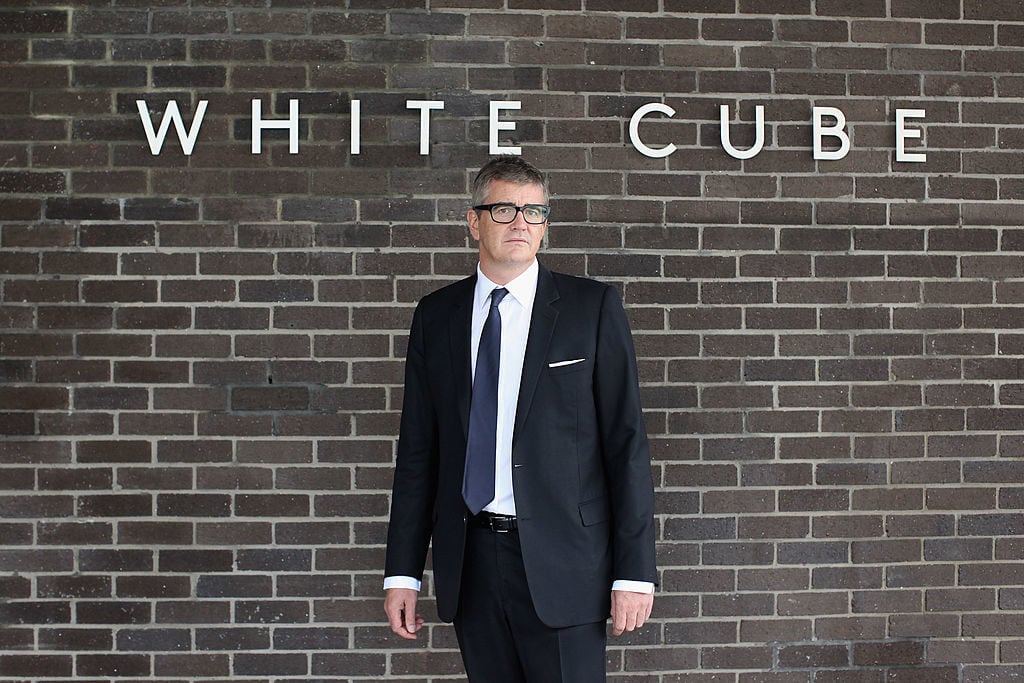
Jay Jopling, owner of White Cube. Photo
by Oli Scarff/Getty Images.
It appears Jopling worked with Philbrick through a mysterious
offshore entity called Ogini Ltd, which was incorporated in Jersey
in the Channel Islands in 2017. Although Jopling declined to
comment on whether he owns the entity, the address for Ogini is
identical to a White Cube entity also registered in Jersey, and
Jopling previously disclosed that the court granted his injunction
request on November 1, 2019—the same date as an injunction granted
to Ogini. A source familiar with the filing says it contains
exceptionally detailed information on Philbrick’s activities,
suggesting a close relationship between the entity and the
dealer.
Another clue? Ogini is Inigo spelled backwards.
A Business Built on Secrets
Some say the Philbrick affair will be a wakeup call for an art
market that has become increasingly financialized but is still not
subject to the same level of regulation as most financial markets.
Philbrick, for example, often provided his profit-hungry financial
backers with verbal or written assurances about the whereabouts or
title of a particular artwork—but rarely provided supporting
evidence.
“Outside of any potential government intervention or
legislation, it’s a call to begin to operate in a slightly more CYA
[cover your ass] manner, in which we establish ways to sort out
what true title is amongst ourselves, and to be less
lackadaisical,” said art advisor Benjamin Godsill. “It’s a great
spurning of self-regulation based on self-interest.”
In fact, it’s something of a miracle that fraud doesn’t occur
more often. Even in the most routine art transactions, buyers and
sellers typically have no idea who is on the opposite end of a
deal, not to mention any clue about how many operators—advisors,
dealers, financial backers—might get involved along the way. The
frequent use of offshore shell companies to conceal investors’ true
identities only obscures matters further.
Philbrick, evidently, was a past master at turning the art
market’s blind spots into lucrative loopholes, taking advantage of
the plethora of sophisticated financial strategies that cropped up
as the global art market ballooned over the past two
decades, including third-party guarantees, less formal
“flipping” agreements, and art-backed loans. For an older
generation of traditional collectors and connoisseurs, such
convoluted deals might be anathema, but for a younger generation of
risk-tolerant buyers, they have become the norm. Art collecting, it
seems, has been replaced by arbitrage.
In all his dealings, Philbrick adopted a common MO: sharing a
measure of risk with clients to buy and sell a work of art without
ever taking physical possession of it, and sharing in the upside
when the flip made a profit. For a while, it worked swimmingly. The
strong returns Philbrick secured early on may have prompted some
backers to look the other way as red flags began to mount and other
market players began to avoid doing business with him.
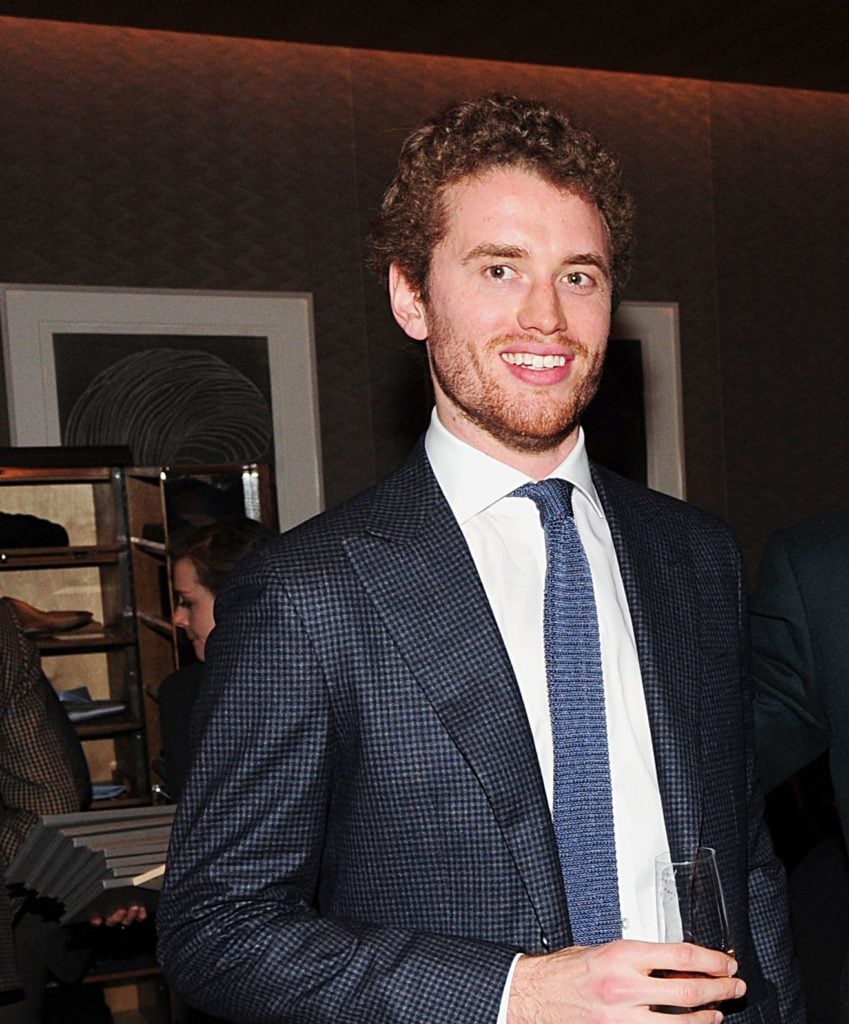
Inigo Philbrick ©Patrick McMullan. Photo
by Liam McMullan / PMC.
What made Philbrick exceptional was not his tactics but rather
the margins he was promising, the number of backers he was working
with, and the number of deals he had in the works at any given
time. “He’s kind of a secondary-market assassin—pure speculation,”
said one dealer. “He attached himself to certain markets that
were perceived as blue-chip and rising, with exponential
profits.”
But before long, some of those markets began to falter, and
Philbrick found himself furiously moving funds around from one
client and deal to the next in order to stay afloat. According to a
detailed report he filed with Companies House, the UK business
registry, in August 2018, Philbrick’s turnover in the 2015–16
financial year was £50.6 million, with a relatively slim profit of
£1.6 million. Turnover nearly doubled, to £96.4 million, the
following year—but Philbrick still posted a loss of £935,000, which
he attributed to “currency loss” from a devalued pound
sterling.
“It might have been fake all along,” said one advisor. “He might
have been stealing from Peter to pay Paul. Certainly, there are
Pauls out there who made out like bandits.”
An Auspicious Start
Given Philbrick’s comfort with treating artworks as
less-than-glorified financial derivatives, it is somewhat
surprising that he is the son of a fairly eminent museum director.
His father, Harry Philbrick, was the director, from 1996 to 2010,
of the Aldrich Museum of Contemporary Art in Ridgefield,
Connecticut, where he staged ambitious shows by difficult artists
like Anselm Kiefer. Afterwards, he spent five years running the
museum at the Pennsylvania Academy of the Fine Arts, where he, too,
engaged in a kind of art flipping: he deaccessioned Edward Hopper’s
East Wind Over Weehawken (1934), selling it at Christie’s
for $40.5 million (double its low estimate), in order to buy the
museum more contemporary art.
Growing up in Connecticut, Inigo graduated from Joel Barlow, a
highly ranked public high school in Redding, in 2005 after a stint
or two on the school’s honor roll. Like his father, he attended
Goldsmiths at the University of London. Their relationship became
strained, however, after Harry divorced Inigo’s mother in 2006 and
remarried in 2009, according to ARTnews.
In an email, Harry Philbrick said that “while Inigo and I have
been estranged for nearly a decade now, I love him and want the
best for him.” He described the allegations against his son as
“deeply concerning,” although he said he has “no knowledge of what
transpired beyond what has been publicly reported.”
Philbrick did not broadcast the estrangement with his father,
consistently presenting himself as more confident, more informed,
and more connected than anyone else in his orbit. “When you Googled
the name, you came across his dad,” one dealer recalled. “No one
knew they were estranged.” Six years before Philbrick got his job
at White Cube, he was already leveraging his art-world
ties, bringing his friends—including now-film director Gia
Coppola— to visit the celebrated artist Rirkrit Tiravanija’s Land
Foundation on a trip to Thailand.
In the years after he left White Cube, his decision to strike
out on his own seemed by all accounts a wise one. He was often
spotted front and center at major evening auctions—an
eyebrow-raising position for someone so young—sitting alongside
Artnet News columnist Kenny Schachter. Schachter has since written about his falling
out with the dealer, which he said pushed him to sell off part
of his collection at Sotheby’s to offset his financial losses.

A now-deleted Instagram photo of
Victoria Baker Harber with Inigo Philbrick. Photo courtesy:
Wikinetworth.com
Several people who knew Philbrick described his laser-like focus
on deal making and the intricacies of a particular artist’s market,
as opposed to the art itself. “He came across as quite quiet and
really kind of facts-based, meaning all about the deal,” one person
said. “I never heard him talk about art so loquaciously” as he did
about finances. Others said he had an encyclopedic knowledge of the
catalogues raisonnés of the artists he speculated in.
According to the Baer Faxt, a subscription-based art-market
newsletter that tracks major buyers at auction, Philbrick bid on at
least 11 six- and seven-figure works between 2014 and 2018 and won
four of them. The priciest acquisition he made during this period
was a $3.5 million Jean-Michel Basquiat, followed by a $3.2 million
Christopher Wool.
Philbrick’s extravagant spending extended beyond business to his
lavish lifestyle, complete with private planes and bottle service
at nightclubs. His girlfriend at the time
of his disappearance, Victoria Baker Harber, is an English
socialite best known for her role on the popular British reality
show “Made in Chelsea.” She moved to Miami when Philbrick opened
his gallery and launched her own boutique, called the Space.
In an Instagram message, Baker Harber told us she “was running
the store separate from” Philbrick and declined to comment on his
legal troubles. “Wish I could be of more help,” she wrote, “but am
in the dark!”
A Dream Deal
Firmly ensconced in the international art market, Philbrick
struck what appeared to be a dream deal in 2015. It would
ultimately be his undoing.
He signed on to buy and sell blue-chip works at a profit on
behalf of a two-person company called Fine Art Partners (FAP),
founded by former Morgan Stanley banker Daniel Tümpel and Loretta
Würtenberger, a German judge turned art researcher.
Under the terms of the agreement, they would jointly acquire
works—at a very favorable split for Philbrick, who only had to
provide 30 or 35 percent of the purchase price. Philbrick would
hold the works in storage until it became clear they were likely to
reach a predetermined target price, at which point he would flip
them. Notably, FAP did not require Philbrick to pay his share of
the purchase price until the resale was complete, giving him ample
time and cash to operate.

Loretta Würtenberger and Daniel Tümpel.
©Rolf Zscharnack
Each artwork had its own contract specifying the acquisition
price and the target sale price. An untitled Donald Judd
stainless-steel sculpture purchased for $2.25 million in 2015, for
example, had a target resale price of $2.8 million, while a
photorealist portrait of Pablo Picasso by Rudolf Stingel, bought
for $7.1 million, had a target of $9 million. The division of
profits hinged on whether Philbrick was able to sell the work for
more or less than the target price; a discount would eat into his
cut.
The agreement was initially lucrative for both sides. But Tümpel
grew increasingly frustrated as months passed with no resales. He
wrote repeatedly to Philbrick stressing the need for FAP to have
money in order to pay its tax bills. Philbrick’s lengthy and
elaborate responses now look like a master class in stalling. “To
rush these sales is signing your own death knell,” he wrote,
somewhat incongruously, at one point.
A Deal Gone Wrong
As things deteriorated, it became clear that the amount of
latitude FAP had given Philbrick—and the limited amount of
information he was sharing—were creating problems.
Correspondence between FAP and Philbrick contains numerous
references to a buyer named Leonid, whom several sources identified
as Leonid Friedland, cofounder of Mercury Group, which owns
Phillips auction house. According to emails attached to the FAP
lawsuit, Friedland bought an untitled Rudolf Stingel painting of
two ravens from Philbrick and FAP for $6 million in 2017.
The same work sold at Phillips in 2018, with a third-party
guarantee, for the slightly lower price of $5.9 million. A year
after that, Philbrick and Tümpel were still discussing the fact
that Friedland had not paid the $6 million he owed for the work,
even as Philbrick inexplicably proposed selling yet another Stingel
triptych to Friedland for $5 million.
“A deal is a good deal when it is completed and you’ve got
profit in your pocket,” Tümpel wrote to Philbrick. “I believe the
Raven should have been paid out by Leonid by last autumn…. That
that has not happened yet, is frustrating for me and maybe this is
due to the German vs. the Russian perception of doing
business.”
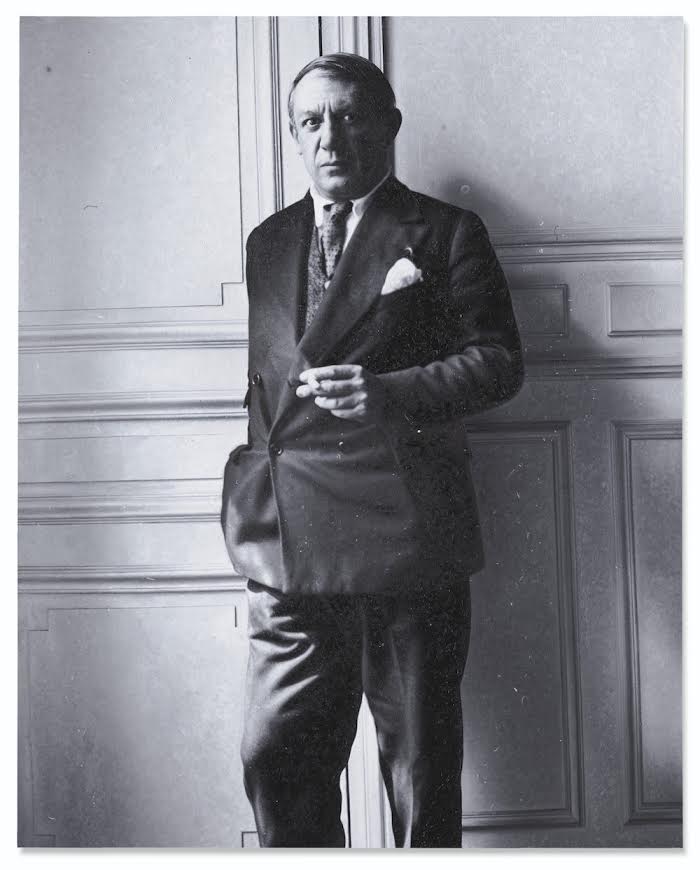
Rudolf Stingel, Untitled (2012).
Image courtesy Christie’s.
The transaction raises many questions. If Friedland acquired the
work in 2017 for $6 million, why had he not paid for it by March
2019? Even if it was Friedland who consigned the work to Philllips
(which seems likely), the painting carried a third-party guarantee,
which means that the auction house had a committed buyer lined
up.
Why, almost two years after the initial sale and after the
painting had changed hands yet again, would Philbrick and FAP still
be discussing Friedland’s nonpayment and not that of the
third-party guarantor? And if Philbrick did receive the money from
Friedland without notifying FAP, where did it go? Through Phillips,
Mercury Group declined to comment. Neither FAP nor its attorneys
have responded to numerous requests for comment.
Even as FAP continued to pursue Philbrick for money and
information about the status of resales into early 2019, the young
dealer was, according to its lawsuit, illicitly selling work
out from under them.
In perhaps the most extreme example to surface to date, legal
documents show that Philbrick sold multiple overlapping shares in
the Stingel painting of Picasso. Two months before he told FAP in
March 2017 that they had acquired the work in full for $7.1
million, he had already invoiced
Satfinance, a firm controlled by the young collector Sasha Pesko,
for a 50 percent share of the same painting worth $3.35
million.
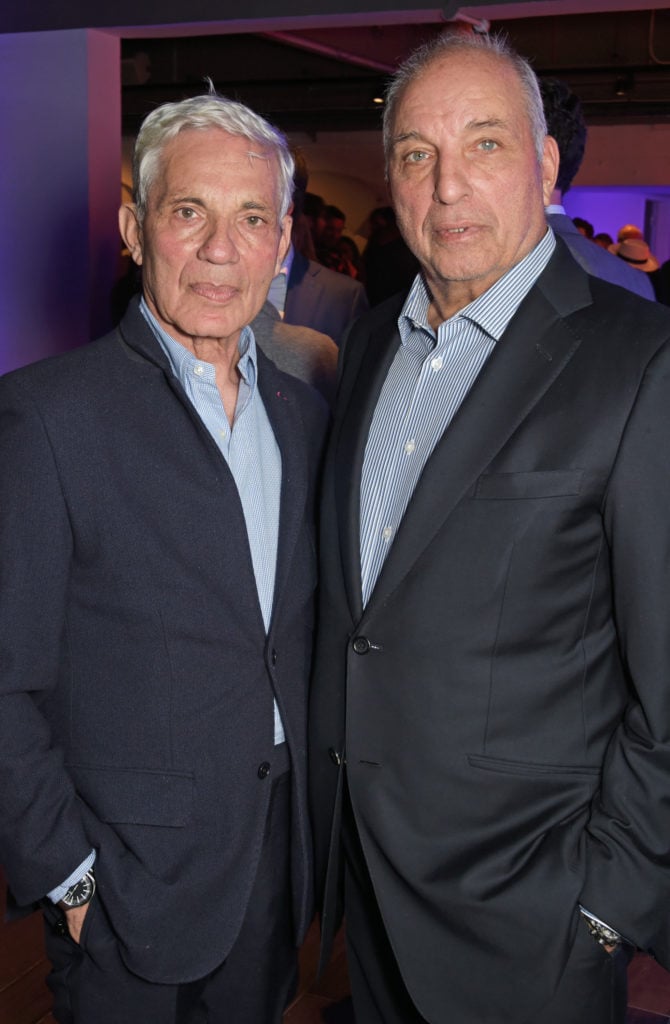
Simon and David Reuben. (Photo by David
M. Benett/Getty Images for Lyric Hammersmith)
Documents show that later, in June 2017, Philbrick sold the
painting again—this time to Guzzini Properties, an investment
vehicle controlled by billionaire UK brothers Simon and David
Reuben. Title was transferred to the brothers, who, around two
years later, consigned the painting to Christie’s, where it sold
for $6.52 million.
All the while, Philbrick kept FAP under the impression that the
work had been consigned on its behalf and that he had secured a
guarantee from Christie’s for $9 million—conveniently, the work’s
target sale price—by falsifying documents, including an eight-page
seller’s agreement that bears Christie’s Rockefeller Center address
at the top.
Now, FAP, Pesko, and the Reuben brothers are fighting in court,
each claiming to be the rightful owner of the painting. While the
lawsuits are ongoing, a judge has ordered Christie’s, which is not
a party to any of the litigation, to keep the painting in
storage.
The Beginning of the End
FAP sued Philbrick on October 4, opening the floodgates. Since
then, at least five other legal claims have been filed in US courts
for numerous works, including the Stingel of Picasso, a Yayoi
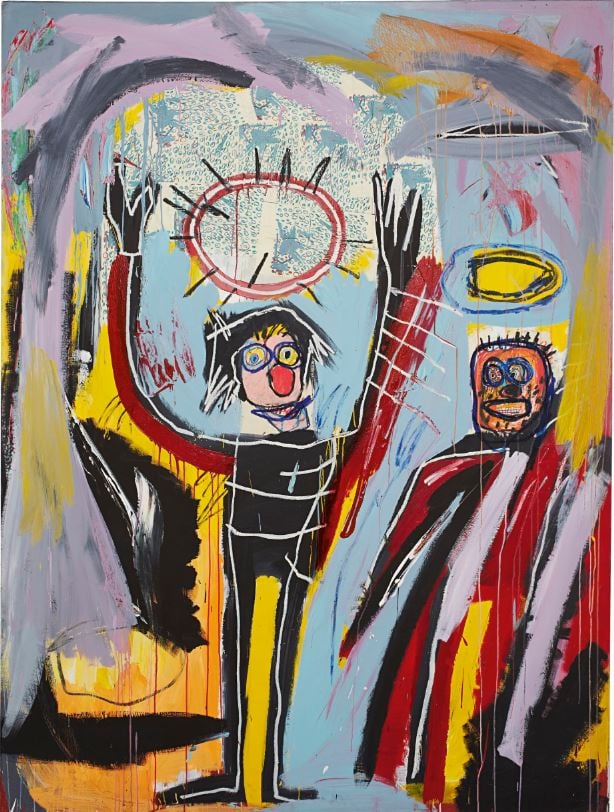
Kusama “Infinity” room, and a Basquiat painting of two crowned
figures titled Humidity (1982). London’s High Court has
also granted at least four separate requests to freeze Philbrick’s
assets.
Further complicating matters, Philbrick used the Basquiat, as
well as four other works, as collateral for a $10 million loan,
which he later increased to $13.5 million, from specialist lender
Athena Art Finance. Philbrick was declared in default in October,
when he missed a six-figure interest payment, and Athena secured
the Basquiat as it was on its way back from a show at the Mori Art
Museum in Tokyo. Pesko, the young collector who also bought a share
of the Stingel, says he is the Basquiat’s rightful owner, having
paid what he claims was an inflated price for a 66 percent share in
2016.
Jean-Michel Basquiat, Humidity
(1982). Photo: Phillips de Pury.
“This fraud was as sophisticated as it was brazen, and time will
tell whether Philbrick acted alone, or whether others should be
held accountable for the damage he has left in his wake,” Pesko’s
attorney Judd Grossman said. “The problems that can arise due to
the lack of transparency in the art world are magnified in cases
like this, where bad actors look to find a way to pledge the same
art, to multiple players, ostensibly for different purposes.”
Sources say there are likely dozens more people who have been
swindled, and many additional works that will be subject to claims
in the wake of Philbrick’s disappearance. Messages sent to
Philbrick at his gallery’s former email address bounced back as
undeliverable. For now, his whereabouts remain unknown, though
rumors have put him everywhere from the Bahamas to Australia to the
Solomon Islands. Philbrick’s Miami attorney stopped representing
him in December, noting that the dealer had “failed to fulfill his
obligations.”
Asked if she thinks the art world will become more cautious, or
demand more transparency, in the wake of the Philbrick scandal,
Miami advisor Karen Boyer was unfazed. This drama, she suggested,
only affects the segment of the art market that treats art as
nothing more than a financial instrument. “When I assist clients in
acquiring artwork, we pay for it and take possession of the art,”
she said. “I work with a small percentage of people that I know and
trust. I don’t ever buy 50 percent of an artwork.”
A version of this story first appeared in the spring 2020
Artnet Intelligence
Report. To download the full report, which has juicy details on
how A.I. could transform the art industry, what art top collectors
are buying (and why), and how titans of the finance industry are
infiltrating the auction houses, click here.
The post What Did Inigo Philbrick Do? How One Precocious
Dealer Allegedly Swindled the Art Market’s Savviest Players Out of
Millions appeared first on artnet News.
Read more https://news.artnet.com/art-world/inigo-philbrick-intelligence-report-2020-1800972
Further reading


Leave a comment