
The World Is on Lockdown. But You Can Still Bump Into All Your Favorite Art-World Randos on a Chaotic Video Chat App Called Houseparty
Thursday was the first big night of the week.
By the early evening, I was chatting with the director of a big
global gallery over drinks when we bumped into a friend of mine, a
prominent artist. It wasn’t an artist the gallery director showed,
but it turned out they knew each other in college. Later, I
had plans to catch up with an art advisor during dinner, and a
director at a space in Chelsea was around, so he joined too. There
was a lot of good wine. Friday was even busier. A director of a
European gallery and I watched as a married couple, two artists,
mixed martinis. “Nate, just a rinse of vermouth, right?”
one artist asked, shaker in hand. Saturday, there was
a raucous surprise party feting the owner of a hip
Brooklyn gallery. After a few drinks, the gallery owner donned a
Warhol wig and started jumping rope in the corner of the room.
Of course all of this—the serendipitous bump-ins, the
coincidental same-place-same-time collisions—happened remotely. I
was in the Catskills, while others were in towns in the Hudson
River Valley, or inhabiting fireplace-laden cottages in Connecticut
hamlets, or safely ensconced in safe houses down south, or hunkered
down in Brooklyn brownstones, or in Noho lofts having not left for
more than a week.
Yes, the insatiably social art-world milieu has found a place to
frolic free during our current plague quarantine. The
oh-so-generous host is an app called Houseparty no one had ever
heard of two weeks ago.

A Complete and Total Shitshow
There are a lot of video chat apps that have become as
indispensable as a limb overnight. We have meetings on Zoom
(which—no surprise—was valued at $44.5 billion on Tuesday, beating
out an increasingly obsolete Uber) and gabfests with family and
friends on Google Hangouts, where we eat dinner together. Hey, it’s
almost like it’s Christmas.
Houseparty is not like Christmas. It’s like being at a
shitshow soirée, maybe even a great shitshow soirée,
maybe even an on-the-verge-of-catastrophe-great shitshow
soirée. At best, it’s redolent of a place like the notorious
cigarette-smoke-clogged art-damaged hang China Chalet, and I’m not
just saying that because most of the people on Houseparty were at
that China Chalet party a few weeks back that, really, feels like
years ago.
You sign up, innocently, and then all of a sudden, you don’t
even have to fire up the app to be lured in. If you enable
notifications (everyone enables notifications) you get pinged every
time one of your friends comes on. The notifications are
enthusiastic. For example: “ Alberto Mugrabi is in the
House!” You also get a ping each time someone from your contacts
joins Houseparty—and the rate at which new people are joining is
increasing day by day. As I was writing this sentence, a
friend logged in, and when I got on the app and connected, he
was at the top of a mountain. He’d literally climbed to the
top of a run that had closed the lifts, skis on his back, and was
getting ready to ride down. Like I said, a great shitshow
soirée.
But there’s one feature that really sets Houseparty apart from
the let’s-circle-back-tomorrow video-conference software, and it
starts with the scrolling feed.
The scrolling feed shows all your Houseparty friends who are
currently online, but also who they’re hanging out with, and at any
point, you can bum-rush their conversations, even if you’ve never
met that other person in your life. Crashers welcome. Suddenly,
it’s your face in a box, and then a lot of other faces in boxes,
with maybe one face you know, but others you do not know—just like
a real-life party.
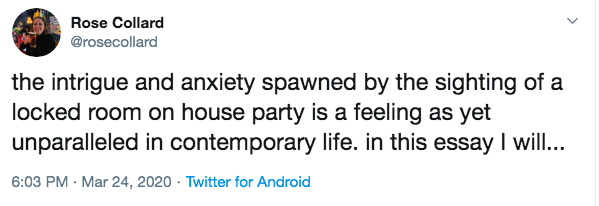
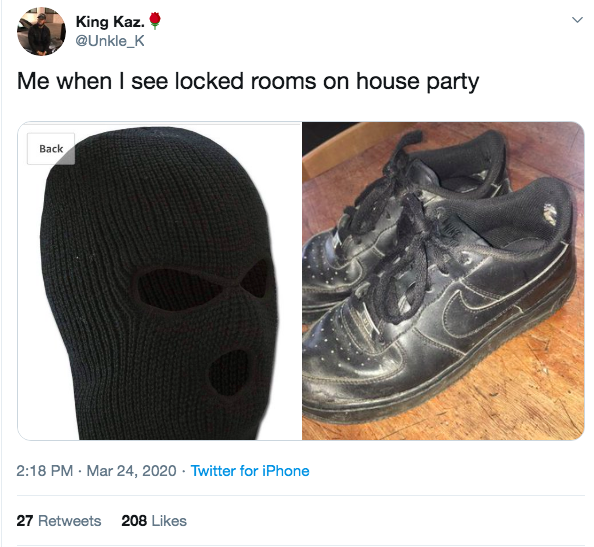
There’s a way to lock the room, and it’s bitchy. On the
feed, it’ll show that a room’s locked—but still tell you who is
in the room. So, if you see a locked room with your friends in
it, it means that someone’s not inviting you.
But it’s when people don’t lock the room that
Houseparty gets fun. To be the active crasher is thrilling. You
parachute in, mid-sentence, and your face pops up on the phones of
seven semi or complete strangers around the world. (It’s eight to a
room, max.)
To be chilling in your digs when it gets crashed is deeply
unsettling. But afterward, you savor that dissonance and realize
you really miss it in a world where you aren’t allowed to leave
your house or get within six feet of another person.
“Houseparty is uncanny to the act of going to an art opening,”
said James Michael Cardoso Shaeffer, the director of Greene
Naftali, the Chelsea gallery. “Out of curiosity, or necessity, you
open the app much like you may begrudgingly, or out of habit, go to
an art opening. Once ‘in,’ you are immediately confronted with
nonconsensual interactions you may or may not want to engage with.
The social anxiety is the same, the platform is different. Amazing
that technology offers us continued practice on how to cleverly
leave a conversation.”
Come In and Stay a While!
Houseparty rose from the ashes of another video chat app,
Meerkat, which was put to pasture in 2016 just weeks after a
high-profile launch at South by Southwest. When announcing the
shutdown, Meerkat founder Ben Rubin introduced a new venture, one
started with former Tumblr and Yahoo exec Sima Sistani, called
Houseparty.
While Meerkat was focused on broadcasting through social media,
Houseparty was a pivot, one that bet on private, not public,
messaging. But Rubin didn’t want it to be too
private. He told Fast Company that he wanted it to be a
more casual, drop-in, drop-out version of conferencing apps.
“We wanted a place where you could casually meet 20 people you
care about without having to schedule anything,” he told Fast
Company in 2017. “You don’t need to set up a call and feel
awkward for FaceTiming somebody.”
The app quickly had a million daily active users, and by 2017,
that number had doubled. Rubin left in April 2019 to be
entrepreneur in residence at Benchmark, a venture capital firm.
Sistani is now Houseparty’s CEO.
(Through a press rep, leadership declined to comment. “We would
like to be sensitive to what’s going on in the world so we won’t be
doing interviews about Houseparty usage during this global
pandemic,” the representative said.)
In June 2019, Houseparty was acquired by Epic Games, the maker
of Fortnite, the online video game that has attracted hundreds of
millions of users in its short period of domination. Because the
game only had a voice chat function, Houseparty would become the
means by which players could talk “face-to-face” while shooting the
bejesus out of the bad guys (or whatever it is people do on
Fortnite). Sistani admitted in a tweet that, going
forward, such was Houseparty’s fate.
But that fate changed drastically earlier this year. On January
10—the day before the first coronavirus death in Wuhan—the
Houseparty app was ranked 704 in the global ranking of free iPhone
apps. Shortly thereafter, it began to rise. In March, it entered
the top 200, and on Monday, March 16, when bars and restaurants in
New York City were forced to close by the state government, it was
ranked 115. By last Sunday, it was ranked 8.
Like Chatroulette, Without the Dicks
While Zoom may be the best place to replicate the tenor and
tempo of a corporate powwow, the art world needed a platform that
actively embraces chaos and abject shit-talking.
“Last night I was having an epic gossip session with some
friends and was thrilled to have the lock function,” said a New
York art dealer who wished to remain anonymous. “Then we unlocked
the doors once our grievances and wild speculations were aired and
a bunch of other friends joined and it gave a comforting sense of
normalcy. My friends and their core personalities are still
intact.”
“Also, love seeing who my ex is talking too,” the dealer said,
speaking to another inevitability of a fairly incestuous scene.
Others craved it just to have variables in an increasingly
monotonous life—even if these variables are the ones that, in the
old world, would have been extremely annoying.
“Houseparty satisfies the constant, desperate need I have to be
doing something, to be meeting people I don’t know, and to be
communicating with people I will quite probably never see or speak
to again,” said a senior account executive at an art-centric public
relations firm.
“It’s like Chatroulette without the dicks,” said a New
York-based spokesperson for an arts nonprofit. “But I expect that
to change as isolation continues.”
“It has all the charm of a real house party, but no one
has to wear underwear,” said a source who works in art
publishing.
“I’ve sold $10,000 in work on Houseparty,” said the art dealer
Ellie Rines, who runs the Manhattan gallery 56 Henry. “It’s better
than an online viewing room.”
Or, as the artist Zak Kitnick put it, “I’ll never forget my
first time.”
And indeed, the potential to meet new people on Houseparty is
only increasing. By Tuesday, a large chunk of my close friends in
the art sphere had joined. And not-yet-friends the algorithm pushed
on me included famous curators, prominent New York gallery owners,
fashion designers who show at Paris Fashion Week, artists in the
Whitney Biennial, and Tico Mugrabi.
But after days of using it—hopping into rooms, having glamorous
friends-of-friend crash into convos—something was missing.
Houseparty feels like you’re hanging out with the art world,
but at the end of the day, when you log off, you’re alone and stuck
in your apartment.
“I kind of love and hate Houseparty,” said the art advisor
Daniel Oglander. “It affords one the ability to stay in contact
with colleagues and friends, but always reminds me of what I’m
missing after the call is over.”
“Human contact is irreplaceable,” he added. “And I miss hugs,
damn it.”
The post The World Is on Lockdown. But You Can Still Bump Into All
Your Favorite Art-World Randos on a Chaotic Video Chat App Called
Houseparty appeared first on artnet News.
Read more https://news.artnet.com/art-world/houseparty-app-1814391
Further reading


Leave a comment