
Nikki Haley Says Emergency Aid for the Arts Doesn’t Help People. Here’s Why She’s Dead Wrong
Today, Congress moved to pass a record-breaking economic
stimulus package amid the heartbreak and chaos of the United
States’s ongoing coronavirus crisis. Meanwhile, politician Nikki
Haley took a moment out of her
day to use the occasion to stoke the fires of conservative
attacks on government art support.
Specifically, Haley, who served as Trump’s UN ambassador until
2018 and is now a prominent fundraiser and
Republican surrogate, shot off a tweet denouncing the tiny
emergency funding bumps given to the National Endowment for the
Arts, National Endowment for the Humanities, Corporation for Public
Broadcasting, and the Kennedy Center as irresponsible.
These are the items included in the stimulus
bill:
$75 mill for public television/radio
$25 mil for the Kennedy Center
$75 mil for the Natl Endowment for the Arts
$75 mill for the Natl Endowment for the HumanitiesHow many more people could have been helped with this money?
— Nikki Haley (@NikkiHaley) March 26, 2020
This type of culture war posturing is as predictable as it is
contemptible right now.
Before Armageddon hit, I had just published a piece laying out a long
response to renewed attacks on the NEA. The idea that arts
funding is “welfare for elites” is an old, old talking point.
Reaching for it is a Pavlovian reflex for conservatives. It serves
a purpose: to distract from giveaways to corporations
and rich people by framing the real problem as lazy cultural
elites living off the fat of government subsidies.
It’s also no mystery why Haley, who has political ambitions and
an eye on the future, would be banging this drum now. She
emerged on the
political scene through the Tea Party,
and the Tea Party came up denouncing the 2009
stimulus as a giveaway to the lazy. That was how the Republican
party found a popular base again after George W. Bush was flushed
from office in disgrace amid the Great Recession.
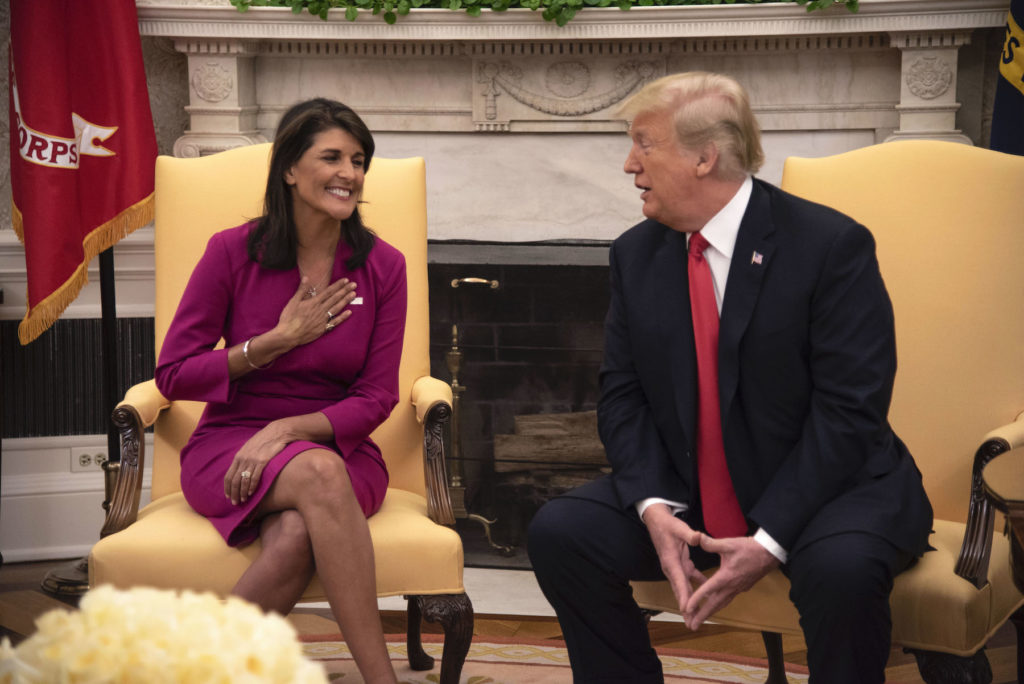
President Donald Trump complements Nikki
Haley after she announced her plan to resign as United Nations
ambassador on October 9, 2018 in Washington, D.C. Photo by Calla
Kessler/The Washington Post via Getty Images.
Haley’s fixation on this particular bugbear is somewhat rich in
the context of a $2 trillion emergency federal aid
package. The measly amounts of stimulus awarded to our already
anemic government art agencies are so small as to really only
matter symbolically.
The American Alliance of
Museums had asked for a $4 billion relief
package—ambitious but justifiable given the absolutely
unprecedented crisis faced by shuttered arts organizations. “We
estimate as many as 30 percent of museums, mostly in small and
rural communities, will not re-open without significant and
immediate emergency financial assistance,” the advocacy group
wrote.
House Democrats originally included $300 million for the
National Endowment for the Arts and another $300 million to the
National Endowment for the Humanities. In the final package, it was
whittled down to $75
million each.
To give you a sense of how inadequate this is: New York’s
Metropolitan Museum alone says it will take a $100 million loss from
coronavirus closures, and have to lay employees off. Across the
country, layoffs have already
begun, at museums, performance venues, theaters, music
festivals. “The majority of organizations don’t have a plan B,”
Zannie Voss, the director of Southern Methodist University’s
DataArts resource told my colleagues Julia Halperin and Javier Pes
in their article about the
current museum crisis.
“How many more people could have been helped with this money?”,
Haley fumes in her tweet, evidently trying to play the “how can we
think of art in a time like this” card.
Let me give an example that might hit a little close to home
about the kinds of people emergency art support might help.

The 2013 festival opened on May 24,
2013, with a ceremony at Charleston’s City Hall. Image courtesy
Wikimedia Commons.
In South Carolina, where Haley was governor from 2011 to 2017,
the Spoleto Festival each year brings opera,
theater, dance, and jazz to venues across Charleston. The pandemic
has already forced the festival to call off its May opening.
“This is truly heartbreaking for our artists, volunteers, staff,
and audience,” Spoleto wrote on social media,
“however, to continue plans in the face of #COVID19 would be
irresponsible.”
What effect will that have? One estimate by the
College of Charleston’s Office of Tourism Analysis put its annual
economic footprint as something like $42 million. Leaving aside the
greater economic impact, in recent decades the festival has
supported some 20 full-time employees and 600 seasonal employees,
according to board chair M. Edward Sellers, writing in an
article for the Post and
Courier. That’s not to mention the performers whose living
is entertaining at events like this.
Those are real people with real jobs, who have had a chunk of
their livelihood wrenched away from them right now—through no fault
of their own.
Sellers, it so happens, laid out those statistics about the
festival in an article defending the National Endowment for the
Arts. “I can say that Spoleto would not have started were it not
for the NEA,” he wrote. A $35,000 grant got the festival off the
ground back in 1977. It now receives funding from the South
Carolina Arts Commission, which gets money from
the NEA.
If similar grants can help arts organizations through a
horrible, scarring time now, isn’t that worth it?
Or is the temptation of ignorant, opportunistic point-scoring
too great, even in a disaster?
The post Nikki Haley Says Emergency Aid for the Arts Doesn’t
Help People. Here’s Why She’s Dead Wrong appeared first on
artnet News.
Further reading


Leave a comment