
11 Acclaimed Artists Offer Strategies for Getting the Most Out of Working From Home, Whether From Your Studio or Bedroom Office
What kind of skills do artists bring to these extraordinary
times? We can think of a few, from creative problem solving to the
capacity for empathy. But there’s one that you may not even have
thought of as a skill: artists are world-class experts on working
alone.
As we try to feel our way through our own new stay-at-home
routines, we reached out to a few artists to see what advice they
had to offer, and how they were coping with working from home now.
Here’s what they had to say.
Center
Yourself
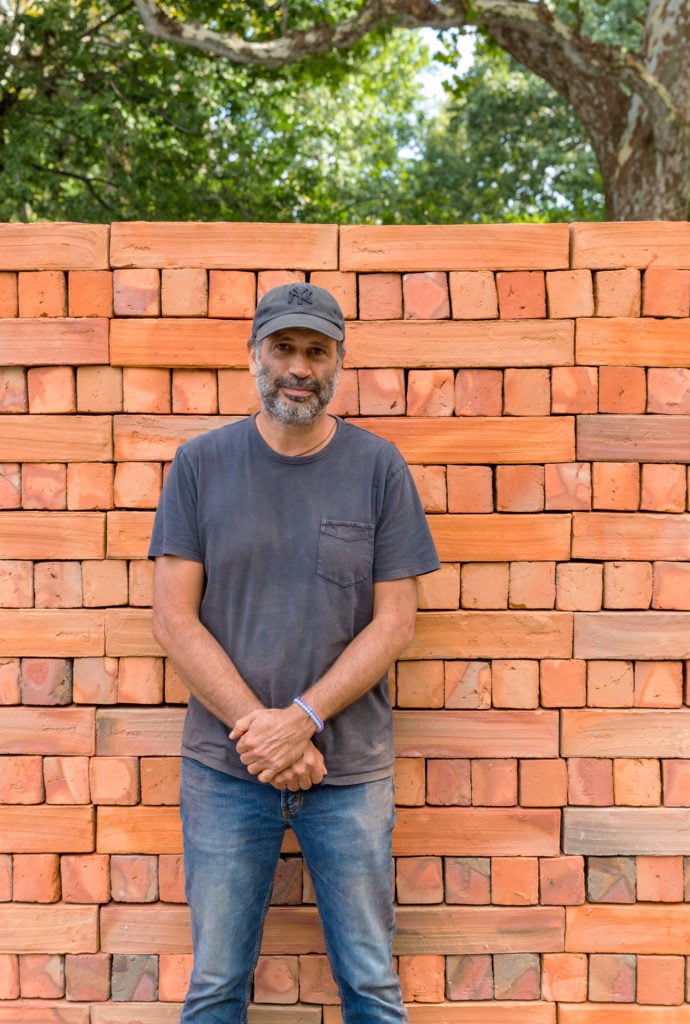
The artist Bosco Sodi. Photo courtesy of
Paul Kasmin Gallery.
Use this time to read, to think,
to concentrate on important things like family, and the process of
creation. These are times to reorganize yourself. You don’t need a
big space, you don’t need a big studio or gallery. Do your work:
create your art.
—Bosco Sodi
Keep the Peace, Maintain
Your Space
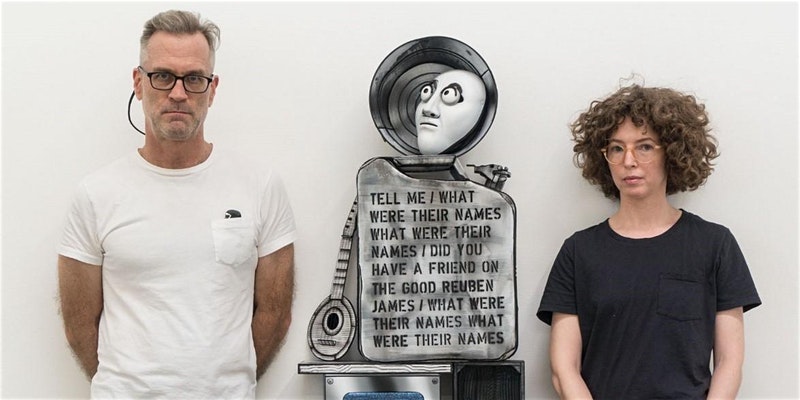
Mary Reid and Patrick Kelley. Courtesy
of the artists.
It’s a form of kindness to curb
your curiosity about what exactly your workmate is doing, and to
give them space to cycle through periods of concentration and
spacing out. It’s easy to feel entitled to look over a shoulder or
say, “What are you doing?” But in the long run, checking most of
these impulses makes for less anxiety, and more spontaneity and
good ideas.
—Mary Reid and Patrick
Kelley
Get Back to Basics
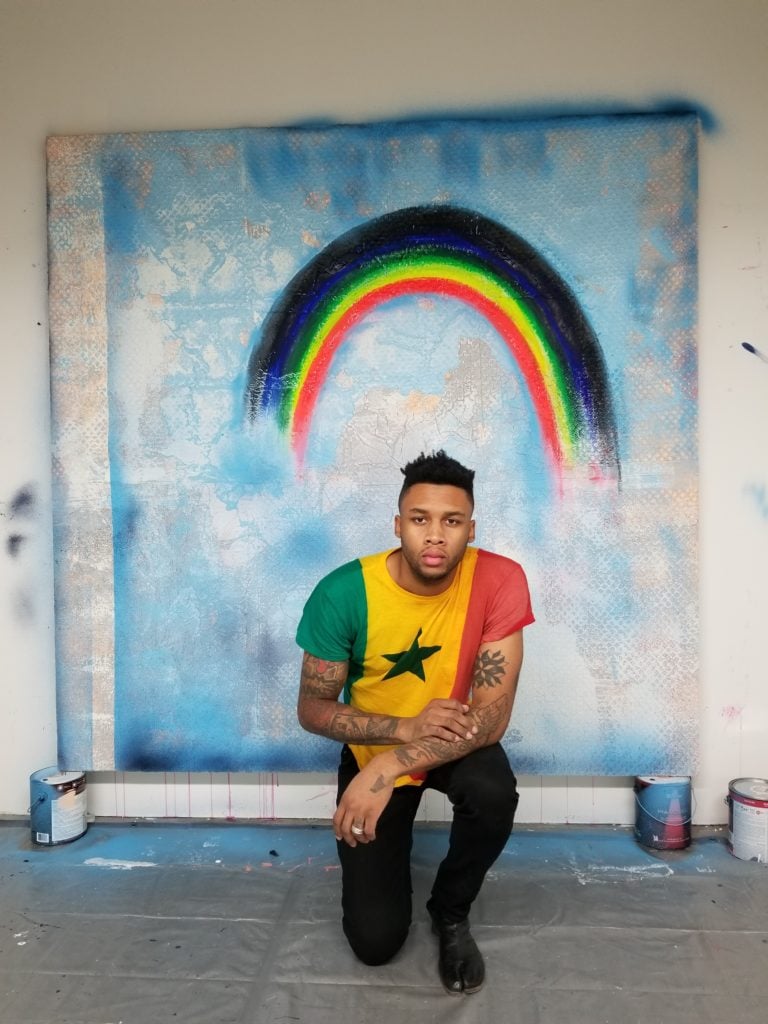
Vaughn Spann, 2018. Courtesy of Half
Gallery.
I was literally just speaking to
a friend about this. I’ve been hoarding nitrile gloves and face
masks for years now. I’ve disciplined myself to never begin working
without putting them both on. Paints and other materials are highly
toxic which I think gets overlooked a lot… while I love paint, I
love my life much more so I
think this is a great time to get back to basics as it relates to
studio health and safety.
Protect yourself by washing your
hands… other than that, call your loved ones, and check on them,
especially your elders… I have a bluetooth speaker in my studio
which allows me talk hands free. Perfect time to have long phone
calls while working in isolation.
—Vaughn Spann
Embrace the
Solitude
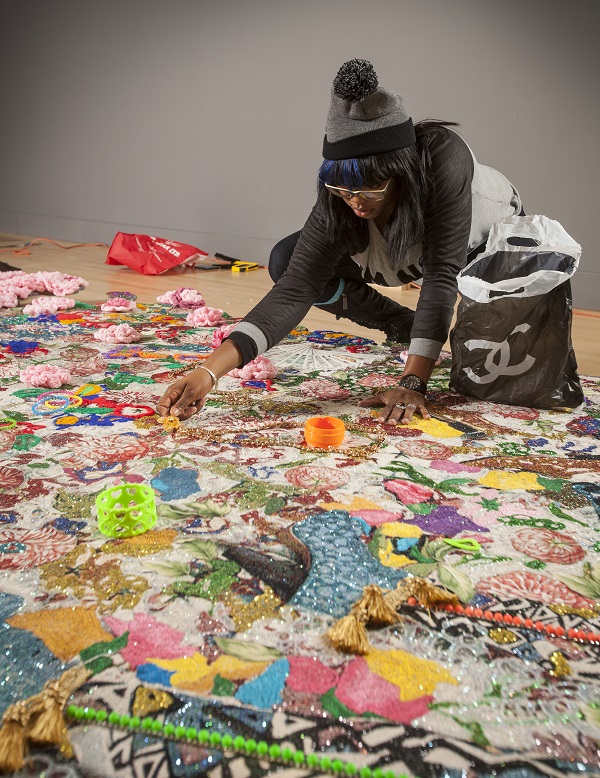
Ebony G. Patterson installing the
exhibition Ebony G. Patterson: Dead Treez at the John Michael
Kohler Arts Center, 2015. Image: Courtesy of the artist, photo:
John Michael Kohler Arts Center.
I have honestly continued my
routine of going to the studio each day. My studio is just 4 mins
drive from my apartment in Chicago. I wash my hands as soon as get
through the doors (home and studio) and change shoes. And I
remember my mother’s words “sing happy birthday to time the
washing,” and so I do. But the life of so many of us as artists is
already isolation.
One thing that has definitely
shifted has been travel. I had a few lectures that have been
cancelled or postponed. I also cancelled my annual birthday trip
this week home to Jamaica. But what’s been great about all of this
is just being rooted in studio without disruption. I feel like I
don’t have to rush to anything! So there has been an opportunity
for mental ease and rest which made me even more aware of
how tired I was! So it’s nice to just go to studio and be… if you
get me? Just be… and stay healthy and careful…
—Ebony G. Patterson
Stay Active to Stay
Grounded
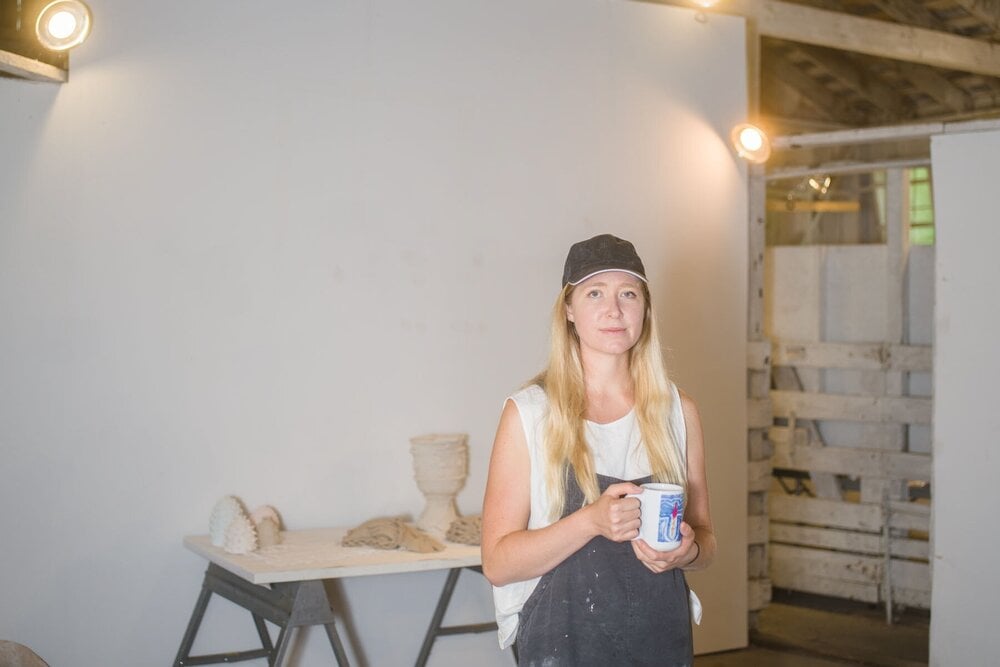
Artist Jen Dwyer in her ceramics studio.
Courtesy of the Wassaic Project.
Depending on what I’m doing if
I’m sculpting, throwing, drawing, or painting rather than planning,
researching, writing, and responding to overdue emails, it can be
easy to sit in the same place for hours at a time so that a whole
day and night has gone by and I haven’t moved much (other than a
morning walk or run).
I’ve found not moving throughout
the day is hard on my body, so I’m trying to get into more of a
routine of stretching throughout the day and taking short breaks
after working for 3 or 4 hours. If I’m working on something I
really don’t want to do, I try to reward myself with calling a
friend, walking, checking social or whatever. If I am doing
something that I have to motivate myself to do, I give myself a
limit of an hour or two of doing that task.
My morning ritual is to
meditate, stretch, run, pull a daily tarot card (spirit animal
tarot cards are my favorite at the moment), take a 30 minute break
of some kind, work for 4 hours, take an hour break work for 3 or 4
hours and then cut myself off and go home.
I also will say the phone is
such a helpful tool for me. I’m pretty introverted. I’ve found it
is pretty easy for me to not talk or see anyone for long stretches
of time. But I feel like for my mental health and happiness carving
out that time to call a friend throughout the day is really
important. It can definitely be hard to do though with looming
deadlines, but I’m working on it.
—Jen Dwyer
Cherish the
Privilege
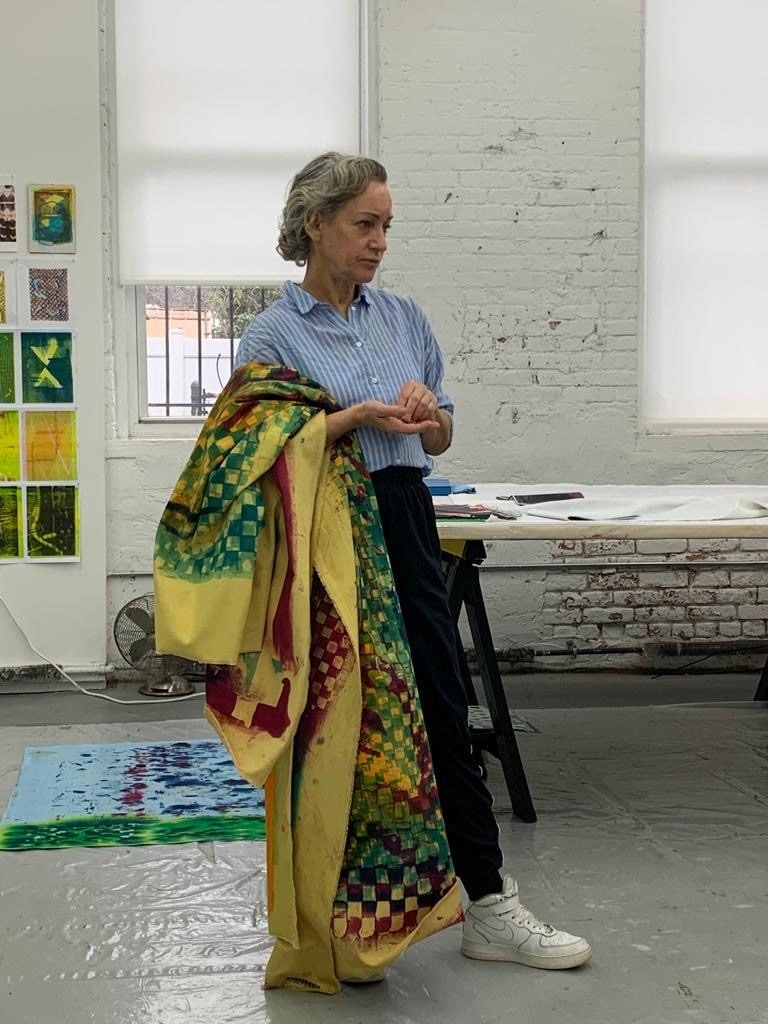
Cheryl Donegan in her home studio.
Photo: Elaine Levy.
The irony is that I worked from
home for over 20 years and then I just moved my studio to Brooklyn
last year! I’ve been still trying to get there as long as the
subway is still running, but I did bring a lot of portable projects
home in case…
I want to be sensitive about
this as—with many things—privilege is involved.
We’ve been talking here about
how lucky we are—we have lived this type of life for years! When my
kids were little I had to admit that being an artist and a parent
working at a home studio was super convenient for getting things
like laundry and cooking done! I could easily walk out of the
studio to stir a pot, put in a load of laundry—but lucky me, I have
a washer/dryer in my home. To some people that will just be salt in
the wound… what are folks who use the laundromat supposed to do? We
live in a loft—baby boomers—so we are not on top of each other.
Again, I don’t want to put something out there that will just make
folks feel bad!
But I remember when I was really
young and lived with an actor on Canal Street. She was really
jealous that I could roll out of bed and work in my space, but she
needed to get hired to do hers. I recognized that and still cherish
it. I can work when no one cares and no one is looking… and I have
and do. And of course that is what it takes. Many artists in the
past have said that they lived as if “a retiree” (Duchamp) or on
“vacation” (Dubuffet or Miro, I think)… sort of the opposite of the
“art worker,” and certainly the contrary of “business art”… but I
guess no one is going to stop us now, as if they ever
could.
—Cheryl
Donegan
Take Breaks, and Make
Playlists

Jacqueline Kiyomi Gordon, courtesy of
YouTube.
My big one right now is coming
up with some kind of structure and taking appropriate breaks.
Whatever hours in the day you like to work, keep to
those—and don’t judge them. Mine right now are around
11 am–4 pm, then 8 pm–2 am. l like a long afternoon break to go for
a walk, cook dinner, maybe watch some TV, but then go back to work.
I also take a lot of breaks. But I have an informal list in my
brain of break-appropriate activities, like making a snack while
reading something dumb, walking around the block, cleaning one
small part of my studio, looking up a new recipe to cook, etc. They
are short 10–15 minute things that will get my mind off of work but
are not so interesting that I don’t go back to work.
Another thing that’s good is
making playlists for different activities or parts of my practice.
I have different ones for morning emails, working on the computer,
working in the studio, cleaning, etc., and I just repeat them. I do
update, and they do change, but it’s super-helpful to
focus.
—Jacqueline Kiyomi Gordon
Separate Life From
Work
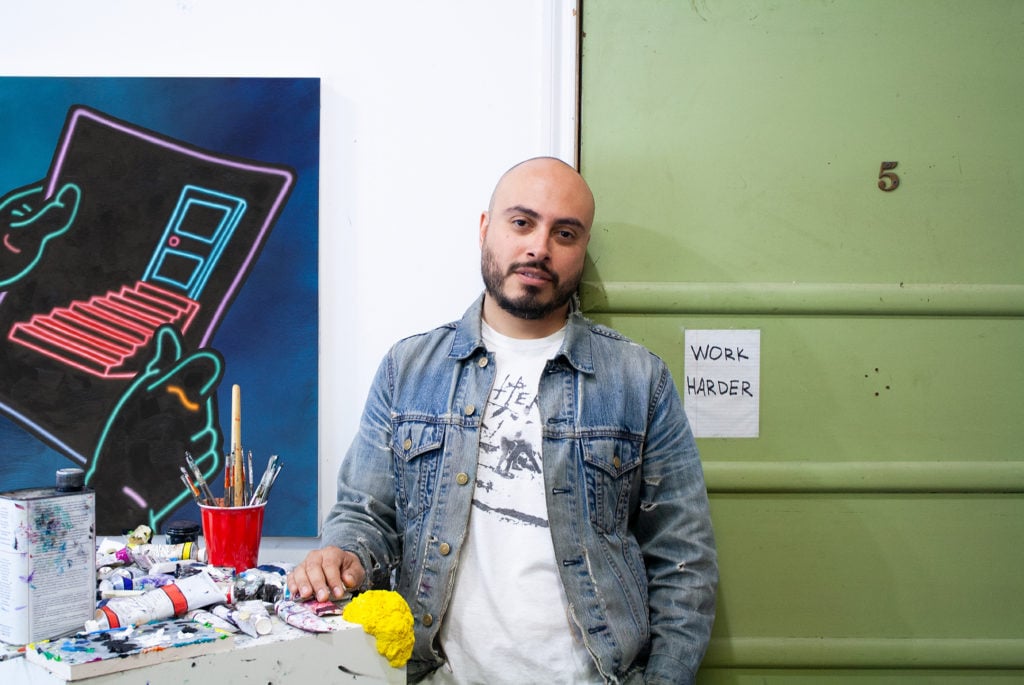
Arthur Peña shown in his studio.
Courtesy of the artist.
Accepting the isolation that a
studio practice already requires is nothing new. However,
collapsing two spaces, live/work, into one presents specific
challenges and in my experience, forces one to confront the very
nature of why they make.
My initial experience working
from home was a forced situation where I found myself with no
studio. My reliable kitchen table ended up housing multiple oil
paintings. I would lean paintings atop my stove to get a good look
at them. After more than a few months, I moved into a large
warehouse (approx. 2,000 square feet) in Dallas where I made half
of it a live/work studio. Raw with cement floors, the space was the
ideal setup for any artist whose only concerns revolved around
their practice—and not necessarily the spiders that gathered in the
shared bathroom or corners of the large room they slept
in.
The entirety of the three years
which I lived with my work mostly revolved around negotiating with
a sense of guilt for not working at all hours of the day and
knowing when to stop working so that I could have some sense of
life outside my head. (I moved to the Bronx in June. My new studio
is just over the 3rd Ave Bridge in South Bronx, about 18 minutes
away from my home.)
I would employ various well-worn
tactics like turning work around or hiding it so I wouldn’t have to
look at it, maintaining a hard start-and-stop schedule or working
through a daily checklist so I wouldn’t overburden myself. These
are all very practical. But how much practicality really belongs in
the studio? These exercises also made work feel like a job, which,
honestly, fuck that.
These current circumstance in
which artists find themselves—having to potentially move their
studio into their home—directly challenges the escapism that making
art and going to a studio provides. I was never one to keep a
sketch book or incessantly doodle; my role as an artist was simply
a truth. I think that was my biggest takeaway from living in my
studio. Sometimes you just need to not make for a while. Does one
stop being an artist if they are not making? This is a deeply
personal question that arose from the pressure of being surrounded
by my work. Be prepared for this.
Lastly, living in my studio, I
found an unexpected challenge was confronting my need to do
something all the time and constantly stay busy. Why? The obvious
answer was the subversion of the constant specter of death but, by
its practical nature, that is what this self-quarantine is all
about. In hindsight, living with your work/in your studio doesn’t
mean that you have to make more; it really means that you have the
time to make more slowly. Pace yourself, you have nowhere else to
go. This echoes both the reality of these challenging times and the
fact that you are always you.
—Arthur Peña
Stick to a
Schedule
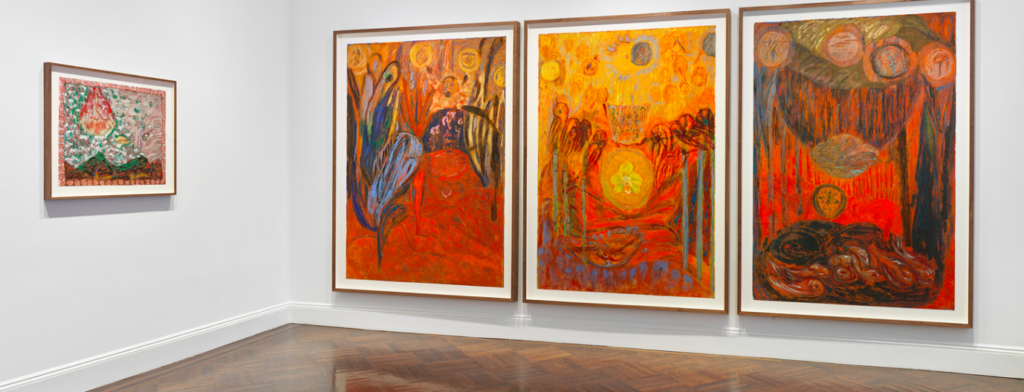
Installation view of “Mimi Lauter
Symphony No. 1,” New York, 2020, Photo: Genevieve Hanson.
For me, the key is having a
strict schedule, compartmentalizing time for work versus time for
everything else, and knowing what I need to accomplish each day in
the studio. I get up in the morning between 6:30 and 7 and I spend
two hours in my garden. That time is dedicated to physical work,
relaxation, and thinking about everything in my life, good and bad,
personal and professional. By 9 am I’m in the studio and I
immediately begin working. Before I leave the studio in the evening
for dinner, I always survey the studio and plan the first task that
I’ll accomplish the next morning. I never work after
dinner.
I think artists work best when
they feel that they can shut out the rest of the world, that’s why
so many artists work late at night or early in the morning. So this
new reality of the rest of the world slowing down should help us
all focus. Maybe a lot of non-artists out there will start
producing something creative! More art, more literature, and more
music might come out of this. Hopefully a sparkling silver
lining.
—Mimi Lauter
Keep Calm and Carry
On
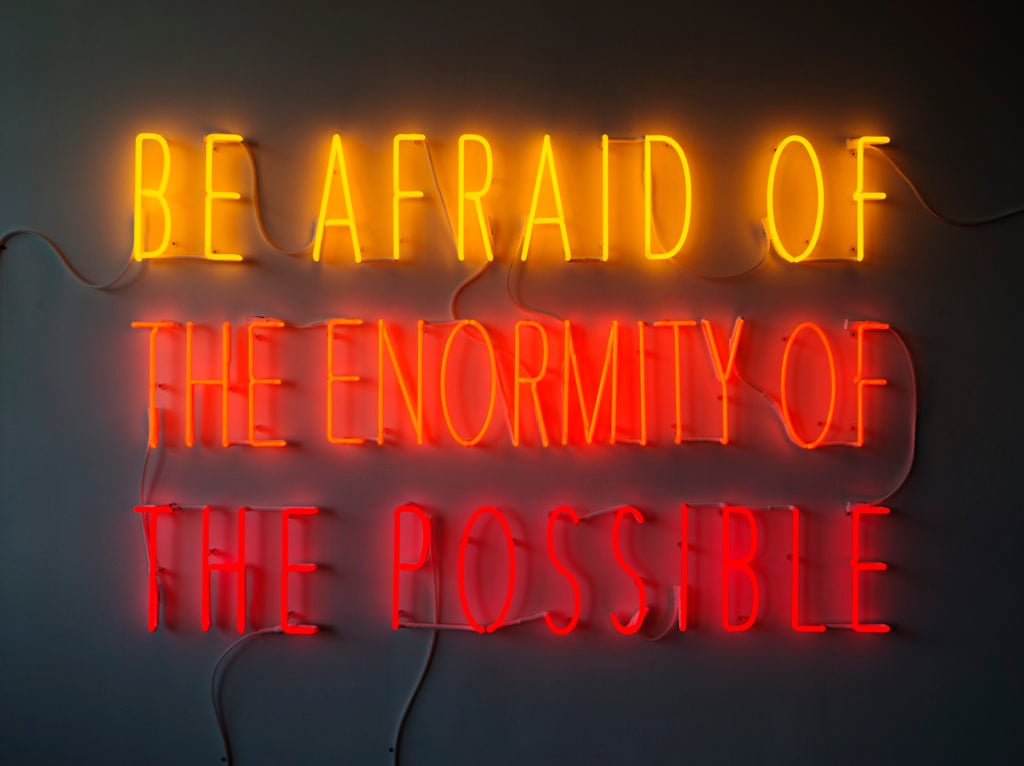
Alfredo Jaar, Be Afraid (2015).
Courtesy of the artist.
The first one is based on a text
by Emile Cioran, the poet of pessimism.
It says “Be afraid of the
enormity of the possible.”
I created this work in
2015.
The second one is based on the
last words of The
Unnamable by
Beckett.
It says “I can’t go on. I’ll go
on.”
I created this work in
2016.
These two works express
everything I can say right now.
—Alfredo Jaar
The post 11 Acclaimed Artists Offer Strategies for Getting
the Most Out of Working From Home, Whether From Your Studio or
Bedroom Office appeared first on artnet News.
Read more https://news.artnet.com/art-world/artist-tips-working-home-1818027
Further reading


Leave a comment