
Why the Centers for Disease Control’s Creepy Illustration of the Coronavirus Is Such an Effective Work of Biomedical Art
The inscrutable sphere with a speckled gray body that bursts
with bright red spines has been seen everywhere now. It accompanies
everything the Centers for Disease Control and Prevention (CDC)
puts out and illustrates countless
news stories.
It has become the unmistakable image of the novel coronavirus,
dubbed Severe Acute Respiratory Syndrome coronavirus 2
(SARS-CoV-2), which causes the illness COVID-19, currently ravaging
the world. And it is a case study in how artists can, in giving
things a visual form, help make the terrifying world around us feel
more comprehensible.
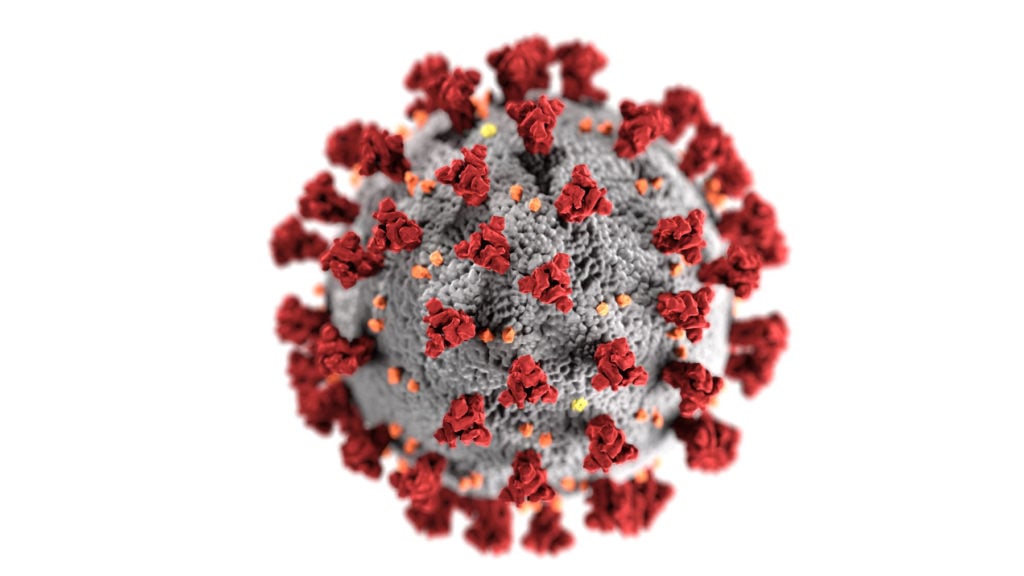
Illustration created at the Centers for
Disease Control and Prevention (CDC) of the ultrastructural
morphology exhibited by coronaviruses. Image by CDC/ Alissa Eckert,
MS and Dan Higgins, MAMS, courtesy the CDC.
As the New York Times reports today, the
picture of the coronavirus is—quite literally—a work of art.
Specifically, it is the work of Alissa Eckert and Dan Higgins,
medical illustrators and “biomedical artists” at the CDC. They were
tasked with making the so-called “beauty shot” image of the virus—a
solo close-up—that would serve in public awareness campaigns,
“bringing the unseeable into view.” It was created in the computer
graphics program Autodesk 3ds Max, and whipped together in about a
week, apparently pretty quick as these things go.
If you want a little bright spot in a bad day, I found this
charming clip of Eckert
talking about her job just last February, from the government
agency’s “I Am CDC” campaign, where she discusses her art hobbies
(portraits of pets) and the prop arm she created to model anthrax
blisters on:
“I love getting up every day not knowing what disease I will be
working on next, but knowing I can help impact people’s health,
safety, and security,” Eckert says. “It’s amazing to see your
artwork reaching so many people and actually making a
difference.”
The now-familiar SARS-CoV-2 image is meant, on one hand, as a
medical illustration, serving an educational purpose. A separate
version released by the CDC labels the different kinds of proteins
on the virus.
The spines in the picture—the “corona” in coronavirus—are
rendered fire engine red to label them as especially important:
this particular virus is distinguished by spines
that are 10 to 20 times more likely to bind to human cells than
previous such viruses, which is what makes it particularly
dangerous.
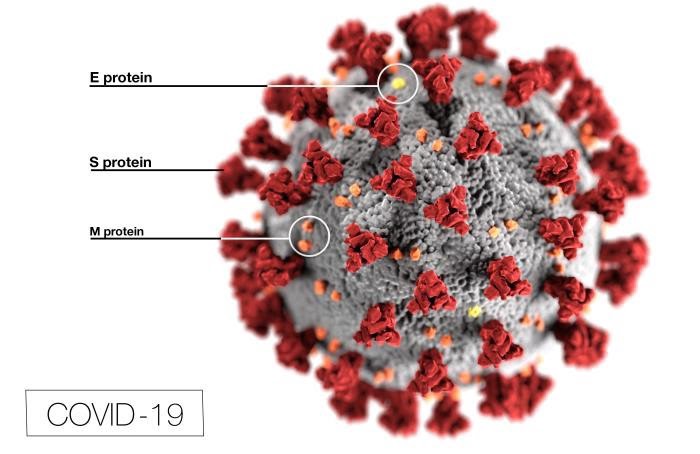
SARS-CoV-2. Image by Alissa Eckert, MS;
Dan Higgins, MAMS for the Centers for Disease Control.
But the CDC image is also a work of visual communication with a
goal to convey an attitude as well as information. Consider how
much more arresting it is than another widely distributed
illustration of the virus, from Rocky Mountain
Labs.
Taken by the lab’s scientists using an electron microscope and
colorized by the RML visual medical arts office, these images (all
available for use via a public Flickr page) look much
more literally scientific, but they are also more indefinite.
Indeed, in releasing them, the lab noted specifically that the
images “do not look much different” from images of other
respiratory coronaviruses.
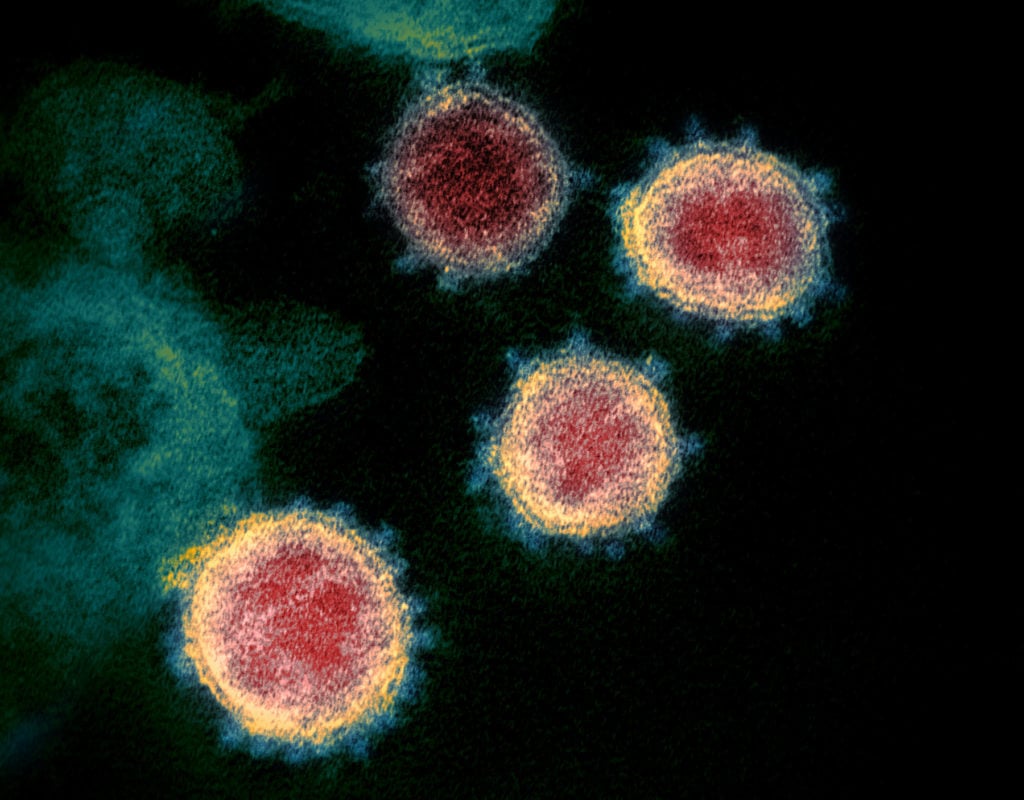
Transmission electron microscope image
showing SARS-CoV-2—also known as 2019-nCoV, the virus that causes
COVID-19—isolated from a patient in the U.S. Image courtesy
NIAID-RML.
The Eckert/Higgins illustration, on the other hand, renders the
virus very distinct. The simulated shallow focus makes it appear as
if you are looking at a 3-D orb looming in real space. All the
elements are crisply delineated, from the scaly, alien gray surface
of the virule, to the knotted structure of the spines, which make
it resemble a landmine.
The shadows cast by the spines, as the Times notes, are
pure fiction, meant to convey symbolically the gravity of what this
virus represents to the public. The crisply delineated colors, in
addition to serving labeling purposes, function as a color scheme
for this virus’s “identity,” the red-on-grey orb serving a
logo-like function for information about the pandemic.
Deployed as a news illustration, the Rocky Mountain Labs image
connotes the message “science at work on the unknown.”
For its part, the CDC image combines two ideas very effectively:
it renders the virus as something scary, unnerving, and present
that you have to take seriously; but it also conveys lucidity—that
this thing is being mapped and figured out. It manages to thread
the needle between the sobering “you need to pay attention” and the
reassuring “we will help you understand this.” Frankly, isn’t that
what we all wish government would do in a crisis?
The post Why the Centers for Disease Control’s Creepy
Illustration of the Coronavirus Is Such an Effective Work of
Biomedical Art appeared first on artnet News.
Read more https://news.artnet.com/opinion/cdc-biometical-art-1822296
Further reading


Leave a comment