
The Gray Market: Why the European Art World Will Recover Faster Than the American One (and Other Insights)
Every Monday morning, Artnet
News brings you The Gray Market. The column decodes important stories from the
previous week—and offers unparalleled insight into the inner
workings of the art industry in the process.
This week, finding that not all
rescues are created equal…
DEEP CUTS
On Monday, economists Emmanuel
Saez and Gabriel Zucman contributed a New York
Times op-ed
that suggests American and European
businesses might recover from our current global crisis along very
different timelines. This
possibility could have major implications for the two continents’
respective art industries, for-profit and nonprofit alike. And if
so, the deciding factor won’t be the amount of government aid
provided to small businesses and the self-employed; it will be the
way that aid was distributed.
Headlined “Jobs Aren’t Being
Destroyed This Fast Elsewhere. Why Is That?,” Saez and Zucman’s
piece opens with a few of the staggering labor figures already
roaring out of a US economy under siege. They report that 3.3
million new people filed for unemployment insurance during the week
of March 15 alone. That was the highest number of first-time
applicants recorded in one week since the Department of Labor
started keeping track of jobless claims in 1967. The previous peak, reached in October
1982, was 695,000—an order of magnitude lower, as this blood-chilling
GIF clarifies.
And if you think that’s bad enough, brace yourselves: the
following week, the number of new unemployment filings doubled to
6.6 million, bringing total jobless claims to about 10 million
during the final two weeks of March 2020.
Yet the most deeply disturbing
element here is that the catastrophe is still in its early stages.
Saez and Zucman relay an estimate that a jaw-dropping 30 percent of
the American workforce could be jobless by July
1. For reference, that’s
also the earliest date the Metropolitan Museum
of Art realistically hopes to reopen. Yet even more aggressive projections exist.
The Washington
Post, for instance,
claimed on Friday that “economists expect that 40 million Americans
will be out of work by mid-April.”
Now, as I covered last
week, the US just passed
the largest rescue bill in its existence: a $2.2 trillion aid
package that includes $349 billion in forgivable loans to small
businesses, $300 billion in direct payments to households, and
another $250 billion in expanded unemployment insurance. Although
the legislation includes very little money specifically earmarked
for arts and culture (about $300 million), plenty of artists, arts
workers, art-business owners, and arts nonprofits will benefit from
these general funding mechanisms.
Yet despite a historic federal
cash infusion, Saez and Zucman argue that “Congress must quickly
design a more forceful response to the crisis.”
Why? Because the US rescue
accepts mass layoffs and small-business destruction as givens,
whereas countries such as Germany, France, and the UK have designed
their own respective efforts to prevent those outcomes in the first
place. And unless something changes, the strategic distinction
could leave the post-crisis American arts infrastructure woefully
behind its transatlantic counterparts.
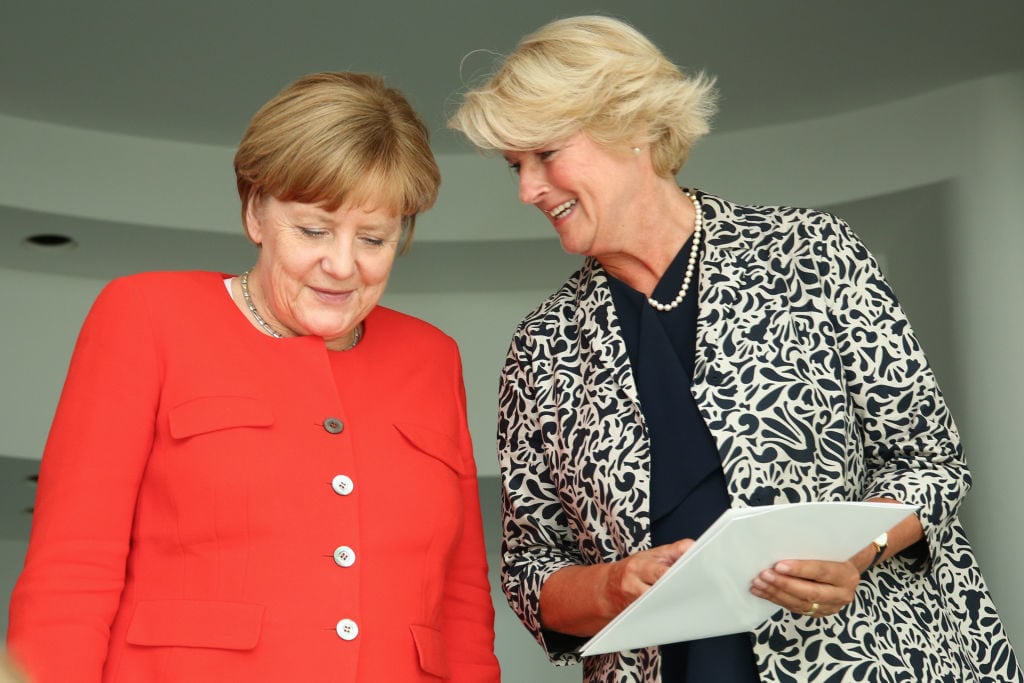
German chancellor Angela Merkel and
culture minister Monika Grütters. Photo: Christian Marquardt/Getty
Images.
THE PRESERVATIONISTS
The critical differences between
US and European rescue measures hinge on two questions: Who gets
money, and what do they have to do to receive it?
Let’s cover the European side of
the equation first—and Brexit be damned, Great Britain’s approach
justifies its inclusion with the rest of the continent.
Across national
borders, the rescue
packages are largely designed to funnel government funding to
businesses of all sizes first—but only on the condition that
employers retain workers, usually at two-thirds or more of their
pre-crisis pay rate, throughout the state-mandated
shutdown.
The wisdom in this approach
comes from recognizing that every capitalist economy is an ongoing
chain reaction that is at risk of backfiring in a prolonged period
of social distancing. Customers confined to their homes stop buying
goods and services from most businesses; most businesses then can’t
manage to pay their staff (or their landlords); many staff members
then lose their jobs, meaning they, in turn, can’t pay their
landlords or buy goods and services from most businesses; and the
vicious cycle repeats, worsening every time.
European-style job-retention
measures aim to reinforce as many existing links in this economic
chain as possible. In the short term, these systems minimize both
the tangible and intangible costs of mass unemployment. The benefit
isn’t just that millions of workers can continue buying essentials
and paying their rent during a society-wide stay-at-home period.
It’s that, once conditions restabilize, the recovery won’t be
delayed by an enormous hunt for new work and new
workers.
Think of it as the economic
equivalent to Jurassic
Park: all the necessary
genetic material has been preserved in amber; flip a few switches,
and the T. Rex is roaring out of the underbrush again almost as
soon as the habitat is ready.
And while the US rescue package
contains elements of this approach, the similarities risk being
undermined by a regrettably on-brand commitment to the law of the
jungle—one that can be especially deadly to an arts economy that
doesn’t necessarily proceed along the most easily trackable
path.
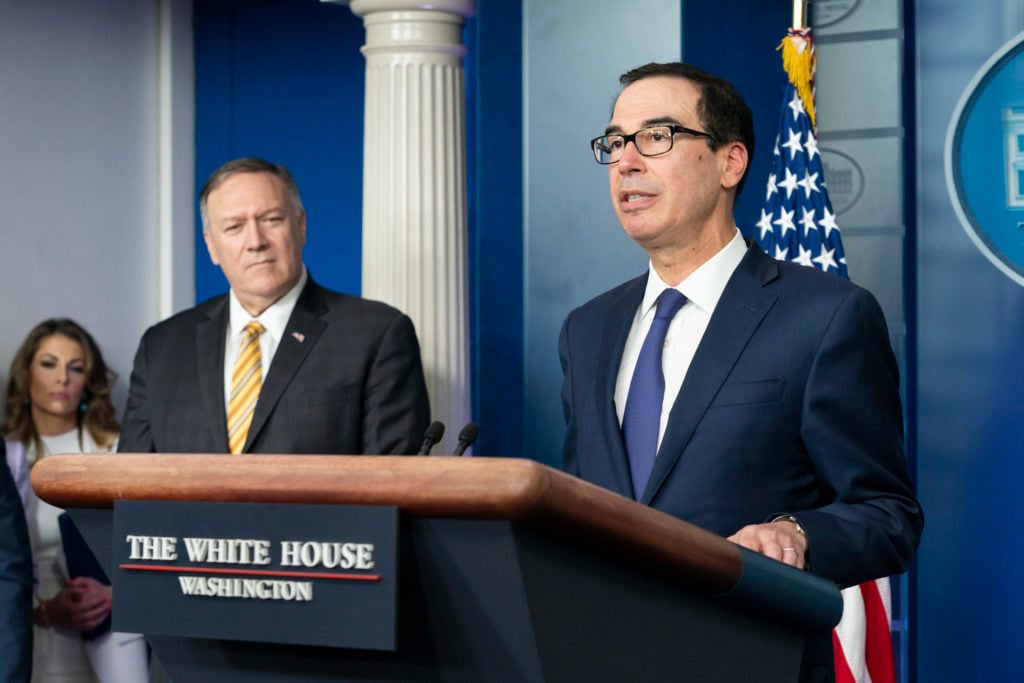
US treasury secretary Steven Mnuchin at
a White House press briefing, with secretary of state Mike Pompeo
looking on. Photo by Andrea Hanks. Courtesy of the White House.
HERE GOES NOTHING
Under the American system, small
businesses—including galleries, nonprofits, art-services
companies, and more—must apply for emergency loans through the
newly established $349 million Paycheck Protection Program (PPP).
The loans are forgivable if recipients channel at least 75 percent
of the funds into keeping staff on payroll at or near their
pre-crisis compensation levels, theoretically incentivizing
business owners to preserve the workforce à la
Europe.
However, the rollout of
the PPP so far borders
on being a junkyard blaze. Final
rules and regulations were not finalized until late last Thursday
night, only hours before lenders were scheduled to launch the
program Friday morning. As a result, many financial
institutions—including major banks such as Wells Fargo,
Citigroup, and PNC—did not
even offer applications for the PPP on the initiative’s opening
day.
Those who did were overwhelmed
by demand. Bank of America alone received 85,000 applications
totaling $22 billion in loans by end-of-day
Friday.
This bungled execution is
already problematic based on the fact that every day counts for
struggling small businesses, most of which only have enough cash on
hand to survive between two and four weeks. But it’s doubly
damaging because the US is distributing its $349 billion in
emergency loans on a first-come, first-served basis. So if you were
a small gallery owner unable to apply on Friday for any reason,
guess what? Tens of billions of dollars in aid are already gone
from the fund, lowering your odds of securing desperately needed
liquidity before the vault is bare.
Yet even the lucky entrepreneurs
who were approved for emergency loans aren’t necessarily out of the
financial danger zone. According to an NBC News
report on Saturday,
bankers “had no idea when these customers would start to see money
in their accounts.” The uncertainty arises from both the tidal wave
of applications and what the US Small Business Administration,
which must process each loan, termed “ongoing technical issues”
syncing its own computer systems to those of
lenders.
Andy Warhol in Paris, April 22nd, 1986.
(Photo by Francois LOCHON/Gamma-Rapho via Getty Images)
What happens to the US galleries
and art-services businesses that don’t manage to fight their way to
a federal emergency loan? It partly depends on geography. New York
City, for instance, has rolled out both an employee-retention grant
program and its own small-business loan initiative. But the New Art
Dealers Alliance (NADA) has been lobbying city and
state officials for weeks because the requirements of the programs,
including the ability to demonstrate a 25 percent decline in
revenue caused by the present crisis, render many of New York’s
small galleries ineligible.
Without significant expansions
of federal, state, and municipal aid, then, many businesses inside
and outside the art world will simply die. In the short term, this
will leave millions of workers no choice but to apply for
unemployment insurance. This separate bureaucratic process is
frustrating enough on its own; an aside in another Times piece
this week mentioned one applicant having to call the New York State
Department of Labor “roughly 240 times in two days in March to
finally connect with a person to file for benefits.”
But relying on unemployment
insurance also amplifies the inefficiencies of an eventual American
recovery by linking payments to weekly proof that the suddenly
jobless are actively hunting for new work. In other words, the
system incentivizes the destruction of pre-crisis links in the
economic chain, making it much more likely that workers must start
over somewhere else when this mess is over—especially since their
former employer may not survive the social-distancing
epoch.
Workers and business owners in
every sector of the art industry are now in danger from these
unprecedented circumstances. In the past seven days alone, three
major American museums—SFMOMA, the Whitney, and
the New Museum—furloughed or laid off employees collectively
numbering in the hundreds. Emerging and midsize galleries in the US
will start closing down for good in the coming weeks, with the
damage radiating out to scores of freelancers and related companies
in the arts.
The end result will be thousands
of Americans left wondering what to do next in one of the most
uncertain moments in art (and human) history. Meanwhile, their
European counterparts will have significantly more stability, now
and in a post-crisis future, strictly because their officials have
designed aid programs meant to preserve the valuable connections
already formed.
This is not to say that great
art, great galleries, and great new institutions won’t arise to
fill the void created by this unprecedented fiasco. Maybe the new
American art world will even be more interesting and more
innovative than the old one. But it will take time to form, and
some promising figures battered by the crisis and abandoned by the
deeply flawed rescue system simply won’t come back. And for a US
art scene already hundreds of years behind Europe, at least in
terms of the way it is valued by the larger culture, we’re kidding
ourselves if we think the “how” of our government’s aid efforts
matters any less than the “how much.”
That’s all for this week. ‘Til
next time, remember: don’t trust the process unless you’re sure
it’s been thought through.
The post The Gray Market: Why the European Art World Will
Recover Faster Than the American One (and Other Insights)
appeared first on artnet News.
Read more https://news.artnet.com/opinion/gray-market-european-american-rescue-measures-1825509
Further reading


Leave a comment