
‘There Is No Support System’: Art Handlers, the Invisible Muscle of the Multibillion-Dollar Art Industry, Face an Uncertain Future as Work Vanishes
After COVID-19 put the entire
globe on lockdown, some aspects of the art world carried on—maybe
not as usual, but usual enough: artists continued to labor in their
studios, auction specialists kept hunting for consignments, and
journalists continued to type away on their laptops. But almost
overnight, art handlers found themselves going from booked-up to
entirely without work. Now, some are applying for food stamps and
searching for ways to pay next month’s rent with no anticipated
income.
In the art world, as elsewhere,
the pandemic has thrown into relief inequalities that existed well
before the lockdown era began. Most art handlers are freelance or
part-time employees with few protections who have found themselves
utterly at sea in the current crisis, as the institutions that
employ them scramble to keep even their full-time employees
afloat.
According to a recent survey of
more than 1,000 art handlers conducted by Art Handler magazine, 80 percent of respondents are worried
about affording rent in the wake of the current crisis and 81
percent cannot work from home.
Among the hundreds of art
handlers who are suddenly out of work is Zaq Landsberg. “In the
course of three to four days, I had more than $8,000 of freelance
work vaporize,” he tells Artnet News.
"background:#FFF; border:0; border-radius:3px; box-shadow:0 0 1px 0 rgba(0,0,0,0.5),0 1px 10px 0 rgba(0,0,0,0.15); margin: 1px; max-width:500px; min-width:326px; padding:0; width:99.375%; width:-webkit-calc(100% - 2px); width:calc(100% - 2px);">
View this post on Instagram
Artists Left High and Dry
Artists often seek out
art-handling gigs because the job’s flexibility enables them to
maintain their own art-making practices. This is particularly
critical because the art-world epicenters they often live in—New
York, San Francisco, London—are among the most expensive cities in
the world. But now, the piecemeal nature of their work has left
many without a support system.
Artist John Bianchi estimates
that around half his annual income comes from art-handling jobs,
mostly for major art fairs and large-scale installations at museums
in Russia and China. Over the course of two weeks, almost all his
prospective gigs were put on hold or cancelled, including an
exhibition in Doha that was due to begin installation on March
12.
“I was not paid for the project
and it looks as if it won’t be happening for quite some time,” he
tells Artnet News. “The uncertainty is what is keeping me, and I’m
guessing most of us, up at night. No one knows how long this will
go on.”
Many art handlers we spoke to
said the uncertainty of whether they would be paid in part or in
full for assigned jobs—or paid in a timely way for completed
jobs—was making it nearly impossible to plan ahead or figure out
what sort of drastic measures they might need to take to limit
their expenses.
“I am currently owed a
significant amount of money by two people for work done before the
new year, so I hope they pay soon,” says artist Daniel Herr, who
estimates that art handling accounts for some 80 percent of his
income. “I work for a few small handling companies and then
intermittently for a handful of galleries, so there is no support
system.”
Some institutions, like Bard
College’s Hessel Museum in Annandale-on-Hudson, New York, are
paying in full for work that was scheduled well before the crisis
hit, even though it can’t be performed (and Bard’s art handlers
will have to work off the time when the lockdown is finally over).
“Our art handlers are very important to us and we wanted to make
sure that the people who expected to be paid for the next three
weeks to finish that project still received that money in the same
time frame,” says Tom Eccles, the director of the Center for
Curatorial Studies at Bard College.
Other institutions ended up
paying only a portion of the promised fee for scheduled work.
Landsberg says the Wallach Art Gallery at Columbia University in
New York, where he was due to complete an installation, provided
“75 percent of the lost wages the first week, and 50 percent of the
second week, and nothing after that.” (Lewis Long, associate
director of external affairs at the Wallach, counters that art
handlers received 80 percent pay for the first week and 50 percent
the following, “though those services were not
performed.”)
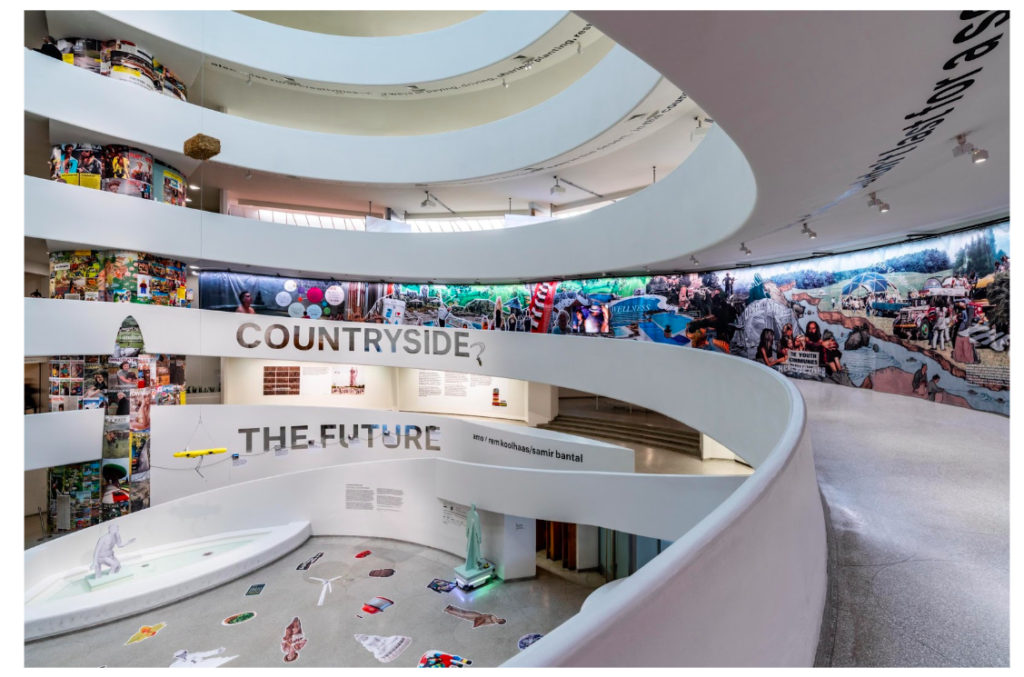
Installation view of “Countryside The
Future” at the Guggenheim. Courtesy of the Solomon R. Guggenheim
Museum.
At the Guggenheim, on-call
workers, including art handlers, will be paid for scheduled work
only through March 29. “Many on-call employees of the museum
committed to working at the Guggenheim prior to the crisis. This,
of course, means that those employees did not schedule other work
during that time,” says Andres Puerta, director of special projects
at IOUE 30, which represents the Guggenheim’s art handlers. “The
Guggenheim is refusing to honor those hours and instead has cut
these employees off.” (Around 20 of the union’s members are
full-time; 11 of those were placed on furlough on April 10,
according to Puerta.)
A Bigger Problem
Even when the market is flush,
the workers who keep the fast-moving global art world on
track—ensuring that museum blockbusters, art fairs, marquee
auctions, or gallery shows actually happen—are also some of the
most vulnerable in the ecosystem, often lacking benefits like
health insurance or paid sick leave.
That is a large reason why last
year saw a wave of unionization efforts (both successful and
unsuccessful) across the country, including among art handlers
at the
Guggenheim and the
art-storage company UOVO. In fact, Art Handler had been planning to spotlight the unionization
trend in its next issue, before the pandemic eclipsed nearly
everything else.
But the current crisis has
revealed that, union or non-union, art handlers are among the most
vulnerable employees in the sector. “Companies are laying off
workers left and right,” says Art Handler magazine founder Clynton Lowry. “In some cases,
employers are really trying to do the best they can, but they are
also small businesses themselves and are obviously taking a
significant hit. No one really knows what the outcome
is.”
Seven art handlers have lost their jobs amid company-wide
layoffs at UOVO—six of whom were involved with a recent failed
attempt to unionize, according to the Art Newspaper. The company says
that “we are committed to supporting our team through the pandemic,
including our art handlers, with secure income.” (Those who were
not laid off will continue to receive full pay for the duration of
the lockdown.)
Teamsters Local 814, which led the company’s failed unionization
efforts, has filed a complaint against UOVO with the National Labor
Relations Board protesting the move.
“They’ve broken the law by firing these union supporters,” union
rep Julian Tysh tells Artnet News. “They figured they could wait
until there was convenient time to get rid of some of the union
agitators, to send a message that this is what happens you dare
stand up for yourself…. They used COVID as an opportunity to clean
house.”
In a statement, UOVO says “perceived support of labor unions was
not a factor in our decision and management was also affected.”
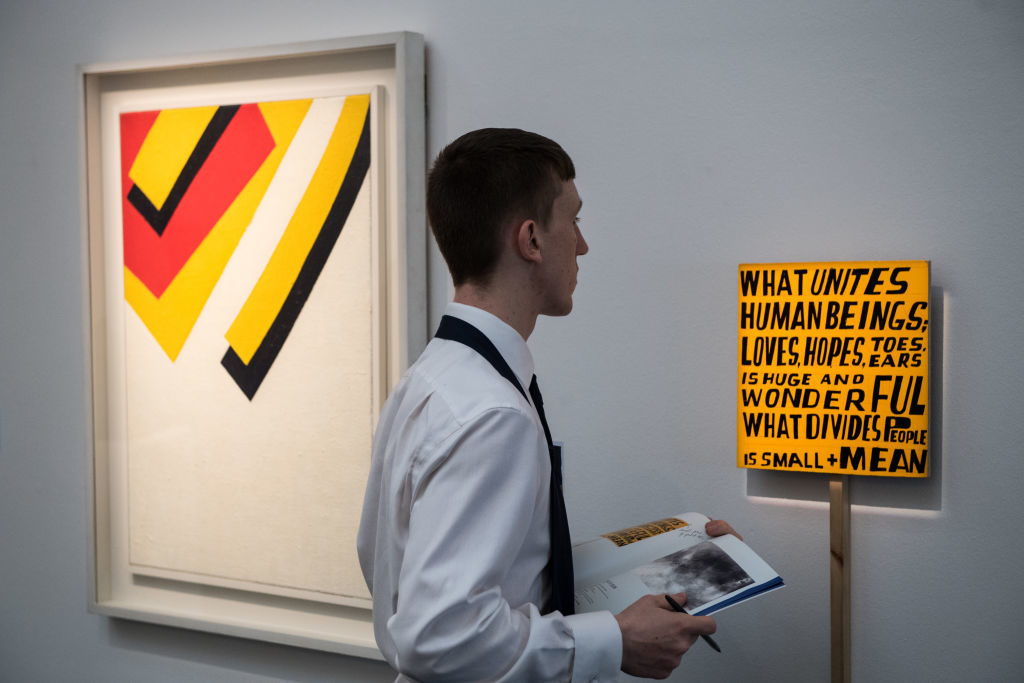
A Sotheby’s art handler takes notes next
to What Unites Human Beings (R) at Sotheby’s. Photo: Chris J
Ratcliffe/Getty Images for Sotheby’s.
Art Storage—and Lives—on Hold
Also unsettling for many
handlers has been the confusing communication about furloughs and
layoffs, and unfulfilled promises of being able to collect on paid
time off. Prior to stay-at-home orders, as the crisis escalated,
“companies were putting the decision on the art handlers to make
the choice on whether or not they should go in to work,”
Lowry says. “That is probably the
most disheartening thing, because obviously they don’t want to put
themselves or anyone else at risk but essentially they are being
offered work.”
An employee of the prominent
fine-art logistics firm Cadogan Tate, who wished to remain
anonymous, said the company initially took measures to ensure their
safety by supplying gloves, hand sanitizer, and cleaning products;
enforcing social distancing; and substituting a mobile app to punch
in and out in lieu of a time clock.
But, the employee said, after
the government issued a work-from-home order for nonessential
employees, “the company sent home only office workers, ignoring
requests from the operations team (art handlers, drivers, warehouse
team members, preparators, etc.) to stagger shifts to slow the
spread of the virus should any of us be infected
already.”
Emails reviewed by Artnet News
confirm that the company initially told workers they would be able
to use paid time off in order to continue receiving paychecks after
the company shut down operations on March 20. But then, according
to the employee, the company “did an about-face” and put them on
“involuntary unpaid leave,” encouraging workers to file for
unemployment.
“We all feel manipulated,” the
Cadogan Tate employee says. “I am applying for work, trying to stay
in New York City obviously, but I have to expand my search and be
open to the possibility of leaving this city that I love so dearly.
Our life and livelihood is in jeopardy.”
Cadogan Tate did not respond to
repeated emails seeking comment.
Other art-shipping companies
have also furloughed scores of workers. Crozier, which has 19
locations in eight states, began a six-week furlough on April 7 for
approximately 300 staff members. Employees will receive health
benefits during this time, according to a
representative.
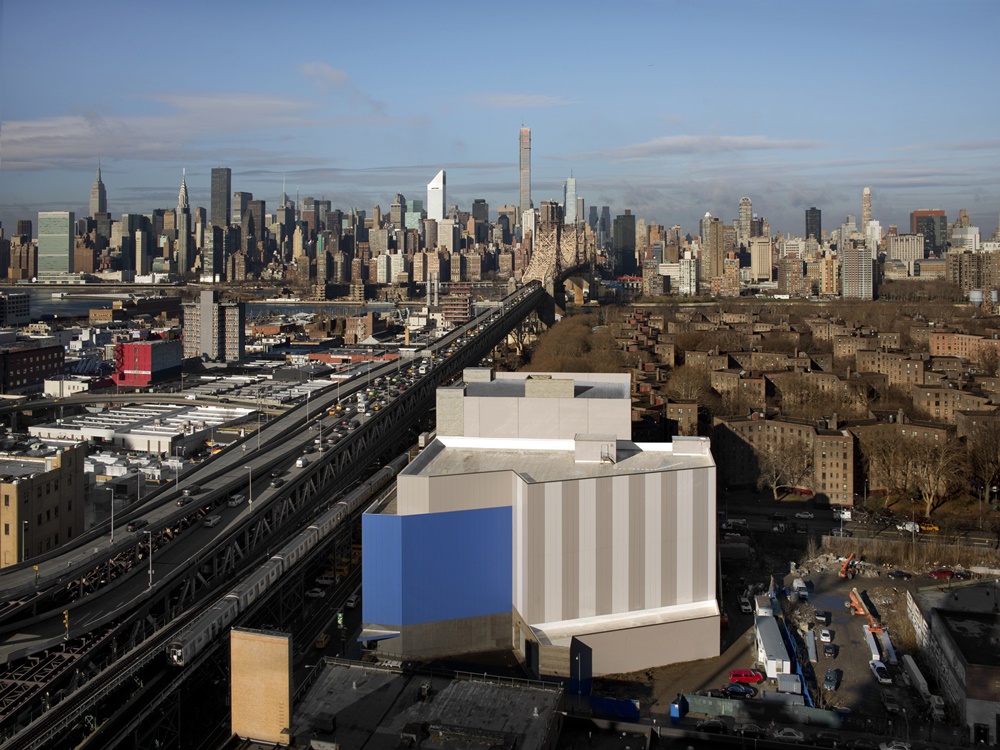
UOVO art storage facility in Long Island
City, Queens. Image courtesy of UOVO.
“As soon as we are able to move
forward with projects deemed essential, we will deploy team members
on a next-day basis, provided it is safe and legally permissible to
do so,” the spokesperson said. “We will reinstate freelance art
technicians on an as-needed basis once business
resumes.”
Logistics company Dietl,
meanwhile, furloughed 15 of its 90-person staff. “They were mostly
people who we very recently hired and just had absolutely no work
for them,” owner Fritz Dietl says. “At some point you need to do
something to save the business. You’re trying to hold on to
everybody else but it depends on how long this continues.” He is
still fully staffed at his Delaware location, he says, with many
employees working from home.
Dietl applied for a small
business payroll loan through the US Government’s CARES Act on the
first day it became available and is waiting to hear back. He also
launched an online platform
where the dozens of freelance
technicians, many of whom are artists, can directly sell their
work.
“In the past ten years, the
freelance work was lucrative and allowed these guys to pursue their
art career and make enough money on the side, and survive,” Dietl
says. “These guys don’t have any safety net to fall back on.” (One
art handler, however, is unimpressed: “Let’s hope he plans on doing
more than holding an online art show,” he says.)
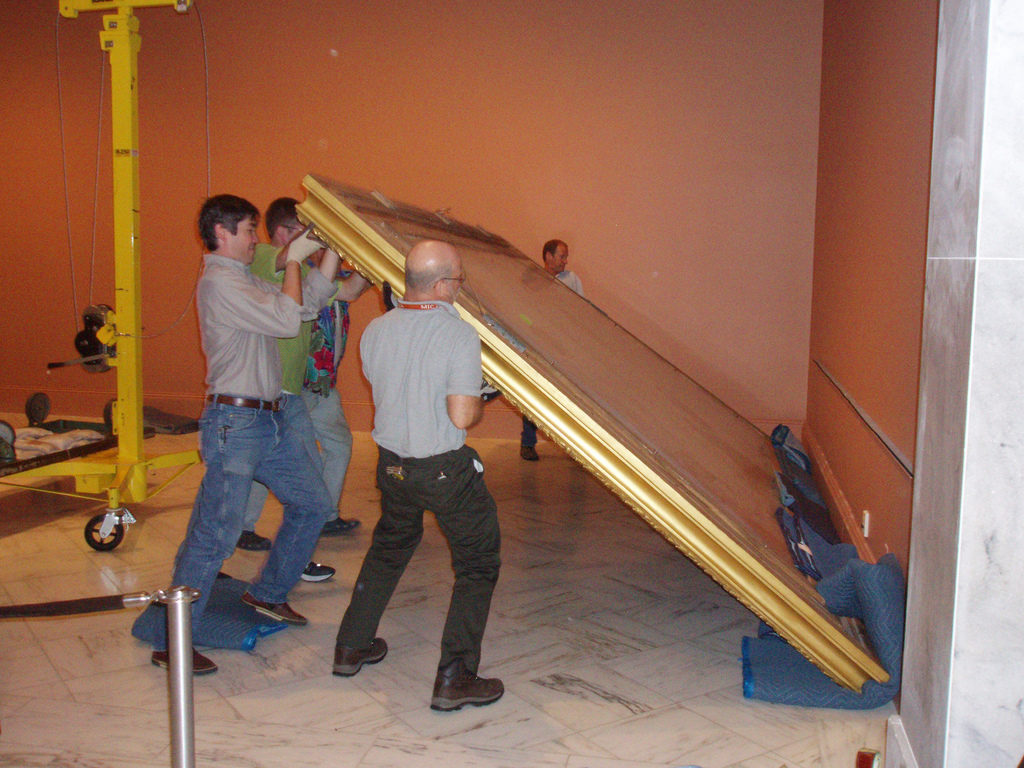
Art handlers at the Smithsonian. Image
courtesy of Flickr.
Looking Ahead
Art handlers, in addition to
their employers, may find a lifeline through the CARES Act, which
makes unemployment benefits available to freelancers and the
self-employed. Dana Lossia, an employment attorney at Levy Ratner,
calls the potential up-to-$600 a week in added emergency funds an
“enormous, huge benefit on top of unemployment.”
Many preparators and
conservators, she adds, may also qualify for traditional
unemployment benefits if they are paid as W-2 employees. “They
might work a ton of hours for a particular institution, or they may
be able to get unemployment benefits from a couple of different
museums,” she says. “They don’t necessarily fall through the
cracks.”
Overwhelmed state unemployment
offices were already being inundated by new applicants before CARES
passed, so getting benefits processed could take time—but it’s
still a crucial lifeline for art handlers and other freelance art
employees facing financial difficulties.
“Hopefully people know you don’t
have to have been fully laid off or let go to get unemployment,”
Lossia adds. “Even furloughed people can get unemployment. Even
people who are still working for that employer but have just seen
their hours scaled back can get unemployment.”
And, despite the acute stress,
some art handlers see a light at the end of the tunnel. “It’s a
rare opportunity to see what a big general strike looks like. It’s
possible when everyone returns there will be more power restored to
the employee,” says art handler Steven Mykietyn,
who works on the Guggenheim’s
multimedia crew. “If I were to casually not come in on a regular
day in non-pandemic times, the show would not turn on for the
guests.”
The Art Handlers Alliance, a
group of professionals working to improve conditions in the field,
also sees the current situation as an opportunity to rectify a
long-held imbalance of power between institutions and those who
transport the art they present. “There’s no doubt that this crisis
has revealed a neglect in the arts,” says Ian, a representative of
the Art Handlers Alliance who asked for his last name to be
withheld. “We can’t go back to the way things were
before.”
The post ‘There Is No Support System’: Art Handlers, the
Invisible Muscle of the Multibillion-Dollar Art Industry, Face an
Uncertain Future as Work Vanishes appeared first on artnet
News.
Read more https://news.artnet.com/art-world/art-handlers-lockdown-1807263
Further reading


Leave a comment